

OBD-II Code B1529: Input Circuit Short to Battery/Voltage
What B1529 means, why it triggers, and how to fix it
- Code B1529 indicates a short-to-battery in a switch circuit, disabling 12V inputs from steering wheel controls or memory seats.
- On 2019-2020 GM vehicles, this code points directly to a failed clock spring or a chafed steering column harness requiring immediate repair.
- For Ford and Chrysler owners, B1529 typically flags a failed memory seat switch or a corroded wire in the driver's side kick panel.
- Do not drive if B1529 is accompanied by an illuminated airbag warning light; this confirms the driver's airbag is completely disabled and will not deploy in a collision.
What Does B1529 Mean?

B1529 is a Body Control Module (BCM) code indicating a short-to-battery in a switch circuit. The BCM detects a constant 12V signal on a circuit that should only show voltage when a button is actively pressed. Because the BCM cannot read the input, it disables the affected system—most commonly the steering wheel controls or memory seats.
Technical definition: The SAE/ISO definition for B1529 is "Memory Set Switch Circuit Short To Battery." General Motors uses it to define a "Device Voltage Reference Output Circuit Voltage Above/Below Threshold" for steering wheel controls. The control module supplies a 5V or 12V reference to a switch and expects a specific voltage drop when a button is pressed. Instead, it sees a constant 12V (battery voltage), indicating a short to power that prevents command recognition.
Can I Drive With B1529?
Yes, But With Caution. Mechanically, the vehicle will drive normally because B1529 isolates to comfort features like steering wheel buttons or memory seats. However, if the airbag warning light is illuminated, the clock spring has failed and the driver's airbag is completely disabled. Driving without a functional airbag dramatically increases the risk of fatal injury in a collision. Do not drive the vehicle until the clock spring is replaced.
Common Causes

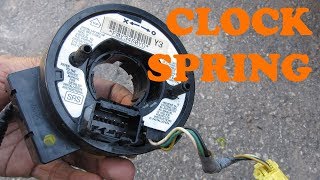
- Failed Clock Spring (Very Common) — The most frequent cause on GM vehicles. The clock spring's internal ribbon cable fatigues and shorts out over time, instantly disabling the steering wheel buttons, horn, and driver's airbag.
- Damaged or Chafed Wiring (Common) — Moving parts pinch and sever wires, creating dead shorts that blow fuses. Steering column harnesses chafe directly under the airbag module (common in GM TSB #21-NA-246), while memory seat wires short out against the metal seat track.
- Faulty Memory Seat Switch or Module (Common) — On Ford and Chrysler vehicles, B1529 points directly to the memory seat system. The door or seat-mounted switch panel fails internally or shorts out from liquid spills like coffee or soda.
- Failed Steering Wheel Control Switch (Less Common) — The internal resistor network inside the steering wheel buttons shorts out. This is the primary culprit when only one or two specific buttons fail while the rest function normally.
- Improper Jump-Starting (Rare) — Voltage spikes from incorrect jumper cable connections or high-output tow truck jump boxes fry sensitive circuits. GM specifically cites improper jump-starting as the trigger for sub-code B1529-07.
- Faulty Body Control Module (BCM) (Very Rare) — The BCM reports the problem but rarely causes it. A failed BCM always presents with multiple unrelated electrical codes and requires professional replacement and programming.
Symptoms

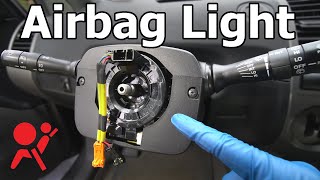
- Airbag warning light is on — Indicates the driver's airbag is disabled due to a severed connection inside the clock spring.
- Steering wheel buttons fail — Volume, cruise control, or phone call buttons stop responding completely or work intermittently.
- Memory seat functions fail — Inability to save or recall a memory position for power seats, mirrors, or the adjustable steering column.
- Horn does not work — The horn's wiring passes through the clock spring and fails simultaneously with the steering wheel buttons.
- Erratic windshield wiper movement — On 2019-2020 Buick Encore and Chevy Trax models, a short in the steering wheel controls activates the front wipers randomly (TSB 21-NA-246).
Diagnostic Flowchart

Tap your situation to follow the diagnostic path that matches what you're seeing on this code.
Common Fixes & Costs
- Replace Clock Spring — Parts: $100-$300, Labor: $150-$300, ~1.5 hr book time (Professional)
- Replace Memory Seat Switch — Parts: $30-$190, Labor: $56-$82, ~0.8 hr book time (DIY)
- Repair Chafed Wiring Harness — Parts: $5-$20, Labor: $100-$350, ~2 hr book time (Intermediate)
- Replace Memory Seat Control Module — Parts: $130-$400, Labor: $61-$90, ~0.8 hr book time (Intermediate)
- Replace Body Control Module (BCM) — Parts: $300-$800, Labor: $100-$250, ~1.5 hr book time (Professional)
Used vs. New Parts: Buying Guide
When a used part is worth it: Never buy a used clock spring. It is a safety-critical component responsible for airbag deployment. Used memory seat switches are acceptable budget options.
Donor-vehicle mileage cap: roughly under 10000 miles for the part to have meaningful remaining life.
Donor quality checklist:
- Buy only new OEM or certified aftermarket clock springs.
- Avoid salvage yard airbag components due to unknown history and moisture exposure.
- Verify exact part numbers to ensure compatibility.
Decision logic:
- If The part is a clock spring or airbag component → Buy new. Cost savings do not justify the immense safety risk.
- If The part is a memory seat switch → A tested, used part from a reputable recycler is acceptable.
Warranty tradeoff: Used clock springs carry 30-day warranties and zero safety guarantees. New OEM parts carry 1-year warranties and meet current safety standards.
Worst-case if a used part fails: 1000-6000+ if a faulty used clock spring fails to deploy the airbag in an accident.
What Happens If You Wait — Timeline
- Immediate: Code B1529 sets. Steering wheel controls or memory seats stop working. If the clock spring fails, the airbag warning light illuminates and the airbag disables. (MPG impact: 0%% · Added cost: 0)
- 0-2 months: The disabled airbag remains a constant, maximum-level safety hazard. (MPG impact: 0%% · Added cost: Potentially infinite (risk of injury/death).)
- 2-6 months: Broken clock spring wires contact other circuits during steering rotation, blowing fuses for connected systems. (MPG impact: 0%% · Added cost: 10-50)
- 6+ months: A severe short circuit from the damaged clock spring fries the Body Control Module (BCM). (MPG impact: 0%% · Added cost: 500-1000)
Cost of Not Fixing It
- Immediate: Loss of function for steering wheel controls, memory seats, or the horn. (Added cost: 0)
- 0-1 month: If the clock spring failed, the driver's airbag is disabled, dramatically increasing the risk of fatal injury in a collision. The vehicle fails state safety inspections. (Added cost: Potentially infinite (cost of injury/death).)
- 1-6+ months: Continued driving with a broken clock spring causes the internal ribbon cable to short against other wires, blowing fuses for unrelated systems. (Added cost: 50-200)
Diagnosis Steps
- Verify the Failure
Confirm which functions are dead. If the airbag light is on and the horn/steering buttons fail, the clock spring is bad. If only the memory seats fail, focus on the seat switch and wiring.
Tools: None (Beginner) - Check for Related Fuses
Locate the fuse box and pull fuses labeled for the Body Control Module (BCM), Memory Seats (MSM), or Steering Wheel Controls (SWC). A blown fuse confirms a dead short in the wiring.
Tools: Fuse puller or needle-nose pliers (Beginner) - Inspect Wiring and Connectors
Look under the driver's seat for pinched or frayed memory seat wires. For steering wheel issues, disconnect the battery, wait 15 minutes, remove the airbag module, and inspect the harness underneath for chafing against the metal frame (per GM TSB #21-NA-246).
Tools: Flashlight, trim removal tools, socket set (Intermediate) - Advanced Scan Tool Analysis
Connect a professional scanner and view live data for the switch pack (PID: SWC Bank 1 Status). Press the buttons. If the data value remains 'Idle' and does not change, the BCM is not receiving the input signal.
Tools: Professional OBD-II Scanner (with BCM live data) (Advanced) - Pinpoint Test: Check Harness Voltage
Disconnect the harness at the suspect switch. Turn the ignition ON. Measure voltage on the HARNESS side between the signal wire and ground. Normal is 0V or a low 5V reference. A reading of 12V confirms a short-to-battery in the wiring harness.
Tools: Multimeter, vehicle-specific wiring diagram (Advanced) - Pinpoint Test: Test Switch Resistors
Disconnect the switch. Measure resistance (Ohms) across the signal and ground pins on the SWITCH itself. Press each button. Each button must produce a unique resistance value matching the service manual. A reading of 0 ohms (short) or infinite resistance (open) means the switch is dead.
Tools: Multimeter, service manual with resistance specs (Advanced) - Test the Clock Spring
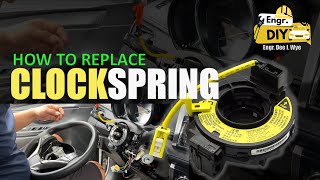
Disconnect the battery and remove the airbag. Check for continuity (less than 2 ohms) through each pin of the clock spring while rotating it lock-to-lock. Infinite resistance or 0 ohms between adjacent wires confirms internal failure.
Tools: Multimeter, socket set, trim removal tools, steering wheel puller (Professional)
When This Code Triggers (Freeze-Frame Conditions)
- Ignition Status: ON / RUN (The code sets when the ignition is on and the BCM actively monitors the switch circuits.)
- Battery Voltage: 11.8V - 14.5V (The fault triggers when the signal circuit voltage improperly matches the stable battery voltage.)
- Component State: Idle / Not Pressed (The BCM logs the fault when it sees constant voltage on a signal line that should read 0V when idle.)
- Time Since Ignition On: > 5 seconds (The code sets during the BCM's initial self-check shortly after startup.)
Related Codes
- B1528 — Indicates "Memory Set Switch Circuit Open." Points to a broken wire rather than a short to power.
- B1530 — Indicates "Memory Set Switch Circuit Short To Ground." The direct opposite of B1529, showing 0 volts on the signal wire instead of 12V.
- P155A — GM-specific code for 'Cruise Control Switch State Undetermined'. Sets alongside B1529 because the BCM cannot read the cruise buttons due to the shorted circuit.
- B0001-B00FF (SRS Codes) — Airbag system codes that trigger simultaneously with B1529 when the clock spring severs the airbag connection.
Climate & Environmental Factors
- High Humidity: Moisture ingress accelerates corrosion on switch terminals and circuit boards, creating the electrical resistance that triggers code B1529.
- Extreme Cold: Sub-zero temperatures make the clock spring's internal ribbon cable stiff and brittle, causing it to snap during steering wheel rotation.
How to Talk to a Mechanic About This Code
Say this: "I have a B1529 code and my symptoms are [CHOOSE ONE: 'my airbag light is on and all my steering wheel buttons are dead' OR 'my memory seat controls are not working']. I'd like to schedule a diagnostic to confirm the cause."
Directs the shop to the most likely cause (clock spring vs. seat module) and prevents unnecessary, expensive diagnostics.
Avoid saying:
- 'My check engine light is on.' (This is a Body code, not an engine code.)
- 'My steering wheel is broken.' (Too vague.)
- 'Just fix whatever is wrong with it.'
Questions to ask before authorizing the repair:
- If they recommend a clock spring: 'Did you test the continuity of the old clock spring to confirm it's open or shorted? Will the steering angle sensor need to be recalibrated after?'
- If they recommend a memory seat switch: 'Did you test the wiring and check for reference voltage at the connector to rule out a wiring issue?'
- If they recommend a BCM: 'What specific tests did you perform to definitively rule out the clock spring, wiring harness, and switches first?'
- Will the part be new OEM, aftermarket, or used? What is the warranty on the part and the labor?
Where to Take It: Dealer vs Independent vs Chain
- Dealer:
Best for: Clock spring replacement involving the SRS/airbag system., Vehicles under warranty., Diagnosing complex electrical issues tied to specific TSBs.
Downsides: Highest labor rates and part costs., Tendency to replace entire assemblies rather than perform detailed wiring repairs. (Typical cost: +50% vs. baseline) - Independent Shop:
Ideal for memory seat issues. For clock spring replacements, ensure the shop has proven SRS expertise.
Best for: Out-of-warranty vehicles., Repairing known wiring issues (Ford kick panels) or replacing memory seat switches.
Downsides: Requires vetting the shop's electrical and SRS/airbag diagnostic expertise (look for ASE A6 and L3 certifications). (Typical cost: +0% vs. baseline) - Chain Shop:
AVOID. This repair requires SRS expertise not typically found at chain shops.
Best for: Reading the initial code for free.
Downsides: Lacks technician skill for complex electrical and safety-critical airbag repairs., High pressure to upsell unnecessary parts. (Typical cost: -10% vs. baseline)
When to Walk Away From the Repair
If the estimated repair cost exceeds 40-50% of the car's private-party value, evaluate your options. However, a disabled airbag is a safety-critical repair that mandates fixing if you plan to keep driving the car.
- Car worth $4000, fix is $600: Fix it. The repair is 15% of the car's value, and a disabled airbag makes the car unsafe and unsellable.
- Car worth $12000, fix is $600: Fix it. This is a minor repair cost compared to the vehicle's value.
- Car worth $2500, fix is $1500: Walk away. The repair cost is 60% of the car's value. The disabled airbag makes it a 'mechanic special.'
What Scan Tool You Need for This Code
Minimum: An OBD-II scanner that reads Body (B) and SRS (Airbag) codes. Basic $20 engine code readers cannot see code B1529.
Cheap scanners only read 'P' codes. You need a tool that communicates with the Body Control Module (BCM) and Supplemental Restraint System (SRS) to diagnose this issue.
Budget: BlueDriver Pro Scan Tool (~$100) — Reads and clears BCM and SRS codes. Views live data from the BCM to verify steering wheel button signals.
Mid-range: Autel MaxiCOM MK808 (~$300) — Provides full system diagnostics and bidirectional controls. Performs the necessary Steering Angle Sensor (SAS) calibration after a clock spring replacement.
Professional: Launch X431 Pro 3S+ (~$900-1500) — Offers dealer-level bidirectional control, component testing, and module programming to definitively pinpoint faults between wiring, switches, or modules.
Rent vs buy: Auto parts stores offer free loaner tools. Verify their scanner reads Body (B) and SRS codes for a one-time diagnosis.
How to Clear the Code After You Fix It
- Ensure the underlying short circuit is physically repaired.
- Reconnect the vehicle's battery.
- Use a professional OBD-II scan tool to clear the code from the BCM.
- If a scan tool is unavailable, complete 50 consecutive key cycles without the fault reoccurring to self-clear.
Drive cycle (~5 minutes): Start the vehicle and test the repaired component (e.g., press all steering wheel buttons). Turn the vehicle off and on several times.
Readiness monitors affected: None
Watch out for:
- Clearing the code without fixing the physical short causes the code to return instantly.
- Disconnecting the battery does not clear the code from the BCM's long-term memory.
- Replacing a clock spring requires a separate SRS (airbag) system reset via scan tool to turn off the airbag light.
Will This Fail Emissions / State Inspection?
No — by itself this code doesn't fail OBD inspection (but it can keep readiness monitors from setting, which causes a separate fail).
- California: Will NOT fail a smog check. Emissions inspections ignore body codes and airbag lights.
- New York: Will NOT fail a safety inspection. An illuminated airbag light is an advisory note, not a rejection cause.
- Texas: Will NOT fail a safety inspection. The airbag system is not an inspected item.
- Virginia / Pennsylvania: WILL fail a safety inspection. An illuminated airbag warning light is an automatic failure.
Most Commonly Affected Vehicles
- Chevrolet Trax (2019-2020) — Prone to a shorted steering wheel harness causing B1529-03 and erratic wipers, detailed in GM TSB #21-NA-246.
- Buick Encore (2019-2020) — Shares the Trax platform and identical steering wheel harness chafing issues (TSB #21-NA-246).
- Ford F-150 (2009-2014) — Commonly sets B1529 due to a failed memory seat "SET" switch or a broken wire in the driver's kick panel.
- Chrysler Town & Country (2008-2016) — Logs B1529 for memory seat issues caused by a failed switch or a blown 40A J13 fuse in the TIPM.
- Dodge Grand Caravan (2011-2020) — Experiences identical memory seat circuit faults as the Chrysler Town & Country.
- Jeep Grand Cherokee (2011-2021) — Sets B1529 for memory seat malfunctions, sometimes resolved by a dealer software update.
- Hyundai Santa Fe (2006-2010) — B1529 specifically indicates a "Passenger airbag On/Off switch defect" on these models.
- Chevrolet Silverado (2008-2013) — B1529-07 (Circuit High Voltage) triggers from improper jump-starting via dual-battery tow trucks.
- BMW 3-Series (2013-2018) — Requires replacement of the entire driver's side seat memory control switch module (SZL) when an internal short is detected.
Manufacturer-Specific Notes
- General Motors: GM uses B1529 for steering wheel control faults. TSB #21-NA-246 for 2019-2020 Trax/Encore models identifies a repairable harness short (B1529-03). Sub-code B1529-07 triggers from improper jump-starting.
- Chrysler/Dodge/Jeep: The memory seat system disables if the BCM doesn't receive a 'Park' signal. Always check the 40A J13 fuse in the TIPM before replacing memory seat components.
- Ford: B1529 associates with the memory seat "SET" switch. On 2015+ F-series trucks, TSB 19-2390 mandates checking the seat module connector for fretting corrosion before replacing parts.
- Hyundai: On 2006-2010 Santa Fe models, B1529 points exclusively to a fault in the manual passenger airbag deactivation switch circuit.
- Saturn: Older Saturn models use B1529 to indicate a "Right Rear Wheel Speed Sensor Circuit Resistance Below Threshold," an ABS issue completely unrelated to body electronics.
Real Owner Stories
2019 Chevy Trax with 60K miles
Airbag light illuminated, and all steering wheel buttons (radio, cruise) and the horn stopped working simultaneously.
What they tried:
- Owner suspected the clock spring based on forum posts and took it to a dealership for diagnosis.
Outcome: Dealer confirmed a failed clock spring. The part was replaced, restoring all functions. Total cost was $280 ($136 parts, $144 labor).
Lesson: When the airbag light, horn, and all steering wheel buttons fail at once, the clock spring is the definitive cause.
2011 Ford F-150 with 130K miles
Driver's side power seat and power mirrors stopped working completely. Code B1529 was present.
What they tried:
- Checked fuse #109 (good).
- Searched forums and inspected the driver's side kick panel wiring.
Outcome: Found a corroded orange wire with a green tracer at a factory splice in the kick panel. Cutting out the corrosion and re-splicing the wire restored all functions.
Lesson: On Ford trucks, B1529 is frequently caused by a broken wire in the kick panel harness, not a failed switch.
2014 Chrysler Town & Country with 115K miles
Multiple electrical failures: no radio, no A/C, wipers stuck on, and a "NO BUS" message on the dash alongside B1529.
What they tried:
- Mechanic suspected a failed TIPM (fuse box).
- Checked CAN bus network resistance (read 60 ohms, indicating intact core network).
Outcome: Traced the short to a faulty driver's door module dragging down the entire communication bus. Replacing the door module fixed all symptoms.
Lesson: A storm of unrelated electrical codes stems from a single bad module shorting the network. Methodical diagnosis prevents unnecessary BCM or TIPM replacements.
2008 Chevy Silverado with intermittent B1529-07
Code for 'Circuit High Voltage' appeared randomly, but steering wheel controls worked perfectly. Owner recently received a jump-start from a tow truck.
What they tried:
- Cleared the code, but it returned as a history code.
Outcome: Service information confirms B1529-07 triggers from improper jump-starting via dual-battery tow trucks. The code cleared permanently after 50 key cycles.
Lesson: If B1529-07 appears after a jump-start with no active symptoms, it is a 'ghost' code from a voltage spike. Let it self-clear.
How to Prevent This Code From Triggering
- Avoid Steering Wheel Lock (Daily habit) — Forcefully turning the steering wheel to its absolute lock position stresses the clock spring's internal ribbon cable, accelerating failure.
- Protect Switches from Liquid Spills (As needed) — Sugary liquids create conductive paths inside switches. Dry spills immediately with compressed air to prevent internal short circuits.
- Use Correct Jump-Starting Procedures (When jump-starting) — Improper jump-starting causes voltage spikes that trigger B1529-07. Always connect Positive to Positive, then Negative to a bare metal ground on the dead car.
- Secure Items Under Seats (When storing items) — Loose objects catch in the seat mechanism, severing the wiring harnesses for the memory seat module.
Frequently Asked Questions
Can I just replace the fuse to fix B1529?
No. Fuses blow to protect a circuit from excessive current caused by a short circuit. A new fuse will immediately blow until you locate and repair the underlying short in the wiring or switch.
Why did my airbag light come on with my radio buttons failing?
The clock spring connects the steering wheel buttons, horn, and driver's airbag to the vehicle's wiring. When the clock spring's internal ribbon cable breaks, it severs all these connections simultaneously. The vehicle disables the airbag as a safety precaution, triggering the warning light.
What is a common misdiagnosis for B1529?
Replacing the Body Control Module (BCM) is the most common and expensive misdiagnosis. The BCM reports the code, but the actual fault is almost always an external short in the switch, wiring, or clock spring. Always test the physical circuits before condemning the computer.
Is it safe to replace a clock spring myself?
No. Replacing a clock spring requires removing the driver's airbag module. Mishandling the airbag causes accidental deployment, leading to severe injury. Stop DIY diagnostics here and hire a professional trained in Supplemental Restraint System (SRS) repairs.
What is code B1529-03 on a Chevy Trax or Buick Encore?
This GM-specific sub-code indicates the BCM detected a short-to-ground on the reference voltage circuit. GM TSB #21-NA-246 identifies the root cause as a chafed wire in the steering wheel harness. Repairing the bare wire resolves the code and restores wiper and steering wheel control function.
Can a bad battery cause code B1529?
Yes. Voltage spikes during jump-starting trigger electrical codes. GM notes that code B1529-07 (Circuit High Voltage) frequently sets after improper jump-starting procedures, particularly from dual-battery tow trucks.
How do you reset the BCM after fixing B1529?
No manual reset is required. Once the short circuit is repaired, the BCM recognizes the proper signal and moves the code to 'history' status. The code clears itself from memory after 50 to 100 malfunction-free ignition cycles, or you can clear it immediately with a scan tool.
Key Takeaways
- Code B1529 indicates a short-to-battery in a switch circuit, disabling 12V inputs from steering wheel controls or memory seats.
- On 2019-2020 GM vehicles, this code points directly to a failed clock spring or a chafed steering column harness requiring immediate repair.
- For Ford and Chrysler owners, B1529 typically flags a failed memory seat switch or a corroded wire in the driver's side kick panel.
- Do not drive if B1529 is accompanied by an illuminated airbag warning light; this confirms the driver's airbag is completely disabled and will not deploy in a collision.
Helpful Videos





Shop the Parts Behind B1529
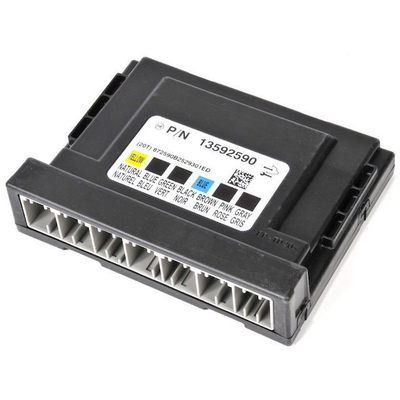
Below are the parts most often responsible for code B1529, ranked by how frequently each one is the actual culprit (per the diagnosis above). Tap any to see what we have for your vehicle.




The information in this article is provided for general reference and educational purposes only. Vehicle specifications, procedures, and part compatibility can vary by production date, trim level, and region. Always consult your vehicle's factory service manual and verify part numbers before purchasing or performing repairs. Safety-critical components such as airbags, seat belts, and braking systems should be installed by a qualified professional.
- 🧭 Diagnostic Flowchart
- 🎬 Helpful Videos
- 🛍️ Shop This Part
- What Does B1529 Mean?
- Can I Drive With B1529?
- Common Causes
- Symptoms
- Common Fixes & Costs
- Used vs. New Parts: Buying Guide
- What Happens If You Wait — Timeline
- Cost of Not Fixing It
- Diagnosis Steps
- When This Code Triggers (Freeze-Frame Conditions)
- Related Codes
- Climate & Environmental Factors
- How to Talk to a Mechanic About This Code
- Where to Take It: Dealer vs Independent vs Chain
- When to Walk Away From the Repair
- What Scan Tool You Need for This Code
- How to Clear the Code After You Fix It
- Will This Fail Emissions / State Inspection?
- Most Commonly Affected Vehicles
- Manufacturer-Specific Notes
- Real Owner Stories
- 2019 Chevy Trax with 60K miles
- 2011 Ford F-150 with 130K miles
- 2014 Chrysler Town & Country with 115K miles
- 2008 Chevy Silverado with intermittent B1529-07
- How to Prevent This Code From Triggering
- Frequently Asked Questions
- Can I just replace the fuse to fix B1529?
- Why did my airbag light come on with my radio buttons failing?
- What is a common misdiagnosis for B1529?
- Is it safe to replace a clock spring myself?
- What is code B1529-03 on a Chevy Trax or Buick Encore?
- Can a bad battery cause code B1529?
- How do you reset the BCM after fixing B1529?
- Key Takeaways
- 🎟️ Get 5% Off