

OBD-II Code B1590: Mirror Vertical Position Sensor Circuit Malfunction
The Ultimate 2026 Guide to Diagnosing and Fixing B1590
- Code B1590 definitions vary by brand: it flags a mirror sensor on GM vehicles, an automatic headlight fault on Fords, and a turn signal switch error on Hyundais.
- On GM vehicles, B1590 disables the automatic memory mirror recall, but manual mirror adjustment via the door switch remains fully operational.
- Inspect the flexible rubber boot between the door and the car body first; repairing a broken wire here costs under $50 in parts compared to a $500+ mirror replacement.
- Test the mirror connector with a multimeter before replacing parts; a healthy GM mirror sensor circuit shows between 1,000 and 7,000 ohms of resistance.
- Installing aftermarket tow mirrors on a truck with a factory memory package instantly triggers B1590 because the new mirrors lack the required 5-volt position sensors.
What Does B1590 Mean?
Code B1590 indicates that the car's computer, typically the Door Control Module (DCM) or Body Control Module (BCM), has detected an abnormal voltage signal from the sensor tracking the vertical (up-and-down) position of a side mirror. This sensor is essential for the memory mirror feature, which automatically adjusts the mirror to a driver's preset position. It is critical to understand that this code's meaning varies by manufacturer. For General Motors vehicles, it points to the mirror sensor. On a Ford, it relates to the automatic headlights, and on a Hyundai, it indicates a fault with the multifunction light switch.
Technical definition: An improper voltage level is detected on the Driver or Passenger Mirror Vertical Position Sensor Signal circuit. The control module supplies a 5-volt reference and a ground to the sensor, expecting a return signal voltage between 0.2 and 4.8 volts. A reading outside this specified range for more than two seconds triggers the code and disables the memory recall function for that specific mirror.
Can I Drive With B1590?
Yes. Your vehicle is safe to drive. Code B1590 is a Body Control Module (BCM) code for a convenience feature and does not affect the vehicle's core safety, powertrain, or braking systems. The only impact is the loss of the automatic memory mirror adjustment.
Common Causes
- Faulty Mirror Position Sensor (Very Common) — The position sensor integrated into the side mirror assembly has failed. The sensor itself is not serviced separately, so fixing it requires replacing the entire mirror unit.
- Damaged Door Wiring or Loose Connector (Common) — The wires running from the door module to the mirror are broken, frayed, or corroded. This damage almost always occurs in the flexible rubber boot between the door and the car body due to repeated opening and closing.
- Incorrect Aftermarket Mirror Installed (Common) — This code frequently appears on trucks and SUVs after factory memory mirrors are replaced with aftermarket tow mirrors that lack the internal position sensor. The computer logs a fault because the expected sensor is missing.
- Low Battery Voltage or Power Interruption (Less Common) — A weak battery, a recent battery replacement, or skipping the required Battery Management System (BMS) reset causes control modules to lose calibration settings or store erroneous fault codes.
- Incorrect Door Switch/Module Installed (Less Common) — A previous repair involved installing the wrong door switch or module (e.g., a switch for power-folding mirrors on a vehicle without that option). This mismatch causes communication errors on the local LIN bus.
- Faulty Door Control Module (DDM/PDM) (Rare) — The control module located inside the door has an internal fault. This is a last-resort diagnosis after the mirror and wiring are confirmed to be in perfect condition.
- Failed BCM/ECU Backup Capacitor (Rare) — In some Japanese vehicles, B1590 means 'B/UP capacitor capacitance big', indicating the backup capacitor on the Body Control Module's circuit board has failed, preventing the module from retaining memory when the car is off.
Symptoms
- Memory seat/mirror functions are disabled — The side mirrors do not automatically move to your saved position when you start the car or select your driver profile.
- Manual mirror adjustment still works — You can still adjust the mirror glass in all directions using the control switch on the door; only the automatic memory recall feature is disabled.
- Service message on the dashboard — The instrument cluster displays a message like "Service Body Control System" or "Service Vehicle Soon," though this code does not illuminate the Check Engine Light.
- Intermittent loss of settings after ignition off — If the code is caused by a failing BCM backup capacitor or battery voltage drop, the clock, radio presets, and other memory-retained settings reset every time the car is turned off.
Diagnostic Flowchart
Tap your situation to follow the diagnostic path that matches what you're seeing on this code.
Common Fixes & Costs
- Replace the Side Mirror Assembly
— Parts: $150-$900, Labor: $75-$250, ~1.2 hr book time
(Intermediate)
Chevrolet Corvette (2005-2013): OEM 25868413 (Driver Side, w/Memory, Heated, Auto-Dim) (Alt: ACDelco 25868413)
GMC Sierra / Chevrolet Silverado (2007-2014): OEM 25894379 (Driver Side, w/Memory, Heated, Signal, Power Fold) (Alt: TYC, Kool Vue, Dorman 128-00959L) - Repair Damaged Door Wiring — Parts: $10-$50, Labor: $200-$500, ~2.5 hr book time (Intermediate)
- Replace the Door Control Module (DDM/PDM)
— Parts: $200-$600, Labor: $125-$250, ~1.5 hr book time
(Professional)
Chevrolet Corvette (2005-2013): OEM 10353086 (Driver Door Module) (Alt: ACDelco 10353086)
GMC Sierra / Chevrolet Silverado (2007-2014): OEM 20953931 (Driver Door Switch w/ Integrated Module) (Alt: ACDelco D1954F) - Reprogram or Re-flash Control Module — Parts: $0, Labor: $100-$250, ~1 hr book time (Professional)
- Replace BCM/ECU Backup Capacitor — Parts: $5-$25, Labor: $300-$700, ~3 hr book time (professional (advanced))
DIY vs Professional
- Replace the Side Mirror Assembly — Beginner: Yes
Tools: Trim removal tools, socket set, needle-nose pliers. - Repair Damaged Door Wiring — Beginner: No
Tools: Multimeter, wire strippers, soldering iron, heat shrink tubing, trim removal tools. - Replace the Door Control Module (DDM/PDM) — Beginner: No
Tools: Trim removal tools, socket set, professional-grade scan tool with programming capabilities.
Used vs. New Parts: Buying Guide
When a used part is worth it: For older, high-mileage vehicles where a new OEM mirror exceeds $300. A used mirror from a reputable salvage yard is a cost-effective solution.
Donor-vehicle mileage cap: roughly under 100000 miles for the part to have meaningful remaining life.
Donor quality checklist:
- Verify the part number and all electronic features (memory, heat, power-fold, auto-dim) match your original mirror exactly.
- Inspect the connector pins for any signs of corrosion or damage.
- Prefer donors from dry climates to minimize internal corrosion.
Decision logic:
- If The vehicle is less than 7 years old or a new aftermarket part is under $250 → Buy a new aftermarket part for a longer warranty and guaranteed functionality.
- If The vehicle is over 10 years old and budget is the primary concern → A used OEM part is a reasonable choice, but test it immediately upon receipt.
- If The specific mirror assembly is known for high failure rates of internal electronics → Favor a new part, as a used one carries a high risk of having the same latent fault.
Warranty tradeoff: Used parts typically offer a 30-90 day warranty for part replacement only. New aftermarket parts come with a 1-year to limited lifetime warranty. New OEM parts carry a 1-2 year warranty.
Worst-case if a used part fails: $150-$400 if a used part fails shortly after the warranty period, requiring repeat labor and another replacement part.
What Happens If You Wait — Timeline
- 0-1 month: Code B1590 is set and stored in the Door Control Module. The memory mirror function for the affected side stops working. Manual adjustment is unaffected. (MPG impact: 0%% · Added cost: $0)
- 1-6 months: If the cause is a broken wire in the door boot, continued flexing wears down the insulation on adjacent wires, increasing the risk of power windows or locks failing. (MPG impact: 0%% · Added cost: $0-$500)
- 6-12 months: If the broken wire shorts to ground, it creates a parasitic battery drain. This causes the battery to go dead if the vehicle sits for several days. (MPG impact: 0%% · Added cost: $150-$350)
- 12+ months: A persistent, unaddressed short circuit overloads the door module's internal circuits, causing it to fail completely and requiring replacement and programming. (MPG impact: 0%% · Added cost: $500-$1000)
Cost of Not Fixing It
- Immediate: Loss of memory mirror function. The driver must manually adjust the mirror each time. (Added cost: 0)
- 1-6 months: If the cause is a broken wire in the door boot, continued flexing degrades insulation on adjacent wires, causing power windows or locks to fail. (Added cost: 0 - $500)
- 6+ months: A persistent short circuit creates a parasitic battery drain, resulting in a dead battery and potential module damage. (Added cost: 150 - $800)
Diagnosis Steps
- Verify the Code and Symptoms
Use an OBD-II scanner capable of reading Body (B) codes to confirm B1590 is active. Note whether the code specifies the driver or passenger side. Test the memory mirror function and the manual adjustment to confirm the exact symptoms.
Tools: OBD-II Scanner (for Body codes) (Beginner) - Analyze Live Data with a Scan Tool
Access the Door Module with an advanced scanner. Observe the live data parameter for 'Mirror Vertical Position'. The voltage must read between 0.2-4.8V and change smoothly as you manually adjust the mirror. If the voltage is stuck at 0V or 5V, it confirms a hard circuit or sensor fault.
Tools: Advanced OBD-II Scanner (Intermediate) - Inspect the Door Harness Boot
Carefully peel back the rubber boot between the door and the A-pillar. Inspect the wiring harness for any signs of pinching, fraying, or broken wires. This is the most common physical failure point for this code.
Tools: Flashlight, Trim removal tool (Beginner) - Test the Mirror Connector
Remove the interior door panel to access the mirror's main electrical connector. Disconnect it and check for green or white corrosion, moisture, or pushed-out pins. Ensure it seats firmly when reconnected.
Tools: Trim removal tools, Screwdriver/socket set (Intermediate) - Perform Advanced Resistance Checks
With the mirror disconnected, use a multimeter set to Ohms (Ω). Test the mirror-side connector. A healthy GM mirror shows 1k-7k Ω between the 5-volt reference and signal circuits. A reading of OL (Open Loop) indicates a dead internal sensor.
Tools: Multimeter, Vehicle-specific wiring diagram (Advanced) - Test the Sensor Circuit Voltage
At the harness-side of the mirror connector, use a multimeter to test the circuit coming from the door module. With the ignition on, you must find a steady 5-volt reference and a good ground (near 0V). If either is missing, the fault is in the wiring harness or the module.
Tools: Multimeter, Vehicle-specific wiring diagram (Advanced) - Check Fuses
Consult your owner's manual to locate the fuses for the Driver Door Module (DDM) and Passenger Door Module (PDM). Pull and inspect the relevant fuses to ensure none are blown.
Tools: Fuse puller or needle-nose pliers (Beginner) - Isolate the Faulty Component
If resistance tests on the mirror fail, replace the mirror assembly. If resistance passes but you are missing the 5V reference at the harness, repair the door harness. If all wiring and the mirror check out perfectly, replace the Door Control Module.
Tools: OBD-II Scanner, Multimeter (Advanced)
When This Code Triggers (Freeze-Frame Conditions)
- Fault Status: Current/Active (The fault is actively being detected by the module.)
- System Voltage: 9-16 Volts (The code sets when battery voltage is within the normal operating range.)
- Ignition Status: ON/RUN (The fault is detected when the ignition is on, powering the door modules.)
- Odometer: Varies (Records the vehicle mileage at the time the fault was first logged.)
Related Codes
- B1580 — The companion code for the 'Mirror Horizontal Position Sensor Circuit'. It almost always appears alongside B1590. The presence of both codes simultaneously strongly points to a shared issue like a faulty connector or a broken 5-volt reference wire.
- B1722 — Indicates a 'Mirror Power Fold Control Circuit Malfunction'. It sets alongside B1590 when incompatible aftermarket mirrors are installed. B1590 disables memory recall, while B1722 disables power-folding.
- B1000 — A general Electronic Control Unit (ECU) malfunction code. If B1000 is present in the door module along with B1590, and the mirror wiring tests good, the door module itself has failed.
- U01B0 — Means 'Lost Communication With Battery Sensor Module'. If this appears with B1590 after a battery change, it proves the root cause is an improper system voltage caused by failing to reset the battery monitoring system.
Climate & Environmental Factors
- Cold Weather: Extremely cold temperatures make wire insulation brittle, significantly increasing the likelihood of wires snapping inside the flexible door boot when the door is opened.
- High Humidity / Water Ingress: Moisture accelerates corrosion on connector pins. Water inside the mirror housing or door module connector causes short circuits and sensor signal failure.
How to Talk to a Mechanic About This Code
Say this: "I have a B1590 code for the mirror position sensor, and the memory function isn't working. Please check for broken wires in the door jamb and test the sensor circuit at the mirror connector before recommending a full mirror replacement."
This signals you understand the common failure points. It directs the technician to perform a proper electrical diagnosis to find the root cause (often a cheap wiring fix) instead of defaulting to the most expensive part replacement.
Avoid saying:
- "My memory mirror is broken."
- "My car has an electrical problem, can you fix it?"
- "Just replace the mirror, I guess."
Questions to ask before authorizing the repair:
- What were the voltage and resistance readings at the mirror connector?
- Did you find any broken or corroded wires in the door harness boot?
- If the mirror assembly needs to be replaced, is the replacement part OEM or aftermarket, and what is the warranty?
Where to Take It: Dealer vs Independent vs Chain
- Dealer:
A safe but expensive option. Use if you suspect a module needs programming and prefer OEM parts, but be prepared for a higher bill.
Best for: Vehicles under warranty, Complex cases where a module replacement and VIN-specific programming are confirmed to be necessary
Downsides: Significantly higher labor rates and diagnostic fees., More likely to recommend replacing a whole assembly (the mirror) rather than repairing a simple component (a wire). (Typical cost: +40% vs. baseline) - Independent Shop:
Best fit for most cases. A good independent auto electrician diagnoses the wiring, sensor, and module to find the true cause of the fault, saving you money.
Best for: Out-of-warranty vehicles where cost is a factor., Diagnosing and repairing electrical issues like broken wires, which they are often more willing to do than dealers.
Downsides: Quality and expertise vary widely. You must find a shop with strong electrical diagnostic skills and the right tools. (Typical cost: +0% vs. baseline) - Chain Shop:
AVOID. This type of nuanced electrical fault is beyond the scope of most chain shops. They are very unlikely to have the correct diagnostic tools to solve this problem.
Best for: Simple, unrelated jobs like oil changes or tires.
Downsides: Technicians generally lack the specialized training and tools for complex electrical or body control module diagnostics., High pressure to sell parts leads to misdiagnosis and unnecessary replacements. (Typical cost: -10% vs. baseline)
When to Walk Away From the Repair
Since B1590 affects a non-essential convenience feature, the decision to repair is based on personal budget and annoyance. If the cost to restore the memory mirror function feels too high, simply don't fix it.
- Car worth $8000, fix is $950: Walk away. A nearly $1,000 repair for a memory mirror on an older vehicle is rarely a good value. Live with manual adjustment or seek a cheaper DIY part solution.
- Car worth $25000, fix is $350: Fix it. A $350 wiring repair to restore a key feature on a newer, more valuable vehicle is a reasonable investment.
- Car worth $15000, fix is $0: Accept it. If the code was caused by installing aftermarket tow mirrors that lack sensors, this is an expected outcome and has no repair cost.
What Scan Tool You Need for This Code
Minimum: A scanner that reads and clears Body (B) codes and displays live data from the Body Control Module (BCM) and Door Control Modules (DDM/PDM).
A cheap, basic $20 code reader only reads Powertrain (P) codes for the engine and transmission. It will not see or clear the B1590 code.
Budget: BlueDriver Pro (~$99) — Connects to your smartphone via Bluetooth to read/clear body codes and show live data from the door modules to see if the sensor voltage changes.
Mid-range: Foxwell NT510 Elite / Innova 5610 (~$150-350) — These handheld scanners offer full system diagnostics, including reading B-codes, viewing live data, and bidirectional controls to command the mirror motor.
Professional: Autel MaxiCOM MK808S / Launch X431 Series (~$450-700) — Provides full bidirectional control, advanced coding functions, and the ability to perform module programming if the DDM/PDM needs to be replaced.
Rent vs buy: Most free rental scanners from auto parts stores are basic code readers that CANNOT read the Body (B) codes necessary for this diagnosis. You must purchase a capable scanner or pay for a professional diagnosis.
How to Clear the Code After You Fix It
- Use an OBD-II scanner capable of reading Body codes to clear the fault.
- Alternatively, disconnect the negative battery terminal for 15 minutes to reset modules.
- Cycle the ignition on and off several times.
Drive cycle: No specific drive cycle is required. For GM vehicles, a history B1590 code clears on its own after 40 consecutive ignition cycles without the fault reoccurring.
Readiness monitors affected: Not Applicable
Watch out for:
- Using a basic $20 OBD-II scanner that only reads Powertrain (P) codes will not see or clear Body (B) codes.
- If the underlying electrical fault is not fixed, the code returns immediately.
- Disconnecting the battery erases radio presets, clock settings, and learned transmission memory.
Will This Fail Emissions / State Inspection?
No — by itself this code doesn't fail OBD inspection (but it can keep readiness monitors from setting, which causes a separate fail).
- California: This code will NOT cause a smog check failure. California's test focuses on Powertrain (P) codes and emissions readiness monitors.
- New York: This code will NOT cause an emissions inspection failure. It may be noted during a safety inspection, but it does not affect passing.
- Texas: This code will NOT cause an emissions inspection failure. The test checks for emissions-related faults only.
Most Commonly Affected Vehicles
- Chevrolet Corvette (2005-2013) — Very common on C6 models with memory packages (RPO AAB). The code often appears as a glitch after a battery disconnect or failure.
- GMC Sierra, Yukon (2007-2014) — Frequently occurs when factory memory mirrors are replaced with aftermarket tow mirrors that lack the position sensor.
- Chevrolet Tahoe, Suburban (2007-2014) — The Driver Door Module logs this fault when the vertical position sensor signal drops out. Wiring in the door jamb is the primary failure point.
- Cadillac Escalade, CTS (2007-2014) — Triggers due to an improper voltage level from the mirror's vertical position sensor, disabling memory functions.
- Buick Enclave (2008-2017) — Shares the GM Lambda platform and electrical architecture with the Traverse and Acadia, making it susceptible to the same door harness wiring failures.
- Chevrolet Traverse (2009-2017) — Susceptible to mirror sensor and door harness wiring failures due to the shared GM Lambda platform architecture.
- Hyundai Elantra, Sonata (2011-2018) — On these models, B1590 indicates a 'Light Multifunction Switch Error', related to the turn signal and headlight stalk, not the mirrors.
- Ford F-150, Explorer (2004-2010) — On Ford vehicles, B1590 indicates 'Autolamp Delay Increase Circuit Short To Ground' and is related to the automatic headlight system, not the mirrors.
Manufacturer-Specific Notes
- General Motors (Chevrolet, GMC, Cadillac): B1590 consistently refers to the 'Mirror Vertical Position Sensor Circuit Malfunction'. Diagnosis relies on standard electrical testing as no widespread Technical Service Bulletin (TSB) exists for this specific code.
- Ford: B1590 has a completely different meaning: 'Autolamp Delay Increase Circuit Short To Ground', related to the automatic headlight system.
- Hyundai: B1590 indicates a 'Light Multifunction Switch Error', meaning the Body Control Module detected a fault in the turn signal or headlight stalk circuit.
- Other (e.g., some Japanese makes): B1590 is defined as 'B/UP capacitor capacitance big', pointing to a failure of the backup capacitor on the main body ECU responsible for retaining memory settings.
Real Owner Stories
2008 Chevrolet Corvette C6 with recurring B1590
Code B1590 appeared for the driver's side mirror after the battery was disconnected for several days. The memory function stopped working, but manual adjustment was fine.
What they tried:
- Confirmed symptoms and DTC with a scanner.
- Considered replacing mirror internals but was concerned about needing to remove the entire door panel.
Outcome: The issue was traced to the battery disconnect scrambling the module's memory. After clearing the code and re-saving the memory seat/mirror positions, the function returned to normal.
Lesson: If B1590 appears immediately after a battery disconnect or replacement, always try clearing the code and reprogramming your memory settings first. It saves you from an unnecessary and expensive repair.
2016 GMC Sierra 1500 LT with B1590 & B1580 after mirror swap
Owner installed aftermarket towing mirrors on a truck that originally had factory mirrors with the memory package. Immediately after installation, codes B1590 and B1580 appeared.
What they tried:
- The owner understood this was an expected outcome of the modification.
- Some owners purchase custom wiring harnesses to add back functionality, but most accept the loss of the memory feature.
Outcome: The codes remained, and the memory mirror function was permanently disabled. This is a known trade-off when swapping to aftermarket tow mirrors that lack position sensors.
Lesson: If you install aftermarket mirrors on a GM truck with a memory package, verify if the new mirrors support the memory function. If not, expect B1590 to appear; it is a feature incompatibility, not a fault.
2010 Chevrolet Tahoe with intermittent B1590
The memory mirror function worked intermittently, and code B1590 was stored in the Driver Door Module.
What they tried:
- A shop initially suspected a faulty mirror assembly.
- A second diagnosis focused on the wiring harness after the owner noted the problem was worse when opening and closing the door.
Outcome: The technician found several broken wires inside the rubber boot between the driver's door and the A-pillar. The wires were repaired using butt connectors and heat shrink tubing for $400. The code was cleared and did not return.
Lesson: Before replacing an expensive mirror or door module, thoroughly inspect the wiring harness in the door jamb. This is a very common point of failure, and a wiring repair is much cheaper than a new mirror assembly.
How to Prevent This Code From Triggering
- Periodically lubricate the door wiring boot. (Every 2-3 years) — Applying a silicone-based lubricant to the rubber boot keeps it flexible and prevents it from binding on the wiring harness, reducing the strain that snaps wires.
- Apply dielectric grease to key connectors. (When a connector is disconnected for any repair.) — Applying a thin layer of non-conductive dielectric grease to the weather seal of connectors prevents moisture intrusion and corrosion, which cause high resistance faults.
- Use a battery tender for long-term storage. (Any time the vehicle will be parked for more than 2-3 weeks.) — Prevents the battery from discharging completely. A deep discharge creates voltage spikes that scramble module memory and set spurious codes like B1590.
- Ensure proper wire routing and protection. (During any aftermarket installation or repair.) — Ensure wires are secured with loom and zip ties, kept away from sharp edges, and not pinched by trim panels. This prevents chafing and short circuits.
Frequently Asked Questions
Is it safe to drive my car with code B1590?
Yes, it is completely safe. For its most common definition (a mirror sensor fault), this code does not affect the engine, brakes, steering, or any other critical safety system. It is purely an issue with a convenience feature.
Why did code B1590 appear right after I installed new tow mirrors?
This is a very common scenario. Your truck's original mirrors had position sensors for the memory feature. Most aftermarket tow mirrors do not include these sensors, so the computer reports a fault because it can no longer get a signal from them.
How do I reset a B1590 code?
The correct way is to use an OBD-II scanner to clear the code after the repair is complete. You can also clear codes by disconnecting the negative battery terminal for 15 minutes, though this resets your radio and learned settings. If the underlying fault isn't fixed, the code returns after about 40 ignition cycles.
What are the most common misdiagnosis mistakes for B1590?
The most common mistake is immediately replacing the expensive mirror assembly when the actual fault is a single broken wire in the flexible rubber door boot. Another pitfall is replacing the Door Control Module when the issue is an improperly programmed module from a previous repair.
The memory mirrors stopped working after my car battery died. Could that cause a B1590 code?
Yes. A significant voltage drop or disconnecting the battery causes modules to lose their learned positions or store glitch codes. Before starting repairs, clear the codes, cycle the ignition, and try to save a new memory position to see if the function returns.
Does B1590 always mean I need a new mirror?
No. While a failed sensor inside the mirror is the most common cause, the problem is often a broken wire, a corroded connector, or a faulty door control module.
Can I fix a B1590 code myself?
A DIYer comfortable with a multimeter and removing a door panel can diagnose and fix a wiring issue or replace the mirror assembly. However, if the control module is the problem, it requires professional replacement and programming with specialized tools.
Will code B1590 turn on my Check Engine Light?
No. B1590 is a Body (B) code, not a Powertrain (P) code, so it will not illuminate the Check Engine Light. It triggers a specific service message on your dashboard or stores silently in the Body Control Module.
Key Takeaways
- Code B1590 definitions vary by brand: it flags a mirror sensor on GM vehicles, an automatic headlight fault on Fords, and a turn signal switch error on Hyundais.
- On GM vehicles, B1590 disables the automatic memory mirror recall, but manual mirror adjustment via the door switch remains fully operational.
- Inspect the flexible rubber boot between the door and the car body first; repairing a broken wire here costs under $50 in parts compared to a $500+ mirror replacement.
- Test the mirror connector with a multimeter before replacing parts; a healthy GM mirror sensor circuit shows between 1,000 and 7,000 ohms of resistance.
- Installing aftermarket tow mirrors on a truck with a factory memory package instantly triggers B1590 because the new mirrors lack the required 5-volt position sensors.
Helpful Videos

Shop the Parts Behind B1590
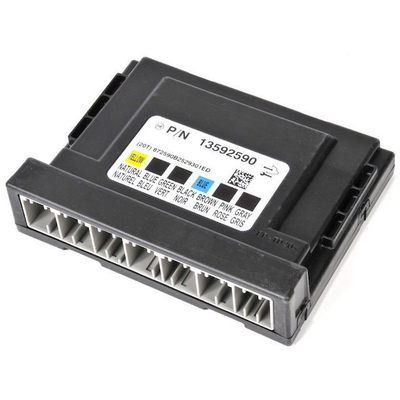
Below are the parts most often responsible for code B1590, ranked by how frequently each one is the actual culprit (per the diagnosis above). Tap any to see what we have for your vehicle.


The information in this article is provided for general reference and educational purposes only. Vehicle specifications, procedures, and part compatibility can vary by production date, trim level, and region. Always consult your vehicle's factory service manual and verify part numbers before purchasing or performing repairs. Safety-critical components such as airbags, seat belts, and braking systems should be installed by a qualified professional.
- 🧭 Diagnostic Flowchart
- 🎬 Helpful Videos
- 🛍️ Shop This Part
- What Does B1590 Mean?
- Can I Drive With B1590?
- Common Causes
- Symptoms
- Common Fixes & Costs
- DIY vs Professional
- Used vs. New Parts: Buying Guide
- What Happens If You Wait — Timeline
- Cost of Not Fixing It
- Diagnosis Steps
- When This Code Triggers (Freeze-Frame Conditions)
- Related Codes
- Climate & Environmental Factors
- How to Talk to a Mechanic About This Code
- Where to Take It: Dealer vs Independent vs Chain
- When to Walk Away From the Repair
- What Scan Tool You Need for This Code
- How to Clear the Code After You Fix It
- Will This Fail Emissions / State Inspection?
- Most Commonly Affected Vehicles
- Manufacturer-Specific Notes
- Real Owner Stories
- 2008 Chevrolet Corvette C6 with recurring B1590
- 2016 GMC Sierra 1500 LT with B1590 & B1580 after mirror swap
- 2010 Chevrolet Tahoe with intermittent B1590
- How to Prevent This Code From Triggering
- Frequently Asked Questions
- Is it safe to drive my car with code B1590?
- Why did code B1590 appear right after I installed new tow mirrors?
- How do I reset a B1590 code?
- What are the most common misdiagnosis mistakes for B1590?
- The memory mirrors stopped working after my car battery died. Could that cause a B1590 code?
- Does B1590 always mean I need a new mirror?
- Can I fix a B1590 code myself?
- Will code B1590 turn on my Check Engine Light?
- Key Takeaways
- 🎟️ Get 5% Off