

Ultimate B1717 Guide: Driver Seat Forward Switch Circuit Failure (2026 Edition)
The definitive guide to diagnosing and fixing OBD-II code B1717, packed with pro tips and real-world data.
- Code B1717 indicates an electrical fault in the driver's seat forward/backward switch circuit, disabling memory and easy-entry functions.
- Always check the power seat fuse and perform a 15-minute battery disconnect reset before buying replacement parts.
- The most common fix is replacing the driver seat switch assembly, which costs between $115 and $300 for parts and labor.
- If your battery dies overnight alongside a B1717 code, perform a parasitic draw test to check for a shorted Driver Seat Module (DSM) pulling more than 50mA.
What Does B1717 Mean?
DTC B1717 indicates the Body Control Module (BCM) or Driver Seat Module (DSM) detects an electrical fault in the driver's seat forward/backward adjustment switch circuit. This fault prevents the module from reading the switch input, disabling seat memory and 'Easy Entry/Exit' functions.
Technical definition: The SAE/ISO definition for B1717 is "Seat Driver Forward Switch Circuit Failure". The control module flags this fault when it detects an abnormal voltage signal—such as an open circuit, short to ground, or short to power—in the driver's seat horizontal forward switch circuit.
Can I Drive With B1717?
Yes. Yes. Code B1717 affects convenience features like power seat adjustment and memory. It does not compromise vehicle safety or drivability. However, a seat stuck in an improper position impairs driver comfort and control, so adjust it manually if possible and schedule an inspection.
Common Causes
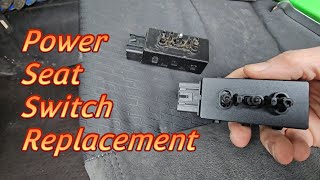
- Faulty Driver Seat Adjustment Switch (Very Common) — Internal contacts wear out, plastic components break, or liquid spills cause corrosion, leading to a short or open circuit within the switch assembly.
- Damaged Wiring or Loose Connectors (Common) — The under-seat wiring harness is highly vulnerable. Wires pinch, chafe, or break from seat movement, and connectors kick loose or corrode over time.
- Blown Power Seat Fuse (Common) — A short circuit in the switch, motor, or wiring blows the protective fuse. Finding the underlying short is required to prevent repeat fuse failures. 🎬 Learn how to quickly find an electrical short in your car.
- Binding Seat Tracks (Less Common) — The physical seat mechanism jams. If the module commands movement but the position sensor detects no change, it flags a circuit fault.
- Faulty Driver Seat Module (DSM) (Less Common) — The electronic control module fails due to internal component degradation, voltage spikes, or water intrusion.
- Corroded Chassis Ground (Less Common) — The seat circuit's ground point—usually a bolt to the floor pan—rusts, creating high resistance that triggers intermittent faults.
- Low Battery Voltage or Software Glitch (Rare) — A dying battery or failing alternator causes widespread electronic instability. Modules require a stable 9V-16V to operate and lock up during low-voltage events.
Symptoms
- Power seat will not move forward or backward — The horizontal adjustment switch is completely unresponsive, though recline or vertical adjustments often still work.
- Memory and Easy Entry/Exit functions inoperative — The vehicle fails to save or recall preset seat positions and will not automatically retract the seat 🎬 See how to reset and reprogram your memory seat functions. when the ignition turns off.
- Seat moves intermittently or autonomously — A shorted wire or switch causes the seat to move without user input, or it only works when wiggling the switch.
- Driver Information Center warning message (also visible on scanner) — B1717 rarely illuminates the Check Engine Light but triggers a specific warning message on the dashboard display.
Diagnostic Flowchart
Tap your situation to follow the diagnostic path that matches what you're seeing on this code.
Common Fixes & Costs
- Replace Driver Power Seat Switch — Parts: $40-$150, Labor: $75-$150, ~0.8 hr book time (Intermediate)
- Repair Damaged Wiring or Connector — Parts: $10-$30, Labor: $120-$250, ~2 hr book time (Intermediate)
- Replace Blown Fuse and Reset System — Parts: $1-$10, Labor: $0, ~0.1 hr book time (DIY)
- Realign and Lubricate Seat Tracks — Parts: $0-$15, Labor: $100-$250, ~1.5 hr book time (DIY)
- Replace Driver Seat Module (DSM) — Parts: $200-$450, Labor: $125-$200, ~1.2 hr book time (Professional)
Used vs. New Parts: Buying Guide
When a used part is worth it: For older, high-mileage vehicles where budget is the primary concern. A used OEM switch from a reputable salvage yard is a cost-effective solution if the part number is an exact match.
Donor-vehicle mileage cap: roughly under 100000 miles for the part to have meaningful remaining life.
Donor quality checklist:
- Verify the part number on the switch itself. Options like memory, 8-way vs 10-way change the switch.
- Inspect the connector pins for any signs of corrosion or damage.
- Ask about the donor vehicle's history; avoid parts from flood-damaged cars.
Decision logic:
- If The vehicle is less than 7 years old OR the cost for a new aftermarket part is under $100 → Buy new (aftermarket or OEM). The warranty and assurance of a non-worn part are worth the small extra cost.
- If The vehicle is over 10 years old AND the OEM part is discontinued or over $250 → A used part is a reasonable choice. A new aftermarket part is also a strong consideration.
- If The part has a known high failure rate for your model → Favor a new part with a warranty, as a used part is likely to have significant wear.
Warranty tradeoff: Used parts typically offer a 30-90 day warranty, often for part replacement only (no labor). New aftermarket parts usually come with a 1-year to limited lifetime warranty. New OEM parts carry a 1-2 year warranty.
Worst-case if a used part fails: $100-$200 if a used switch fails after the warranty period, requiring repeat labor costs for diagnosis and replacement.
What Happens If You Wait — Timeline
- 0-2 weeks: Code B1717 is set. Driver's seat forward/backward adjustment and associated memory/easy-exit functions stop working. The issue is a major inconvenience but does not affect vehicle operation. (MPG impact: 0%% · Added cost: $0)
- 1-3 months: If the fault is due to an intermittent short circuit, it causes a parasitic battery drain. The owner experiences a weak or dead battery after the vehicle sits for a couple of days. (MPG impact: 0%% · Added cost: $150-$350 (Cost of a new battery if the original is damaged by repeated deep discharge cycles))
- 3-9 months: The intermittent short becomes permanent. The parasitic draw drains a healthy battery overnight, leaving the driver stranded and requiring frequent jump-starts. (MPG impact: 0%% · Added cost: $200-$500 (Includes new battery and potential diagnostic fees for the no-start condition))
- 9+ months: Worst-case scenario: A persistent short circuit overheats the input driver circuit within the Driver Seat Module (DSM) or Body Control Module (BCM), causing permanent module damage. (MPG impact: 0%% · Added cost: $400-$900+ (Cost to replace and program a failed DSM or BCM, in addition to fixing the original short))
Cost of Not Fixing It
- Immediate: Loss of driver's seat forward/backward adjustment and memory functions. This is a major inconvenience and a distraction if the seat is stuck in an uncomfortable position. (Added cost: $0)
- 1-6 months: If the cause is a short circuit, it creates a parasitic draw, leading to a dead battery. This leaves you stranded and reduces the overall lifespan of your battery. (Added cost: $150-$350 for a new battery)
- 6+ months: A persistent and unaddressed short circuit in the wiring or switch overheats and damages the input/output driver within the Driver Seat Module (DSM), turning a simple repair into a costly module replacement. (Added cost: $400-$800+)
Diagnosis Steps
- Check Fuses First
Consult the owner's manual for the 'Power Seats' or 'DSM' fuse. Visually inspect and test with a multimeter. A blown fuse indicates an underlying short.
Tools: Fuse puller, Multimeter (Beginner) - Perform a System Reset and Re-calibration
Disconnect the negative battery terminal for 15 minutes. Reconnect, then move the seat to its absolute limits (full forward, back, up, down), holding the switch for 3 seconds at each end to force the module to re-learn limits.
Tools: 10mm wrench (Beginner) - Scan for All Trouble Codes
Use an OBD-II scanner capable of reading Body ('B') codes. Note related codes like B1718 (open circuit) or B1720 (short to ground) to pinpoint the fault.
Tools: OBD-II Scanner (with B-code capability) (Beginner) - Visually Inspect Underneath the Seat
Use a flashlight to inspect all under-seat wiring. Look for shiny copper from chafed wires, pinched harnesses, and loose or corroded connectors.
Tools: Flashlight (Intermediate) - Test the Switch Circuit
Unplug the seat switch. Verify 12V on the power wire and continuity to ground. Test the switch pins for the forward/backward function using the Ohms setting; it should read 'OL' unpressed and under 1 ohm pressed.
Tools: Multimeter, Wiring diagram, Trim removal tools (Advanced) - Check for a Stuck Seat Track
If the motor clicks but the seat stays put, the track is physically binding. Unbolt the motor, manually align the tracks, and clear any debris.
Tools: Socket set, Torx bits (Intermediate) - [ADVANCED] Test Module Voltage and Ground
Back-probe the DSM main connector. Verify stable battery voltage (11-14V) on the power pin and less than 2 ohms of resistance on the ground pin.
Tools: Multimeter, Back-probe kit, Wiring diagram (Advanced) - [ADVANCED] Check for Signal Circuit Shorts
Disconnect harness connectors at the switch and module. Probe the signal wire to chassis ground (should read 'OL') and check for DC voltage (should read 0V) to rule out shorts.
Tools: Multimeter, Wiring diagram (Advanced) - [PRO TIP] Analyze Switch Signal
Back-probe the signal wire to the DSM. A functioning switch produces a clean square wave on an oscilloscope, dropping from reference voltage to near 0V when pressed.
Tools: Automotive Oscilloscope, Probing kit (Professional) - [PRO TIP] Perform a Parasitic Draw Test
If the battery dies overnight, connect a multimeter in series with the negative battery cable. A draw above 50mA indicates an internal short. Pull seat fuses to isolate the circuit.
Tools: Multimeter with 10A capability (Professional)
When This Code Triggers (Freeze-Frame Conditions)
- Control Module Voltage: 11.5V - 14.5V (The fault is logged when the BCM/DSM performs a self-test of the switch circuit, which occurs during key-on or when the switch is operated.)
- Ignition Status: RUN or ACC (The module must be powered on to detect a circuit fault. This happens when the ignition is in the accessory or run position.)
- Switch Input Voltage: 0V or >4.5V (varies) (The code sets when the module sees a voltage on the signal line that is outside the expected range.)
- Fault Type: Circuit Open/Short to Ground/Short to Power (The freeze frame data for body codes includes a specific fault type identifier, which is highly valuable for diagnosis.)
Related Codes
- B1718 — Refers to 'Seat Driver Forward Switch Circuit Open'. This is a more specific version of B1717, indicating a complete break in the wire or a failed internal switch contact.
- B1719 — Refers to 'Seat Driver Forward Switch Circuit Short to Battery'. This means the signal wire is touching a power source, causing it to have constant voltage.
- B1720 — Refers to 'Seat Driver Forward Switch Circuit Short to Ground'. This means the signal wire is touching the vehicle's chassis or a ground wire.
- B1D9B-54 — This is a Jeep-specific code for 'Seat Horizontal Front Stop Not Learned-Missing Calibration'. It often appears with B1717. It means the module lost its memory of the seat's physical limits.
Climate & Environmental Factors
- High Humidity / Wet Climates: Accelerates corrosion on wiring connectors, ground points, and internal switch contacts. Moisture brought into the vehicle on shoes collects in the carpet and under the seat, creating a perfect environment for electrical faults.
- Extreme Cold: Plastic wire insulation and trim panel clips become brittle in very cold temperatures. This increases the risk of them cracking or breaking during seat movement or when attempting a repair.
- Road Salt (Winter Climates): In regions where road salt is used, salt-laden moisture is tracked into the vehicle. This saline moisture is highly corrosive and quickly degrades under-seat wiring and chassis ground points.
How to Talk to a Mechanic About This Code
Say this: "I have a B1717 code for the driver's seat forward switch circuit, and the memory functions are not working. I'd like to schedule a diagnostic to confirm if the fault is the switch, the under-seat wiring, or the control module."
This signals you have done your research and directs the technician to perform a specific electrical diagnosis. It avoids a vague request that leads to unnecessary part replacements, like a costly seat motor.
Avoid saying:
- 'My seat is broken, fix it.'
- 'My check engine light is on, can you look at it?'
- 'Just do whatever you think is best.'
Questions to ask before authorizing the repair:
- Did you test the switch itself for continuity and resistance?
- Have you verified power and ground at the switch connector and the seat module?
- If you are recommending a module replacement, have you definitively ruled out the wiring and the switch first?
- If a new module is needed, does it require programming and is that included in the labor cost?
Where to Take It: Dealer vs Independent vs Chain
- Dealer:
Best for: Vehicles under warranty, Complex repairs requiring module programming or software updates (TSBs), Manufacturer-specific quirks known to the brand
Downsides: Typically highest labor rates and parts costs, More inclined to replace entire assemblies rather than perform a component-level repair (Typical cost: +50% vs. baseline) - Independent Shop:
Best fit for most cases. A reputable independent shop with strong electrical diagnostic skills is perfectly equipped to handle a B1717 fault and is more cost-effective than a dealer.
Best for: Out-of-warranty vehicles where cost is a factor, Common electrical faults that don't require proprietary software, Building a long-term relationship with a mechanic
Downsides: Quality and electrical diagnostic skill vary widely; vet shops by reviews and ASE certifications, May lack expensive, dealer-specific programming tools (Typical cost: +0% vs. baseline) - Chain Shop:
Not recommended. Diagnosing a B1717 code effectively is beyond the scope of their typical service model. Risk of misdiagnosis or unnecessary parts replacement is high.
Best for: Simple, high-volume jobs like tires, oil changes, and brakes
Downsides: Technicians lack the deep electrical diagnostic training needed for intermittent 'B' codes, Business model encourages quick parts replacement over detailed diagnosis (Typical cost: -10% vs. baseline)
When to Walk Away From the Repair
If the estimated repair cost exceeds 50% of the car's private-party value, seriously consider selling or trading it in instead of repairing it.
- Car worth $4000, fix is $450: Fix it. The repair cost is a small fraction of the vehicle's value.
- Car worth $3000, fix is $1200: Borderline. The repair is approaching 50% of the car's value. Get a second opinion before proceeding, especially if the car has other issues.
- Car worth $2000, fix is $1500: Walk away. The repair cost is not economical. The money is better put toward a replacement vehicle.
What Scan Tool You Need for This Code
Minimum: A scanner that can read Body ('B') control module codes. Basic sub-$30 readers that only show Powertrain ('P') codes will not see B1717.
The cheapest code readers show 'No Codes Found' because they cannot communicate with the Body Control Module (BCM) or Driver Seat Module (DSM). You need a tool that specifically lists ABS, Airbag, BCM, or 'all systems' scanning capability.
Budget: BlueDriver Pro (~$99) — This Bluetooth scanner pairs with a smartphone app and reads and clears 'B' codes, views live data from the seat module, and provides a database of reported fixes.
Mid-range: Foxwell NT510 Elite (~$180) — A powerful handheld tool that offers OE-level diagnostics for a specific car brand. It provides deep system access, live data graphing, and bi-directional control to command the seat module to perform actions.
Professional: Autel MaxiCOM MK808 / MK808S (~$450-550) — A professional-grade tablet scanner with full bi-directional control, all-system access, and advanced service functions. It performs specific module initializations or calibrations required after replacing a Driver Seat Module.
Rent vs buy: Most auto parts store loaner tools are basic code readers designed only for Check Engine Lights and cannot read 'B' codes. For this specific code, you need to buy a capable scanner or take it to a shop.
How to Clear the Code After You Fix It
- Fix the underlying electrical fault (e.g., replace switch, repair wire).
- Use an OBD-II scan tool capable of reading 'B' codes to clear the fault from the BCM/DSM memory.
- Alternatively, disconnect the negative battery terminal for 15 minutes for a hard reset.
- Operate the power seat through all its functions to confirm the repair is successful and the code does not return.
Drive cycle (~1 minutes): Body codes like B1717 do not require a complex emissions-style drive cycle. After clearing the code, the module re-tests the circuit the next time the ignition is turned on or the seat switch is used.
Readiness monitors affected: None
Watch out for:
- Clearing the code without fixing the root cause results in the code returning immediately upon the next self-test.
- Disconnecting the battery clears the code but resets radio presets, clocks, and learned memory for other modules, requiring a seat re-calibration.
Will This Fail Emissions / State Inspection?
No — by itself this code doesn't fail OBD inspection (but it can keep readiness monitors from setting, which causes a separate fail).
- California: A B1717 code will not cause a smog check failure. California's test focuses on powertrain ('P') codes that trigger the Check Engine Light and the status of emissions readiness monitors.
- New York: An OBD-II emissions inspection in NY fails a vehicle if the Malfunction Indicator Lamp (MIL) is commanded on. Since B1717 does not illuminate the MIL, it will not cause an emissions failure.
- Texas: In the 17 counties requiring emissions testing, the inspection looks for active powertrain codes that turn on the Check Engine Light. A body code like B1717 is not part of the emissions test.
Most Commonly Affected Vehicles
- Jeep Grand Cherokee (2017-2022) — Very common issue. Often presents as a failure of the 'Easy Entry/Exit' feature. May be accompanied by code B1D9B-54. TSB 08-035-23 REV. A addresses a required software update for 2022 models.
- Ford F-150, Explorer (2011-2020) — On 2015-2020 F-150s, the wiring harness under the seat is a known weak point. A TSB exists for harness issues on 2015-2019 models.
- Chevrolet / GMC Silverado / Sierra, Tahoe / Yukon (2007-2014) — The main switch assembly is a frequent failure item and is a well-documented DIY replacement. On some GMC models, B1717 is assigned to the 'Mirror Power Fold Control Switch Circuit'.
- Cadillac / GMC Escalade / Yukon Denali (2015-2020) — Sharing a platform with the Tahoe/Yukon, these luxury SUVs suffer from similar issues with the seat switch pack, DSM, and under-seat wiring harness.
- Dodge / Ram Ram 1500/2500, Charger, Durango (2009-2018) — Problems are frequently traced to the main seat switch assembly or chafed wires in the harness that runs along the seat frame.
- Peugeot / Citroen Various (Expert, Jumpy, etc.) (2010-2024) — In PSA group vehicles, this and many other body codes appear simultaneously after the battery is drained or jump-started, indicating a system voltage issue rather than a specific part failure.
- Skoda / Volkswagen Superb, Touareg, Tiguan (2011-2023) — Owners report that seat memory presets fail to save. The cause is often a faulty switch, a poor ground connection under the seat, or a software issue requiring a system reset.
- Toyota/Lexus Various (2008-2024) — On these vehicles, the memory function is often restored by performing a re-calibration. Move the seat and seatback to their absolute maximum forward/back and up/down positions to reset the system's learned limits.
Manufacturer-Specific Notes
- Jeep/Chrysler/Dodge: Multiple Technical Service Bulletins (TSBs) exist for memory seat issues. TSB 08-035-23 REV. A requires a software update for 2022 Grand Cherokees to fix memory and easy entry/exit problems.
- Ford: Ford's official diagnostic procedure involves using their proprietary scan tool (IDS) to monitor specific Parameter IDs (PIDs) for the switch and position sensors in real-time before checking wiring.
- GM (Chevrolet/GMC/Cadillac): Be aware of code ambiguity. On some GMC models, B1717 is defined as 'Mirror Power Fold Control Switch Circuit'. When swapping seats, the passenger seat position sensor must be transferred to avoid a 'Service Airbag' light.
- European Makes (Peugeot, VW, BMW): These vehicles are highly sensitive to battery health. A weak battery, failing alternator, or jump-starting the car causes a flood of non-specific body control module codes, including B1717.
Real Owner Stories
2018 Jeep Grand Cherokee at 75K miles - Memory Seat Failure
Owner noticed the 'Easy Entry/Exit' feature stopped working. Soon after, the memory seat buttons became unresponsive. The seat adjusted manually but would not save new positions. Codes B1717 and B1D9B-54 were present.
What they tried:
- Checked the power seat fuse, which was intact.
- Disconnected the battery for 30 minutes to reset the modules.
- Performed the seat re-calibration procedure by moving the seat to its full travel limits in all directions.
Outcome: After reconnecting the battery and performing the re-calibration, the B1D9B-54 code cleared and all memory functions were restored. The B1717 code also cleared and did not return. Total cost: $0.
Lesson: Always try the simplest fixes first. For memory seat issues, a system reset and re-calibration is a free and highly effective solution before replacing parts.
2016 Ford F-150 at 110K miles - Intermittent Seat Movement
The driver's seat moved forward intermittently. Wiggling the switch sometimes helped. Eventually, it stopped moving forward altogether, and code B1717 was stored.
What they tried:
- Replaced the driver's seat switch assembly ($80 part). The problem remained.
- Visually inspected the wiring under the seat but saw no obvious damage.
Outcome: A technician found a corroded wire splice in the harness located under the driver's side door scuff plate, a known issue on this platform. Repairing the corroded wire ($150 labor) fixed the problem permanently.
Lesson: Do not assume the switch is bad. The wiring harness, especially in vulnerable areas like under the seat or along the door sill, is a common failure point requiring thorough inspection.
2012 Dodge Grand Caravan at 130K miles - Dead Battery & B1717
The vehicle's battery died if it sat for more than two days. After jump-starting, the B1717 code was present and the power seat was inoperative.
What they tried:
- Replaced the battery, assuming it was old and wouldn't hold a charge.
- Pulled the power seat switch to inspect for visible damage or shorts, but found none.
Outcome: A parasitic draw test revealed a draw over 1 amp. Pulling fuses isolated the draw to the Driver Seat Module (DSM). The DSM had an internal short, causing it to stay 'awake'. Replacing the DSM with a $120 salvage unit solved both the battery drain and the B1717 code.
Lesson: If B1717 is accompanied by a dead battery, suspect a parasitic draw. A faulty control module fails to go to 'sleep' when the car is off, draining the battery.
How to Prevent This Code From Triggering
- Keep the under-seat area clear. (Ongoing / During vehicle cleaning) — Prevents objects like water bottles or tools from rolling under the seat, where they jam the mechanism or pinch the wiring harness during seat movement.
- Be cautious with liquids near controls. (Daily habit) — Spilled liquids seep into the switch housing, corroding the delicate internal contacts and causing shorts or open circuits.
- Periodically inspect under-seat wiring. (Every 6 months / During interior detailing) — Allows for early detection of wires that are stretched taut, rubbing against sharp metal edges, or showing signs of wear.
- Clean seat tracks and apply lubricant. (Every 1-2 years) — Dirt and grit build up in the seat tracks, increasing friction and putting more strain on the seat motor. Cleaning and applying white lithium grease ensures smooth operation.
- Use dielectric grease on connectors. (When a connector is disconnected for any repair) — Moisture enters electrical connectors and corrodes the pins. Applying dielectric grease to the connector seal keeps moisture out.
Frequently Asked Questions
What does the 'B' in code B1717 stand for?
The first letter of a DTC indicates the vehicle system the fault is in. 'B' stands for Body, which includes components in the passenger compartment like seats, lighting, and climate controls. 'P' is for Powertrain, 'C' is for Chassis, and 'U' is for Network communication.
What are the most common misdiagnoses for a B1717 code?
The biggest error is confusing it with similar codes. On a Honda, P1717 is a Transmission Range Switch fault, and on some Nissans, C1717 relates to the airbag system. Always use a scanner that provides the code's definition for your specific make and model.
My scan tool says B1717 is for the power folding mirror. Is that correct?
Yes, on certain vehicles, particularly some GMC models, the B1717 code is assigned to the 'Mirror Power Fold Control Switch Circuit'. This highlights why manufacturer-specific information is crucial when diagnosing Body codes.
Why did my memory seat stop working after my battery died?
When power is lost, the Driver Seat Module (DSM) forgets the learned physical limits of the seat's travel and enters a safety mode. You must perform a seat re-calibration procedure to restore normal function. This involves moving the seat to its full forward, back, up, and down extremes.
Can a bad seat motor cause a B1717 code?
It is unlikely to be the direct cause. Code B1717 specifically faults the control circuit for the switch. However, a motor that is seized or shorted blows the circuit's fuse, which then triggers the code.
Why did a dealer quote me over $1,500 for a B1717 fix?
A high quote is often for a 'worst-case scenario' diagnosis, assuming a failed motor and track assembly. The actual problem might be a simple wiring issue or a misaligned track that can be fixed for much less. Always seek a second opinion from a trusted independent shop.
Do I need a special scanner to read B-codes like B1717?
Yes. The most basic, cheapest code readers only display generic 'P' (Powertrain) codes. To reliably read 'B' (Body), 'C' (Chassis), and 'U' (Network) codes, you need a slightly more advanced scanner.
Can I install a memory seat from another car to fix this?
It is complex and not a simple plug-and-play swap. You must ensure the replacement seat has the exact same features and that its control module and wiring are compatible. On many modern vehicles, you must transfer the original passenger seat position sensor to the new seat to prevent airbag system errors.
Will clearing the code fix the problem?
No. Clearing the code only erases the fault from the module's memory. The moment you try to use the seat again, the module re-runs its diagnostic test, detects the same electrical fault, and the code immediately returns.
Key Takeaways
- Code B1717 indicates an electrical fault in the driver's seat forward/backward switch circuit, disabling memory and easy-entry functions.
- Always check the power seat fuse and perform a 15-minute battery disconnect reset before buying replacement parts.
- The most common fix is replacing the driver seat switch assembly, which costs between $115 and $300 for parts and labor.
- If your battery dies overnight alongside a B1717 code, perform a parasitic draw test to check for a shorted Driver Seat Module (DSM) pulling more than 50mA.
Helpful Videos
Shop the Parts Behind B1717
Below are the parts most often responsible for code B1717, ranked by how frequently each one is the actual culprit (per the diagnosis above). Tap any to see what we have for your vehicle.



The information in this article is provided for general reference and educational purposes only. Vehicle specifications, procedures, and part compatibility can vary by production date, trim level, and region. Always consult your vehicle's factory service manual and verify part numbers before purchasing or performing repairs. Safety-critical components such as airbags, seat belts, and braking systems should be installed by a qualified professional.
- 🧭 Diagnostic Flowchart
- 🎬 Helpful Videos
- 🛍️ Shop This Part
- What Does B1717 Mean?
- Can I Drive With B1717?
- Common Causes
- Symptoms
- Common Fixes & Costs
- Used vs. New Parts: Buying Guide
- What Happens If You Wait — Timeline
- Cost of Not Fixing It
- Diagnosis Steps
- When This Code Triggers (Freeze-Frame Conditions)
- Related Codes
- Climate & Environmental Factors
- How to Talk to a Mechanic About This Code
- Where to Take It: Dealer vs Independent vs Chain
- When to Walk Away From the Repair
- What Scan Tool You Need for This Code
- How to Clear the Code After You Fix It
- Will This Fail Emissions / State Inspection?
- Most Commonly Affected Vehicles
- Manufacturer-Specific Notes
- Real Owner Stories
- 2018 Jeep Grand Cherokee at 75K miles - Memory Seat Failure
- 2016 Ford F-150 at 110K miles - Intermittent Seat Movement
- 2012 Dodge Grand Caravan at 130K miles - Dead Battery & B1717
- How to Prevent This Code From Triggering
- Frequently Asked Questions
- What does the 'B' in code B1717 stand for?
- What are the most common misdiagnoses for a B1717 code?
- My scan tool says B1717 is for the power folding mirror. Is that correct?
- Why did my memory seat stop working after my battery died?
- Can a bad seat motor cause a B1717 code?
- Why did a dealer quote me over $1,500 for a B1717 fix?
- Do I need a special scanner to read B-codes like B1717?
- Can I install a memory seat from another car to fix this?
- Will clearing the code fix the problem?
- Key Takeaways
- 🎟️ Get 5% Off