

Ultimate Guide to OBD-II Code B1787: Occupant Sensor Collision Alert
What B1787 means, why it triggers, and how to fix it for good
- Code B1787 disables the front passenger airbag because the Occupant Classification System (OCS) falsely registered a collision event.
- Hitting a pothole or curb triggers 80% of B1787 codes, requiring a software recalibration rather than physical parts replacement.
- Expect to pay a shop $150 to $300 for a mandatory 'Zero Point Calibration' using a bidirectional scanner to clear this latched code.
- Never replace the OCS sensor or seat assembly before testing the under-seat wiring and attempting the scanner reset.
What Does B1787 Mean?
Code B1787 signifies the Occupant Classification System (OCS) ECU received a 'collision detected' signal from the front passenger seat weight sensor. This does not automatically mean the vehicle crashed. The system is extremely sensitive and triggers from a sharp jolt like hitting a pothole, dropping a heavy object on the seat, or aggressive seat movement. The system logs the B1787 fault, illuminates the airbag warning light, and disables the passenger airbag until inspected and reset.
Technical definition: The SAE/ISO definition for B1787 is "Rear Occupant Classification Sensor LH Collision Detection." This indicates the OCS ECU received a signal from the passenger seat weight sensor suggesting a significant impact. This code is 'latched,' meaning it cannot be erased by a simple code clearing; it requires a specific bidirectional recalibration procedure.
🎬 Watch: Complete guide to B1787 and Zero Point CalibrationCan I Drive With B1787?
Yes, but unsafe Yes, the vehicle operates normally, but it is critically unsafe for any front-seat passenger. When code B1787 is active, the passenger-side airbag system is disabled as a primary safety protocol. In a collision, the airbag will not deploy, significantly increasing the risk of serious injury or death. Drive only to a repair shop.
Common Causes
- False Collision Trigger from Sharp Jolt (Very Common) — The most frequent cause is a 'latched' code in the system's memory from a non-accident event like hitting a curb, pothole, or dropping a heavy object on the seat. The system interprets this as a collision and requires a 'Zero Point Calibration' reset. 🎬 Learn how to perform a Zero Point Calibration on your car
- Improper Seat Re-installation (Common) — Removing the passenger seat for cleaning or repair without disconnecting the battery sets this code. The system detects an unexpected change in the sensor's status and flags it as a major fault requiring recalibration.
- Loose, Corroded, or Damaged Wiring (Common) — The OCS connectors live under the passenger seat. Items pushed under the seat, moisture from spills, or aggressive vacuuming dislodge or corrode the connectors, interrupting the signal and triggering the code.
- Battery Voltage Irregularity (Less Common) — A dying battery or improper jump-start causes a voltage spike or drop. The sensitive Supplemental Restraint System (SRS) and OCS modules interpret this electrical anomaly as a system fault, triggering B1787.
- Faulty Occupant Classification Sensor (Less Common) — The sensor itself—often a pressure-sensitive mat or strain gauges built into the seat frame—fails due to age, liquid damage, or repeated physical stress.
- Faulty Occupant Classification ECU (Rare) — The dedicated control module (ECU) processing the seat sensor information fails. This is uncommon and is only considered after ruling out calibration, wiring, and sensor issues.
- Previous Unrepaired Accident (Rare) — The vehicle was in a minor collision that triggered the sensor but did not deploy the airbags. If the code was never properly cleared and recalibrated after the repair, it remains active.
Symptoms
- Airbag Warning Light is On — The Supplemental Restraint System (SRS) light stays illuminated on the dashboard, indicating a hard fault in the safety system.
- 'Passenger Airbag Off' Light is Illuminated — The indicator light confirming passenger airbag deactivation stays on, even when an adult sits in the seat, confirming the system is in fail-safe mode.
- Warning Message on Multi-Information Display (MID) — Newer vehicles display a specific text message like "SRS Airbag System Malfunction" on the screen between the gauges.
- Passenger Seatbelt Warning Light Flashes Erroneously — The passenger seatbelt reminder light flashes continuously, even when the seat is empty or buckled, due to the OCS fault.
Diagnostic Flowchart
Tap your situation to follow the diagnostic path that matches what you're seeing on this code.
Common Fixes & Costs
- Zero Point Calibration and Sensitivity Check — Parts: $0, Labor: $150-$300 (Typically 1-1.5 hours of diagnostic labor at a dealership or qualified independent shop), ~1.2 hr book time (Professional)
- Secure/Repair Under-Seat Wiring — Parts: $0-$20 (for connectors or wiring supplies), Labor: $150-$200 (1 hour labor to access, diagnose, and repair the harness connection), ~1 hr book time (Intermediate)
- Replace Occupant Classification Sensor / Seat Assembly
— Parts: $300-$1500+ (Cost varies greatly depending on if the sensor is sold alone or integrated into the entire seat cushion assembly), Labor: $225-$400 (1.5-2 hours labor to remove seat, replace the cushion/sensor, and perform post-install calibration), ~1.8 hr book time
(Professional)
Toyota Camry (2005-2011): OEM Part of seat cushion assembly, not typically sold separately. (Alt: Dorman 601-004 (Sensor only))
Toyota RAV4 (2006-2012): OEM Part of seat cushion assembly. (Alt: N/A) - Replace Occupant Classification ECU
— Parts: $200-$700, Labor: $150-$300 (Labor for installation and mandatory post-replacement programming/calibration), ~1.5 hr book time
(Professional)
Toyota Camry (2005-2010): OEM 89952-35011 (Alt: N/A)
Toyota RAV4 (2014-2018): OEM 89952-0R050 (example, verify by VIN) (Alt: N/A)
Used vs. New Parts: Buying Guide
When a used part is worth it: For a complete seat assembly or OCS ECU, a used part from a low-mileage vehicle with a clean history (no accidents, no flood damage) is a cost-effective alternative to expensive new OEM parts.
Donor-vehicle mileage cap: roughly under 80000 miles for the part to have meaningful remaining life.
Donor quality checklist:
- Verify the donor vehicle was not salvaged due to a collision or flood.
- Obtain the VIN of the donor car to check its history and for open recalls.
- Match the part number exactly; identical-looking SRS components have different internal calibrations.
- Purchase from a reputable auto recycler offering a warranty.
Decision logic:
- If The only required fix is Zero Point Calibration → Do not buy any parts. The existing components are functional.
- If The sensor is confirmed faulty and available new as a separate part for under $300 → Buy new to ensure reliability and a longer service life.
- If The sensor is integrated into an expensive seat cushion or assembly → Purchase a certified, tested used assembly from a low-mileage donor to manage costs.
Warranty tradeoff: Used SRS parts typically come with a 30-90 day warranty covering only the part's function, not labor. New OEM parts installed by a dealer carry a 12-month/12,000-mile warranty.
Worst-case if a used part fails: $300-$600 if a used sensor or ECU is also faulty, requiring repeat labor for diagnosis and installation.
What Happens If You Wait — Timeline
- Immediate: Code B1787 sets. The airbag warning light illuminates, and the passenger-side airbag system is immediately disabled as a fail-safe. (MPG impact: 0%% · Added cost: $0)
- 0-12 months: The vehicle is driven with a disabled passenger airbag, posing a critical safety risk. There is no progressive mechanical damage to the car itself. (MPG impact: 0%% · Added cost: $0 in vehicle damage, but severe risk of personal injury.)
- At the next state inspection: The vehicle automatically fails safety inspections in states like Virginia, New York, and Pennsylvania due to the illuminated airbag light. (MPG impact: 0%% · Added cost: $50-$200 in failed inspection fees and lost time.)
- After an accident occurs: The passenger airbag fails to deploy. Insurance companies reduce injury claim payouts or argue negligence because a known safety fault was ignored. (MPG impact: 0%% · Added cost: Thousands in denied medical coverage or personal injury claims.)
Cost of Not Fixing It
- Immediate: The passenger-side airbag system is disabled and will not deploy in a collision, drastically increasing the risk of serious injury or death for a front-seat passenger. (Added cost: N/A)
- During Ownership: The vehicle fails any state safety inspection that checks for an active airbag warning light, preventing registration renewal. (Added cost: $50-$200 in failed inspection fees and lost time.)
- After an Accident: An insurance company denies a claim or reduces a payout for injuries because a known safety system fault was ignored. (Added cost: Thousands in denied medical coverage or personal injury claims.)
Diagnosis Steps
- Confirm Latched Code with SRS Scanner
Use an OBD-II scanner with SRS/Airbag system capabilities to confirm B1787 is the active fault. Attempt to clear the code; because it is latched, it returns immediately, confirming the system requires recalibration.
Tools: OBD-II Scanner (with SRS/OCS capability) (Beginner) - Perform Visual Inspection of Under-Seat Wiring
Inspect the area under the front passenger seat. Look for loose electrical connectors, chafed wires, or foreign objects (water bottles, umbrellas) pressing on the sensor or wiring harness.
Tools: Flashlight (Beginner) - Perform Zero Point Calibration
This is the most critical and common fix. Ensure the seat is empty and the vehicle is on a level surface. Using a professional bidirectional scan tool, navigate to the Occupant Detection module and execute the 'Zero Point Calibration' utility.
Tools: Professional Scan Tool (e.g., Techstream, Autel) (Intermediate) - Perform Sensitivity Check via Live Data
Immediately after a successful calibration, place a calibrated weight (typically 30 kg / 66 lbs) on the center of the passenger seat. Use the scan tool's live data function to view the 'Occupant Weight' PID. The reading must fall within the manufacturer's specified range (e.g., 27 kg to 33 kg). A reading outside this range indicates a faulty sensor.
Tools: Professional Scan Tool, Calibrated Weights (30 kg / 66 lb) (Advanced) - Test Sensor Harness Voltage & Resistance
If calibration fails, disconnect the OCS ECU connector under the seat. Turn the ignition ON. Measure voltage between the power supply pin and chassis ground; it should be 10V or higher. Next, disconnect the battery and measure the resistance of the communication wires between the OCS ECU and the main Airbag module. Resistance should be less than 1.0 Ω.
Tools: Digital Multimeter, Vehicle-Specific Wiring Diagram (Advanced) - Isolate and Replace Faulty Component
If calibration fails and all wiring tests pass, the fault lies with the OCS sensor or the OCS ECU. Replace the sensor/seat assembly. After replacement, you must perform the Zero Point Calibration and Sensitivity Check again for the system to function.
Tools: Professional Scan Tool, Basic Hand Tools (Professional)
When This Code Triggers (Freeze-Frame Conditions)
- Event Data Recorder (EDR) Status: Crash Data Logged (The SRS module logs a 'hard code' and stores data upon detecting an impact event, whether a real collision or a false trigger from a jolt.)
- Vehicle Speed: Any (The code sets at any speed. The EDR records the vehicle speed at the exact moment of the event.)
- Brake Status: On or Off (The system records whether the brakes were applied during the impact event.)
- Seatbelt Status: Buckled or Unbuckled (The SRS module records the passenger seatbelt status at the time of the event, a key input for deployment decisions.)
Related Codes
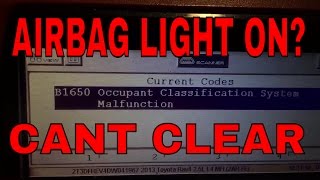
- B1650 — B1650 is a general 'Occupant Classification System Malfunction' code. If you see B1650 and B1787 together, B1787 is the specific root cause (collision event).
- B165A — This is a pointer code. The main SRS airbag module sets B165A to indicate it detected a fault within the separate OCS module. You must scan the Occupant Detection ECU specifically to find B1787.
- B1150 — This is an SRS diagnostic code set by the main airbag module. Toyota service information states that if B1150 is found, troubleshooting for B1787 should be performed.
- B1785, B1786, B1788 — These codes are part of the same family as B1787 and relate to different aspects of the OCS sensor collision detection, also requiring Zero Point Calibration.
Climate & Environmental Factors
- Physical Jolts: This is the primary environmental trigger. Driving on rough roads with potholes, hitting curbs, or speed bumps too quickly creates a sharp g-force that the OCS sensor misinterprets as a collision event, latching the B1787 code.
- Ambient Climate (Temperature/Humidity): High humidity environments or water ingress into the cabin (from spills or leaks) accelerates corrosion on the wiring and connectors under the seat, disrupting the sensor signal.
How to Talk to a Mechanic About This Code
Say this: "I have an airbag light on, and a scan showed code B1787. My research indicates this is a 'latched' code often caused by a jolt and that a 'Zero Point Calibration' of the Occupant Classification System is the first required step. Can you confirm your shop has the bidirectional scan tool to perform this specific SRS/OCS calibration for a [Your Vehicle's Make/Model]?"
This signals you are an informed customer. It directs the shop to the most common and least expensive fix first (calibration) and prevents them from immediately quoting a costly part replacement. It also vets the shop's capability to handle this specific safety system repair.
Avoid saying:
- 'My airbag light is on, can you just fix it?'
- 'I think I need a new airbag sensor.'
- 'Just do whatever you think is necessary.'
Questions to ask before authorizing the repair:
- Did the Zero Point Calibration procedure complete successfully? If not, what was the error?
- If you are recommending a part replacement, can you show me the live data from the sensitivity check that proves the sensor is out of specification?
- Is the cost of the post-repair calibration included in the quote for the part replacement?
- What is the warranty on this specific repair, including both parts and labor?
Where to Take It: Dealer vs Independent vs Chain
- Dealer:
A safe but expensive choice. They are guaranteed to have the right tools and procedures but will likely be the costliest option for an out-of-warranty vehicle.
Best for: Vehicles under warranty., Cases where a Technical Service Bulletin (TSB) or recall applies., When you want a guaranteed fix using OEM tools (e.g., Techstream) and are less price-sensitive.
Downsides: Highest labor rates, typically 1.5-2x more than an independent shop., May be quicker to replace an entire assembly rather than diagnose a simpler wiring or sensor issue. (Typical cost: +50% vs. baseline) - Independent Shop:
Best fit for most owners, provided you vet the shop first. Ask them directly if they can perform an 'OCS Zero Point Calibration' before you book the appointment.
Best for: Out-of-warranty vehicles where cost is a major factor., Building a relationship with a trusted local mechanic.
Downsides: Shop quality and capabilities vary widely. You MUST verify they own a professional-grade scan tool with bidirectional SRS/OCS calibration functions for your specific vehicle make. (Typical cost: +0% vs. baseline) - Chain Shop:
AVOID for this code. The risk of misdiagnosis or an incomplete repair (e.g., replacing a part without the mandatory calibration) is very high. This is not a simple parts-swapping job.
Best for: Simple, high-volume jobs like oil changes, tires, and brakes.
Downsides: Technicians often lack the specialized training and expensive scan tools required for complex SRS diagnostics., Business model pressures technicians to upsell unnecessary parts rather than perform detailed diagnostics. (Typical cost: -10% vs. baseline)
When to Walk Away From the Repair
If the estimated repair cost exceeds 50% of the car's private-party value, sell or trade it in.
- Car worth $8000, fix is $200: Fix it. A calibration is a minor cost to restore a critical safety feature.
- Car worth $5000, fix is $2200: Borderline. This repair is nearly 50% of the car's value. Get a second opinion to confirm a part replacement is truly necessary before proceeding.
- Car worth $3000, fix is $2000: Walk away. The repair cost is too high relative to the vehicle's value. The money is better put towards a replacement vehicle.
What Scan Tool You Need for This Code
Minimum: A bidirectional scan tool with the ability to access the SRS/Airbag module and perform manufacturer-specific 'Special Functions' like 'Zero Point Calibration' or 'OCS Reset'.
A basic $20-$80 code reader only reads and clears generic engine codes. It CANNOT communicate with the SRS module, and lacks the bidirectional capability to command the mandatory calibration procedure.
Budget: None for the complete fix (~$0) — Scanners in this price range read/clear SRS codes for initial diagnosis, but CANNOT perform the required Zero Point Calibration. You cannot fully fix this code with a tool under $100.
Mid-range: Foxwell NT510 Elite / NT530 (with specific manufacturer software) (~$180) — Provides full SRS system access and contains the specific 'Zero Point Calibration' special function needed to recalibrate the OCS module and permanently clear the B1787 code.
Professional: Autel MaxiCOM MK808 / MK808BT (~$450) — Offers broad vehicle coverage and OEM-level diagnostic functions. It easily performs Zero Point Calibration, Sensitivity Checks with live data, and other advanced SRS diagnostics.
Rent vs buy: Auto parts stores do NOT rent the professional-grade, bidirectional scanners required for this repair. If this is a one-time fix, it is more cost-effective to pay a qualified shop the $150-$300 diagnostic fee.
How to Clear the Code After You Fix It
- Ensure the passenger seat is empty and the vehicle is on a level surface.
- Connect a professional-grade bidirectional scan tool with SRS/OCS capabilities.
- Navigate to the Occupant Detection ECU menu.
- Perform the 'Zero Point Calibration' utility.
- Perform the 'Sensitivity Check' using specified weights (typically 30 kg / 66 lbs) to confirm sensor accuracy.
- Use the scan tool to clear the B1787 code from both the OCS and main SRS modules.
Drive cycle (~5 minutes): A standard emissions drive cycle is NOT applicable. The reset is achieved exclusively through the bidirectional calibration procedure. After successful calibration, a 5-minute test drive confirms the airbag warning light remains off.
Readiness monitors affected: None
Watch out for:
- Using a basic OBD-II scanner that cannot access the SRS or OCS modules.
- Attempting to clear the code without performing the mandatory Zero Point Calibration; the code returns immediately.
- Performing calibration on an unlevel surface or with items on the passenger seat.
- Replacing expensive parts before attempting the calibration procedure.
Will This Fail Emissions / State Inspection?
No — by itself this code doesn't fail OBD inspection (but it can keep readiness monitors from setting, which causes a separate fail).
- California: An airbag light does not cause a failure of the emissions (smog) inspection. However, it is a safety defect and the vehicle is not considered legally roadworthy.
- New York: An illuminated airbag warning light is immediate grounds for safety inspection failure.
- Texas: An airbag light will NOT cause a vehicle to fail the state safety inspection, but it remains a critical safety issue.
- General: States with mandatory safety inspections (like Virginia and Pennsylvania) WILL fail a vehicle for an illuminated airbag light, as it indicates a primary safety system is inoperative.
Most Commonly Affected Vehicles
- Toyota Camry (2004-2011) — Very common issue. TSB EL009-05 was issued for 2004-2005 models specifically to address this code and provide updated calibration procedures.
- Toyota RAV4 (2006-2019) — Frequently reported after hitting potholes. A recall (NHTSA 23V-865) for 2020-2022 models addresses a faulty OCS sensor causing similar symptoms.
- Lexus RX (330/350/400h) (2004-2009) — Owners frequently report this code appearing without any accident history, often triggered by a child kicking the seatback.
- Toyota Sienna (2005-2017) — Commonly requires recalibration. The service manual explicitly details the B1787 code and the necessity of performing calibration as the primary fix.
- Toyota Tundra (2014-2020) — The OCS system is sensitive to impacts and often requires a dealer-level scan tool for recalibration.
- Scion tC (2005-2016) — Shares the same sensitive OCS technology as the Corolla and Camry and is known to set the B1787 code from jolts or after seat removal.
- Nissan Altima (2013-2018) — Nissan vehicles experience similar OCS faults, though they present as code B1650. The fix is identical: a Zero Point Calibration is required.
- Subaru Outback (2005-2014) — Subaru models present a general ODS failure code (like B1650) for the same events. For 2010-2014 models, this often requires replacing the passenger seat bottom cushion.
Manufacturer-Specific Notes
- Toyota/Lexus/Scion: The code definition is "Rear Occupant Classification Sensor LH Collision Detection," but the sensor is physically located in the front passenger (Right Hand) seat assembly. This naming is a frequent source of diagnostic error.
- Toyota/Lexus/Scion: For many models, the sensor is integrated into the seat cushion foam or the entire seat frame. A simple sensor failure requires replacing the entire seat cushion, which is very expensive.
- Toyota/Lexus/Scion: RECALL NOTICE: A major safety recall (NHTSA Campaign: 23V-865) was issued for approximately 1 million 2020-2022 vehicles. A manufacturing issue causes the OCS sensor to short circuit. Check your VIN before paying for repairs.
- General: This is a 'latched' or 'hard' code. Once B1787 is set, it MUST be cleared with a capable scan tool after a successful calibration; it will not go away on its own.
- Toyota/Lexus/Scion: Toyota issued multiple Technical Service Bulletins (TSBs), including EL009-05 and BR001-04, acknowledging the system's sensitivity and providing updated calibration procedures.
Real Owner Stories
2007 Lexus RX with Airbag Light
The owner purchased the vehicle with the airbag light on. A scan revealed code B1787.
Outcome: A Zero Point Calibration and Sensitivity Check were performed using a professional scan tool and a 65-pound weight. The B1787 code cleared, and the airbag light went out, resulting in a free fix.
Lesson: Always attempt the Zero Point Calibration before replacing expensive components. A non-collision event is the most common trigger for this latched code.
2004 Toyota Camry XLE with SRS Light
The SRS light and 'Passenger Airbag Off' indicator were constantly lit.
Outcome: The owner learned a basic scanner cannot clear this latched code. They used a professional-grade tool with Toyota SRS capability to perform the mandatory Zero Point Calibration, successfully fixing the issue.
Lesson: A basic OBD-II scanner cannot fix this issue. You must use a bidirectional tool to perform the required calibration procedures.
2014 Toyota Avalon with Multiple SRS Codes
The airbag light illuminated after removing the passenger seat for interior work. A scan showed B1650 and B1787.
Outcome: The mechanic performed a Zero Point Calibration. After calibration, B1787 cleared, which immediately allowed B1650 to clear, turning off the airbag light.
Lesson: If codes B1650 and B1787 appear together, address B1787 first. Calibration is mandatory after removing or reinstalling the passenger seat.
How to Prevent This Code From Triggering
- Drive cautiously on rough roads (Daily habit) — Avoiding potholes and slowing down for speed bumps prevents the sensor from misinterpreting a sharp g-force as a collision.
- Keep the area under the passenger seat clear (Always) — Items rolling under the seat damage the sensitive OCS wiring harness and connectors, causing a short or open circuit.
- Be careful with liquids in the cabin (Always) — Spilled drinks seep into the under-seat connectors, causing corrosion that disrupts the sensor signal and triggers the airbag light.
- Follow proper procedure when removing the passenger seat (During maintenance/cleaning) — Always disconnect the battery and wait 90 seconds before unplugging SRS connectors. A Zero Point Calibration is mandatory after reinstallation.
- Maintain a healthy vehicle battery (Ongoing) — A weak battery causes voltage spikes that corrupt the memory in sensitive modules like the OCS ECU, triggering fault codes.
Frequently Asked Questions
Can I just reset the airbag light myself?
No. You can clear the code with a standard scanner, but it will come back instantly because it's a 'latched' fault. The system requires a successful Zero Point Calibration before the code permanently clears, requiring a professional-grade scan tool.
Is it safe to drive with the B1787 code?
While the vehicle is mechanically safe to drive, it is not safe for a front passenger. The passenger-side airbags are disabled when this code is active, meaning they will not deploy in an accident.
I hit a pothole and the airbag light came on. Is this related?
Yes, this is a very common trigger for code B1787. The sharp jolt is misinterpreted by the sensitive seat sensor as a collision event, even if no damage occurred.
My mechanic replaced the sensor, but the light is still on. What went wrong?
The most common mistake is improper procedure. After replacing any OCS component, performing a Zero Point Calibration and Sensitivity Check is mandatory. If skipped, the system remains in fault mode and the light stays on.
What does 'Occupant Classification System Malfunction' mean?
This is a general fault message indicating the passenger weight sensor system is offline. Code B1787 is a specific version of this fault, pointing to a 'collision event' as the trigger.
Can a bad battery cause the airbag light to come on?
Yes. Low voltage or voltage spikes from a failing battery or jump-starting causes sensitive electronic modules like the OCS computer to set fault codes, including B1787.
Why does the repair cost so much if it might just be a reset?
If the system only needs calibration, the cost is 1 to 2 hours of shop labor ($150-$300). However, if the sensor is truly faulty, it is often integrated into the seat cushion, requiring an expensive assembly replacement.
What is 'Zero Point Calibration'?
This is a software reset that establishes a new baseline for the weight sensor, telling the system what the seat feels like when empty. It is the first required step to fix a B1787 code after a jolt incorrectly triggers it.
Key Takeaways
- Code B1787 disables the front passenger airbag because the Occupant Classification System (OCS) falsely registered a collision event.
- Hitting a pothole or curb triggers 80% of B1787 codes, requiring a software recalibration rather than physical parts replacement.
- Expect to pay a shop $150 to $300 for a mandatory 'Zero Point Calibration' using a bidirectional scanner to clear this latched code.
- Never replace the OCS sensor or seat assembly before testing the under-seat wiring and attempting the scanner reset.
Helpful Videos


Shop the Parts Behind B1787
Below are the parts most often responsible for code B1787, ranked by how frequently each one is the actual culprit (per the diagnosis above). Tap any to see what we have for your vehicle.


The information in this article is provided for general reference and educational purposes only. Vehicle specifications, procedures, and part compatibility can vary by production date, trim level, and region. Always consult your vehicle's factory service manual and verify part numbers before purchasing or performing repairs. Safety-critical components such as airbags, seat belts, and braking systems should be installed by a qualified professional.
- 🧭 Diagnostic Flowchart
- 🎬 Helpful Videos
- 🛍️ Shop This Part
- What Does B1787 Mean?
- Can I Drive With B1787?
- Common Causes
- Symptoms
- Common Fixes & Costs
- Used vs. New Parts: Buying Guide
- What Happens If You Wait — Timeline
- Cost of Not Fixing It
- Diagnosis Steps
- When This Code Triggers (Freeze-Frame Conditions)
- Related Codes
- Climate & Environmental Factors
- How to Talk to a Mechanic About This Code
- Where to Take It: Dealer vs Independent vs Chain
- When to Walk Away From the Repair
- What Scan Tool You Need for This Code
- How to Clear the Code After You Fix It
- Will This Fail Emissions / State Inspection?
- Most Commonly Affected Vehicles
- Manufacturer-Specific Notes
- Real Owner Stories
- 2007 Lexus RX with Airbag Light
- 2004 Toyota Camry XLE with SRS Light
- 2014 Toyota Avalon with Multiple SRS Codes
- How to Prevent This Code From Triggering
- Frequently Asked Questions
- Can I just reset the airbag light myself?
- Is it safe to drive with the B1787 code?
- I hit a pothole and the airbag light came on. Is this related?
- My mechanic replaced the sensor, but the light is still on. What went wrong?
- What does 'Occupant Classification System Malfunction' mean?
- Can a bad battery cause the airbag light to come on?
- Why does the repair cost so much if it might just be a reset?
- What is 'Zero Point Calibration'?
- Key Takeaways
- 🎟️ Get 5% Off