

The Ultimate Guide to OBD-II Code B1818: Driver's Seat Belt Pretensioner Circuit Failure
What B1818 Means, Why It's Critical, and Exactly How to Fix It
- Code B1818 disables your entire airbag system, meaning zero safety devices will deploy in a crash.
- Check the yellow SRS wiring harness under the driver's seat first, as damaged wires or corroded pins cause the majority of these short-circuit faults.
- Verify your specific vehicle's code definition, because B1818 means 'low resistance' on a Ford but indicates a charging system failure on a Dodge Ram.
- A healthy pretensioner squib measures between 2.0 and 3.0 ohms; anything under 1.5 ohms confirms an internal short circuit requiring replacement.
What Does B1818 Mean?
B1818 is a Diagnostic Trouble Code (DTC) indicating a fault within the Supplemental Restraint System (SRS), most commonly related to the driver's side seat belt pretensioner circuit. The pretensioner is a pyrotechnic safety device that explosively tightens the seat belt fractions of a second into a collision. This code sets when the Restraints Control Module (RCM) detects electrical resistance in the pretensioner's circuit below the manufacturer's specified range, indicating a short circuit.
Technical definition: The most common definition for OBD-II code B1818 is 'Driver Pretensioner Circuit Resistance Low'. This means the Restraints Control Module (RCM) measured an electrical resistance value in the driver's seat belt pretensioner circuit below the allowable threshold (typically under 1.5 ohms). However, the definition varies significantly by manufacturer. For some vehicles, it indicates a 'short to positive', while on others (like Dodge Rams), it points to a charging system failure. Accurate diagnosis requires verifying the code's exact meaning for your specific vehicle.
Can I Drive With B1818?
Yes, But With Caution. You can physically drive the vehicle, but it is extremely unsafe. The B1818 code signifies that the entire Supplemental Restraint System (SRS) is disabled as a fail-safe. In a collision, the airbags and seat belt pretensioners will NOT deploy. Driving should be strictly limited to getting the vehicle to a repair facility.
Common Causes
- Damaged or Corroded Under-Seat Wiring (Very Common) — The yellow SRS wiring and connector for the pretensioner live under the driver's seat. Constant seat adjustment, kicked items, or water intrusion from spills and leaks easily damage wires or corrode connector pins. This creates a bridge between circuits, causing the low resistance fault.
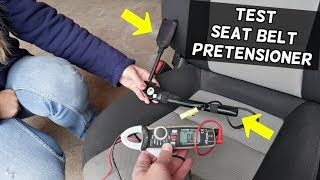
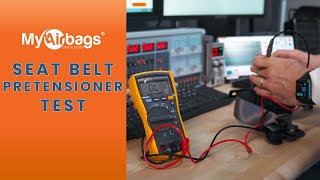
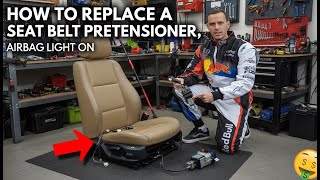
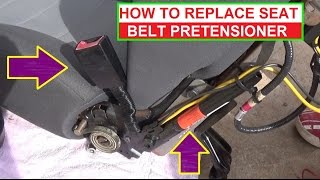
- Faulty Driver's Seat Belt Pretensioner (Common) — The pretensioner unit contains a pyrotechnic squib that can fail internally. The squib develops a short, causing its resistance to drop below the standard 2-3 ohm specification. 🎬 Watch: How to test and replace a seat belt pretensioner
- Low or Recently Replaced Vehicle Battery (Less Common) — A weak battery causes voltage drops during startup that the sensitive RCM interprets as a system fault. Disconnecting and reconnecting the battery also occasionally sets a phantom fault code requiring an SRS-capable scanner to clear.
- Faulty Clock Spring (Spiral Cable) (Less Common) — In some vehicle designs, the pretensioner circuit routes through the clock spring in the steering column. A worn clock spring causes this code, almost always accompanied by a non-functional horn or dead steering wheel controls.
- Previous Accident History (Rare) — If the vehicle was in an accident where pretensioners deployed, they are permanently spent. If they were not replaced, or if the RCM was not properly reset, this code persists.
- Faulty Restraints Control Module (RCM) (Rare) — The control module's internal circuitry that monitors pretensioner resistance can fail. This is a last-resort diagnosis after proving all wiring and components are functional.
Symptoms
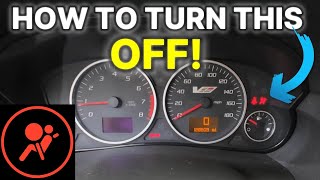
- Airbag Warning Light On — The primary symptom is a continuously illuminated airbag or SRS warning light on the instrument cluster.
- Failed State Safety Inspection — A vehicle automatically fails its annual safety inspection in most jurisdictions if the airbag warning light is illuminated.
- Airbag System Disabled (scan-tool only — no driver-felt sign) — The RCM disables the entire SRS system when B1818 is active. No safety devices will deploy in a crash.
Diagnostic Flowchart
Tap your situation to follow the diagnostic path that matches what you're seeing on this code.
Common Fixes & Costs
- Repair or Secure Under-Seat Wiring/Connector — Parts: $0-$25, Labor: $125-$250, ~1.5 hr book time (Intermediate)
- Replace Driver's Seat Belt Pretensioner Assembly
— Parts: $200-$500, Labor: $150-$350, ~1.5 hr book time
(Professional)
Ford F-150 (2004-2008): OEM 33039305A (Buckle Pretensioner) (Alt: Mail-in repair services are common alternatives.)
Ford Explorer (2002-2010): OEM 7L2Z-78611B09AD (Retractor Assembly) (Alt: Used assemblies available via certified recyclers.) - Rebuild Original Pretensioner (Mail-in Service) — Parts: $75-$150, Labor: $125-$250 (for removal/reinstallation), ~1.5 hr book time (DIY)
- Replace Clock Spring
— Parts: $75-$300, Labor: $200-$400, ~2.0 hr book time
(Intermediate)
Ford F-150 (2004-2008): OEM 8L3Z14A664A (Alt: Dorman, Standard Motor Products (CSP201)) - Replace Restraints Control Module (RCM)
— Parts: $300-$800, Labor: $200-$400 (includes programming), ~2.5 hr book time
(Professional)
Ford F-150 (2006-2008): OEM 6L34-14B321-BA (Alt: Mail-in reset services clear crash data for ~$50-$100.)
DIY vs Professional
- Repair or Secure Under-Seat Wiring/Connector 🟢 Beginner
Tools: Socket set (for battery), flashlight, electrical contact cleaner. - Replace Driver's Seat Belt Pretensioner Assembly 🟢 Beginner
Tools: Socket set, Torx bit set (commonly T50), trim removal tools, torque wrench. - Replace Restraints Control Module (RCM) 🟢 Beginner
Tools: Socket set, trim removal tools, dealer-level programming software.
Used vs. New Parts: Buying Guide
When a used part is worth it: Buying a used pyrotechnic pretensioner is generally discouraged due to safety risks. However, it is a budget-conscious option for older vehicles if sourced from a reputable, certified automotive recycler guaranteeing the donor car was not flooded or crashed.
Donor-vehicle mileage cap: roughly under 100000 miles for the part to have meaningful remaining life.
Donor quality checklist:
- Verify the donor vehicle was not in a flood or fire.
- Visually inspect the connector for corrosion and the pyrotechnic tube for physical damage.
- Match the part number exactly; SRS components are highly specific to trim and year.
Decision logic:
- If The vehicle is less than 10 years old or holds significant value → Buy a new OEM part or use a professional rebuild service. Cost savings do not justify the safety risk.
- If Budget is the primary constraint and the alternative is driving with disabled airbags → A used OEM part from a certified recycler is better than a disabled system.
Warranty tradeoff: New OEM parts carry a 1-year warranty. Professional rebuild services offer lifetime warranties. Used salvage parts typically offer 30 days and do not cover installation labor.
Worst-case if a used part fails: $300-$600 if the used part fails prematurely, requiring repeat labor and a new part. The ultimate cost is failure to deploy in an accident.
What Happens If You Wait — Timeline
- Immediately: Code B1818 sets. The airbag warning light illuminates. The RCM disables the entire Supplemental Restraint System as a fail-safe. (MPG impact: 0%% · Added cost: $0 (Safety system is inoperative))
- 0-12 months: The vehicle fails state safety inspections. The risk of severe injury in a collision is dramatically increased. (MPG impact: 0%% · Added cost: $50-$200 in potential fines or failed inspection fees.)
- 12-24 months: If caused by moisture, ongoing corrosion spreads to adjacent wires in the harness, causing failures in power seats or other modules. (MPG impact: 0%% · Added cost: $250-$750 for complex harness repairs.)
- 24+ months: Severe corrosion compromises the main floor harness or shorts out the RCM itself. (MPG impact: 0%% · Added cost: $800-$2000+ for RCM replacement and harness repair.)
Cost of Not Fixing It
- Immediately: The entire Supplemental Restraint System is disabled. In a collision, no airbags or pretensioners will deploy. (Added cost: N/A (Severe Safety Risk))
- Next State Inspection: The vehicle fails mandatory safety inspections, preventing legal registration renewal. (Added cost: $50-$200 in fines and re-inspection fees.)
- Long-Term: If caused by water intrusion, ongoing corrosion spreads to adjacent wiring, destroying the main floor harness or the RCM itself. (Added cost: $800-$2000+ for comprehensive harness and module replacement.)
Diagnosis Steps
- Confirm Code Definition for Your Vehicle
Use an SRS-capable OBD-II scanner to confirm B1818. Crucially, verify the code's definition for your exact make, model, and year using a service manual. B1818 means 'low resistance' on a Ford, but indicates a charging system issue on a Dodge.
Tools: OBD-II Scanner (SRS capable), Service Manual (Beginner) - Inspect and Clean Under-Seat Connector
Disconnect the negative battery terminal and wait 30 minutes for the SRS capacitors to discharge. Unplug the yellow SRS connector under the driver's seat. Inspect for green/white corrosion or bent pins. Spray both sides with electrical contact cleaner, reconnect securely, and clear the code.
Tools: Socket wrench, Electrical contact cleaner (Beginner) - Perform a Live Data 'Wiggle Test'
Using a scanner that displays live SRS data, monitor the resistance value for the 'Driver Pretensioner Circuit'. Wiggle the connector and wiring harness under the seat. If resistance fluctuates wildly, you have pinpointed an intermittent connection or broken wire.
Tools: Advanced OBD-II Scanner (Live Data) (Intermediate) - Simulate the Pretensioner with a Resistor
To definitively isolate the pretensioner, plug a 2.5-ohm SRS test resistor into the vehicle-side harness connector in place of the pretensioner. Reconnect the battery and clear the code. If the code stays off, the pretensioner is internally shorted and requires replacement.
Tools: 2.5 Ohm SRS Test Resistor, OBD-II Scanner (Advanced) - Test Pretensioner Resistance Directly
With the battery disconnected, use a multimeter set to a low ohms scale. Many SRS connectors feature an internal 'shorting bar' that connects the pins when unplugged as a safety feature. Carefully bypass this bar with fine probes. A healthy pretensioner reads 2.0 to 3.0 ohms. Readings under 1.5 ohms confirm an internal short.
Tools: Multimeter, Fine-point probes (Advanced) - Test the Wiring Harness for Shorts
If the pretensioner tests good, unplug the RCM. Test the vehicle-side harness for continuity between the two pretensioner wires. It should read infinite resistance (open circuit). If there is continuity, the wires are shorted together within the harness. Test each wire against a chassis ground to rule out a short-to-ground.
Tools: Multimeter (Advanced)
When This Code Triggers (Freeze-Frame Conditions)
- Ignition Status: ON (The SRS module performs a self-test immediately upon key-on.)
- System Voltage: 11.5V - 14.5V (The module checks for sufficient power; low system voltage triggers related faults but is a key baseline parameter.)
- SRS Warning Lamp Status: ON (Commanded) (The code sets when the module detects the fault during its self-test and commands the airbag light to illuminate.)
Related Codes
- B1811 — The direct opposite of B1818. It indicates an 'Open Circuit' (resistance too high) in the driver's pretensioner, usually caused by a broken wire or unplugged connector.
- B1819 — The passenger-side equivalent of B1818, indicating 'Passenger Pretensioner Circuit Resistance Low'.
- B1878 — A specific short circuit code for 'Driver Pretensioner Circuit Short to Ground', pointing to a wire shorted directly to the vehicle chassis.
- B0052 — The newer, SAE-standardized code for 'Driver Seatbelt Pretensioner Deployment Control', pointing to the exact same component and circuit.
Climate & Environmental Factors
- Moisture and Road Salt: Water from rain, spills, or salty winter road spray penetrates unprotected connectors under the seats. This moisture acts as an electrolyte, causing rapid corrosion on pins that creates a low-resistance short circuit.
- Temperature Cycling: Repeated expansion and contraction of connector materials due to hot and cold swings causes 'fretting corrosion'. This microscopic rubbing wears away protective coatings, making the connector highly vulnerable to moisture-induced shorts.
How to Talk to a Mechanic About This Code
Say this: "I have an airbag light on and my scanner shows code B1818, pointing to the driver's seat belt pretensioner circuit. I suspect it might be the common issue with the wiring under the seat. I'd like you to test the circuit resistance properly before recommending a full part replacement."
This directs the technician to the specific system, mentions the most common failure point, and requests proper diagnosis instead of immediately replacing the expensive pretensioner. It establishes you as an informed customer.
Avoid saying:
- 'My airbag light is on, can you fix it?' (Too vague, invites a costly, broad diagnosis).
- 'Just replace the sensor.' (You may be asking for the wrong part).
- 'Do whatever you think is best.' (Relinquishes all control over the cost).
Questions to ask before authorizing the repair:
- Did you find the fault in the wiring, the connector, or the pretensioner itself?
- Did you measure the resistance of the pretensioner? What was the reading in ohms?
- If the pretensioner needs replacement, is the estimate for a new OEM part or a rebuilt unit?
Where to Take It: Dealer vs Independent vs Chain
- Dealer:
A safe but expensive choice. Best if you suspect an unusual manufacturer quirk or if the RCM needs replacement.
Best for: Vehicles under warranty., Complex cases involving manufacturer-specific code definitions., Repairs requiring RCM replacement and programming.
Downsides: Highest labor rates., May default to replacing an entire assembly when a smaller wiring fix is possible. (Typical cost: +50% vs. baseline) - Independent Shop:
Best fit for most B1818 situations. An experienced independent mechanic diagnoses and repairs common wiring or pretensioner issues effectively.
Best for: Out-of-warranty vehicles where the cause is common under-seat wiring., Cost-conscious owners seeking a balance of expertise and value.
Downsides: Quality varies. You must vet the shop's comfort level with SRS/airbag system repairs., May lack dealer-level software for module programming. (Typical cost: +0% vs. baseline) - Chain Shop:
AVOID. SRS repairs are safety-critical and require specialized knowledge beyond the scope of most chain shops.
Best for: Simple, unrelated maintenance like oil changes or tires.
Downsides: Technicians lack specialized SRS diagnostic experience., High risk of misdiagnosis or refusing the job entirely. (Typical cost: -10% vs. baseline)
When to Walk Away From the Repair
If the total estimated repair cost for the B1818 code exceeds 50-60% of your car's private-party value, it is time to seriously consider if the investment is worthwhile.
- Car worth $3000, fix is $1800: Walk away. The repair cost is 60% of the car's value. Sell the car 'as-is' with full disclosure.
- Car worth $15000, fix is $800: Fix it. The repair is a small fraction of the vehicle's value and is critical for safety.
- Car worth $5000, fix is $750: Borderline, but likely worth fixing. It restores a critical safety feature and makes the car sellable.
What Scan Tool You Need for This Code
Minimum: A scanner that reads and clears Supplemental Restraint System (SRS) / Airbag codes. A basic $20 engine-only code reader will NOT see the B1818 code.
Standard OBD-II scanners only communicate with the Engine Control Unit. B1818 is stored in the separate Restraints Control Module. You need a tool specifically advertised with SRS capabilities.
Budget: BlueDriver Pro Bluetooth Scanner (~$100) — Connects to your smartphone to read and clear SRS codes for most major brands. It displays live data, which is essential for performing a 'wiggle test' on the under-seat wiring.
Mid-range: Foxwell NT630 Plus / Autel AutoLink AL619 (~$120) — Dedicated handheld units that reliably read and clear Engine, ABS, and SRS codes without requiring a phone.
Professional: Autel MaxiCOM MK808 (~$500-1200) — Offers full bidirectional control, advanced live data graphing, and access to all vehicle modules. Required if you need to program a new RCM.
Rent vs buy: Most auto parts stores do NOT rent out SRS-capable scanners due to liability. Buying a budget SRS scanner pays for itself by avoiding a single diagnostic fee at a shop.
How to Clear the Code After You Fix It
- Perform the physical repair with the battery disconnected.
- Reconnect the battery.
- Use an OBD-II scan tool with SRS/airbag capability to access the Restraints Control Module.
- Select 'Clear Codes'. The airbag light will turn off immediately if the fault is resolved.
Drive cycle: No drive cycle is required. The SRS system performs a self-test at every key-on. If the fault is fixed and cleared, the light stays off.
Readiness monitors affected: None. Readiness monitors apply only to emissions systems.
Watch out for:
- Disconnecting the battery does not clear an SRS code; it must be cleared with a compatible scan tool.
- If the vehicle was in an accident, the module stores 'crash data' which standard scanners cannot clear. It requires professional reprogramming.
Most Commonly Affected Vehicles
- Ford F-150 & Explorer (2002-2018) — Extremely common issue caused by damage to the under-seat wiring harness. NHTSA investigated 2015-2018 F-150s for pretensioners catching fire after deployment.
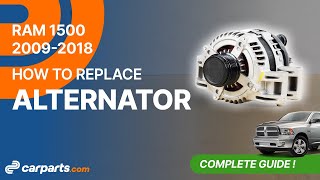
- Dodge Ram 1500/2500 (2002-2008) — On these trucks, B1818 often means 'Battery Sense Circuit Low Input', indicating an alternator or charging system issue, not an SRS fault.
- Kia / Hyundai Accent, Elantra, Optima (2019-2023) — Subject to major recalls (NHTSA 22V-354) where pretensioners abnormally deploy and project metal fragments into the cabin during a crash.
- Lexus IS, ES, RX (2020-2022) — B1818 often defines as 'Short to B+ in Passenger Squib'. A massive 2023 recall involved faulty passenger OCS sensors short-circuiting and disabling airbags.
Manufacturer-Specific Notes
- Ford: On 1997-2003 Explorers, B1818 means 'Wiper Rear Motor Up Relay Coil Circuit Failure', completely unrelated to the airbag system.
- Dodge / Ram: B1818 is defined as 'Battery Sense Circuit Low Input', pointing to a fault in the alternator or charging system, not the SRS.
- Peugeot / Citroen: B1818 triggers an 'Oil level fault' message. A Technical Service Bulletin requires modifying the dipstick tube to correct an inaccurate reading relative to the sensor.
- Toyota / Lexus: The B18xx series codes often refer to the passenger side. B1818 specifically means 'Short to B+ in Front Passenger Side Squib 2nd Step Circuit'.
Real Owner Stories
2007 Ford F-150 - The Easy Fix
Airbag light stayed on with code B1818. The owner frequently adjusted the power seat.
Outcome: After disconnecting the battery, the owner cleaned the connector, replugged it securely, and added zip ties to provide slack. The code cleared and did not return. Total cost: $10.
Lesson: Always check the under-seat area first. Seat movement and stored items easily damage wiring harnesses.
2005 Toyota Matrix - The Misdiagnosis
Airbag light on with an SRS code. The horn and cruise control also stopped working simultaneously.
Outcome: The owner replaced the clock spring in the steering column, which fixed the horn, cruise control, and the airbag light. The original seat belt was fine. Cost of unnecessary part: $250.
Lesson: Pay attention to all symptoms. If steering wheel functions fail alongside an SRS light, the clock spring is the culprit.
2006 Dodge Ram 2500 - The Unusual Cause
Airbag light on with code B1818. The truck's voltmeter behaved erratically.
Outcome: The owner tested the charging system and replaced a failing alternator. The B1818 code disappeared. The SRS system was never the problem.
Lesson: Code definitions are not universal. Verify what the code means for your specific make and model to avoid wasting money on the wrong system.
How to Prevent This Code From Triggering
- Apply Dielectric Grease to Connectors (During any repair or inspection) — Dielectric grease seals out moisture and oxygen, preventing the corrosion on connector pins that causes short circuits.
- Secure Under-Seat Harness (Once) — Zip-tying the SRS harness with adequate slack prevents wires from being pulled or pinched by seat movement.
- Address Water Leaks Immediately (As needed) — Fixing leaking sunroof drains or door seals prevents water from pooling on the floor pan and wicking into electrical connectors.
Frequently Asked Questions
Is it safe to drive with code B1818?
No. The code signifies the entire airbag and safety restraint system is offline. In an accident, your airbags and seat belt pretensioners will not deploy, drastically increasing the risk of serious injury.
Can a low battery cause the B1818 code?
Yes. The SRS module is highly sensitive to voltage drops. A weak battery or a recent replacement can store a phantom low-voltage fault that simply needs to be cleared with an SRS-capable scanner.
Will my car fail a state inspection with the airbag light on?
Yes. Most states consider an illuminated airbag warning light an automatic failure for a vehicle safety inspection because a critical safety system is inoperative.
Can I use a resistor to turn off the airbag light?
Using a resistor is a diagnostic tool, not a repair. While a 2.5-ohm resistor tricks the module into turning off the light, it permanently disables the pretensioner. This leaves you unprotected in a crash and creates massive liability.
I replaced the pretensioner, but the B1818 code is still there. What's next?
This indicates the fault is in the wiring harness or the RCM itself. You must perform a continuity test on the wiring between the RCM and the pretensioner connector to locate the short.
Can I fix a B1818 code myself?
A DIYer can safely inspect and clean the under-seat connector. Stop DIY and take the vehicle to a certified shop if you lack an SRS-capable scanner or are uncomfortable handling pyrotechnic devices. Replacing the RCM requires professional programming and is never a DIY job.
How much does it cost to fix code B1818?
A simple wiring repair at a shop costs $150-$250. Replacing the seat belt pretensioner ranges from $350 to $850. Using a mail-in rebuild service for your original part reduces the total cost to around $200-$350 including labor.
Key Takeaways
- Code B1818 disables your entire airbag system, meaning zero safety devices will deploy in a crash.
- Check the yellow SRS wiring harness under the driver's seat first, as damaged wires or corroded pins cause the majority of these short-circuit faults.
- Verify your specific vehicle's code definition, because B1818 means 'low resistance' on a Ford but indicates a charging system failure on a Dodge Ram.
- A healthy pretensioner squib measures between 2.0 and 3.0 ohms; anything under 1.5 ohms confirms an internal short circuit requiring replacement.
Helpful Videos
Shop the Parts Behind B1818
Below are the parts most often responsible for code B1818, ranked by how frequently each one is the actual culprit (per the diagnosis above). Tap any to see what we have for your vehicle.



The information in this article is provided for general reference and educational purposes only. Vehicle specifications, procedures, and part compatibility can vary by production date, trim level, and region. Always consult your vehicle's factory service manual and verify part numbers before purchasing or performing repairs. Safety-critical components such as airbags, seat belts, and braking systems should be installed by a qualified professional.
- 🧭 Diagnostic Flowchart
- 🎬 Helpful Videos
- 🛍️ Shop This Part
- What Does B1818 Mean?
- Can I Drive With B1818?
- Common Causes
- Symptoms
- Common Fixes & Costs
- DIY vs Professional
- Used vs. New Parts: Buying Guide
- What Happens If You Wait — Timeline
- Cost of Not Fixing It
- Diagnosis Steps
- When This Code Triggers (Freeze-Frame Conditions)
- Related Codes
- Climate & Environmental Factors
- How to Talk to a Mechanic About This Code
- Where to Take It: Dealer vs Independent vs Chain
- When to Walk Away From the Repair
- What Scan Tool You Need for This Code
- How to Clear the Code After You Fix It
- Most Commonly Affected Vehicles
- Manufacturer-Specific Notes
- Real Owner Stories
- 2007 Ford F-150 - The Easy Fix
- 2005 Toyota Matrix - The Misdiagnosis
- 2006 Dodge Ram 2500 - The Unusual Cause
- How to Prevent This Code From Triggering
- Frequently Asked Questions
- Is it safe to drive with code B1818?
- Can a low battery cause the B1818 code?
- Will my car fail a state inspection with the airbag light on?
- Can I use a resistor to turn off the airbag light?
- I replaced the pretensioner, but the B1818 code is still there. What's next?
- Can I fix a B1818 code myself?
- How much does it cost to fix code B1818?
- Key Takeaways
- 🎟️ Get 5% Off