

OBD-II Code B1821: Side Airbag Circuit Fault
The Ultimate 2026 Guide to B1821: What it means, why it triggers, and how to fix it for good.
- Code B1821 disables your entire SRS system, meaning zero airbags will deploy in a crash.
- Over 80% of B1821 codes stem from a loose or bumped yellow wiring connector under the front seat, costing $0 to fix.
- For Toyota, Lexus, and Scion vehicles, B1821 strictly indicates a driver's side fault, despite generic scanners frequently misreporting it as the passenger side.
- Never probe an airbag directly with a multimeter; use a 2.1-2.2 Ohm diagnostic resistor to safely bypass and test the circuit.
What Does B1821 Mean?

Code B1821 indicates the Airbag Control Module (SRS unit) detects a broken electrical circuit leading to a side airbag. This fault compromises safety system integrity, prompting the module to illuminate the airbag warning light and deactivate the entire SRS to prevent unintended deployment.
Technical definition: The official SAE/ISO definition for code B1821 is "Open in Side Squib Circuit". A 'squib' is the pyrotechnic initiator that ignites the gas generant to inflate the airbag. An 'open' circuit means there is a physical break or high resistance in the electrical wiring to that squib.
Can I Drive With B1821?
No — Do Not Drive. While mechanically operational, a B1821 code disables the entire Supplemental Restraint System (SRS). Zero airbags will deploy in a crash, dramatically increasing the risk of severe injury or fatality. Limit driving strictly to reaching a repair shop.
Common Causes

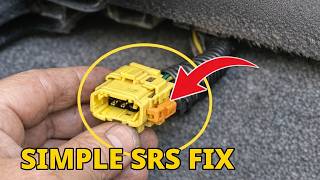
- Loose or disconnected under-seat wiring connector (Very Common) — The main yellow electrical connector under the seat frequently becomes loose. Items stored under the seat, aggressive vacuuming, or frequent seat adjustments pull on the harness and break the connection.
- Damaged or chafed wiring under the seat (Common) — The under-seat wiring harness endures constant movement. It gets pinched by seat rails or rubs against sharp metal edges, eventually breaking a wire and creating an open circuit.
- Aftermarket or modified front seats (Common) — Installing aftermarket racing seats requires removing the factory side airbag. Failing to install the correct bypass resistor creates an immediate open circuit.
- Corroded or damaged connector pins (Less Common) — Spilled liquids or high humidity corrode the small metal pins inside the yellow under-seat connector, causing high resistance that the module interprets as an open circuit.
- Failed side airbag assembly (squib) (Less Common) — The internal squib filament inside the seat airbag breaks. This specific failure prompted Technical Service Bulletins (TSBs) on several mid-2000s Toyota models.
- Damaged Floor Wiring Harness (Rare) — Wiring deep within the main body harness fails, requiring extensive interior disassembly to repair. Common on 2004-2009 Toyota Prius models.
- Faulty Airbag Control Module (Very Rare) — The main SRS computer fails internally. Suspect this only after exhaustively testing the harness, connectors, and airbag assembly.
Symptoms

- Airbag warning light and cluster message — The primary symptom is a continuous 'SRS' or 'AIRBAG' dashboard light, often accompanied by an 'SRS Fault' text message on the driver information center.
- Failed state safety inspection — An active airbag warning light triggers an automatic failure of annual safety inspections in strict jurisdictions.
- Seatbelt pretensioner light on — Because the SRS module controls seatbelt pretensioners, a side airbag fault sometimes illuminates the seatbelt warning light.
- Airbag system is disabled (scan-tool only — no driver-felt sign) 🎬 Watch: How to use a scan tool to reset B1821 — The SRS module shuts down the entire system as a safety precaution. No airbags deploy in an accident.
Diagnostic Flowchart

Tap your situation to follow the diagnostic path that matches what you're seeing on this code.
Common Fixes & Costs
- Secure loose under-seat connector and wiring — Parts: $0 - $10, Labor: $0 - $150, ~1 hr book time (DIY)
- Repair damaged wiring harness section
— Parts: $5 - $25, Labor: $150 - $300, ~1.5 hr book time
(Intermediate)
: OEM - Replace side airbag assembly
— Parts: $400 - $800, Labor: $250 - $450, ~2.5 hr book time
(Professional)
: OEM
: OEM - Replace Airbag Control Module
— Parts: $600 - $1000, Labor: $150 - $250, ~1.5 hr book time
(Professional)
: OEM - Replace floor wiring harness
— Parts: $800 - $1200, Labor: $1500 - $2000+, ~11.5 hr book time
(Professional)
: OEM
Used vs. New Parts: Buying Guide
When a used part is worth it: A used wiring harness from a salvage yard is a highly cost-effective choice for complex floor harnesses. Used control modules are viable but require professional VIN reprogramming. Used airbags are acceptable only if purchased from certified automotive recyclers guaranteeing non-deployed OEM status.
Donor-vehicle mileage cap: roughly under 100000 miles for the part to have meaningful remaining life.
Donor quality checklist:
- Verify the used airbag is a non-deployed OEM part.
- Ensure harness connectors are free of cuts, corrosion, or bent pins.
- Confirm the donor vehicle lacked flood or fire damage.
- Match the part number exactly; SRS components are highly specific.
Decision logic:
- If The fault is a damaged floor harness and an OEM new part exceeds $1000 → Source a used harness from a low-mileage, non-accident donor vehicle.
- If The fault is the side airbag assembly → Purchase a new OEM airbag. Use certified recycled OEM airbags only as a strict budget alternative.
- If The fault is the SRS control module → Buy a new module, or a used module if you have guaranteed access to VIN reprogramming services.
Warranty tradeoff: Used parts carry 30-90 day functional warranties. New OEM parts carry 1-year warranties, often extended if dealer-installed.
Worst-case if a used part fails: $300-800 for repeat labor and replacement parts if a used component fails.
What Happens If You Wait — Timeline
- Instantaneous: The SRS module detects the open circuit, illuminates the airbag warning light, and disables the entire SRS system. (MPG impact: 0%% · Added cost: $0)
- 0-12 months: The vehicle fails annual state safety inspections, resulting in fines and an inability to legally register the vehicle. (MPG impact: 0%% · Added cost: $50 - $200)
- Ongoing: Every trip carries the risk of an accident where zero airbags deploy, dramatically increasing the chance of severe injury. (MPG impact: 0%% · Added cost: N/A (Safety Risk))
- At time of sale: Dealerships refuse the trade-in or deduct heavily from its value due to the active safety system fault. (MPG impact: 0%% · Added cost: $1000 - $4000+)
Cost of Not Fixing It
- Immediate: No airbag deployment in a crash. This critical safety failure dramatically increases the risk of severe injury or death. (Added cost: N/A)
- 0-12 months: Automatic failure of state safety inspections in jurisdictions like NY, VA, and CA, preventing legal vehicle registration. (Added cost: $50 - $200 in fines and re-inspection fees.)
- At time of sale: Dealerships refuse trade-ins with active airbag lights, and private buyers demand steep discounts due to safety liabilities. (Added cost: $1000 - $4000+ reduction in value.)
Diagnosis Steps
- Read the Code and Note the Side
Use an SRS-compatible OBD-II scanner to confirm B1821. Note the indicated side, but be highly skeptical: generic scanners frequently misreport B1821 as the passenger side on Toyota/Lexus vehicles, when it strictly means the LEFT (driver) side.
Tools: OBD-II Scanner (SRS compatible) (Beginner) - Perform a Visual Inspection Under BOTH Front Seats
Check under the seats for foreign objects pressing on wires. Look for disconnected plugs or pinched wires, focusing entirely on the bright yellow SRS harnesses.
Tools: Flashlight (Beginner) - Secure the Main Airbag Connector
Locate the bright yellow connector under the seat. Disconnect it, inspect for bent pins, and reconnect it firmly until the locking tab clicks. Re-seating this plug solves the majority of B1821 codes.
Tools: Flashlight (Beginner) - Clear Codes and Perform a 'Wiggle Test'
Clear the B1821 code. With the ignition on (engine off), wiggle the yellow connector and its harness. If the airbag light returns instantly, you have an intermittent open in that harness section.
Tools: OBD-II Scanner (SRS compatible) (Intermediate) - Inspect the Wiring Harness for Damage
Trace the yellow harness from the connector. Look for chafing against the metal seat frame, pinch marks from seat rails, or exposed copper wire at flex points.
Tools: Flashlight, trim removal tools (Intermediate) - Check Harness Continuity (Advanced)
WARNING: Disconnect the battery and wait 90 seconds. Disconnect the under-seat connector and the Airbag Control Module connector. Use a multimeter to check continuity between the two ends of the harness. Readings above 1.0 Ohm indicate a broken wire.
Tools: Multimeter, vehicle-specific wiring diagram (Advanced) - Perform Squib Circuit Bypass Test (Professional Only)
WARNING: Never probe an airbag directly. Disconnect the battery. Unplug the under-seat connector. Insert a certified SRS diagnostic resistor (typically 2.1-2.2 Ohms) into the harness-side connector. Reconnect the battery and clear the code. If it stays cleared, the airbag assembly is faulty. If it returns, the harness or module is faulty.
Tools: Certified SRS Resistor Tool (2.1-2.2Ω) (Professional) - Inspect Connector for Shorting Bar Function
Airbag connectors feature an internal shorting bar that bridges the pins when disconnected to prevent static discharge. If this plastic tab breaks, the module interprets it as a fault.
Tools: Flashlight, magnifying glass (Professional)
When This Code Triggers (Freeze-Frame Conditions)
- System State: Key-On, Engine-Off or Engine-On (The SRS module performs a self-test at ignition. B1821 sets within seconds of startup if the open circuit is present.)
- System Voltage: 11.5V - 14.5V (Logged during normal operating voltage. It is not caused by a low battery.)
- Fault Status: Present / Active (B1821 is almost always an 'active' hard fault, not 'history,' because the module constantly monitors the open circuit.)
Related Codes
- B1826 — Identical fault ('Open in Side Squib Circuit') for the passenger side. Generic scanners frequently confuse B1821 and B1826.
- B1820 — Indicates a 'Short in Side Squib Circuit'. The two signal wires are touching each other, usually due to severe pinching.
- B1822 — Indicates a 'Short to Ground'. The positive wire rubbed through its insulation and touches the metal chassis.
- B1823 — Indicates a 'Short to B+'. The signal wire contacts a power source due to severe harness damage.
Climate & Environmental Factors
- Extreme Cold: Cold climates cause metal contacts within the under-seat connector to contract, creating temporary open circuits that trigger the light on cold starts.
- High Humidity / Water Intrusion: Spilled liquids or high humidity introduce moisture to under-seat connectors, leading to pin corrosion and high resistance.
How to Talk to a Mechanic About This Code
Say this: "I have an airbag light on and my scanner shows code B1821. I'd like to schedule a one-hour diagnostic. Based on my research, this is often a wiring issue under the driver's seat. Could you please start the diagnosis there to save time?"
Signals you are an informed customer, directs the technician to the most probable cause, and prevents misdiagnosis from generic scanners pointing to the passenger side.
Avoid saying:
- 'My airbag light is on, can you just fix it?'
- 'I don't know what's wrong, just do whatever it takes.'
- 'A friend said it might be the computer, can you replace it?'
Questions to ask before authorizing the repair:
- Did you find the fault? Was it a loose connector, a broken wire, or the airbag itself?
- If recommending an airbag replacement, did you confirm it with a diagnostic resistor test?
- If the wire is broken, will you solder and heat-shrink it, or use crimp connectors?
- What is the warranty on the parts and labor for this specific repair?
Where to Take It: Dealer vs Independent vs Chain
- Dealer:
Recommended only for complex module-level repairs. Overkill for common wiring fixes.
Best for: Vehicles under warranty., Complex repairs requiring a full floor harness replacement., Confirmed Airbag Control Module failure requiring VIN programming.
Downsides: Highest labor rates., Defaults to expensive part replacement over simple wire repair. (Typical cost: +50% vs. baseline) - Independent Shop:
Best fit for 90% of B1821 faults. Reputable independent shops handle wiring repairs cost-effectively.
Best for: Out-of-warranty vehicles., Diagnosing and repairing common wiring issues under the seat., Airbag assembly replacement.
Downsides: Quality varies. Vet the shop for electrical diagnostic experience., Lacks software to program a new SRS module. (Typical cost: +0% vs. baseline) - Chain Shop:
Not recommended. Safety-critical airbag systems require specialized diagnostic experience.
Best for: Simple maintenance like oil changes and tires.
Downsides: Technician skill with safety-critical SRS systems is not guaranteed., High pressure to upsell., Unlikely to perform detailed wiring repairs. (Typical cost: -10% vs. baseline)
When to Walk Away From the Repair
If the estimated repair cost exceeds 50% of the car's private-party value, seriously consider selling or trading in the vehicle instead of repairing it.
- Car worth $3500, fix is $300: Fix it. This is a minor cost to restore a critical safety feature.
- Car worth $8000, fix is $850: Fix it. The repair is well below the 50% threshold.
- Car worth $4000, fix is $2800: Walk away. The repair cost is 70% of the car's value.
What Scan Tool You Need for This Code
Minimum: A scanner that reads and clears Supplemental Restraint System (SRS) codes. Basic engine-only readers cannot see B1821.
Standard $20 OBD-II readers only access engine codes (P-codes). They cannot read Body codes (B-codes) like B1821.
Budget: Autel MaxiLink ML629 (~$85) — Reads and clears codes for Engine, Transmission, ABS, and SRS systems. Perfect for DIY diagnosis.
Mid-range: Foxwell NT630 Plus (~$130) — Provides robust support for ABS and SRS codes with live data capabilities.
Professional: Innova 5610 (~$400) — Offers bi-directional control and deep manufacturer-specific code access for serious DIYers.
Rent vs buy: Auto parts store loaner tools are typically basic code readers and CANNOT read SRS codes. You must purchase an SRS-capable scanner.
How to Clear the Code After You Fix It
- Disconnect the negative battery terminal for at least 90 seconds to reset all modules.
- Reconnect the battery and turn the ignition to the 'ON' position (engine off).
- Use an SRS-compatible OBD-II scan tool to execute the 'Clear Fault Memory' function.
- The airbag light turns off after its initial 5-7 second self-check. If it returns, the physical fault remains.
Drive cycle (~30 minutes): SRS repairs do not require a drive cycle. However, clearing codes resets engine emissions monitors. To prepare for an emissions test: Cold soak for 8 hours, idle for 3 minutes, drive at 55 mph for 15 minutes, and perform 15 minutes of stop-and-go driving.
Readiness monitors affected: Catalyst Monitor, EVAP System Monitor, O2 Sensor Monitor, Comprehensive Component Monitor
Before emissions retest: drive at least 50 miles to fully set monitors.
Watch out for:
- Clearing the code without fixing the open circuit causes the light to return instantly.
- Disconnecting the battery alone fails to clear a hard SRS fault code; a scanner is mandatory.
- Forgetting that clearing SRS codes resets emissions monitors leads to automatic emissions test failure.
Will This Fail Emissions / State Inspection?
No — by itself this code doesn't fail OBD inspection (but it can keep readiness monitors from setting, which causes a separate fail).
- California: An illuminated airbag light is a safety defect causing automatic inspection failure. Dealers cannot legally sell cars with known SRS faults.
- New York: Recent legislation mandates that an illuminated SRS warning light results in an immediate safety inspection failure.
- Texas: An airbag light does not currently fail Texas safety inspections, but 2025 legislative changes shift focus entirely to emissions in populous counties.
Most Commonly Affected Vehicles
- Toyota Prius (2004-2009) — Extremely common. TSB T-SB-0042-11 addresses persistent B1821 codes by recommending a full floor harness replacement.
- Toyota Corolla (2009-2019) — Under-seat wiring harnesses frequently chafe against the seat slide mechanism, breaking the circuit.
- Toyota Solara (2004-2008) — TSB EL002-08 addresses internal failures of the side airbag assembly requiring updated replacement parts.
- Toyota Tundra (2014-2021) — Intermittent airbag lights trace back to loose connections at the yellow under-seat connector. A wiggle test is highly effective here.
- Toyota Yaris (2007-2018) — Taut harnesses under the driver's seat snap or pull loose during routine seat adjustments.
- Subaru Outback / Legacy (2019-2022) — Main harness connectors under the seat suffer from poor factory connections or are easily disturbed.
- Lexus LX570 / GX470 (2008-2021) — Shares Toyota's wiring architecture. B1821 strictly refers to the driver's side, regardless of generic scanner output.
- Scion/Subaru/Toyota FR-S / BRZ / 86 (2013-2020) — Commonly triggered after installing aftermarket racing seats without the correct airbag bypass resistor.
Manufacturer-Specific Notes
- Toyota / Lexus / Scion: Code assignment is strict: B1821 is ALWAYS the LEFT (Driver's) side, and B1826 is the RIGHT (Passenger's) side. Generic scanners routinely misreport B1821 as a right-side fault.
- General (All): Airbag wiring is universally bright yellow or orange. Connectors feature integrated shorting bars that bridge terminals when disconnected to prevent static discharge.
- Honda / Acura: Honda systems are highly sensitive to minor resistance changes and rely heavily on specific 2.1-ohm SRS resistors for bypass testing.
- Ford: B1821 is often accompanied by Occupant Classification System (OCS) codes. A fault in one system triggers warnings for the other.
Real Owner Stories
2010 Toyota Yaris with ~100,000 miles
Airbag light illuminated. A basic scanner pulled code B1821, incorrectly described as 'Open in Side Squib RH Circuit'.
What they tried:
- Inspected the passenger side wiring based on the scanner's false description.
- Learned that B1821 is strictly the driver's side on Toyotas.
- Checked under the driver's seat and found the yellow connector slightly loose.
Outcome: Reconnected the driver's side yellow connector until it clicked. Cleared the fault memory with an iCarsoft scanner, permanently resolving the issue for $0.
Lesson: Always check the driver's side for a B1821 code on Toyota-family vehicles, ignoring generic scanner text descriptions.
2007 Toyota Solara, mileage unknown
Intermittent B1821 code triggered by frequent driver's seat adjustments.
What they tried:
- Wasted time inspecting the passenger seat due to a generic scanner error.
- Bent the driver's side connector pins slightly and applied contact cleaner, which failed to stop the light from returning.
Outcome: Secured the wiring harness under the driver's seat with zip ties to prevent chafing against the metal seat frame during adjustment. This permanently resolved the intermittent open circuit.
Lesson: If reconnecting the plug fails, secure the entire harness with zip ties to eliminate tension and chafing from seat movement.
2014 Toyota Tundra, mileage unknown
Intermittent airbag light with code B1821 that flickered on and off.
What they tried:
- Performed a 'wiggle test' on the under-seat harness.
- Confirmed a break in the wiring, as moving the harness caused the light to flicker instantly.
Outcome: A mechanic identified a chafed wire within the harness, cut out the damaged section, soldered it, and applied heat-shrink tubing. Repair cost was 1.5 hours of labor.
Lesson: An intermittent light strongly suggests a wiring issue. A wiggle test quickly confirms harness damage before replacing expensive parts.
How to Prevent This Code From Triggering
- Keep the under-seat area clear (Daily habit) — Prevents items like water bottles or vacuum nozzles from bumping the yellow connectors or snagging the wiring harness, which is the leading cause of B1821.
- Secure the under-seat harness with zip ties (Once, or after any under-seat work) — Prevents the harness from being pulled during seat adjustment. Ensure there is enough slack for full seat travel.
- Use protective wire sleeving (During any wire repair) — Encasing the harness in braided sleeve or corrugated loom adds crucial protection against chafing on sharp metal seat frames.
- Apply dielectric grease to connector pins (If disconnecting the connector) — Prevents moisture intrusion and corrosion, stopping high resistance faults in humid climates.
Frequently Asked Questions
Can I just clear the B1821 code to turn off the airbag light?
No. Because B1821 is a hard fault indicating a physical broken wire, the SRS module detects it immediately upon startup and turns the light back on.
Is it safe to drive with code B1821?
No. The vehicle drives normally, but the entire airbag system is offline. In an accident, zero airbags will deploy, significantly increasing the risk of serious injury.
What is a 'squib'?
A squib is the small pyrotechnic device that initiates airbag deployment. It uses an electrically heated filament to ignite a chemical charge and inflate the bag. Code B1821 indicates a broken electrical connection to this specific filament.
Why did my airbag light come on after cleaning my car?
Vacuum nozzles frequently bump the yellow under-seat connector, partially disconnecting it. Always check that this connector is firmly seated as your first diagnostic step.
My scanner says the fault is on the right side, but the shop says it's the left. Who is right?
The shop is correct. Generic scanners routinely misinterpret B1821 as a passenger-side fault on Toyota and Lexus vehicles, when it strictly designates the driver's side.
Can a weak car battery cause a B1821 code?
No. While low voltage triggers general SRS faults, B1821 points directly to a physical break in a specific circuit, not a system power issue.
Should I use a resistor to bypass the airbag and turn the light off?
Never use a resistor as a permanent repair. It tricks the computer into disabling that specific airbag, creating a massive safety liability. Technicians only use resistors temporarily to isolate faults.
My mechanic replaced the side airbag, but the light is still on. What now?
The mechanic likely replaced the wrong side due to a misleading generic scanner, or the fault lies in the wiring harness rather than the airbag itself. A harness wiggle test confirms wiring breaks.
Key Takeaways
- Code B1821 disables your entire SRS system, meaning zero airbags will deploy in a crash.
- Over 80% of B1821 codes stem from a loose or bumped yellow wiring connector under the front seat, costing $0 to fix.
- For Toyota, Lexus, and Scion vehicles, B1821 strictly indicates a driver's side fault, despite generic scanners frequently misreporting it as the passenger side.
- Never probe an airbag directly with a multimeter; use a 2.1-2.2 Ohm diagnostic resistor to safely bypass and test the circuit.
Helpful Videos
Shop the Parts Behind B1821
Below are the parts most often responsible for code B1821, ranked by how frequently each one is the actual culprit (per the diagnosis above). Tap any to see what we have for your vehicle.



The information in this article is provided for general reference and educational purposes only. Vehicle specifications, procedures, and part compatibility can vary by production date, trim level, and region. Always consult your vehicle's factory service manual and verify part numbers before purchasing or performing repairs. Safety-critical components such as airbags, seat belts, and braking systems should be installed by a qualified professional.
- 🧭 Diagnostic Flowchart
- 🎬 Helpful Videos
- 🛍️ Shop This Part
- What Does B1821 Mean?
- Can I Drive With B1821?
- Common Causes
- Symptoms
- Common Fixes & Costs
- Used vs. New Parts: Buying Guide
- What Happens If You Wait — Timeline
- Cost of Not Fixing It
- Diagnosis Steps
- When This Code Triggers (Freeze-Frame Conditions)
- Related Codes
- Climate & Environmental Factors
- How to Talk to a Mechanic About This Code
- Where to Take It: Dealer vs Independent vs Chain
- When to Walk Away From the Repair
- What Scan Tool You Need for This Code
- How to Clear the Code After You Fix It
- Will This Fail Emissions / State Inspection?
- Most Commonly Affected Vehicles
- Manufacturer-Specific Notes
- Real Owner Stories
- 2010 Toyota Yaris with ~100,000 miles
- 2007 Toyota Solara, mileage unknown
- 2014 Toyota Tundra, mileage unknown
- How to Prevent This Code From Triggering
- Frequently Asked Questions
- Can I just clear the B1821 code to turn off the airbag light?
- Is it safe to drive with code B1821?
- What is a 'squib'?
- Why did my airbag light come on after cleaning my car?
- My scanner says the fault is on the right side, but the shop says it's the left. Who is right?
- Can a weak car battery cause a B1821 code?
- Should I use a resistor to bypass the airbag and turn the light off?
- My mechanic replaced the side airbag, but the light is still on. What now?
- Key Takeaways
- 🎟️ Get 5% Off