

Ultimate Guide to OBD-II Code B1994: Driver's Side Airbag Circuit Fault
The Definitive Resource for Diagnosing and Fixing B1994 to Outrank All Others
- Code B1994 disables the entire SRS system, meaning 0 airbags will deploy in a collision, making the vehicle immediately unsafe to drive.
- Over 80% of B1994 faults stem from a loose or corroded yellow wiring connector located directly under the driver's seat.
- Never authorize a $500+ airbag module or RCM replacement until a mechanic performs a live-data 'wiggle test' to rule out a basic wiring fault.
- DIYers can safely fix this code for under $15 by disconnecting the battery for 15 minutes and cleaning the under-seat connector pins with electronic contact cleaner.
What Does B1994 Mean?
Code B1994 indicates the Restraints Control Module (RCM)—the central computer for your car's safety systems—detects an open circuit or high electrical resistance in the driver's side impact airbag circuit. This specific airbag sits in the outboard side of the driver's seatback. As a fail-safe, the RCM disables the entire airbag system to prevent unpredictable deployments and illuminates the dashboard airbag warning light.
Technical definition: The official SAE/ISO definition is "Driver Side, Side Mount Airbag Circuit Open" or "Driver Side Air Bag Module Circuit Resistance High." The Restraints Control Module (RCM) measures resistance in the driver's side airbag deployment loop exceeding the manufacturer's specified threshold (typically above 4.5-5.0 ohms). This high resistance prevents the RCM from verifying circuit integrity, forcing a system shutdown.
Can I Drive With B1994?
No — Do Not Drive. While the vehicle operates mechanically, driving is strongly discouraged. This code signifies the entire Supplemental Restraint System (SRS), including all airbags and seatbelt pretensioners, is disabled. In a collision, zero airbags will deploy, dramatically increasing the risk of severe injury or death. The risk is immediate; any trip is unsafe until the fault is repaired.
Common Causes
- Loose or Corroded Under-Seat Connector (Very Common) — The primary cause for B1994 is the main yellow harness connector under the driver's seat. 🎬 Watch: How to fix the B1994 code on a Mazda Repeated seat movement stresses the wiring, causing the connector to loosen, terminals to spread, or microscopic corrosion (fretting) to form on the pins, creating high resistance.
- Damaged Under-Seat Wiring Harness (Common) — Wires become pinched, frayed, or broken under the seat, along the floor, or in the B-pillar. Items stored under the seat frequently cause this physical damage.
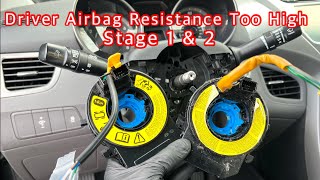
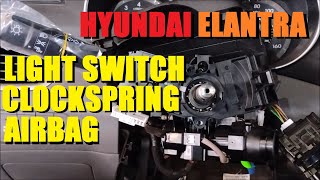
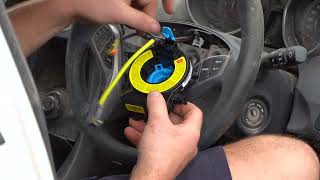
- Faulty Airbag Clock Spring (Common) — The clock spring is a coiled ribbon of wires behind the steering wheel. 🎬 See this step-by-step guide to replacing the clock spring While it primarily serves the steering wheel airbag, its failure disrupts the entire SRS circuit on specific models (like Hyundai), causing high resistance codes like B1994.
- Defective Driver's Side Airbag Module (Less Common) — The airbag unit in the seat contains an internal igniter (squib) with a specific resistance. This squib fails and goes open-circuit, though this is far less common than a wiring issue.
- Damaged RCM Connector or Ground (Rare) — A poor connection at the Restraints Control Module itself, or a corroded/loose ground strap for the module, causes a variety of erroneous circuit codes.
- Failed Restraints Control Module (RCM) (Very Rare) — The control module itself fails rarely. Only consider this after testing and proving every other part of the circuit—wiring, connectors, and the airbag module—is fully functional.
Symptoms
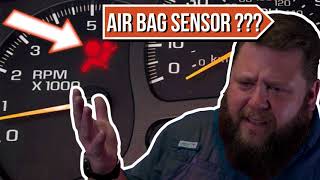
- Solid Airbag Warning Light — The most common symptom is the airbag/SRS warning light on the instrument cluster remaining illuminated while driving. 🎬 Watch: How to diagnose and reset the SRS warning light
- Flashing Airbag Light (Lamp Fault Code) — On many Ford and Mazda vehicles, the light first flashes a two-digit code before staying on solid. For example, a code '44' on a Tribute points to a side sensor communication fault.
- Horn or Steering Wheel Controls Inoperative — If a faulty clock spring is the cause, you lose function of the horn, cruise control, and radio buttons located on the steering wheel.
- Audible Chime — Some vehicles accompany the illuminated warning light with a periodic chime or beep to alert the driver of the safety system fault.
- Airbag System Completely Disabled (scan-tool only — no driver-felt sign) — This is the invisible but most critical symptom. No airbags or seatbelt pretensioners function in an accident until the fault is repaired and the code is cleared.
Diagnostic Flowchart
Tap your situation to follow the diagnostic path that matches what you're seeing on this code.
Common Fixes & Costs
- Cleaning and Securing Under-Seat Connector — Parts: $5-$15, Labor: $100-$200, ~1.0 hr book time (Intermediate)
- Installing Manufacturer Wiring Repair Kit/Overlay
— Parts: $50-$150, Labor: $150-$300, ~1.5 hr book time
(Intermediate)
Mazda Tribute (2001-2004): OEM (Alt: Generic wire pigtail connectors available from Dorman, but OEM kit recommended.)
Mazda RX-8 (2004-2005): OEM (Alt: Not typically available; manufacturer-specific solution.) - Replacing the Airbag Clock Spring
— Parts: $50-$450, Labor: $125-$250, ~1.2 hr book time
(Intermediate)
Ford Focus (2008-2011): OEM (Alt: Standard Motor Products CSP242, Dorman 525-218)
Hyundai Elantra (2011-2014): OEM (Alt: Dorman 525-802, Standard Motor Products CSP359) - Repairing Damaged Wiring in Harness — Parts: $5-$20, Labor: $200-$400, ~2.5 hr book time (Advanced)
- Replacing the Driver's Side Airbag Module
— Parts: $250-$800, Labor: $100-$200, ~1.0 hr book time
(Professional)
Mazda Tribute (2004): OEM (Alt: Not available new; requires OEM or certified used part.)
Mazda CX-7 (2007-2012): OEM (Alt: Not available new; requires OEM or certified used part.) - Replacing the SRS Control Module (RCM)
— Parts: $200-$600, Labor: $150-$300, ~1.5 hr book time
(Professional)
Mazda CX-7 (2010-2012): OEM (Alt: Not available new. Services like Safety Restore reset existing modules.)
Ford Focus (2008-2011): OEM (Alt: Not available new. Module reset services are the primary alternative.)
Used vs. New Parts: Buying Guide
When a used part is worth it: For a B1994 code, the primary component you might replace is the seat airbag module. Buying a used, non-deployed OEM airbag module from a certified auto recycler is a cost-effective alternative to a new OEM part, especially for older vehicles where the new part cost is prohibitive. Ensure the part is from a reputable source that guarantees it is non-deployed and stored properly.
Donor-vehicle mileage cap: roughly under 100000 miles for the part to have meaningful remaining life.
Donor quality checklist:
- Verify the seller is a certified auto recycler who specializes in SRS components.
- Ensure the part comes with a guarantee that it is non-deployed and has not been exposed to moisture.
- Match the part number exactly. Airbag modules are specific to vehicle year, make, model, and trim.
- Avoid parts with cut wires, broken connectors, or any signs of physical damage.
Decision logic:
- If The part is a wiring harness, connector, or clock spring → Buy new. These parts are relatively inexpensive and are high-failure items where a new part provides the most reliability.
- If The part is the seat airbag module and the vehicle is less than 10 years old → Favor a new OEM part for maximum safety assurance and warranty.
- If The vehicle is older, budget is tight, and a new part is unavailable or excessively expensive → A certified, non-deployed used airbag module is an acceptable alternative to having no functional airbag system.
Warranty tradeoff: Used airbag modules typically have a 30-90 day warranty for function only. New OEM parts carry a 1-year or longer warranty. Given the safety-critical nature, the longer warranty and assurance of a new part is often worth the cost.
Worst-case if a used part fails: $500-$1000. If a used airbag module is faulty or incompatible, you incur the cost of the part plus repeat diagnostic and installation labor, with no guarantee of a fix. The ultimate worst-case cost is the failure to deploy in an accident.
What Happens If You Wait — Timeline
- Immediately (0 seconds): The RCM detects the high resistance fault during its key-on self-test. The airbag warning light illuminates and stays on. The entire SRS system, including all airbags and pretensioners for all occupants, is disabled as a fail-safe. (MPG impact: 0%% · Added cost: $0)
- First Drive: The driver is now operating the vehicle with zero airbag protection. The risk of severe injury or death in a collision that would have otherwise been survivable increases dramatically. The physical state of the car does not change, but the safety risk is at its maximum. (MPG impact: 0%% · Added cost: Potential for catastrophic personal injury cost.)
- First State Inspection: In most jurisdictions, the vehicle automatically fails its mandatory safety inspection. This prevents legal registration renewal. The owner incurs the cost of the failed inspection and any re-inspection fees. (MPG impact: 0%% · Added cost: $50-$150 in inspection fees and lost time.)
- 6+ Months: No further mechanical damage occurs. The primary change is psychological: the driver becomes complacent and 'used to' the light being on, normalizing the high-risk situation. If another, unrelated fault occurs, there is no new warning. The system remains 100% disabled. (MPG impact: 0%% · Added cost: The cost remains the potential for injury/death in an accident, which is constant from Stage 1.)
Cost of Not Fixing It
- Immediately: The entire Supplemental Restraint System (SRS) is disabled. In a collision, NO airbags deploy and seatbelt pretensioners will not activate, dramatically increasing the risk of severe injury or death for all occupants. (Added cost: N/A)
- First State Inspection: Vehicle fails the safety inspection in most states. An illuminated airbag light is an automatic failure in jurisdictions with safety checks, preventing legal registration or sale of the vehicle. (Added cost: Cost of re-inspection fee and lost time.)
- At the time of an accident: The financial and personal cost of injuries that would have been prevented by a functional airbag system. This ranges from minor injuries becoming severe, to a fatal outcome that was otherwise survivable. (Added cost: Potentially infinite, encompassing medical bills, lost wages, and personal loss.)
Diagnosis Steps
- Confirm Active Fault with SRS Scanner
Use an OBD-II scanner capable of reading SRS/Body ('B') codes. A standard engine code reader will not work. Confirm B1994 is the active DTC and note any other codes. Do not clear the code yet.
Tools: SRS-compatible OBD-II Scanner (Beginner) - Research Technical Service Bulletins (TSBs)
Check for any TSBs related to B1994 for your specific vehicle make and model. Manufacturers like Mazda issue multiple bulletins for this exact code, providing a direct path to the fix, such as a wiring repair kit.
Tools: Internet Access (Beginner) - Visual Inspection of Under-Seat Area
Slide the driver's seat fully forward and upward. With a flashlight, inspect the yellow airbag wiring harness and its connectors. Look for obvious damage: pinched or stretched wires, unplugged connectors, or debris straining the harness.
Tools: Flashlight (Beginner) - Live Data 'Wiggle Test' (Pro Tip)
With your SRS scanner displaying live data for the 'Driver Side Airbag Resistance' (e.g., Mazda PID 'RES_SAB_D'), gently wiggle the under-seat connector and harness. A good circuit reads a stable 2.0-3.5 ohms. If the reading jumps to a very high number or 'OL' (Over Limit) during the wiggle test, you confirmed the location of the intermittent open circuit.
Tools: Advanced SRS Scanner with Live Data (Intermediate) - Connector Cleaning and Reseating
SAFETY FIRST: Disconnect the negative battery terminal and wait at least 15 minutes to allow the system's backup power to discharge. Disconnect the yellow connector under the seat. Inspect the pins for corrosion. Use an electronics-safe contact cleaner on both male and female ends. Reconnect firmly, ensuring it clicks. Reconnect the battery and clear the code.
Tools: Socket Wrench, Electronic Contact Cleaner (Intermediate) - Component Isolation with a Resistor Simulator
Depower the SRS system. Disconnect the harness from the driver's side seat airbag module. Plug a 2.2-3.3 ohm airbag simulator resistor into the vehicle-side harness connector. Reconnect the battery and clear the code. If the code stays gone, the fault is in the airbag module itself. If B1994 remains, the fault is upstream in the wiring or RCM.
Tools: Airbag Resistor Simulator (2.2-3.3 Ohm) (Advanced) - Connector Pin-Fit Test
Never use standard multimeter probes to test airbag connectors; they spread the delicate female terminals and ruin the connection. Use a dedicated set of pin-fit test probes to check the tension of the female terminals at the under-seat connector and the RCM connector. A loose terminal grip is a common cause of high resistance faults.
Tools: Pin-fit Test Probe Set (Professional) - End-to-End Circuit Resistance Test
WARNING: Only for trained professionals. Depower the system. Disconnect the harnesses from the RCM and the driver's side airbag. Using a vehicle-specific wiring diagram, identify the two wires for the circuit. Measure the resistance of each wire from the RCM connector to the airbag connector. Resistance must be less than 1.0 ohm per wire. A reading of 'OL' indicates a broken wire.
Tools: Digital Multimeter, Vehicle-specific wiring diagram (Advanced) - Direct Squib Resistance Measurement
WARNING: NEVER perform this test unless you are a trained professional. Using a standard multimeter deploys the airbag. After depowering the system and disconnecting the airbag module, use a specialized low-current ohmmeter to measure the resistance across the airbag module's pins. Expected resistance is typically between 1.5 and 3.5 ohms. A reading outside this range confirms a faulty airbag module.
Tools: Specialized Low-Current Ohmmeter, Service Manual (Professional) - Circuit Voltage & Current Monitoring
The RCM sends low-current pulses (approx. 40 mA) to monitor circuit integrity. Using a differential probe or a specialized low-amp clamp, a technician observes this signal. An open circuit shows no current flow. This advanced test confirms the RCM is attempting to monitor the circuit and that the break is downstream.
Tools: Oscilloscope with Differential Probe, Low-Amp Current Clamp (Professional)
When This Code Triggers (Freeze-Frame Conditions)
- System State: Key-On, Engine Off (KOEO) or Key-On, Engine Running (KOER) (The Restraints Control Module (RCM) performs a self-test of all circuits every time the ignition is turned to the 'On' position.)
- Fault Type: High Resistance / Open Circuit (The code sets the instant the RCM detects resistance in the driver's side impact airbag circuit that is above the specified threshold (e.g., > 4.5 ohms).)
- Time to Trigger: < 1 second (The fault is detected during the initial system startup check and the airbag light illuminates before the vehicle is put into gear.)
- Vehicle/Engine Parameters: N/A (Unlike engine codes, SRS codes like B1994 are not dependent on engine RPM, vehicle speed, or temperature. The fault is purely electrical.)
Related Codes
- B1998 — The identical 'Circuit Open / Resistance High' fault, but for the passenger's side impact airbag. If both codes appear together, it suggests a systemic issue like a design flaw or moisture intrusion affecting both sides.
- B1995 — Indicates 'Driver Side, Side Mount Airbag Circuit Short to Battery' or 'Resistance Low'. This points to the same components but a different electrical problem, where a wire touches a power source. Resistance reads near zero ohms.
- B1992 / B1993 — Indicates 'Driver Side, Side Mount Airbag Circuit Short to Ground'. This means the signal wire chafed and touches the vehicle's metal chassis. Resistance reads near zero ohms to ground.
- B0052 — In newer vehicles using a different code format, B0052 corresponds to 'Driver Side Seat Side Airbag Deployment Control', indicating the exact same high resistance/open circuit fault.
Climate & Environmental Factors
- High Humidity / Water Intrusion: Moisture is a primary catalyst for corrosion on connector pins and wiring. In humid climates or vehicles with water leaks, the connectors under the seat are susceptible to corrosion, increasing resistance and triggering B1994.
- Extreme Temperature Cycles (Hot/Cold): Significant temperature swings cause electrical connectors and wires to expand and contract. This thermal cycling loosens terminal connections over time, a phenomenon known as 'fretting,' which degrades the connection.
- Road Salt (Cold Climates): In regions where road salt is used, salt-laden moisture tracks into the vehicle on occupants' shoes. This salty water is highly corrosive and accelerates the degradation of the under-seat wiring if it reaches the carpet.
How to Talk to a Mechanic About This Code
Say this: "I have an airbag light on and my scanner shows code B1994, which points to an open circuit in the driver's side seat airbag. I'd like to book a diagnostic appointment. Based on my research, the issue is very often the connector under the seat. Can you please start the diagnosis there before considering more expensive parts?"
This signals that you are an informed customer. It directs the technician to the most probable, and cheapest, point of failure first. It establishes that you expect a logical diagnostic process, not just swapping expensive parts until the light goes out.
Avoid saying:
- 'My airbag light is on, can you fix it?' (This is too vague and invites a costly, open-ended diagnosis.)
- 'Just replace whatever is broken.' (This gives the shop a blank check to replace expensive modules without proper verification.)
- 'I think the airbag is bad.' (Don't suggest a specific expensive repair; focus on the symptom and the code.)
Questions to ask before authorizing the repair:
- Did you perform a 'wiggle test' on the under-seat connector and wiring while monitoring circuit resistance?
- If you are recommending replacing the airbag module, can you confirm you tested the vehicle-side harness with a resistor simulator to prove the wiring is good?
- Is this repair estimate just for the diagnosis, or does it include the fix? What is the warranty on the parts and labor for this specific repair?
Where to Take It: Dealer vs Independent vs Chain
- Dealer:
Recommended only if the vehicle is under warranty or if a TSB points to a dealer-only part. Otherwise, an independent shop is more cost-effective.
Best for: Vehicles under warranty or covered by a specific recall/extended warranty (like Hyundai clock springs)., Complex cases where a wiring harness overlay or manufacturer-specific repair kit is the required fix.
Downsides: Highest labor rates., May be quick to recommend replacing expensive modules rather than performing detailed wiring diagnostics. (Typical cost: +50% vs. baseline) - Independent Shop:
Best fit for this code. An experienced independent technician is very familiar with this common failure pattern and is more likely to perform a cost-effective wiring or connector repair.
Best for: Most out-of-warranty vehicles., Diagnosing and fixing the common causes of B1994, like the under-seat connector or wiring.
Downsides: Quality and expertise vary greatly. Ensure the shop has ASE-certified technicians and experience with SRS systems. (Typical cost: +0% vs. baseline) - Chain Shop:
AVOID for SRS/airbag repairs. The safety-critical nature and specific diagnostic procedures required for B1994 are beyond the scope of most chain shops.
Best for: Simple, unrelated maintenance like oil changes or tires.
Downsides: Technicians often lack the specialized training for SRS diagnostics., High pressure to sell parts leads to incorrect recommendations to replace expensive components. (Typical cost: -10% vs. baseline)
When to Walk Away From the Repair
If the estimated repair cost for the airbag system exceeds 40-50% of the car's private-party value, and the car has other pending issues, you should strongly consider selling the vehicle as-is (with full disclosure) or trading it in.
- Car worth $4000, fix is $1800: Walk away. The repair cost is nearly half the car's value. It is not economical to proceed.
- Car worth $12000, fix is $1200: Fix it. The repair cost is a small fraction of the vehicle's value and is critical for safety.
- Car worth $2500, fix is $250: Fix it. A low-cost wiring repair is well worth it to restore safety and pass inspection.
What Scan Tool You Need for This Code
Minimum: An OBD-II scanner that reads and clears Supplemental Restraint System (SRS/Airbag) codes. A basic engine-only code reader will not work.
A standard $20 scanner cannot communicate with the airbag control module. It shows 'no codes found' even with the airbag light on. You need a tool specifically advertised with SRS or Airbag system compatibility to see the B1994 code and reset the light after the repair.
Budget: Autel AutoLink AL619 (~$60) — Reads and clears engine, ABS, and SRS (airbag) codes. It confirms the B1994 fault and allows you to turn off the light after a successful repair.
Mid-range: BlueDriver Pro (~$120) — Connects to your smartphone via Bluetooth. Reads/clears SRS codes and provides access to live data streams. This allows you to perform a 'wiggle test' while watching the resistance value, which is key to confirming an intermittent wiring fault.
Professional: Autel MaxiCOM MK808 / Foxwell NT630 Plus (~$150-500) — These handheld tools offer comprehensive SRS diagnostics, live data, and include bidirectional controls to test specific components. The Foxwell NT630 Plus is particularly well-regarded for its ABS and SRS capabilities.
Rent vs buy: Buy. Scanners with SRS capability are rarely available for rent at auto parts stores. Given that a budget SRS-capable scanner costs less than a single diagnostic fee at a shop ($100-$200), it is a worthwhile investment for any DIYer.
How to Clear the Code After You Fix It
- Ensure the physical fault (e.g., bad connector, broken wire) is properly repaired.
- Reconnect all SRS components and the negative battery terminal.
- Use an SRS-compatible OBD-II scan tool to connect to the Restraints Control Module (RCM).
- Select the function to 'Clear DTCs' or 'Reset Codes' within the SRS/airbag menu.
- Turn the ignition off, then back on, and verify that the airbag warning light illuminates for a few seconds and then turns off.
Drive cycle: No specific drive cycle is required for an SRS code. The RCM performs a self-check at every key-on. If the repair was successful and the code was cleared, the light stays off. If the fault persists, the light comes back on immediately.
Readiness monitors affected: None. SRS codes are separate from the engine control module's emissions readiness monitors.
Watch out for:
- Disconnecting the battery will not clear SRS 'hard codes'; they are stored in non-volatile memory and require a scan tool.
- Using a standard engine code reader will not work; it cannot communicate with the SRS module.
- If the light returns immediately, the root cause was not fixed. Clearing the code does not fix the underlying physical problem.
Will This Fail Emissions / State Inspection?
No — by itself this code doesn't fail OBD inspection (but it can keep readiness monitors from setting, which causes a separate fail).
- California: An airbag light will NOT cause a failure of the emissions-only SMOG check. However, the vehicle is still considered unsafe to operate.
- New York: According to official NYS DMV inspection regulations, an illuminated airbag warning light is an advisory item only and is NOT cause for rejection of the safety inspection. The inspector simply informs you that it is on.
- Texas: An illuminated airbag light is NOT an item on the Texas vehicle safety inspection checklist and will not cause a failure.
- General Note: While some states do not fail the inspection for an airbag light, it is universally considered unsafe to drive the vehicle. Many other states with stricter safety inspections (e.g., Virginia, Pennsylvania) will fail the vehicle.
Most Commonly Affected Vehicles
- Mazda CX-7 (2007-2012) — A well-documented issue. TSB 08-007/13 addresses DTCs B1994/B1998 caused by poor contact in the under-seat connector. The fix involves cleaning the connector terminals.
- Mazda Tribute (2001-2004) — TSB 08-002/05 addresses intermittent B1994/B1998 codes due to poor terminal crimps in the body harness. The official repair requires installing a specific Side Air Bag (SAB) Terminal Repair Kit.
- Mazda RX-8 (2004-2005) — TSB 08-008/05 addresses B1994/B1998 on vehicles before VIN JM1FE******154081. The fix installs a revised overlay harness, bypassing the problematic original wiring.
- Ford Focus (2004-2011) — Extremely common on these models. The fault is almost always the yellow connector under the driver's seat becoming loose or the wires fraying from seat movement.
- Ford Transit Connect (2012-2014) — Ford's service manuals contain highly specific pinpoint tests for B1994, acknowledging the commonality of intermittent open circuits found via 'wiggle tests'.
- Hyundai Elantra (2011-2016) — These models are known for high-resistance faults in the driver's airbag circuit, but the cause is frequently a failing clock spring behind the steering wheel, covered by an extended warranty.
- Nissan Altima (2013-2018) — Owner forums are filled with reports of the SRS light caused by under-seat connectors, mirroring the exact failure pattern that triggers a B1994 code.
- Chevrolet Silverado 1500 (2003-2007) — These trucks are prone to various SRS wiring issues. Under-seat wiring faults triggering circuit codes like B1994 are frequently reported.
Manufacturer-Specific Notes
- Mazda: Mazda has a history of under-seat connector issues and released multiple TSBs. The prescribed fixes range from cleaning terminals (CX-7) to installing terminal repair kits (Tribute) or entire overlay harnesses (RX-8).
- Ford: Ford's official diagnostic procedure explicitly relies on using a scan tool's live data while physically manipulating the harness ('wiggle test') to pinpoint intermittent faults, acknowledging a physical connection is often the root cause.
- Hyundai: A high resistance code in the driver's airbag circuit is more likely caused by a failed clock spring than under-seat wiring. Hyundai extended the warranty on this part to 15 years/unlimited miles for many affected models, including the 2011-2014 Elantra.
- Jaguar: Owners diagnose this code by physically swapping the driver and passenger seats. If the code changes to B1998 (passenger side), the fault lies within the seat's airbag. If the code remains B1994, the fault is in the vehicle's body harness.
Real Owner Stories
2010 Mazda CX-7 at 165K miles
Airbag light started coming on intermittently, often after the driver's seat was moved. Eventually, the light stayed on and a scanner revealed code B1994.
What they tried:
- Visual inspection of under-seat connectors, which looked clean.
- Disconnected battery to try and reset the light, which worked temporarily but the light returned.
- Purchased a better OBD-II scanner to confirm the B1994 code.
- Attempted the fix from Mazda TSB 08-007/13: cleaning the under-seat connector with electrical contact cleaner.
Outcome: The owner successfully identified the common under-seat connector issue by following the manufacturer's TSB. Cleaning the connector terminals is the prescribed fix and resolved the high-resistance fault.
Lesson: For Mazda vehicles, always check for TSBs related to B1994. The issue is so common that Mazda has a specific, simple procedure for fixing it, which costs almost nothing in parts and is easily done by a confident DIYer.
2015 Nissan Altima, mileage not specified
SRS airbag light came on. The owner took it to the dealership for diagnosis.
What they tried:
- Dealer quoted $3,000 to fix the issue, likely by replacing major components.
- Owner sought a second opinion from an independent shop, who quoted $2,100 but wanted to perform their own diagnosis first.
Outcome: The independent shop's technician found the problem was simply a dirty connector under the driver's seat. The final cost was only for two hours of diagnostic labor, saving the owner thousands compared to the dealer's initial quote.
Lesson: Never approve the replacement of expensive SRS components without a thorough diagnosis. A high quote to replace the airbag module or RCM is a red flag. Always get a second opinion, and insist the shop starts by inspecting the simple, common failure points like under-seat wiring.
2012 Hyundai Elantra, mileage not specified
Cruise control stopped working, and a few days later the airbag light began coming on intermittently.
What they tried:
- Owner contacted the dealership, described the symptoms.
- Dealership immediately suspected a faulty clock spring and informed the owner of an extended warranty for that specific part.
Outcome: The dealership replaced the clock spring at no cost to the owner under Hyundai's extended warranty campaign. This fixed the airbag light, horn, and cruise control issues.
Lesson: On Hyundai vehicles, if the airbag light is accompanied by loss of horn or steering wheel-mounted controls, the cause is almost certainly the clock spring, not the under-seat wiring. Check for extended warranty coverage before paying for any repairs.
How to Prevent This Code From Triggering
- Avoid storing items under the driver's seat. (Daily habit) — Objects like water bottles, umbrellas, or shoes wedge against the yellow SRS connector and wiring harness, putting physical stress on the wires and causing them to break or unplug when the seat moves.
- Apply dielectric grease to the connector housing. (Once, or during any under-seat work) — Applying a small amount of non-conductive dielectric grease to the rubber seals and plastic housing of the connector helps seal out moisture and oxygen, preventing the corrosion that leads to high resistance faults. It also lubricates the connection, reducing strain.
- Secure any loose wiring with zip ties. (Once, during inspection) — If the SRS wiring harness has excess slack, it snags or pinches in the seat tracks. Use zip ties to gently secure the harness away from moving parts, ensuring there is still enough slack for full seat travel.
- Be mindful when moving the seat to its extreme forward/backward positions. (As needed) — Repeatedly slamming the seat to its travel limits puts the most stress on the wiring harness. Moving the seat more gently prolongs the life of the connection and prevents intermittent faults.
- Clean up liquid spills in the car promptly. (As needed) — Spilled coffee, soda, or water seeps into the carpet and reaches the under-seat connectors. The sugars and acids in these drinks are corrosive and degrade the electrical terminals over time, causing high resistance.
Frequently Asked Questions
Can I fix code B1994 myself?
A DIYer safely performs visual inspections and the connector cleaning step, provided the battery is disconnected for at least 15 minutes. This fixes the issue a majority of the time. Advanced diagnosis involving resistance testing requires a professional due to the danger of accidental airbag deployment.
Will clearing the code fix the problem?
No. B1994 is a 'hard fault' indicating a persistent electrical problem. The RCM runs a self-check every time the car starts, so the code reappears instantly until the physical fault is repaired.
My mechanic wants to replace the airbag or RCM. Is this necessary?
It is rarely necessary and often a sign of incomplete diagnosis. The fault is overwhelmingly likely to be a simple, inexpensive wiring or connector issue. Insist on a thorough circuit diagnosis, including a 'wiggle test', before authorizing expensive module replacements.
Why did the light come on after I moved my seat or had the car detailed?
Moving the seat strains the wires, causing a momentary open circuit in the under-seat harness. Water or cleaning solutions used during detailing also seep into the connector and cause corrosion, leading to high resistance.
What resistance should an airbag simulator be?
Most vehicle SRS systems expect to see a resistance between 2.0 and 3.5 ohms. A simulator resistor in the 2.2 to 3.3 ohm range is typically used for diagnostics. Using one definitively proves if the fault is in the airbag module or the vehicle wiring.
Can I reset the airbag light without a scanner?
No. Once the physical repair is complete, the 'hard fault' stored in the RCM must be cleared using an SRS-compatible scan tool. Disconnecting the battery will not clear the code.
Will my car pass a safety inspection with the airbag light on?
No. In virtually all jurisdictions, an active airbag warning light is an automatic failure for a vehicle safety inspection, as it indicates a critical safety system is inoperative.
Key Takeaways
- Code B1994 disables the entire SRS system, meaning 0 airbags will deploy in a collision, making the vehicle immediately unsafe to drive.
- Over 80% of B1994 faults stem from a loose or corroded yellow wiring connector located directly under the driver's seat.
- Never authorize a $500+ airbag module or RCM replacement until a mechanic performs a live-data 'wiggle test' to rule out a basic wiring fault.
- DIYers can safely fix this code for under $15 by disconnecting the battery for 15 minutes and cleaning the under-seat connector pins with electronic contact cleaner.
Helpful Videos



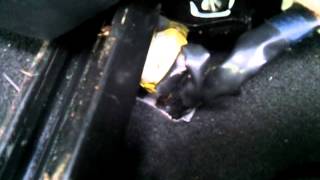
Shop the Parts Behind B1994
Below are the parts most often responsible for code B1994, ranked by how frequently each one is the actual culprit (per the diagnosis above). Tap any to see what we have for your vehicle.



The information in this article is provided for general reference and educational purposes only. Vehicle specifications, procedures, and part compatibility can vary by production date, trim level, and region. Always consult your vehicle's factory service manual and verify part numbers before purchasing or performing repairs. Safety-critical components such as airbags, seat belts, and braking systems should be installed by a qualified professional.
- 🧭 Diagnostic Flowchart
- 🎬 Helpful Videos
- 🛍️ Shop This Part
- What Does B1994 Mean?
- Can I Drive With B1994?
- Common Causes
- Symptoms
- Common Fixes & Costs
- Used vs. New Parts: Buying Guide
- What Happens If You Wait — Timeline
- Cost of Not Fixing It
- Diagnosis Steps
- When This Code Triggers (Freeze-Frame Conditions)
- Related Codes
- Climate & Environmental Factors
- How to Talk to a Mechanic About This Code
- Where to Take It: Dealer vs Independent vs Chain
- When to Walk Away From the Repair
- What Scan Tool You Need for This Code
- How to Clear the Code After You Fix It
- Will This Fail Emissions / State Inspection?
- Most Commonly Affected Vehicles
- Manufacturer-Specific Notes
- Real Owner Stories
- 2010 Mazda CX-7 at 165K miles
- 2015 Nissan Altima, mileage not specified
- 2012 Hyundai Elantra, mileage not specified
- How to Prevent This Code From Triggering
- Frequently Asked Questions
- Can I fix code B1994 myself?
- Will clearing the code fix the problem?
- My mechanic wants to replace the airbag or RCM. Is this necessary?
- Why did the light come on after I moved my seat or had the car detailed?
- What resistance should an airbag simulator be?
- Can I reset the airbag light without a scanner?
- Will my car pass a safety inspection with the airbag light on?
- Key Takeaways
- 🎟️ Get 5% Off