

OBD-II Code B2229: Varies by Manufacturer (Immobilizer, Airbag, or Body Motor Fault)
What B2229 means, why it triggers, and how to fix it
- On 2007-2013 Chrysler, Dodge, and Jeep vehicles, B2229 indicates a fatal Wireless Control Module (WCM/WIN) failure that immobilizes the engine and requires a $500+ replacement or a $150 mail-in repair.
- For Ford and Mazda models, B2229 signals a shorted passenger airbag circuit, disabling the entire Supplemental Restraint System (SRS) until repaired and cleared with an advanced scanner.
- Check NHTSA recall 14V-373 if you own a 2008-2010 Chrysler or Dodge; a defective WIN module shuts the engine off while driving, causing a total loss of power steering and brakes.
- Do not confuse the body code B2229 with the powertrain code P2229 ('Barometric Pressure Sensor Circuit High'), as they require completely different diagnostic paths.
- On 2013-2018 Toyota RAV4s, B2229 points to a failed right-side power liftgate motor, which costs approximately $600 to replace at a shop but serves as a manageable $480 DIY fix.
What Does B2229 Mean?
The meaning of code B2229 depends entirely on your vehicle's manufacturer. For Chrysler, Dodge, Jeep, and Ram, it signals a fatal internal error in the anti-theft immobilizer module (WCM, WIN, or SKREEM), preventing the engine from starting. On Ford and Mazda, it indicates a short circuit in the passenger airbag system, disabling all airbags. For 2013-2018 Toyota RAV4s, this code points to a failed right-side power liftgate motor.
Technical definition: The formal definition varies by manufacturer. Common definitions include: Chrysler/Jeep/Dodge/Ram: SKREEM (Sentry Key Remote Entry Module) Internal / WCM (Wireless Control Module) Internal - Immobilizer failure. | SAE Generic: Air Bag Passenger Circuit Short to Ground - Loop #2. | Toyota: PBD (Power Back Door) Unit Motor RH Circuit.
Can I Drive With B2229?
Yes, But With Caution. Driving is possible but carries significant risks depending on the fault. If the code is for a Chrysler/Dodge/Jeep immobilizer, the engine will not restart, leaving you stranded. Critically, NHTSA recall 14V-373 notes the faulty ignition module on 2008-2010 models shuts the engine off while driving, causing a total loss of power steering, brakes, and airbags. If the airbag light is on (common for Ford), the entire Supplemental Restraint System (SRS) is disabled and will not deploy in a crash.
Common Causes
- Internal Failure of the Wireless Control Module (WCM/WIN) (Very Common) — This is the most frequent cause on Chrysler, Dodge, and Jeep vehicles. The security module that reads your key fails internally, preventing the car from starting. Electrostatic discharge from the key often causes the module to lock up permanently.
- Damaged or Corroded Wiring Harness (Common) — For the airbag fault, wires under the passenger seat break or disconnect from seat movement. Moisture entering the yellow under-seat SRS connector after a deep interior cleaning also causes corrosion and a short-to-ground fault. For the Toyota liftgate fault, wires in the flexible loom between the body and hatch break from repeated use.
- Faulty Totally Integrated Power Module (TIPM) (Common) — On Chrysler-family vehicles, a faulty TIPM fails to send the start signal to the starter relay, perfectly mimicking a WCM failure. This is a frequent point of misdiagnosis, as the no-crank, no-start symptoms are identical.
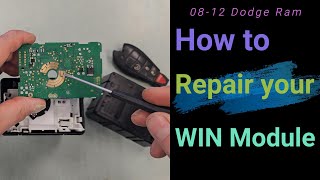
- Defective Ignition Node (Chrysler Recall 14V-373) (Common) — A major safety recall covers many 2008-2010 Chrysler, Dodge, and Jeep vehicles because jarring from the road causes the key to drop from 'RUN' to 'ACCESSORY,' shutting off the engine and disabling safety systems. This is a mechanical failure mode of the WIN module. 🎬 Watch: How to repair a stalling or no-start ignition module
- Failed Power Liftgate Motor Assembly (Less Common) — On affected Toyota models, the motor that opens and closes the rear hatch fails internally, triggering the code and disabling automatic operation.
- Faulty Airbag System Component (Less Common) — A defective passenger occupant classification sensor or a bad steering wheel clock spring causes the airbag computer to report a short circuit.
- Improperly Installed Aftermarket Accessories (Rare) — An aftermarket remote starter or alarm that is not correctly integrated with the factory security system interferes with the WCM's communication, leading to intermittent no-start issues.
- Poor Ground Connection (Rare) — A loose or corroded ground wire for the affected module (airbag, body control, or immobilizer) causes incorrect voltage readings and triggers the code.
Symptoms
- Engine will not crank or start — When you turn the key or press the start button, nothing happens or the engine cranks but does not fire. This is the primary symptom for Chrysler, Dodge, and Jeep vehicles.
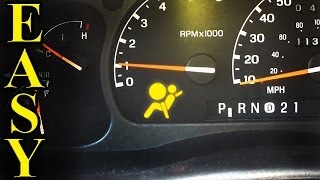
- Airbag warning light is on — The SRS (Supplemental Restraint System) light on your dashboard illuminates, indicating the entire airbag system is disabled. 🎬 See this guide on diagnosing and fixing airbag light issues
- Engine stalls while driving — On recalled Chrysler, Dodge, and Jeep models, the engine unexpectedly shuts off, resulting in a total loss of power steering and brakes.
- Power liftgate does not work — The automatic rear hatch will not open or close when you press the button on the remote or the vehicle.
- Red security light is on or flashing — A small red dot or key symbol on the instrument cluster stays on or flashes, indicating the anti-theft system is active and preventing the car from starting.
- Key is stuck in ignition or won't turn — On Chrysler models with a FOBIK (Fob Integrated Key), the WIN module failure causes the key to become physically stuck in the ignition or prevents it from turning.
Common Fixes & Costs
- Replace Wireless Control Module (WCM/WIN) and Program Keys — Parts: $350-$600, Labor: $150-$300, ~1.5 hr book time (Professional)
- Repair or Rebuild Original WCM/WIN Module (Mail-in Service) — Parts: $150-$250 (service cost), Labor: $100-$200 (for removal and reinstallation), ~1.0 hr book time (Intermediate)
- Repair or Replace Damaged Airbag Wiring Harness/Pigtail — Parts: $50-$250, Labor: $250-$600, ~2.5 hr book time (Professional)
- Replace Power Liftgate Motor Assembly — Parts: $450-$500, Labor: $110-$161, ~1.2 hr book time (DIY)
- Replace Clock Spring — Parts: $200-$1100, Labor: $150-$250, ~1.8 hr book time (Advanced)
Used vs. New Parts: Buying Guide
When a used part is worth it: For the Chrysler WCM/WIN module, a used part is almost never a good idea. It is VIN-locked to the donor vehicle and requires special tools to 'virginize' or clone, which is complex and risky. The best non-new option is a mail-in repair service for your original module, which requires no programming upon return.
Donor-vehicle mileage cap: roughly under 200000 miles for the part to have meaningful remaining life.
Donor quality checklist:
- Match the part number exactly; modules for different models or options (like remote start) are not interchangeable.
- Avoid used modules entirely unless you have confirmed access to a specialist who can clone your original module's data onto the used one.
Decision logic:
- If You want a plug-and-play solution and can wait for shipping → Use a mail-in repair service for your original WCM/WIN module.
- If You need the vehicle fixed immediately → Buy a new OEM module and have it programmed by a dealer or qualified locksmith with the proper tools. 🎬 Watch: Professional walkthrough of a WIN module replacement and programming
- If Budget is the absolute top priority and you accept high risk → A used module from a salvage yard is the cheapest part, but programming costs and failure risk erase savings.
Warranty tradeoff: Mail-in repair services typically offer a 1-year to lifetime warranty. New OEM parts have a 1-2 year warranty. Used parts from a salvage yard often have a 30-90 day warranty at best.
Worst-case if a used part fails: $300-$600 if a used module fails or cannot be programmed, covering the part cost, programming attempts, and additional diagnostic labor.
Cost of Not Fixing It
- Immediate: For Chrysler/Dodge/Jeep, the vehicle will not start, leaving the driver stranded. For recalled models, the engine shuts off while driving, causing a loss of power steering, brakes, and airbags. (Added cost: $100-$300 for towing, plus the cost of an emergency repair.)
- Immediate: For airbag-related faults, the entire Supplemental Restraint System (SRS) is disabled. In the event of a crash, airbags will not deploy, drastically increasing the risk of serious injury or death. (Added cost: Incalculable personal safety risk.)
- Ongoing: For the Toyota liftgate fault, the only consequence is the inconvenience of the power hatch not functioning. It poses no safety risk and will not damage other components. (Added cost: Negligible.)
Diagnosis Steps
- Identify the Fault by Vehicle and Symptom
Determine which system the code refers to. If your car is a Chrysler/Dodge/Jeep/Ram and it won't start, you have an immobilizer issue. If the airbag light is on, it's an SRS issue. If the power hatch doesn't work on your Toyota, it's a liftgate issue.
Tools: OBD-II Scanner (Beginner) - Check Fuses and Reset Modules
Consult your owner's manual to find fuses for the immobilizer, SRS/Airbag, or Power Liftgate. For a Chrysler no-start, reset the WCM by pulling the IOD (Ignition Off Draw) fuse for 60 seconds. For airbag faults, disconnect the vehicle's 12V battery for at least 1 minute to drain the backup power supply before inspecting wiring.
Tools: Owner's Manual, Fuse Puller or Pliers (Beginner) - Verify Key and Battery (Immobilizer Fault)
For a no-start issue on a Chrysler product, try a different key to rule out a key-specific transponder failure. Ensure the car battery is fully charged (12.4-12.6V) and the terminals are clean and tight, as voltage below 12V causes module communication errors.
Tools: Spare Key, Battery Tester or Multimeter (Intermediate) - Inspect Wiring (Airbag or Liftgate Fault)
If you have an airbag code, look under the passenger seat for the bright yellow connector. Ensure it is clean, dry, and securely clicked into place. For a liftgate code, inspect the rubber wire loom between the vehicle body and the top of the hatch for broken or chafed wires.
Tools: Flashlight (Intermediate) - Inspect for Known Failure Points (TSBs & Recalls)
Check for recalls or Technical Service Bulletins (TSBs). For 2008-2010 Dodge/Chrysler vans and Journeys, recall R03 / NHTSA 14V-373 addresses engine stalling from a bad WIN module. For 2014-2016 Ford Explorers, TSB 21B11 addresses airbag lights caused by damaged second-row seat belt wiring.
Tools: NHTSA Website or Repair Database (Intermediate) - [PRO TIP] Test Module with an Advanced Scan Tool (Immobilizer Fault)
A professional scan tool communicates directly with the WCM. If the scan tool cannot communicate with the WCM ('off bus' status), the module has failed internally. Verify that the VIN stored in the Powertrain Control Module (PCM) matches the VIN in the WCM. A mismatch prevents the car from starting.
Tools: Advanced Bi-Directional Scan Tool (Advanced) - [ADVANCED] Differentiate WCM vs. TIPM Failure (Chrysler No-Start)
To confirm the TIPM is not the cause, test the fuel pump relay circuit. Remove the M25 (20A) fuse from the TIPM. With a multimeter, check for 12V at the power-side terminal of the M25 slot for the first 1-2 seconds after turning the key to 'RUN'. If there is no voltage, the TIPM's internal fuel pump relay has failed, not the WCM.
Tools: Digital Multimeter, TIPM Fuse Diagram (Advanced) - [PRO TIP] Test Circuit Integrity with a Multimeter (Liftgate/Airbag Fault)
For a Toyota liftgate fault, use a digital multimeter to test the motor harness. Disconnect the motor and ECU connectors and check for continuity between them (should be below 1 Ω). Then, check for a short to ground by testing resistance from each wire to the chassis (should be 10 kΩ or higher).
Tools: Digital Multimeter, Vehicle-Specific Wiring Diagram (Advanced) - [ADVANCED] Test CAN Bus Voltage at WCM (Chrysler No-Start)
To rule out network issues, back-probe the WCM connector with a multimeter. On a high-speed CAN bus, the CAN High and CAN Low wires should both read approximately 2.5V with the key on, engine off. When active, CAN High toggles to ~3.5V and CAN Low to ~1.5V. If voltages are stuck high or low, you have a network-wide problem or a short in the harness.
Tools: Digital Multimeter or Oscilloscope, Wiring Diagram, T-pins (Advanced) - Clear Hard Faults with an Advanced Scan Tool
After any repair to an airbag system, the B2229 code is stored as a 'hard fault' that cannot be cleared by disconnecting the battery. A professional-grade scan tool with SRS capabilities is required to communicate with the Restraints Control Module (RCM) and clear the code to turn off the warning light.
Tools: Advanced Bi-Directional Scan Tool (Advanced)
When This Code Triggers (Freeze-Frame Conditions)
- Vehicle Speed: 0 mph (The fault is logged during the key-on self-test, before the vehicle is moving.)
- RPM: 0 (For the immobilizer fault, the code sets when the engine fails to start.)
- Battery Voltage: 11.5-12.5V (Code sets during key-on, engine-off state. Low voltage causes module communication errors.)
- Ignition Status: RUN (The internal module fault is typically detected when the key is turned to the 'RUN' or 'START' position.)
Related Codes
- B2224 — Appears with B2229 on Chrysler products; it is another code indicating a general internal WCM/SKREEM failure. Having both B2224 and B2229 together is a definitive confirmation that the module itself has failed and needs replacement.
- B1A35 — Often found with B2229, this code means 'Unidentified Key Communication Error'. B2229 points to the WCM being faulty, while B1A35 means the WCM cannot read the key. If you have both, the WCM is almost certainly the cause.
- B2228 — This code for 'Air Bag Driver Circuit Short to Ground' is the direct counterpart to the generic B2229 definition. B2229 indicates a fault on the passenger side, while B2228 indicates the exact same type of fault on the driver's side.
- U0168 — This is a network communication code for 'Lost Communication With Vehicle Security Control Module (WCM)'. It often appears alongside B2229 on Chrysler vehicles when the WCM fails and drops off the CAN bus network, confirming a dead module.
Climate & Environmental Factors
- Low Humidity / Cold & Dry Climates: Increases the likelihood of electrostatic discharge (ESD). On Chrysler, Dodge, and Jeep vehicles, a static shock from the operator's hand to the key travels to the Wireless Control Module (WCM/WIN), causing internal logic failure and triggering code B2229.
- High Humidity / Water Intrusion: Causes corrosion in electrical connectors. For the airbag variant of B2229, moisture in the under-seat connectors is a common cause of the short-to-ground fault that triggers the code.
How to Clear the Code After You Fix It
- For airbag faults, the code must be cleared with an SRS-compatible scan tool.
- For Chrysler immobilizer faults, if a new module is installed, it must be programmed first, then codes cleared.
- A simple battery disconnect will not clear a 'hard fault' from the airbag or security modules.
Drive cycle (~5 minutes): A traditional emissions drive cycle is not required. The Body Control Module (BCM) and Restraints Control Module (RCM) perform a self-test at every key-on event. After repair and clearing the code with a scanner, cycle the ignition off and on. The warning light should remain off if the fix was successful.
Readiness monitors affected: Not applicable for B-codes
Watch out for:
- Assuming a battery disconnect will clear an airbag or security code.
- Using a basic OBD-II reader that cannot communicate with the SRS or WCM modules to clear the code.
- Not addressing the root cause (e.g., bad wiring, faulty module), which causes the code to return immediately.
Will This Fail Emissions / State Inspection?
No — by itself this code doesn't fail OBD inspection (but it can keep readiness monitors from setting, which causes a separate fail).
- California: An airbag light will NOT fail a standard biennial smog check, which is only concerned with emissions. However, if the vehicle has a salvage title, it must pass a more comprehensive Vehicle Safety Systems Inspection where a missing or non-functional airbag system causes a failure.
- New York: As of recent DMV guidelines, an illuminated airbag warning light is an advisory item, not an automatic failure for a safety inspection. The inspector notes it on the report, but the vehicle can still pass.
- Texas: An illuminated airbag light is NOT an item on the Texas state safety inspection checklist and will not cause a failure.
Most Commonly Affected Vehicles
- Jeep Grand Cherokee, Wrangler, Liberty, Compass, Patriot (2007-2013) — Prone to internal failure of the Wireless Control Module (WCM/SKREEM), causing a no-start condition. For the 2007 Grand Cherokee, this is one of the most reported problems.
- Dodge Grand Caravan, Charger, Nitro, Journey, Ram 1500/2500/3500 (2008-2010) — These models share the faulty WIN module. Grand Caravan and Journey were part of NHTSA recall 14V-373 for the key moving from RUN to ACC while driving, causing the engine to stall.
- Chrysler 300, Town & Country, Sebring (2008-2010) — The Town & Country was also included in the major NHTSA recall 14V-373 for the defective WIN module that shuts the engine off, disabling power steering, brakes, and airbags.
- Toyota RAV4 (2013-2021) — On these models, B2229 points to a failure in the power back door (liftgate) motor or its wiring. TSB T-SB-0168-13 specifically addresses this for 2013 models.
- Ford Explorer, Mustang, F-150 (2011-2018) — On Ford vehicles, B2229 corresponds to the generic definition of a passenger airbag circuit short. For 2014-2016 Explorers, Customer Satisfaction Program 21B11 addresses damaged wiring for the 2nd-row inflatable seat belts.
- Lincoln MKX, MKT (2011-2018) — As a Ford brand, Lincoln vehicles log B2229 for airbag circuit faults, often related to wiring under seats or a faulty clock spring.
- Chevrolet Malibu (2011-2014) — These vehicles are representative of a common pattern where damaged wiring under the power seats triggers various airbag circuit codes like the generic B2229 definition.
- Mazda 3, 6, CX-5 (2010-2018) — Mazda uses B2229 for airbag circuit faults. Diagnosis is similar to Ford, focusing on under-seat wiring, connectors, and the clock spring.
Manufacturer-Specific Notes
- Chrysler / Dodge / Jeep / Ram: For these brands, B2229 almost exclusively means the anti-theft module (WCM/WIN/SKREEM) has failed. The module name varies: SKREEM in older models, WCM in the mid-2000s, and WIN in later models with a FOBIK.
- Chrysler / Dodge / Jeep (Recall): A critical safety recall (NHTSA 14V-373) covered 2008-2010 models for a defective WIN module made by Continental. Road vibrations cause the key to rotate from 'RUN' to 'ACCESSORY,' shutting off the engine and disabling power steering, brakes, and airbags.
- Toyota: On models with a power liftgate, this code specifically targets a fault in the right-side liftgate motor circuit. It is not related to security or airbags.
- Ford / GM / Others: On many other vehicles, B2229 aligns with the generic SAE definition of an airbag circuit short. This is commonly caused by damaged wiring under the passenger seat due to movement or objects stored there.
Frequently Asked Questions
What is the difference between code B2229 and P2229?
This is a critical distinction. B2229 is a 'Body' code that varies by make, typically for the immobilizer or airbags. P2229 is a universal 'Powertrain' code for 'Barometric Pressure Sensor A Circuit High'. Diagnosing one as the other leads to incorrect repairs.
Why won't my Jeep start and I have a B2229 code?
This means the Wireless Control Module (WCM), which is your vehicle's security system, has an internal failure. It no longer recognizes your key, preventing the engine from starting as a theft deterrent. The module must be replaced and programmed, or the original module can be sent out for repair.
Is it safe to drive with an airbag code B2229?
No. While the vehicle will drive, the airbag warning light indicates the entire Supplemental Restraint System (SRS) is disabled for safety. In an accident, the airbags will not deploy. This is a serious safety risk that requires immediate repair.
Can I replace the WCM/WIN module myself?
Replacing the module is physically simple, but it requires electronic programming to your vehicle's VIN and keys using special scan tools. A common cost-effective alternative is to remove the original module and mail it to a repair service. They fix the internal faults and return it ready to be reinstalled without needing programming.
What happens if I replace the WCM and the PCM at the same time on my Chrysler?
If both the main engine computer (PCM) and the security module (WCM/SKREEM) are replaced simultaneously, you must also replace and program all new ignition keys. The security 'secret key' is shared between these three components. If all are new, a complete system initialization is required.
What does SKREEM stand for?
SKREEM stands for Sentry Key REmote Entry Module. It is one of Chrysler's names for the vehicle's immobilizer module, which is also known as the WCM (Wireless Control Module) or WIN (Wireless Ignition Node).
What is the most common misdiagnosis for a B2229 no-start?
On Chrysler vehicles, the most common mistake is replacing the battery, starter, or key fobs when the WCM/WIN module is the actual cause. Another pitfall is confusing the WCM failure with a faulty Totally Integrated Power Module (TIPM), which produces identical no-crank symptoms. Proper diagnosis with an advanced scan tool is essential.
Key Takeaways
- On 2007-2013 Chrysler, Dodge, and Jeep vehicles, B2229 indicates a fatal Wireless Control Module (WCM/WIN) failure that immobilizes the engine and requires a $500+ replacement or a $150 mail-in repair.
- For Ford and Mazda models, B2229 signals a shorted passenger airbag circuit, disabling the entire Supplemental Restraint System (SRS) until repaired and cleared with an advanced scanner.
- Check NHTSA recall 14V-373 if you own a 2008-2010 Chrysler or Dodge; a defective WIN module shuts the engine off while driving, causing a total loss of power steering and brakes.
- Do not confuse the body code B2229 with the powertrain code P2229 ('Barometric Pressure Sensor Circuit High'), as they require completely different diagnostic paths.
- On 2013-2018 Toyota RAV4s, B2229 points to a failed right-side power liftgate motor, which costs approximately $600 to replace at a shop but serves as a manageable $480 DIY fix.
Helpful Videos
Shop the Parts Behind B2229
Below are the parts most often responsible for code B2229, ranked by how frequently each one is the actual culprit (per the diagnosis above). Tap any to see what we have for your vehicle.



The information in this article is provided for general reference and educational purposes only. Vehicle specifications, procedures, and part compatibility can vary by production date, trim level, and region. Always consult your vehicle's factory service manual and verify part numbers before purchasing or performing repairs. Safety-critical components such as airbags, seat belts, and braking systems should be installed by a qualified professional.
- 🎬 Helpful Videos
- 🛍️ Shop This Part
- What Does B2229 Mean?
- Can I Drive With B2229?
- Common Causes
- Symptoms
- Common Fixes & Costs
- Used vs. New Parts: Buying Guide
- Cost of Not Fixing It
- Diagnosis Steps
- When This Code Triggers (Freeze-Frame Conditions)
- Related Codes
- Climate & Environmental Factors
- How to Clear the Code After You Fix It
- Will This Fail Emissions / State Inspection?
- Most Commonly Affected Vehicles
- Manufacturer-Specific Notes
- Frequently Asked Questions
- What is the difference between code B2229 and P2229?
- Why won't my Jeep start and I have a B2229 code?
- Is it safe to drive with an airbag code B2229?
- Can I replace the WCM/WIN module myself?
- What happens if I replace the WCM and the PCM at the same time on my Chrysler?
- What does SKREEM stand for?
- What is the most common misdiagnosis for a B2229 no-start?
- Key Takeaways
- 🎟️ Get 5% Off