

OBD-II Code B2234: Driver Airbag Circuit Resistance Low
The Ultimate Expert Guide to Diagnosing and Fixing B2234
- Code B2234 indicates a low-resistance short circuit (typically under 1.0 ohm) in the driver's airbag system, instantly disabling the airbag.
- A broken clock spring causes over 80% of B2234 faults, especially when accompanied by a dead horn or malfunctioning steering wheel buttons.
- Operating a vehicle with an active B2234 code guarantees the driver's airbag will not deploy during a frontal collision.
- Never replace a $200+ clock spring without first verifying live resistance data using an SRS-compatible scan tool to rule out a loose $5 connector clip.
What Does B2234 Mean?
Code B2234 indicates the vehicle's Restraints Control Module (RCM) detected a short circuit in the driver's side airbag circuit. A normal airbag squib circuit maintains a specific electrical resistance, typically between 1.5 and 3.7 ohms. This fault triggers when the resistance drops below that threshold (usually under 1.0 ohm), forcing the computer to disable the driver's airbag to prevent accidental deployment.
Technical definition: Air Bag Driver Inflator Circuit Resistance Low on Squib – Loop #2. Modern dual-stage airbags use two separate inflator circuits (Loop #1 and Loop #2) for controlled deployment. This code isolates a low-resistance short in the second-stage circuit. Rarely, some Honda/GM models use this code to indicate a 'Right Front Power Window Master Switch Input Short to Ground'.
Can I Drive With B2234?
No — Do Not Drive. Driving is physically possible but extremely unsafe. The B2234 code confirms the driver's side airbag system is disabled. In a frontal collision, the airbag will not deploy, dramatically increasing the risk of serious head injury or death. There is no safe distance to drive with this fault; consider the vehicle unsafe to operate until repaired.
Common Causes
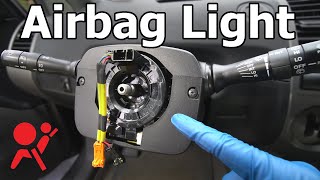
- Faulty Clock Spring (Spiral Cable) (Very Common) — The clock spring is a coiled ribbon cable behind the steering wheel that maintains electrical connections while the wheel turns. Constant rotation fatigues the thin internal wires, causing them to rub together and create a low-resistance short circuit.
- Damaged or Loose Wiring Connectors (Common) — Bright yellow airbag connectors frequently vibrate loose or suffer from broken plastic Connector Position Assurance (CPA) clips, especially on GM vehicles. Additionally, internal 'shorting bars' designed to safe the airbag when unplugged often stick, causing a permanent short.
- Faulty Driver's Airbag Module (Squib/Inflator) (Less Common) — The airbag unit inside the steering wheel contains the inflator (squib). This component occasionally develops an internal short circuit, causing the low resistance reading.
- Water Intrusion into SRS Control Module (Less Common) — On vehicles like the Hyundai Elantra, the SRS module sits under the center console. Water from a clogged A/C drain or a leaking windshield seeps into the module, corroding the circuit board and triggering false resistance faults.
- Faulty Restraints Control Module (RCM) (Rare) — The computer module monitoring the airbag system fails internally and incorrectly reports a low resistance fault when the circuit is perfectly healthy. This is a diagnosis of exclusion after verifying all other components.
- Previous Improper Repairs or Modifications (Rare) — Installers fitting aftermarket remote starters, alarms, or stereos frequently pinch, tap into, or damage sensitive airbag wiring, creating an immediate short circuit.
- Short in Power Window Master Switch (Rare) — For the alternate manufacturer-specific definition of this code (some Honda/GM models), the main driver's door window switch panel has an internal short to ground. This occurs without an airbag warning light.
Symptoms
- Airbag Warning Light is On — The dashboard airbag icon or 'SRS' light remains illuminated permanently, confirming a hard fault in the Supplemental Restraint System.
- Horn Does Not Work or Works Intermittently — Because the horn's wiring routes through the clock spring, a failure in the ribbon cable often kills the horn simultaneously.
- Steering Wheel Buttons Malfunction — Radio, cruise control, or phone buttons mounted on the steering wheel stop working due to severed connections inside the clock spring.
- Grinding or Clicking Noise When Turning Steering Wheel — A physically shattered clock spring makes audible rubbing, clicking, or grinding sounds during steering.
- Driver's Power Window Controls Inoperative — If your vehicle uses the alternate definition for this code, the master power window switch on the driver's door fails to operate.
- Low Resistance Value on Scan Tool Live Data (scan-tool only — no driver-felt sign) — Live data from the SRS module shows the driver's airbag circuit resistance below the specified threshold (typically under 1.0 ohm).
Diagnostic Flowchart
Tap your situation to follow the diagnostic path that matches what you're seeing on this code.
Common Fixes & Costs
- Replace Clock Spring — Parts: $80-$400, Labor: $100-$250, ~1.5 hr book time (Intermediate)
- Repair or Clean Wiring Connectors — Parts: $5-$50, Labor: $50-$150, ~0.5 hr book time (DIY)
- Replace Driver's Airbag Module — Parts: $400-$1000, Labor: $50-$150, ~0.7 hr book time (Professional)
- Replace SRS Control Module — Parts: $500-$900, Labor: $150-$300, ~2 hr book time (Professional)
- Replace Power Window Master Switch — Parts: $60-$350, Labor: $50-$150, ~0.3 hr book time (DIY)
DIY vs Professional
- Repair or Clean Wiring Connectors — Beginner: Yes
Tools: Flashlight, contact cleaner, dielectric grease, small pick. - Replace Clock Spring — Beginner: No
Tools: Socket set, torque wrench, trim removal tools, steering wheel puller. - Replace Driver's Airbag Module — Beginner: No
Tools: Socket set, screwdrivers, trim removal tools. - Replace SRS Control Module — Beginner: No
Tools: Socket set, trim removal tools, professional scan tool.
Used vs. New Parts: Buying Guide
When a used part is worth it: Buy a new aftermarket clock spring for reliability. A used OEM clock spring from a non-accident vehicle is a viable budget option for older cars. Never buy a used airbag module unless sourced from a certified rebuilder due to extreme safety risks.
Donor-vehicle mileage cap: roughly under 80000 miles for the part to have meaningful remaining life.
Donor quality checklist:
- Verify the donor vehicle was not scrapped due to flood, fire, or a frontal collision.
- Match the part number exactly; small variations cause immediate incompatibility.
- Avoid parts with any signs of corrosion or melted plastic.
Decision logic:
- If The part is the clock spring and a new aftermarket part is under $150 → Buy new aftermarket for the warranty and guaranteed function.
- If The part is the airbag inflator/module itself → Buy new OEM. The safety risk of a used or counterfeit explosive part is too high.
- If Vehicle is >150K miles and a new clock spring is >$300 → A used OEM part from a reputable recycler is an acceptable budget choice.
Warranty tradeoff: Salvage yard parts offer a 30-90 day functional warranty. New aftermarket parts include a 1-year to limited lifetime warranty. New OEM parts carry a 1-year warranty.
Worst-case if a used part fails: $250-$500 if a used part fails shortly after installation, representing repeat labor plus a replacement part.
What Happens If You Wait — Timeline
- Immediate (First Key-On): The SRS module detects the short, sets code B2234, illuminates the airbag warning light, and completely disables the driver's side airbag. (MPG impact: 0%% · Added cost: $0 (Safety risk is the immediate cost))
- 0-12 Months (First Safety Inspection): The vehicle automatically fails its annual safety inspection, making it illegal to register or operate. (MPG impact: 0%% · Added cost: $50-$200 in failed inspection fees and fines.)
- 1-6+ Months (Cascading Component Failure): If the root cause is a failing clock spring, the horn and steering wheel buttons fail completely as the internal ribbon cable shreds further. (MPG impact: 0%% · Added cost: $0 (Loss of convenience functions))
- Ongoing (Collision Event): A frontal collision occurs. The disabled driver's airbag fails to deploy, resulting in severe head or chest trauma. (MPG impact: 0%% · Added cost: $10,000+ (Severe medical costs and increased legal liability))
Cost of Not Fixing It
- Immediate: The driver's airbag is disabled and will not deploy in a collision, representing a critical loss of a primary safety system. (Added cost: $0 (Safety risk))
- 0-12 Months: The vehicle automatically fails mandatory annual safety inspections in applicable jurisdictions, preventing legal registration. (Added cost: $50-$200 (Failed inspection fees and fines))
- Ongoing: Operating a vehicle with a knowingly disabled safety system increases legal liability for preventable injuries in an at-fault accident. (Added cost: $10,000+ (Potential legal fees and medical damages))
Diagnosis Steps
- Read the Code and Note Symptoms
Use an SRS-compatible OBD-II scanner to confirm B2234 is the active fault. Note if the horn or steering wheel buttons are dead, which immediately isolates the fault to the clock spring.
Tools: OBD-II Scanner (SRS compatible) (Beginner) - Test Steering Wheel Controls
Press the horn and test the cruise control and radio buttons. If they fail alongside the airbag light, the clock spring is the definitive culprit.
Tools: None (Beginner) - Inspect Under-Seat and Steering Column Connectors
Visually inspect all bright yellow connectors under the driver's seat and at the steering column base. Ensure they are securely plugged in and check for broken plastic locking clips (CPAs).
Tools: Flashlight (Beginner) - Monitor Live Resistance Data with a Scan Tool
Access SRS live data and monitor the 'DRIVER_SQUIB_RES' (or similar) Parameter ID. A normal reading is 1.5 to 3.5 ohms. A reading below 1.0 ohm confirms a short. Slowly turn the steering wheel lock-to-lock; if the resistance fluctuates wildly or drops to zero, the clock spring is broken.
Tools: Advanced OBD-II Scanner with Live Data (Intermediate) - PRO TIP: Test Clock Spring Continuity with a Multimeter
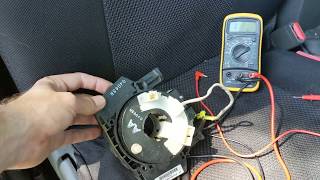
Disconnect the battery, wait 15 minutes, and remove the airbag and steering wheel. Disconnect the clock spring. Set a multimeter to Ohms. Probe corresponding pins on the front and back of the clock spring. Rotate the clock spring slowly; a jump to infinite resistance (OL) indicates a broken internal wire.
Tools: Multimeter, socket set, trim removal tools (Advanced) - PRO TIP: Measure for a Direct Short to Ground
With the battery disconnected, unplug the main SRS control module connector. Set your multimeter to Ohms. Place one probe on the airbag circuit pin and the other on a bare metal chassis ground. A reading near zero ohms confirms a short to ground in the wiring harness.
Tools: Multimeter, vehicle-specific wiring diagram (Advanced) - Visually Inspect the Clock Spring and Airbag Module
Disconnect the battery and wait 15 minutes. Remove the driver's airbag. Inspect the clock spring connectors for melted wires or stuck shorting bars. Check the airbag module for physical damage or corrosion.
Tools: Socket set, trim removal tools, screwdriver (Advanced) - Test the Circuit with a Resistor (Professional Only)
Disconnect the battery, remove the driver's airbag, and plug a 2.2-2.7 ohm diagnostic resistor into the clock spring's connector. Reconnect the battery. If the B2234 code clears, the wiring and RCM are perfect, proving the airbag module itself is faulty.
Tools: Airbag system diagnostic resistor set, OBD-II scanner (Professional)
When This Code Triggers (Freeze-Frame Conditions)
- System State: Ignition ON (The SRS module performs a mandatory self-check immediately when the ignition turns on.)
- Time After Key-On: 0-7 Seconds (The primary resistance check occurs in the first 7 seconds. If the short exists, the SRS light remains illuminated instead of turning off.)
- Circuit Status: Continuously Monitored (The SRS module constantly monitors circuit resistance. The B2234 code sets the exact millisecond a low resistance value is detected.)
- Battery Voltage: 11.5V - 14.5V (Low or fluctuating system voltage from a dying battery causes unpredictable SRS module behavior and false resistance faults.)
Related Codes
- B1934 — Indicates 'Driver Airbag Igniter Circuit Resistance Low on Squib - Loop #1'. Seeing B1934 and B2234 together guarantees a fault affecting both stages simultaneously, isolating the problem to the clock spring.
- B0002 — The generic SAE equivalent code for 'Driver's Airbag Igniter Circuit Resistance Low'. A generic scanner displays B0002 for the exact same short-circuit fault.
- B2232 — Indicates 'Driver Airbag Circuit Resistance HIGH'. This is the exact opposite of B2234. It points to a severed wire or unplugged connector rather than a short circuit.
- B1342 — A generic code for an internal fault in the Restraints Control Module (RCM). If wiring and components test perfectly, the RCM is faulty and generating a false B2234 code.
Climate & Environmental Factors
- High Humidity / Water Intrusion: Moisture accelerates corrosion on connector pins and circuit boards. Water leaks from clogged A/C drains directly destroy floor-mounted SRS control modules, causing permanent shorts.
- Extreme Cold: Freezing temperatures make plastic wire insulation and connector bodies brittle. Metal contacts contract, creating loose connections that trigger intermittent resistance faults.
- Extreme Heat and Temperature Cycles: Long-term exposure to high heat degrades chemical propellants in older airbag inflators and causes electrical connectors to expand and contract, breaking connections over time.
How to Talk to a Mechanic About This Code
Say this: "I have an airbag light on, and my scanner shows code B2234 for the driver airbag circuit. I know the clock spring is a common failure, but I want you to test the circuit resistance to confirm before replacing any parts."
This directs the technician to perform a logical diagnosis rather than blindly replacing the most common part, saving you money if the problem is just a loose connector.
Avoid saying:
- 'My airbag light is on, can you just fix it?'
- 'I think I need a new clock spring.'
- 'Just do whatever it takes to turn the light off.'
Questions to ask before authorizing the repair:
- Did you check the live resistance data from the SRS module while turning the wheel?
- Can you confirm the problem isn't just a loose or corroded connector?
- What is the warranty on the parts and labor for this repair?
- Will you be using an OEM or aftermarket part?
Where to Take It: Dealer vs Independent vs Chain
- Dealer:
Recommended only if the vehicle is under warranty or requires complex module programming.
Best for: Vehicles under warranty or covered by a specific recall/TSB., Complex cases requiring SRS control module replacement and manufacturer-specific programming., When you want guaranteed OEM parts.
Downsides: Significantly higher labor rates and parts costs., More inclined to replace entire assemblies rather than perform simple wiring repairs. (Typical cost: +50% vs. baseline) - Independent Shop:
Best fit for most scenarios. An experienced independent mechanic easily diagnoses and repairs common B2234 causes.
Best for: Out-of-warranty vehicles where the cause is a clock spring or connector., Cost-conscious owners seeking lower labor rates.
Downsides: May lack the expensive, manufacturer-specific scan tools needed for module programming on newer vehicles. (Typical cost: +0% vs. baseline) - Chain Shop:
AVOID. Airbag system repair requires expertise not found at high-volume chain shops.
Best for: Never recommended for airbag system diagnostics or repair.
Downsides: Technicians lack specialized training for safety-critical SRS repairs., High pressure to upsell services., Lack the correct diagnostic tools to read live SRS data. (Typical cost: -10% vs. baseline)
When to Walk Away From the Repair
If the total estimated repair cost for the B2234 fault exceeds 40-50% of your car's private party value, strongly consider selling the vehicle.
- Car worth $4500, fix is $2200: Walk away. A repair cost that is half the car's value is a poor investment.
- Car worth $12000, fix is $800: Fix it. This repair is well below the threshold and restores a critical safety feature.
- Car worth $2500, fix is $1200: Borderline. At 48% of the vehicle's value, the repair is a massive investment. Get a second opinion.
What Scan Tool You Need for This Code
Minimum: An OBD-II scanner that specifically reads and clears codes from the SRS (Supplemental Restraint System) module.
A standard $20 engine code reader cannot communicate with the SRS module. It will not see the B2234 code, nor will it clear the airbag light after a repair.
Budget: BlueDriver Pro (~$90) — Reads and clears SRS codes on most major makes and displays live data for airbag circuit resistance.
Mid-range: Foxwell NT630 Plus / Autel MaxiCOM MK808 (~$150-350) — Offers full SRS system diagnostics, including reading codes, viewing live data streams with graphing, and clearing faults.
Professional: Autel MaxiSys MS906 / Launch X431 Series (~$600-1500) — Provides full bidirectional control and performs advanced functions like SRS module programming and coding.
Rent vs buy: Auto parts stores do NOT rent scanners capable of reading SRS codes. You must buy a capable scanner. Given the sub-$100 price of the budget pick, buying is mandatory.
How to Clear the Code After You Fix It
- Perform the physical repair of the faulty component.
- Reconnect the vehicle's battery.
- Use an SRS-compatible OBD-II scan tool to access the Supplemental Restraint System.
- Select the function to 'Clear Codes' or 'Reset Faults'.
Drive cycle (~10 minutes): SRS faults do not require an emissions-style drive cycle. Turn the ignition to 'ON'. The airbag light illuminates for a 7-second self-test and then turns off. A 10-minute test drive ensures the light does not return.
Readiness monitors affected: None. The SRS system does not use readiness monitors.
Watch out for:
- The code returns instantly if the underlying physical short circuit is not repaired.
- Using a basic $20 OBD-II code reader that cannot access the SRS module.
- Assuming disconnecting the battery clears an active SRS hard fault.
Will This Fail Emissions / State Inspection?
Yes — this code typically fails an OBD-II emissions inspection.
- California: Will NOT fail. California's smog check focuses strictly on emissions; the airbag system is ignored.
- New York: Will NOT fail. An illuminated airbag light is an advisory item on the inspection report but is not grounds for failure.
- Texas: Will NOT fail. As of 2025, most safety inspections are eliminated, and emissions testing ignores SRS codes.
- Virginia: WILL fail. Virginia enforces a comprehensive safety inspection, and an active airbag light causes immediate rejection.
Most Commonly Affected Vehicles
- Ford Transit Connect (2010-2013) — Frequently experiences B2234 alongside B1934, pointing directly to a faulty clock spring common to the dual-stage airbag.
- Mazda 6 (2002-2008) — Known to set B2234 due to clock spring failure or a hard-to-reach connector located behind the radio.
- Mazda RX-8 (2004-2011) — Owners frequently report B2234, with the clock spring being the definitive point of failure.
- Ford Explorer (2002-2005) — The airbag system is highly prone to low resistance codes due to premature clock spring wear.
- Hyundai Elantra (2011-2018) — Prone to water leaks from clogged A/C drains that destroy the center-console-mounted SRS Control Module.
- Chevrolet Cobalt, HHR (2006-2011) — Subject to GM TSBs where airbag codes are caused by brittle, broken Connector Position Assurance (CPA) clips on yellow airbag connectors.
- Nissan Tiida, Versa (2007-2012) — The clock spring is a known high-failure part, leading to an airbag light and a dead horn.
- Lincoln Town Car (2003-2011) — Prone to clock spring failures. Many were also part of the Takata airbag inflator recall, which causes separate SRS faults.
Manufacturer-Specific Notes
- Ford / Mazda: B2234 almost exclusively refers to a failed clock spring. Ford issued Customer Satisfaction Program 15N01 extending clock spring warranties up to 10 years/150,000 miles on specific models.
- General Motors (Chevrolet): Airbag circuit codes are frequently caused by faulty connectors rather than broken components. TSBs point to broken Connector Position Assurance (CPA) clips on yellow connectors as the primary culprit.
- Honda / General Motors: Some models use B2234 to indicate a 'Right Front Power Window Master Switch Input Short to Ground'. If you have this code but no airbag light, replace the driver's door window switch.
- Hyundai: The SRS Control Module in models like the Elantra sits under the center console, making it highly vulnerable to water damage from clogged A/C drain lines.
Real Owner Stories
2010 Ford Transit Connect with B2234 & B1934
Airbag light came on steadily. A scan revealed both B2234 (Loop #2) and B1934 (Loop #1). Horn and steering wheel controls still worked.
What they tried:
- Inspected connectors under the seat and at the steering column base, finding them secure.
Outcome: Because both airbag loops showed a low resistance fault simultaneously, the clock spring was identified as the single point of failure common to both circuits. Replacing the clock spring permanently cleared the codes.
Lesson: When you see low resistance codes for both airbag stages (B2234 and B1934) together, the clock spring is the guaranteed culprit.
2009 Chevy HHR with 'Service Airbag' message
'Service Airbag' warning appeared on the dash, a common problem for HHRs and Cobalts.
What they tried:
- Unplugged and applied dielectric grease to all accessible yellow connectors under both front seats.
- Checked GM TSB #08-09-41-002H, which pointed to connector X211 behind the passenger kick panel.
Outcome: The owner removed the passenger kick panel, popped the red lock tab on the yellow connector, and reseated it firmly. This action permanently cleared the airbag light.
Lesson: On GM vehicles, never assume a major component failed. The most common cause is a poor connection due to brittle plastic CPA clips. Check TSBs first.
2009 Mazda 6 with multiple seemingly unrelated issues
Car wouldn't shift out of Park, Traction Control lights were on, key fob wasn't recognized, and the horn didn't work.
What they tried:
- Based on the dead horn, the owner assumed a clock spring failure and replaced it, which fixed nothing.
Outcome: The combination of a shift lock failure and stability control issues pointed to a blown brake light switch circuit. The clock spring was not the root cause.
Lesson: Don't get tunnel vision. If you have unrelated warnings (like shift lock or stability control), diagnose those first. A single blown fuse or faulty switch triggers multiple system warnings.
2011 Hyundai Elantra with airbag light after heavy rain
Airbag light appeared after high humidity and rain. The owner heard a 'sloshing' sound in the dash.
What they tried:
- A mechanic checked the clock spring and connectors, finding them in perfect condition.
Outcome: A clogged A/C drain line caused water to back up and leak onto the SRS control module under the center console, corroding the circuit board. The module required an $800 replacement and programming.
Lesson: If an airbag fault appears after heavy rain or you hear water inside the cabin, suspect a destroyed SRS control module before assuming a wiring fault.
How to Prevent This Code From Triggering
- Apply dielectric grease to accessible connectors (During any related interior maintenance) — Dielectric grease seals out moisture and oxygen, preventing corrosion on connector pins that causes shorts or high resistance.
- Avoid turning the steering wheel lock-to-lock with force (Daily habit) — Repeatedly slamming the steering stops puts maximum stress on the clock spring's internal ribbon cable, accelerating breakage.
- Secure the clock spring during steering/suspension work (During relevant repairs) — If the steering linkage is disconnected, over-rotating the steering wheel instantly snaps the clock spring. Use a strap to hold the wheel in place.
- Regularly clean A/C drains and check for cabin water leaks (Annually, before rainy seasons) — Prevents water from backing up and destroying floor-mounted SRS control modules, a common issue in Hyundai and Honda vehicles.
Frequently Asked Questions
Is it safe to drive with code B2234?
No. This code confirms the driver's airbag is disabled and will not deploy in an accident, significantly increasing the risk of severe injury or death.
What is a 'shorting bar' in an airbag connector?
A shorting bar is a built-in safety feature that automatically connects the two airbag terminals when unplugged, preventing accidental deployment from static electricity. A faulty shorting bar that sticks when plugged in causes a permanent B2234 code.
What are common misdiagnosis mistakes for B2234?
The most common mistake is replacing the expensive clock spring without testing the circuit. The fault is often a loose connector or a broken $5 CPA clip. Always verify live resistance data before buying parts.
I cleared the code but it came back instantly. Why?
Code B2234 is a 'hard fault,' meaning the control module detects a continuous physical short circuit. The code will not stay cleared until the broken wire or connector is repaired.
Can I replace the clock spring myself to fix code B2234?
Yes, but only if you are an experienced DIYer. The job requires removing the explosive airbag module, which causes serious injury if mishandled. Always disconnect the negative battery terminal and wait 30 minutes before starting.
My airbag light is on, but my horn and steering wheel buttons still work. Could it still be the clock spring?
Yes. The clock spring contains multiple separate wire circuits. The specific wires connected to the airbag squib often break while the horn wires remain intact.
How much does it cost to fix code B2234?
A clock spring replacement costs $180 to $650 depending on the vehicle. If the driver's airbag module failed, expect to pay $450 to $1150. Replacing a water-damaged SRS control module costs $650 to $1200.
Key Takeaways
- Code B2234 indicates a low-resistance short circuit (typically under 1.0 ohm) in the driver's airbag system, instantly disabling the airbag.
- A broken clock spring causes over 80% of B2234 faults, especially when accompanied by a dead horn or malfunctioning steering wheel buttons.
- Operating a vehicle with an active B2234 code guarantees the driver's airbag will not deploy during a frontal collision.
- Never replace a $200+ clock spring without first verifying live resistance data using an SRS-compatible scan tool to rule out a loose $5 connector clip.
Helpful Videos
Shop the Parts Behind B2234
Below are the parts most often responsible for code B2234, ranked by how frequently each one is the actual culprit (per the diagnosis above). Tap any to see what we have for your vehicle.



The information in this article is provided for general reference and educational purposes only. Vehicle specifications, procedures, and part compatibility can vary by production date, trim level, and region. Always consult your vehicle's factory service manual and verify part numbers before purchasing or performing repairs. Safety-critical components such as airbags, seat belts, and braking systems should be installed by a qualified professional.
- 🧭 Diagnostic Flowchart
- 🎬 Helpful Videos
- 🛍️ Shop This Part
- What Does B2234 Mean?
- Can I Drive With B2234?
- Common Causes
- Symptoms
- Common Fixes & Costs
- DIY vs Professional
- Used vs. New Parts: Buying Guide
- What Happens If You Wait — Timeline
- Cost of Not Fixing It
- Diagnosis Steps
- When This Code Triggers (Freeze-Frame Conditions)
- Related Codes
- Climate & Environmental Factors
- How to Talk to a Mechanic About This Code
- Where to Take It: Dealer vs Independent vs Chain
- When to Walk Away From the Repair
- What Scan Tool You Need for This Code
- How to Clear the Code After You Fix It
- Will This Fail Emissions / State Inspection?
- Most Commonly Affected Vehicles
- Manufacturer-Specific Notes
- Real Owner Stories
- 2010 Ford Transit Connect with B2234 & B1934
- 2009 Chevy HHR with 'Service Airbag' message
- 2009 Mazda 6 with multiple seemingly unrelated issues
- 2011 Hyundai Elantra with airbag light after heavy rain
- How to Prevent This Code From Triggering
- Frequently Asked Questions
- Is it safe to drive with code B2234?
- What is a 'shorting bar' in an airbag connector?
- What are common misdiagnosis mistakes for B2234?
- I cleared the code but it came back instantly. Why?
- Can I replace the clock spring myself to fix code B2234?
- My airbag light is on, but my horn and steering wheel buttons still work. Could it still be the clock spring?
- How much does it cost to fix code B2234?
- Key Takeaways
- 🎟️ Get 5% Off