

Ultimate Guide to OBD-II Code B2416: Height Control Sensor Malfunction
The definitive, expert-driven guide to diagnosing and fixing code B2416, a complex fault with multiple meanings across Toyota, Lexus, Nissan, and Hyundai.
- Code B2416 has multiple meanings; verify your vehicle's specific definition before diagnosing, as it ranges from Toyota headlight sensors to Nissan liftgate touch strips.
- On Toyota, Lexus, and Subaru vehicles, B2416 almost always indicates a failed rear ride height sensor or a seized linkage arm caused by undercarriage corrosion.
- Replacing the ride height sensor requires a mandatory software initialization using a bidirectional scan tool; skipping this step leaves the 'AFS OFF' light flashing.
- Repair costs range from $40 for a DIY linkage arm replacement to over $800 for a dealer-installed OEM sensor and calibration.
What Does B2416 Mean?
B2416 is a manufacturer-specific Body Control Module (BCM) code. For Toyota, Lexus, and Subaru, the main computer detects a fault in the ride height sensor circuit, disabling automatic headlight leveling (AFS) or air suspension. For Nissan, it indicates a broken power liftgate touch sensor. On Hyundai, it points to a brake fluid pressure sensor or HVAC actuator fault. The computer registers an out-of-range signal or loses communication entirely.
Technical definition: The official SAE/ISO definition for code B2416 is "Height Control Sensor Malfunction". However, vehicle manufacturers assign this B-series code to other systems. Depending on the make and model, B2416 indicates: - **Toyota/Lexus/Subaru:** An open or short in the vehicle height sensor circuit, a sensor malfunction, or a power supply fault detected by the AFS ECU or Suspension Control Module. - **Nissan:** An open circuit in the right-hand touch sensor for the power liftgate system. - **Hyundai:** A low input voltage in the power supply circuit for the Brake Fluid Pressure Sensor. - **GM/Ford:** A Climate Control Recirculation Actuator operating outside specified limits.
Can I Drive With B2416?
Yes, But With Caution. Yes, but with significant caution. The headlight leveling system defaults to its lowest position as a fail-safe, reducing nighttime illumination distance from over 300 feet to under 150 feet. At 60 mph, your stopping distance exceeds 200 feet, meaning you will out-drive your headlights. Night driving is strongly discouraged. On air suspension models, ride quality degrades significantly. On Nissan models, the power liftgate becomes inoperative. There is no risk of progressive mechanical damage, but the safety risk from poor visibility is high.
Common Causes
- Failed Ride Height Sensor (Toyota/Lexus/Subaru) (Very Common) — The sensor itself is the most frequent failure. As an electro-mechanical part exposed to road salt, water, and debris, its internal components wear out or short circuit from water intrusion.
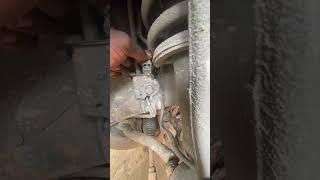
- Seized or Broken Sensor Linkage Arm (Very Common) — The sensor connects to the suspension via a small linkage arm with ball joints. These joints seize from rust, snapping the arm 🎬 See how to repair a broken sensor linkage arm. and causing the sensor to send a fixed, out-of-range signal.
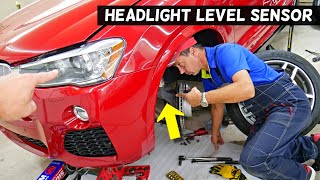
- Corroded Wiring or Connector (Common) — Located in the wheel well, 🎬 Watch: Where to find the headlight level sensor on your car. the sensor's wiring harness and connector are highly susceptible to damage from road debris and salt, leading to a poor connection, a short to ground, or a broken circuit.
- Incorrect Sensor Installation (Common) — After suspension repairs, mechanics often reinstall the sensor's linkage arm upside down or leave it unplugged. This forces the sensor to output a fixed, out-of-range voltage, triggering the fault code.
- Failed Power Liftgate Touch Sensor (Nissan) (Common) — On specific Nissan models (Pathfinder, Rogue), this code points directly to a failure of the touch sensor strip on the power liftgate, preventing automatic operation.
- Uncalibrated Suspension Modification (Less Common) — Lifting or lowering the suspension changes the base reading of the height sensor. If the system is not recalibrated with a diagnostic tool, the control module flags the new default output as out of range.
- Failed Control Module (ECU) (Rare) — The computer module that reads the sensor's data occasionally fails. This is the last component to suspect after thoroughly testing the sensor and wiring.
Symptoms
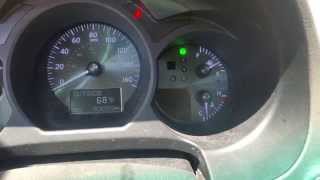
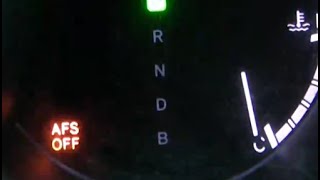
- Flashing AFS OFF Light — On Toyota, Lexus, and Subaru, a flashing 'AFS OFF' or headlight 🎬 Watch: A quick fix for the flashing AFS light. symbol on the dashboard indicates the automatic leveling system is disabled.
- Headlights Aimed Severely Low — The AFS system defaults the headlights to their lowest position to avoid blinding other drivers, resulting in dangerously poor forward visibility at night.
- Headlights Fail Startup Self-Test — Vehicles with AFS perform a self-check at startup, sweeping the headlights up and down. This sequence stops working when code B2416 is active.
- Incorrect Ride Height (Air Suspension) — A failed sensor causes one corner of an air-suspended vehicle to stick too high or too low, resulting in an uneven stance and a harsh ride.
- Power Liftgate Inoperative (Nissan) — The automatic rear door fails to open or close when using the exterior touch sensor on affected Nissan models.
- Brake Warning Light or HVAC Clicking (Hyundai) — Hyundai vehicles display an ABS/ESC warning light for brake sensor faults, or emit a repetitive clicking noise from the dashboard for HVAC actuator faults.
- Stuck Sensor Voltage (scan-tool only — no driver-felt sign) — When viewing live data on a scan tool, the height sensor voltage remains static when the suspension is compressed, confirming a failed sensor or circuit.
Diagnostic Flowchart
Tap your situation to follow the diagnostic path that matches what you're seeing on this code.
Common Fixes & Costs
- Replace Ride Height Sensor — Parts: $40-$450, Labor: $75-$150, ~0.8 hr book time (DIY)
- Replace Ride Height Sensor Linkage Arm — Parts: $20-$80, Labor: $50-$100, ~0.5 hr book time (DIY)
- Perform System Initialization/Calibration — Parts: $0, Labor: $100-$200, ~1.0 hr book time (Professional)
- Repair Wiring or Replace Connector Pigtail — Parts: $15-$50, Labor: $125-$300, ~1.5 hr book time (Intermediate)
- Replace Power Liftgate Touch Sensor (Nissan) — Parts: $100-$300, Labor: $150-$250, ~1.2 hr book time (Intermediate)
Used vs. New Parts: Buying Guide
When a used part is worth it: A used OEM sensor from a low-mileage, non-rust-belt donor is cost-effective if a new OEM part exceeds $400. Avoid used parts if the failure mode is corrosion-related.
Donor-vehicle mileage cap: roughly under 80000 miles for the part to have meaningful remaining life.
Donor quality checklist:
- Verify the donor vehicle is from a dry, southern climate.
- Ensure the part number matches exactly.
- Inspect photos for cracked plastic or rust on the linkage arm.
Decision logic:
- If An OEM-supplier part (e.g., Aisin) is available for $150-$250 → Buy the new OEM-supplier part for the best balance of quality and cost.
- If Vehicle has over 150K miles and budget is tight → Buy a used part from a reputable salvage yard with a 90-day warranty.
- If Options are limited to a $40 no-name part or a $500 OEM part → Favor the OEM part if long-term reliability is critical to avoid repeat labor.
Warranty tradeoff: Used parts carry a 30-90 day warranty. Aftermarket parts offer 1-year to lifetime warranties. New OEM parts carry a 1-year warranty.
Worst-case if a used part fails: $200-$400 if a cheap aftermarket part fails prematurely, requiring a second repair.
What Happens If You Wait — Timeline
- Immediately: The 'AFS OFF' warning light flashes. Headlights default to their lowest aim, severely reducing night visibility. (MPG impact: 0%% · Added cost: $0)
- 0-12 months: Vehicle fails annual state safety inspections. Driver risks receiving a 'fix-it ticket' for improper equipment. (MPG impact: 0%% · Added cost: $50-$250)
- 6-18 months (Air Suspension Models): Incorrect height data causes the air compressor to run excessively, leading to premature compressor burnout. (MPG impact: 0-2%% · Added cost: $800-$1,500)
- 12+ months (Air Suspension Models): Uncorrected uneven ride height causes abnormal tire wear due to poor alignment geometry, requiring premature tire replacement. (MPG impact: 0%% · Added cost: $400-$1,200)
Cost of Not Fixing It
- Immediately: Significantly reduced nighttime visibility due to headlights defaulting to their lowest position. Increases the risk of out-driving your headlights. (Added cost: $0)
- 0-6 months: Failure of state safety inspections in states like New York and Texas. Potential for a traffic citation for improper equipment. (Added cost: $50-$250)
- 6+ months: On air suspension models, bad sensor data causes the air compressor to run excessively, leading to premature compressor burnout and uneven tire wear. (Added cost: $800-$1500)
Diagnosis Steps
- Confirm the Definition for Your Vehicle
Perform an online search for your specific Make, Model, Year, and 'B2416' to confirm the affected system. Diagnosing a headlight sensor on a Nissan with this code wastes time.
Tools: Smartphone or Computer (Beginner) - Visually Inspect the Sensor and Linkage
Locate the ride height sensor near the rear lower control arm. Check for a broken plastic linkage arm, a cracked sensor body, or a connector filled with green corrosion.
Tools: Flashlight, Jack, Jack Stands (Beginner) - Read Live Data with a Scan Tool
Use an advanced OBD-II scanner to access Body Control Module (BCM) live data. Observe the 'Height Control Sensor' voltage. Bounce the vehicle's corner; the reading must change smoothly. A stuck value (0.0V or 5.0V) confirms a failure.
Tools: Advanced OBD-II Scanner (Intermediate) - Check System Fuses
Locate the fuse for the 'AFS', 'ECU-IG', 'Suspension Control Module', or 'Power Back Door' system in the owner's manual. Replace any blown fuses.
Tools: Owner's Manual, Fuse Puller (Beginner) - Test the Connector for Power and Ground
Unplug the sensor. With the ignition on, use a multimeter to check for a 5-volt reference signal on one pin and a solid ground on another. Missing power or ground indicates a wiring problem upstream, not a bad sensor.
Tools: Multimeter, Wiring Diagram (Intermediate) - Benchmark Sensor Voltage vs. Position
Back-probe the signal wire with the sensor plugged in. A healthy Toyota/Lexus sensor reads ~2.5V at neutral height, sweeps toward 4.5V when compressed, and drops toward 0.5V when extended. Static voltage means the sensor is dead.
Tools: Multimeter with Back-Probes (Advanced) - Test Sensor Internal Resistance
Disconnect the sensor and measure resistance between terminals 1 and 3. A Toyota/Lexus rear sensor should read 25.5kΩ ± 6kΩ. An open circuit (infinite resistance) or dead short (near zero ohms) confirms internal failure.
Tools: Multimeter (Advanced) - Check for Wiring Continuity
Disconnect the sensor and the control module. Test for continuity on the signal wire between the two connectors (must be <1 Ω). Test resistance between the signal wire and ground to check for shorts (must be >10 kΩ).
Tools: Multimeter, Wiring Diagram (Advanced) - Verify ECU Power Output
If the sensor lacks a 5V reference, disconnect the AFS/Suspension ECU and test for 5V output directly at the ECU pin. If 5V is present at the ECU but not the sensor, the wiring is broken. If the ECU outputs nothing, the ECU has failed.
Tools: Multimeter, ECU Pinout Diagram (Professional)
When This Code Triggers (Freeze-Frame Conditions)
- System Status: Active/Failed (The ECU detects a malfunction in the sensor or circuit during a self-check.)
- Ignition Status: ON (The fault is detected shortly after startup during the AFS system initialization sequence.)
- Vehicle Speed: 0 mph or >15 mph (The check occurs at startup (0 mph) or during steady-state driving as the system monitors vehicle pitch.)
- Sensor Voltage: <0.2V or >4.8V (The height sensor signal voltage falls outside its expected range, indicating an open or short circuit.)
Related Codes
- B241A — Specific to Toyota/Lexus, B241A points to a fault in the sensor's signal circuit. B2416 indicates a power supply issue. They frequently trigger together, confirming a rear sensor circuit fault.
- C1761 — A suspension code for 'Abnormal Headlamp Leveling' or 'Compressor Relay Malfunction'. Triggers when the air compressor runs too long due to bad data from a faulty height sensor.
- B2417 — On Nissan vehicles, B2417 is the companion code indicating a fault in the 'Left touch sensor circuit' for the power liftgate.
- C1782 — Indicates an exhaust solenoid fault on air suspension vehicles. If paired with C1761, it points to a broader air suspension failure rather than just the height sensor.
Climate & Environmental Factors
- Road Salt and High Humidity: The height sensor and linkage sit on the undercarriage, directly exposed to road spray. In 'Rust Belt' regions, salt accelerates corrosion, seizing ball joints and destroying internal sensor seals.
- Extreme Temperature Swings: Constant heating and cooling cycles degrade the sensor's plastic housing and internal weather seals, allowing moisture to penetrate and short the circuit.
How to Talk to a Mechanic About This Code
Say this: "I have a [Vehicle Year, Make, Model] with a B2416 code and a flashing AFS light. Based on my research, this is likely an issue with the rear height control sensor, linkage, or wiring. Please start with a visual inspection and test for power at the sensor connector before recommending a replacement part."
This directs the technician to the most common, simple failure points first (linkage, wiring) instead of starting with time-consuming diagnostics. It sets the expectation for a proper diagnosis, not just a parts-cannon approach.
Avoid saying:
- 'My AFS light is on, can you fix it?'
- 'Just replace the height sensor.'
- 'Do whatever you think is best.'
Questions to ask before authorizing the repair:
- Did you find the failure in the sensor, the linkage, or the wiring?
- Did you confirm the sensor had power and ground before condemning it?
- Does your repair quote include the cost of the mandatory system initialization?
- Can you show me the broken or corroded part after the repair is complete?
Where to Take It: Dealer vs Independent vs Chain
- Dealer:
A safe but expensive option. The dealer guarantees the correct tools for the critical calibration step. Choose this if you prioritize a guaranteed fix over cost.
Best for: Vehicles under warranty., Repairs requiring manufacturer-specific tools for AFS initialization.
Downsides: Highest labor rates and OEM part prices., Prefers selling complete sensor assemblies over repairing linkages. (Typical cost: +50% vs. baseline) - Independent Shop:
The best fit for most owners. An independent specialist offers better pricing, but you must ask directly: 'Can you perform a Toyota AFS initialization?'
Best for: Out-of-warranty vehicles where cost is a factor., Shops specializing in your vehicle's brand.
Downsides: Quality varies widely., You must verify they own a bidirectional scan tool capable of performing AFS initialization. (Typical cost: +0% vs. baseline) - Chain Shop:
Avoid for this repair. They cannot perform the required calibration, leaving you with the same warning light and forcing a second shop visit.
Best for: Routine maintenance like oil changes and tires.
Downsides: Technicians lack experience with specific B-codes., Do not possess the bidirectional scan tools needed for calibration. (Typical cost: -10% vs. baseline)
When to Walk Away From the Repair
If the estimated repair cost exceeds 40-50% of the car's private-party value, seriously consider selling or trading in the vehicle instead of repairing it.
- Car worth $8000, fix is $950: Fix it. The repair cost is well below the threshold and is necessary for safety and state inspections.
- Car worth $3500, fix is $1200: Borderline. The cost approaches 40% of the car's value. Get a second opinion to see if a cheaper wiring repair is possible.
- Car worth $2000, fix is $1100: Walk away. The repair cost exceeds 50% of the vehicle's value. It is not economically sensible to proceed.
What Scan Tool You Need for This Code
Minimum: A scan tool that reads Body Control Module (BCM) codes and performs bidirectional control for system initialization.
A basic $20 OBD-II reader only scans the powertrain and cannot see B-series codes. Furthermore, basic scanners cannot perform the mandatory 'AFS Initialization' special function.
Budget: BlueDriver Pro (~$100) — Reads and clears BCM codes to confirm the fault. Lacks the bidirectional control needed for AFS initialization. Good for diagnosis, but cannot complete the repair.
Mid-range: Foxwell NT510 Elite (~$180) — The best choice for serious DIYers. With vehicle-specific software, it reads BCM codes, views live data, and performs the 'AFS Headlamp Reset' initialization function.
Professional: Autel MaxiCOM MK808S (~$450) — Offers full-system diagnostics, deep BCM access, and bidirectional control to test components and perform initializations across multiple vehicle makes.
Rent vs buy: Auto parts store rentals are basic readers and insufficient for this code. For a one-time fix, pay a shop for 1 hour of labor to perform the calibration. Buy a mid-range scanner only if you plan to do advanced DIY repairs.
How to Clear the Code After You Fix It
- Use a compatible OBD-II scan tool to clear the B2416 code from the AFS or Suspension control module.
- For Toyota/Lexus, perform the 'Headlight Leveling System Initialization' procedure using a bidirectional scan tool.
- Disconnecting the battery for 15 minutes clears the code temporarily but does not replace proper initialization.
Drive cycle (~20 minutes): A specific drive cycle is not required. The system re-checks at startup. For Toyota/Lexus, driving on a straight road for 2 minutes at 15-50 mph completes automatic calibration after initialization.
Readiness monitors affected: Not applicable. B-series codes do not affect emissions readiness monitors.
Watch out for:
- Failing to perform system initialization after replacing the sensor keeps the AFS light on.
- Using a basic code reader that only accesses the Powertrain Control Module (PCM) cannot clear BCM codes.
- Clearing the code without fixing the mechanical issue causes the code to return immediately.
Will This Fail Emissions / State Inspection?
No — by itself this code doesn't fail OBD inspection (but it can keep readiness monitors from setting, which causes a separate fail).
- California: B2416 does not fail the OBD-II emissions check. However, an illuminated 'AFS OFF' light fails the visual/functional check at the technician's discretion.
- New York: Safety inspections require proper headlight operation. An illuminated 'AFS OFF' warning light guarantees an inspection failure.
- Texas: Vehicle inspections check headlight aiming. A disabled auto-leveling system or persistent dashboard warning lamp results in failure.
Most Commonly Affected Vehicles
- Lexus RX Series (RX350, RX400h, RX450h) (2004-2015) — Extremely common failure due to rear sensor placement. Part number for 2010-2015 RX350 rear right sensor is 89407-48061.
- Lexus IS Series (IS250, IS350) (2006-2015) — Front and rear ride height sensors for the AFS system fail frequently.
- Lexus GS Series (GS300, GS350, GS430) (2006-2011) — Triggers the flashing AFS light due to a faulty rear height control sensor.
- Lexus LS Series (LS430, LS460) (2001-2012) — A well-documented failure point for both AFS and air suspension systems.
- Toyota Prius (2004-2015) — The rear height sensor linkage arm snaps frequently in rust-prone areas. The arm is available separately.
- Subaru Outback, Legacy, Forester, Impreza (2006-2014) — Uses a functionally identical headlight leveling sensor that fails often. Common part numbers are 84021-AG000 (front) and 84031-FG000 (rear).
- Nissan Pathfinder, Rogue, Patrol (2014-2024) — B2416 indicates an 'Open Circuit' in the power liftgate's right-hand touch sensor, unrelated to headlights.
- Hyundai Various (2010-2024) — B2416 indicates a 'Brake Fluid Pressure Sensor Power Supply Circuit' fault or an HVAC actuator issue.
Manufacturer-Specific Notes
- Toyota/Lexus: Replacing a height sensor or suspension component requires system initialization using a bidirectional scan tool. Without this, the AFS system remains disabled and the warning light stays on.
- Subaru: The headlight level sensor on 2006-2014 models is a high-failure part. TSB 07-58-10R addresses these sensors and provides updated replacement parts.
- Nissan: Code B2416 refers exclusively to the power liftgate touch sensor. Do not inspect suspension components on these vehicles.
- Toyota: Unplugging the headlight leveling ECU behind the glove box temporarily disables the 'Check Headlight System' warning on some Prius models, but permanently disables auto-leveling.
Real Owner Stories
2011 Lexus IS250 with B2416 after suspension work
The 'AFS OFF' light flashed and code B2416 appeared immediately after a shop performed suspension work.
What they tried:
- The mechanic checked for power, ground, and signal at the connector, finding all voltages normal.
Outcome: Visual inspection revealed the height sensor's linkage arm was installed upside down. Flipping the linkage to the correct orientation and clearing the codes resolved the issue instantly.
Lesson: If the code appears immediately after suspension repairs, the cause is an installation error, such as incorrect orientation or a disconnected plug.
2008 Lexus LS460 with a pristine-looking but faulty sensor
The 'AFS OFF' light blinked on a rust-free Florida car. A scan showed code B2416.
What they tried:
- The owner opened the rear height control sensor, finding no internal corrosion.
- They cleaned the contacts and disconnected the battery for 30 minutes, but the light remained.
Outcome: The sensor failed electronically despite its clean appearance. The fix required replacing the sensor and performing a system initialization.
Lesson: Visual inspections are not foolproof. Sensors fail electronically without visible corrosion. Battery disconnects do not fix hard faults.
2015 Subaru Outback with failed sensor after being rear-ended
After a rear-end collision, the headlights aimed extremely low and the 'Auto Headlight Leveler Disable' warning appeared.
What they tried:
- The owner manually re-aimed the headlights, but the warning light persisted.
Outcome: A dealership diagnosed a shattered rear suspension level sensor. The repair cost $295.
Lesson: Physical impacts from collisions or large potholes easily break the delicate sensor or linkage arm.
Subaru Forester with an easy, no-cost fix
The automatic headlight beam leveler warning light illuminated after a battery change.
What they tried:
- The owner sprayed the undercarriage sensors with electrical contact cleaner.
Outcome: After cleaning the sensors, the warning light disappeared permanently. Dirt and surface corrosion on the external connector caused the fault.
Lesson: Always try the simplest fix first. Thoroughly cleaning the sensor and connector resolves minor connection issues for almost no cost.
How to Prevent This Code From Triggering
- Clean the sensor and linkage (Twice per year, before and after winter) — Washing the undercarriage removes road salt. Spraying the sensor body and connector with electrical contact cleaner prevents poor connections.
- Apply a protective coating (Every 1-2 years) — Applying a lanolin-based spray (Fluid Film) creates a hydrophobic barrier that repels water and salt, slowing corrosion.
- Lubricate the linkage arm ball joints (Annually) — Applying water-resistant grease keeps the small ball joints moving freely, preventing them from seizing and snapping the arm.
- Visually inspect the linkage (Every 5,000 miles during tire rotations) — A quick visual check catches a bent or cracked linkage arm before it fails completely.
Frequently Asked Questions
Why is my AFS light still on after replacing the sensor?
The control module requires a new 'zero' position. This initialization process requires a professional bidirectional scan tool. Without it, the computer retains the fault code and disables the system.
What voltages should I look for when testing the sensor?
A typical 3-pin sensor has a 5V reference, ground, and signal wire. The signal outputs ~0.5V when fully extended, ~2.5V at normal height, and ~4.5V when fully compressed.
Can I use a used or aftermarket height sensor?
Yes, aftermarket or used OEM sensors save hundreds of dollars. Prioritize OEM-supplier brands like Aisin for reliability. Regardless of the part used, you must perform a system initialization after installation.
Why does my car have a ride height sensor without air suspension?
Modern vehicles with HID or LED headlights use this sensor for the Automatic Front-lighting System (AFS). It adjusts headlight aim based on vehicle load. This keeps the beams focused on the road instead of blinding oncoming traffic.
Can I unplug the AFS module to clear the light?
Unplugging the leveling ECU disables the dashboard warning light but also disables the entire auto-leveling system. Your headlights remain stuck in their lowest position, creating a severe nighttime safety hazard. This is a dangerous bypass, not a repair.
What is the most common misdiagnosis for B2416?
Mechanics often replace the sensor without checking for a corroded connector or seized linkage arm. Another major error is failing to perform the mandatory post-repair software initialization. Finally, diagnosing the suspension on a Nissan when the code refers to the liftgate wastes time and money.
Key Takeaways
- Code B2416 has multiple meanings; verify your vehicle's specific definition before diagnosing, as it ranges from Toyota headlight sensors to Nissan liftgate touch strips.
- On Toyota, Lexus, and Subaru vehicles, B2416 almost always indicates a failed rear ride height sensor or a seized linkage arm caused by undercarriage corrosion.
- Replacing the ride height sensor requires a mandatory software initialization using a bidirectional scan tool; skipping this step leaves the 'AFS OFF' light flashing.
- Repair costs range from $40 for a DIY linkage arm replacement to over $800 for a dealer-installed OEM sensor and calibration.
Helpful Videos
Shop the Parts Behind B2416
Below are the parts most often responsible for code B2416, ranked by how frequently each one is the actual culprit (per the diagnosis above). Tap any to see what we have for your vehicle.



The information in this article is provided for general reference and educational purposes only. Vehicle specifications, procedures, and part compatibility can vary by production date, trim level, and region. Always consult your vehicle's factory service manual and verify part numbers before purchasing or performing repairs. Safety-critical components such as airbags, seat belts, and braking systems should be installed by a qualified professional.
- 🧭 Diagnostic Flowchart
- 🎬 Helpful Videos
- 🛍️ Shop This Part
- What Does B2416 Mean?
- Can I Drive With B2416?
- Common Causes
- Symptoms
- Common Fixes & Costs
- Used vs. New Parts: Buying Guide
- What Happens If You Wait — Timeline
- Cost of Not Fixing It
- Diagnosis Steps
- When This Code Triggers (Freeze-Frame Conditions)
- Related Codes
- Climate & Environmental Factors
- How to Talk to a Mechanic About This Code
- Where to Take It: Dealer vs Independent vs Chain
- When to Walk Away From the Repair
- What Scan Tool You Need for This Code
- How to Clear the Code After You Fix It
- Will This Fail Emissions / State Inspection?
- Most Commonly Affected Vehicles
- Manufacturer-Specific Notes
- Real Owner Stories
- 2011 Lexus IS250 with B2416 after suspension work
- 2008 Lexus LS460 with a pristine-looking but faulty sensor
- 2015 Subaru Outback with failed sensor after being rear-ended
- Subaru Forester with an easy, no-cost fix
- How to Prevent This Code From Triggering
- Frequently Asked Questions
- Why is my AFS light still on after replacing the sensor?
- What voltages should I look for when testing the sensor?
- Can I use a used or aftermarket height sensor?
- Why does my car have a ride height sensor without air suspension?
- Can I unplug the AFS module to clear the light?
- What is the most common misdiagnosis for B2416?
- Key Takeaways
- 🎟️ Get 5% Off