

OBD-II Code B2427: Power Liftgate/Trunk Sensor Fault
What B2427 means, why it triggers, and how to fix it
- Code B2427 indicates a right-side power liftgate fault, most commonly a failed spindle motor on Nissan/Infiniti models or a faulty anti-pinch strip on Hyundai/Kia vehicles.
- Never replace the $400+ spindle motor without first checking the glovebox master switch, testing the 12V battery, and inspecting the motor's electrical connector for spread terminals.
- Dealerships frequently quote over $1,200 to replace both liftgate motors, but replacing only the failed right-side unit with a $200 used OEM part resolves the issue for a fraction of the cost.
- Operating the liftgate manually is safe, but a failed spindle motor cannot support the hatch's weight, creating a severe injury risk if the 100-pound door falls unexpectedly.
What Does B2427 Mean?

Code B2427 indicates the Body Control Module (BCM) or Power Tailgate Module (PTGM) detects a fault with a right-side power liftgate sensor. Depending on the manufacturer, this is either the motor's position sensor (spindle sensor) or the anti-pinch safety sensor. The computer triggers this code when the sensor signal is missing, incorrect, or shows an open circuit.
Technical definition: The SAE/ISO definition for B2427 is manufacturer-specific. Nissan/Infiniti defines it as 'SPINDLE SENSOR RH' (right lift motor position sensor fault). Hyundai/Kia defines it as 'Right Pinch Strip Open or Stuck High' (weather seal safety sensor fault). Toyota uses it for a 'CAN Communication Malfunction'. Certain Kia models use it for 'VVT solenoid A circuit high input' (an engine fault). Always verify the exact definition for your specific model.
Can I Drive With B2427?
Yes. Yes. This code disables the automatic power liftgate, which does not impact engine performance or primary safety systems. However, you must operate the trunk manually. A significant safety risk exists: the failed components cannot support the heavy liftgate's weight, causing it to fall unexpectedly and potentially cause injury.
Common Causes

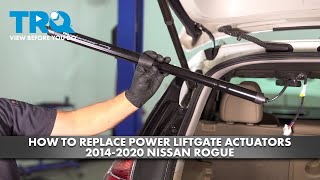
- Failed Right Power Liftgate Spindle/Motor Assembly (Very Common) — This is the primary cause on Nissan and Infiniti vehicles. The electric motor and integrated Hall effect position sensor assembly that lifts the right side of the gate fails internally, requiring replacement of the entire unit. 🎬 Watch this step-by-step guide to replacing the liftgate actuators.
- Spread or Damaged Connector Terminals (Common) — The female terminal in the wiring harness connector for the spindle motor spreads apart, creating a poor or intermittent connection. This mimics a failed motor but only requires a terminal repair.
- Weak or Failing Vehicle Battery (Common) — Low or unstable battery voltage causes the power liftgate controller to malfunction and set fault codes. The liftgate system is one of the first features to fail when a battery weakens due to its high power draw.
- Damaged or Corroded Wiring Harness (Common) — The wiring harness running to the liftgate flexes constantly and pinches, frays, or corrodes. This occurs most often inside the flexible rubber conduit between the body and the hatch, creating an open or short circuit.
- Failed Right Anti-Pinch Sensor Strip (Less Common) — On Hyundai and Kia vehicles, this sensor is a rubber strip around the opening that detects obstructions. If the strip or its internal wiring sustains damage or sees an incorrect voltage, it sets this code and disables the power closing feature.
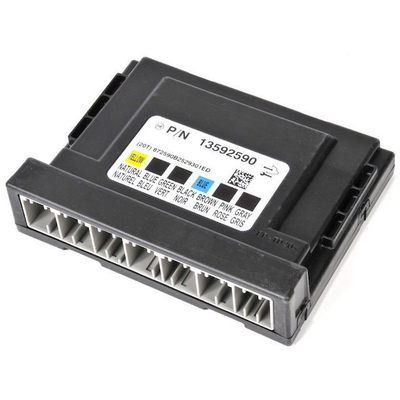
- Faulty Automatic Back Door Control Module (Rare) — The control module that operates the liftgate fails internally. Nissan issues Technical Service Bulletins (TSBs) where replacing this module is the required fix for certain models.
- Control Module Needs Calibration (Rare) — The system's memory or calibration corrupts, often after a battery replacement. A simple recalibration procedure or a software update from the dealer resolves the issue without replacing parts.
Symptoms

- Power liftgate will not open or close — The primary symptom is a complete failure of the power liftgate to operate when commanded by the key fob, dashboard button, or gate switch.
- Multiple warning beeps when trying to operate — The vehicle emits a series of warning chimes (typically three consecutive beeps) indicating the power liftgate system has a fault and is disabled.
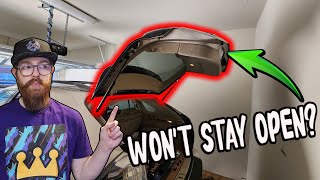
- Power liftgate droops and will not stay open — Internal failure of the motor assembly prevents it from holding the weight of the liftgate, causing it to slowly drift down or fall shut. 🎬 See how to fix a liftgate that won't stay open.
- Grinding or growling noise during operation — A failing spindle motor makes a loud, unusual grinding or growling sound as it struggles to operate.
- Power liftgate opens partially then closes — The gate starts to open, moves a few inches, then reverses and closes, or simply stops in place.
- Liftgate works intermittently — The power liftgate works correctly in certain temperatures or randomly, pointing to a poor electrical connection rather than a completely failed motor.
Diagnostic Flowchart
Tap your situation to follow the diagnostic path that matches what you're seeing on this code.
Common Fixes & Costs
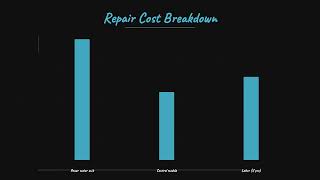
- Replace Right Power Liftgate Spindle/Motor — Parts: $250-$600, Labor: $150-$300, ~1.5 hr book time (Intermediate)
- Repair Damaged Wiring Harness or Connector Terminal — Parts: $10-$50, Labor: $150-$300, ~2.0 hr book time (Advanced)
- Replace Both Left and Right Spindles — Parts: $500-$1200, Labor: $250-$450, ~2.5 hr book time (Intermediate)
- Replace Right Anti-Pinch Sensor Strip — Parts: $100-$200, Labor: $150-$300, ~1.5 hr book time (Intermediate)
- Replace Automatic Back Door Control Unit — Parts: $300-$600, Labor: $100-$200, ~1.0 hr book time (Intermediate)
Used vs. New Parts: Buying Guide
When a used part is worth it: Due to the high cost of new OEM spindle motors ($250-$600+ per side), a quality used OEM part from a reputable auto recycler is an excellent, cost-effective alternative for out-of-warranty vehicles.
Donor-vehicle mileage cap: roughly under 100000 miles for the part to have meaningful remaining life.
Donor quality checklist:
- Match the OEM part number exactly. Superseded numbers are not always compatible.
- For Nissan/Infiniti, verify if the donor vehicle is US-built (VIN starts with 1, 4, 5) or Japan-built (VIN starts with J) as parts are not interchangeable.
- Ensure the seller offers a functional warranty (30-90 days is standard).
- Avoid parts with visible damage to the housing or connectors.
Decision logic:
- If Vehicle is under factory or extended warranty → Use warranty for a new OEM part and professional installation.
- If Vehicle is out of warranty and budget is a primary concern → A used OEM part is the best value. Aftermarket parts are an option but have lower long-term reliability than OEM.
Warranty tradeoff: Used OEM parts typically come with a 30-90 day functional warranty. New aftermarket parts range from 1-year to lifetime warranties. New OEM parts typically carry a 1-year/12,000-mile warranty.
Worst-case if a used part fails: $250-500 if a used part fails after the warranty period, requiring repeat labor costs plus another replacement part.
What Happens If You Wait — Timeline
- 0-1 month: Initial fault occurs. The power liftgate becomes inoperative, accompanied by warning beeps. The gate must be operated manually, presenting a major safety risk of falling. (MPG impact: 0%% · Added cost: $0)
- 1-3 months: A parasitic battery drain develops if the fault is due to a shorted wire. Strain increases on the working left-side motor. (MPG impact: 0%% · Added cost: $50-$250 (for battery testing and potential replacement))
- 3-12 months: The opposing left-side liftgate motor fails prematurely from counteracting the failed side. The liftgate has no power assistance and is very difficult to open. (MPG impact: 0%% · Added cost: $600-$1100 (cost of the second motor replacement))
- 12+ months: Prolonged moisture intrusion in the flexible conduit leads to severe corrosion, shorting out and damaging the Automatic Back Door Control Unit. (MPG impact: 0%% · Added cost: $1000-$1800+ (cost of a new control module plus complex wiring harness repair))
Cost of Not Fixing It
- 0-1 month: Inconvenience and major safety risk. The liftgate must be operated manually and cannot support its own weight, risking injury. Potential for parasitic battery drain exists. (Added cost: Negligible)
- 1-6 months: Increased strain on the opposing left-side liftgate motor causes it to fail prematurely. A persistent parasitic draw reduces the lifespan of the vehicle's 12V battery. (Added cost: $200-$400 (for premature battery replacement))
- 6+ months: If the cause is a damaged wiring harness, continued moisture ingress leads to severe corrosion, damaging the control module and requiring complex electrical repairs. (Added cost: $600-$1500+ (for module replacement and advanced wiring repair))
Diagnosis Steps
- Check the Power Liftgate Master Switch
Locate the master switch in the glove box or on the lower dashboard that disables the power liftgate system. Ensure this switch is in the 'ON' position before proceeding.
Tools: None (Beginner) - Perform a System Hard Reset
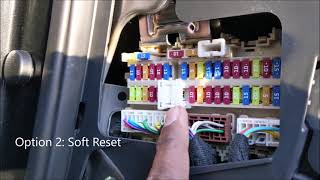
Disconnect the negative terminal of the vehicle's 12V battery for at least 30 minutes to clear electronic glitches. Reconnect it and test the liftgate. Perform a manual re-initialization procedure if required by your model.
Tools: 10mm wrench (Beginner) - Listen and Observe Operation
Operate the power liftgate while listening at the rear of the vehicle. Note any grinding noises and which side they originate from. A noise from the right side confirms a failed right spindle motor.
Tools: None (Beginner) - Visually Inspect Wiring and Conduit
Open the liftgate manually. Inspect the flexible rubber conduit between the body and the liftgate for cracking, pinching, or exposed wires. Check the anti-pinch rubber strips for visible damage.
Tools: Flashlight (Beginner) - Check for Technical Service Bulletins (TSBs)
Search online for TSBs for your specific vehicle's make, model, and year related to code B2427. Manufacturers like Nissan and Infiniti provide specific repair instructions for this exact code.
Tools: Smartphone or computer (Intermediate) - Test Spindle/Sensor Circuit and Terminals
Access the wiring connector for the right liftgate spindle motor. Inspect the female terminals for 'spread' or damage causing a poor connection. Use a multimeter to check for proper voltage, ground, and resistance according to the wiring diagram.
Tools: Multimeter, trim removal tools, wiring diagram, terminal tension test pins (Advanced) - Monitor Pinch Strip Voltage (Hyundai/Kia)
For Hyundai/Kia models, use a scan tool to monitor live data for 'Right Pinch Strip Voltage'. Normal voltage is under 3.6V. A reading over 3.66V for more than 600ms confirms a fault in the sensor circuit.
Tools: Professional OBD-II Scan Tool (Advanced) - Test Pinch Strip Resistance (Hyundai/Kia)
Disconnect the anti-pinch sensor. Measure resistance between the two terminals. A Hyundai Veracruz specifies ~6.2 kOhms uncompressed, dropping to ~500 Ohms when compressed. Infinite resistance indicates a failed sensor strip.
Tools: Multimeter, trim removal tools (Advanced) - Scan and Recalibrate the System
Use a bidirectional scan tool to access the Automatic Back Door Control Module. Check for related codes, then perform a system recalibration or initialization procedure as described in the factory service manual.
Tools: Bidirectional OBD-II Scan Tool (Professional)
When This Code Triggers (Freeze-Frame Conditions)
- Battery Voltage: 11.5V - 12.5V (During an open/close attempt with engine off. Voltage drop is a key trigger.)
- Command Source: Active (Fault logged when a signal is received from the key fob, dashboard switch, or liftgate button.)
- Vehicle Gear: Park (System must confirm vehicle is in Park to operate; fault sets if this signal is missing or invalid.)
- Sensor Signal (RH): Missing or Erratic (The module expects a specific sequence of pulses from the spindle sensor and sets the code when the signal is absent or incorrect.)
Related Codes
- B2426 — The identical fault for the left-side spindle sensor ('SPINDLE SENSOR LH'). It frequently appears alongside B2427. Diagnosis is a mirror image, focusing on the left motor.
- B2417 — Means 'TOUCH SEN L OPEN' and refers to the left anti-pinch touch sensor. Triggered with B2427 if there is a general wiring or module issue.
- B2422 — Relates to 'Back door state' or 'Drive Motor Short Low'. Indicates a general logic or motor circuit problem, pointing strongly towards a failing control module or major wiring short.
- B2437 — Defined as 'Spindle Motor RH,' pointing directly to a fault within the motor's drive circuit (high current draw) rather than the sensor signal. The repair is identical: replace the right spindle unit.
Climate & Environmental Factors
- Cold Weather: Low temperatures reduce the effectiveness of gas support struts, putting extreme strain on the electric motors. Wiring and plastic components become brittle and crack inside the flexible conduit.
- High Humidity / Salt: Moisture and road salt accelerate corrosion on wiring connectors, grounds, and the liftgate strut bodies. Nissan issued a recall (NHTSA #16V219000) for 2014-2016 Rogues due to insufficient anti-corrosion coating on liftgate stays.
How to Talk to a Mechanic About This Code
Say this: "I have an OBD-II code B2427 on my [Your Car's Make and Model]. I'd like to schedule a diagnostic appointment. Based on my research, this code points to a fault with the right-side power liftgate system. Please specifically check the [spindle motor connector/pinch strip sensor] before recommending a full component replacement."
This directs the technician to the most likely failure points, preventing a broad, expensive diagnostic process. It avoids misdiagnosis on brands where B2427 has multiple meanings.
Avoid saying:
- 'My trunk isn't working, can you fix it?' (Too vague, invites costly diagnosis).
- 'Just replace whatever is broken.' (Gives the shop a blank check to replace expensive assemblies).
- 'I think the motor is bad.' (State the code and symptoms instead to ensure a proper diagnostic path).
Questions to ask before authorizing the repair:
- Did you check for Technical Service Bulletins (TSBs) related to this code for my vehicle?
- If recommending a motor replacement, did you inspect the electrical connector terminals for looseness or corrosion?
- If recommending a pinch strip replacement (Hyundai/Kia), what was the voltage or resistance reading?
- Can you show me the damaged part or the diagnostic reading that confirms the failure?
- What is the warranty on the recommended parts and labor?
Where to Take It: Dealer vs Independent vs Chain
- Dealer:
Recommended if the vehicle is under warranty or if initial diagnosis by an independent shop is inconclusive.
Best for: Vehicles under factory or extended warranty., Complex cases where manufacturer-specific TSBs or software updates are the likely fix., When the code's meaning is ambiguous and requires a dealer-level scan tool.
Downsides: Highest labor rates and parts costs., More inclined to replace an entire assembly rather than repairing a wire. (Typical cost: +50% vs. baseline) - Independent Shop:
Best fit for most out-of-warranty repairs, provided you choose a reputable shop with modern equipment.
Best for: Out-of-warranty vehicles, especially common models like the Nissan Rogue., Cost-conscious owners, as labor and parts costs are lower., Electrical repairs, as they are more willing to repair wiring or connectors.
Downsides: Shop quality and diagnostic capabilities vary greatly., May not have immediate access to the latest TSBs or required software updates. (Typical cost: +0% vs. baseline) - Chain Shop:
AVOID for this code. The diagnostic complexity is a poor match for the typical chain shop business model.
Best for: Simple, unrelated maintenance like oil changes or tire rotations.
Downsides: Technicians lack specialized diagnostic training for complex body electrical codes., High potential for misdiagnosis or upselling unnecessary parts. (Typical cost: -10% vs. baseline)
When to Walk Away From the Repair
If the total estimated repair cost exceeds 40-50% of the car's current private-party value, seriously consider selling or trading in the vehicle instead of repairing it.
- Car worth $11000, fix is $1200: Fix it. The repair cost is 11% of the car's value, well below the walk-away threshold.
- Car worth $4500, fix is $2000: Walk away. The repair cost is 44% of the vehicle's value. It is not a sound financial decision to invest that much into an older car for a convenience feature.
What Scan Tool You Need for This Code
Minimum: A scanner that reads manufacturer-specific 'B' (Body) trouble codes and views live data from the Body Control Module or Power Tailgate Module.
A basic $20 code reader only shows 'P' (Powertrain) codes and will not see B2427. You need a tool that communicates with the liftgate module and reads its specific data streams.
Budget: BlueDriver Pro Scan Tool (~$100) — Reads and clears Body codes like B2427. Displays live data from the liftgate module to check pinch strip voltage or spindle sensor signals.
Mid-range: Foxwell NT510 Elite (~$180) — Offers bidirectional control to command the liftgate to open/close and perform the required system re-initialization or calibration after a part replacement.
Professional: Autel MaxiCOM MK808 / Launch CRP919 (~$450-600) — Provides full professional-level bidirectional control and OEM-level diagnostic functions. Accesses all modules, performs advanced coding, and runs any required calibration for module replacement.
How to Clear the Code After You Fix It
- Use an OBD-II scan tool to clear 'B' (Body) codes from the BCM or Power Tailgate Module.
- Perform a 'hard reset' by disconnecting the negative battery terminal for at least 15 minutes to clear volatile memory.
- Perform a system initialization/calibration procedure as specified by the manufacturer.
Drive cycle (~5 minutes): Manually move the liftgate to the fully open position. Press and hold the close button on the liftgate edge until it beeps to re-learn the position. Allow the gate to power-close fully. Test operation using all methods through one full open and close cycle.
Readiness monitors affected: Not Applicable. Body codes like B2427 do not affect emissions readiness monitors.
Watch out for:
- Clearing the code with a scan tool will not fix the problem; the code returns immediately if the hardware fault persists.
- After a battery disconnect, the system MUST be re-initialized, or it will not operate correctly even with new parts.
- Forgetting to check and re-enable the master power liftgate switch in the dashboard or glovebox after service.
Will This Fail Emissions / State Inspection?
No — by itself this code doesn't fail OBD inspection (but it can keep readiness monitors from setting, which causes a separate fail).
- California: This code will NOT cause a smog check failure. California's BAR-OIS inspection focuses on powertrain ('P') codes that illuminate the 'Check Engine' light.
- New York: This code will NOT cause an emissions inspection failure. The NY VIP3 inspection system scans for MIL-related faults, and B2427 does not command the MIL on.
- Texas: This code will NOT cause an OBD inspection failure. The inspection is for emissions-related powertrain codes only.
Most Commonly Affected Vehicles
- Nissan Rogue (2015-2020) — Extremely prone to premature failure of the power liftgate spindle motors. Newer 2021+ models use different parts for US-built (VIN starts with 1, 4, 5) vs. Japan-built (VIN starts with J) vehicles.
- Nissan Murano (2015-2018) — TSB NTB15-073d addresses B2427 by checking battery voltage, performing a system calibration, and potentially reprogramming or replacing the control unit.
- Infiniti QX50 / QX55 (2019-2022) — Subject to TSB ITB21-021 for B2427 caused by a faulty back door spindle producing a growling noise. The TSB advises replacing ONLY the failed spindle unit.
- Nissan Pathfinder (2019-2023) — TSB NTB23-034 for the 2023 model indicates B2427 is caused by a faulty Automatic Back Door Control Unit, not the spindle motor.
- Hyundai Veracruz / ix55 (2007-2012) — The code points to a failure of the 'Right Pinch Strip'. The module sets the code if the sensor circuit voltage exceeds 3.66V for more than 600ms.
- Kia Sorento (2011-2015) — B2427 points to a fault in the 'Right Pinch Strip' sensor circuit. On other Kia models, this code means 'VVT solenoid A circuit high input', an engine fault requiring extreme caution.
- Ford Explorer (2016-2019) — Widely known for power liftgate failures with identical symptoms caused by failing liftgate motors and wiring issues in the hatch hinge area, though they may log a different code.
- Chrysler / Dodge Town & Country / Grand Caravan (2008-2016) — Notorious for power liftgate failures due to broken wires in the flexible harness and failing motors, presenting identical symptoms.
Manufacturer-Specific Notes
- Nissan / Infiniti: This code almost always points to a failed right-side power liftgate motor (spindle). Before replacing the expensive motor, check for spread terminals in the connector and verify battery health to avoid misdiagnosis.
- Hyundai / Kia: B2427 refers to the 'Right Pinch Strip,' a safety sensor. Diagnostic focus is on checking the sensor strip and its wiring for high voltage readings (>3.66V) or incorrect resistance.
- Kia (Warning): CRITICAL: On some Kia models, B2427 is defined as 'VVT solenoid A circuit high input', an engine timing fault completely unrelated to the liftgate. Always verify the code definition with a model-specific service manual.
- Toyota / Lexus: B2427 means 'CAN Communication Malfunction' related to the lighting system (AFS) or another network module. Diagnosis involves troubleshooting the vehicle's communication network, not the liftgate.
- Ford / GM: This code is not typically used for power liftgates. A P-prefix code like P2427 refers to an EGR system fault. Consult a model-specific service manual.
Real Owner Stories
2018 Nissan Rogue at 75,000 miles
Power liftgate became completely inoperative. Pressing any button resulted in three beeps, but no movement. The gate opened manually but would not stay up.
What they tried:
- Checked the master switch in the glovebox (it was ON).
- Performed a battery disconnect/reconnect (hard reset) with no change.
- Dealer diagnosed a failed right-side spindle motor.
Outcome: The dealer quoted $1,200 to replace both spindles. The owner sourced a used OEM right-side spindle from an auto recycler for $220. Replacing only the failed right side restored perfect operation. Total cost was $220 and 2 hours of DIY labor.
Lesson: A complete failure with warning beeps on a Nissan Rogue strongly points to a failed spindle motor. You do not need to replace both, and a used OEM part saves hundreds of dollars.
2019 Infiniti QX50 with intermittent failure
The power liftgate worked fine for days, then failed to open or opened only a few inches. A 'growling' noise was heard from the right rear.
What they tried:
- Tested the battery, which was good.
- Inspected the wiring harness in the flexible conduit and found no damage.
- Wiggling the main connector to the right spindle motor temporarily resolved the issue.
Outcome: A mechanic identified a 'spread terminal' in the female connector for the right spindle motor. The terminal was re-tensioned and secured, avoiding a $600+ motor replacement. Repair cost was 1.5 hours of diagnostic labor ($225).
Lesson: Intermittent operation is often a sign of a bad electrical connection. Always inspect connectors for spread terminals before replacing expensive components.
2009 Hyundai Veracruz with power close disabled
The power liftgate opened automatically but would not power-close. Pressing the close button resulted in a beep, but no action. Code B2427 was stored.
What they tried:
- A hard reset and system re-initialization failed.
- A shop quoted for a new liftgate motor, misunderstanding the Hyundai-specific code definition.
- A second shop checked live data for 'Right Pinch Strip Voltage'.
Outcome: The scan tool showed Right Pinch Strip Voltage stuck at 4.9V, indicating an open circuit. The tech found a broken wire inside the rubber pinch strip. The right-side pinch strip assembly was replaced, restoring function. Total cost was $450.
Lesson: The same code means different things on different brands. On a Hyundai, B2427 points to the safety pinch strip, not the motor. Misdiagnosis leads to ordering the wrong parts.
How to Prevent This Code From Triggering
- Lubricate Liftgate Hinges and Strut Ball Joints (Every 12 months) — Reduces mechanical binding and strain on the hinges, lessening the load on the electric motors. Use a silicone or dry graphite lubricant.
- Maintain Full Battery Voltage (Ongoing) — The liftgate control module is highly sensitive to low voltage. Ensure regular long drives to fully charge the battery and use a battery tender if the vehicle sits.
- Periodically Inspect Wiring Conduit (Every 24 months) — Visually inspect the flexible rubber conduit between the body and the liftgate for cracks or tears to prevent moisture ingress and chafed wires.
- Keep Pinch Sensors and Latch Clean (During car washes) — Dirt or ice on the rubber pinch strips or latch mechanism causes false obstruction readings, preventing the gate from closing and stressing the system.
- Avoid Manually Forcing the Gate (Daily habit) — Manually pushing or pulling the gate against the motor's resistance strips internal gears and causes the system to lose its position calibration.
Frequently Asked Questions
Can I just replace the sensor instead of the whole liftgate motor?
No. On most vehicles, the position sensor is a non-serviceable Hall effect sensor integrated into the spindle motor assembly. The entire unit must be replaced.
Is it safe to open my trunk manually with code B2427?
Yes, manual operation is safe. However, the failed lift supports cannot hold the heavy gate open, creating a significant injury risk if it falls unexpectedly.
Why did my dealer quote me over $1,200 for this repair?
Spindle motor assemblies are costly parts ($250-$600+ each). Shops often recommend replacing both the left and right units simultaneously, driving the total parts and labor cost over $1,200.
Can a low battery cause code B2427?
Absolutely. A weak battery causes modules to receive low voltage, triggering body codes like B2427. The power liftgate system has a high current draw and is extremely sensitive to battery health.
My liftgate works fine sometimes but fails other times. Is it definitely a bad motor?
Intermittent failure is usually caused by a poor electrical connection, not a failed motor. The most likely culprits are a 'spread terminal' in the motor's electrical connector or a partially broken wire in the flexible harness.
Can I just reset the B2427 code to fix it?
Clearing the code will not fix a hardware or wiring fault; it will return immediately. A 'hard reset' by disconnecting the battery can clear a temporary electronic glitch, but it is not a permanent fix for a failed part.
My liftgate seems to be leaking fluid, is this related?
No. Power liftgate spindles are electric motor-driven actuators, not hydraulic. Any fluid is likely normal water drainage from rain or a car wash.
What's the difference between code B2427 and P2427?
B2427 is a Body code for the power liftgate. P2427 is a Powertrain code indicating an EGR Cooling Valve Control Circuit High issue. Confusing them leads to incorrect and expensive repairs.
My liftgate closes part way and then opens back up. Is that code B2427?
It is possible, but this symptom is commonly caused by a faulty latch sensor or anti-pinch sensors detecting a false obstruction. The latch and pinch sensors must be investigated alongside the spindle motor.
Key Takeaways
- Code B2427 indicates a right-side power liftgate fault, most commonly a failed spindle motor on Nissan/Infiniti models or a faulty anti-pinch strip on Hyundai/Kia vehicles.
- Never replace the $400+ spindle motor without first checking the glovebox master switch, testing the 12V battery, and inspecting the motor's electrical connector for spread terminals.
- Dealerships frequently quote over $1,200 to replace both liftgate motors, but replacing only the failed right-side unit with a $200 used OEM part resolves the issue for a fraction of the cost.
- Operating the liftgate manually is safe, but a failed spindle motor cannot support the hatch's weight, creating a severe injury risk if the 100-pound door falls unexpectedly.
Helpful Videos
Shop the Parts Behind B2427
Below are the parts most often responsible for code B2427, ranked by how frequently each one is the actual culprit (per the diagnosis above). Tap any to see what we have for your vehicle.




The information in this article is provided for general reference and educational purposes only. Vehicle specifications, procedures, and part compatibility can vary by production date, trim level, and region. Always consult your vehicle's factory service manual and verify part numbers before purchasing or performing repairs. Safety-critical components such as airbags, seat belts, and braking systems should be installed by a qualified professional.
- 🧭 Diagnostic Flowchart
- 🎬 Helpful Videos
- 🛍️ Shop This Part
- What Does B2427 Mean?
- Can I Drive With B2427?
- Common Causes
- Symptoms
- Common Fixes & Costs
- Used vs. New Parts: Buying Guide
- What Happens If You Wait — Timeline
- Cost of Not Fixing It
- Diagnosis Steps
- When This Code Triggers (Freeze-Frame Conditions)
- Related Codes
- Climate & Environmental Factors
- How to Talk to a Mechanic About This Code
- Where to Take It: Dealer vs Independent vs Chain
- When to Walk Away From the Repair
- What Scan Tool You Need for This Code
- How to Clear the Code After You Fix It
- Will This Fail Emissions / State Inspection?
- Most Commonly Affected Vehicles
- Manufacturer-Specific Notes
- Real Owner Stories
- 2018 Nissan Rogue at 75,000 miles
- 2019 Infiniti QX50 with intermittent failure
- 2009 Hyundai Veracruz with power close disabled
- How to Prevent This Code From Triggering
- Frequently Asked Questions
- Can I just replace the sensor instead of the whole liftgate motor?
- Is it safe to open my trunk manually with code B2427?
- Why did my dealer quote me over $1,200 for this repair?
- Can a low battery cause code B2427?
- My liftgate works fine sometimes but fails other times. Is it definitely a bad motor?
- Can I just reset the B2427 code to fix it?
- My liftgate seems to be leaking fluid, is this related?
- What's the difference between code B2427 and P2427?
- My liftgate closes part way and then opens back up. Is that code B2427?
- Key Takeaways
- 🎟️ Get 5% Off