

B2615 on 2011-2015 Chevrolet Volt: Causes and Fixes for Inoperative Lights and Camera
On a 2011-2015 Chevy Volt, code B2615 almost always means the 7.5A F7DR fuse has blown due to a short circuit in the wiring for the sun visor vanity mirror. The fix is to find and repair the chafed wire in the headliner and replace the fuse, costing under $10 for parts.
- B2615 on a 2011-2015 Volt is almost certainly caused by a short in the sun visor wiring.
- The primary symptom is a blown 7.5A F7DR fuse, leading to no reverse lights, no backup camera, and no dome lights.
- Do not simply replace the fuse; it will blow again. You must find and repair the shorted wire first.
- The repair is typically inexpensive if you can locate and fix the chafed wire yourself.
What's Unique About the 2011-2015 Chevrolet VOLT
The 2011-2015 first-generation Volt is uniquely prone to this specific failure. The wiring for the driver and passenger sun visor vanity lights (circuit 6815) is routed in a way that makes it susceptible to chafing and shorting out where the visor pivots. This issue became so common that General Motors issued multiple Technical Service Bulletins (TSBs), culminating in PIC5602C, to help technicians quickly diagnose the problem by pointing them directly to the blown F7DR fuse and the likely short in the sun visor wiring.
Diagnostic Flowchart
Tap your situation to follow the diagnostic path that matches what you're seeing on this vehicle.
Symptoms You May Notice
- Reverse lights do not work
- Backup camera is inoperative (black or blank screen)
- Interior dome lights do not turn on
- Vanity mirror/sunshade lights are inoperative
- Check Engine Light or other service message may be displayed
- Right Side Daytime Running Lamp (DRL) may be inoperative
- Replacing the backup camera
- Replacing the dome light assembly
- Replacing the Body Control Module (BCM) without first finding the short circuit
Most Likely Causes
- Shorted Sun Visor Wiring 🔴 High Probability The wiring for the illuminated vanity mirrors (circuit 6815) passes through the visor's pivot point. Repeated movement of the sun visor can cause the wire's insulation to wear through, creating a short to the metal chassis. This is the most common root cause for the B2615 code on this vehicle.
How to confirm: Inspect the wiring going into the driver's and passenger's sun visors. You will need to partially lower the front of the headliner. Look for pinched, frayed, or bare wires right where the wiring enters the pivot arm of the visor. A common test is to disconnect one visor, replace the fuse, and see if the short is gone. If the fuse blows again, disconnect the other visor and re-test.
Typical fix: Repair the damaged section of wire with a butt connector or by soldering and using heat-shrink tubing. Ensure the repaired wire is routed to prevent future chafing, potentially adding protective sheathing. In severe cases, or if the short is internal to the visor, the entire sun visor assembly must be replaced. 🎬 See this walkthrough on fixing the visor wiring and camera.
Est. part cost: $1-$10 for wire repair supplies, $40-$150 for a used or new sun visor assembly. - Blown F7DR 7.5A Fuse 🔴 High Probability This fuse is the direct consequence of the shorted wiring. It is designed to blow to protect the Body Control Module (BCM) and wiring from damage.
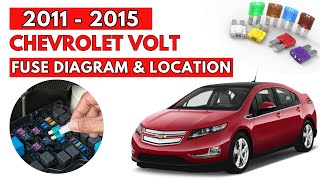
How to confirm: Locate the fuse box on the right side of the instrument panel (passenger side dash). 🎬 Watch: Locate and access your Volt's interior fuse panels. Remove and visually inspect the 7.5 amp mini fuse in the F7DR position. A multimeter set to continuity is the most reliable way to check if the fuse is blown.
Typical fix: Replace the fuse. IMPORTANT: If the underlying short circuit is not repaired first, the new fuse will blow immediately. This is a symptom, not the root cause.
Est. part cost: $1-$5 for a pack of fuses.
Rare But Worth Checking
- Faulty Body Control Module (BCM): → Shop Body Control Module This is extremely rare. The BCM is a robust computer. It should only be considered as the cause after all wiring has been meticulously inspected and confirmed to be free of shorts.
- Short in Dome Light or Reverse Light Harness: While less common than the sun visor issue, it's possible for the wiring to the dome light or reverse lights to become damaged or shorted, causing the same fuse to blow. One owner on a forum found the main rear harness connector had come loose over time, causing similar symptoms.
Diagnosis Steps
- Verify the symptoms: Confirm that the reverse lights, backup camera, and dome/vanity lights are all inoperative.
- Locate the interior fuse panel on the right side of the instrument panel, accessible by opening the passenger door.
- Identify and remove the F7DR 7.5A fuse. Visually inspect it, but preferably test for continuity with a multimeter to confirm it is blown.
- If the fuse is blown, do not replace it yet. The next step is to find the short circuit.
- Start with the most likely cause: the sun visor wiring. Carefully lower the front edge of the headliner to gain access to the wiring for both sun visors. This may involve removing the A-pillar trim.
- Visually inspect the wires (Circuit 6815) leading to each visor's pivot point for any signs of chafing, pinching, or bare copper. The damage is often right where the wire flexes.
- If a damaged wire is found, repair it using appropriate wire repair techniques (e.g., solder and heat shrink). Add protective tape or loom to the area.
- If no damage is visible, disconnect the electrical connector for the driver's side sun visor.
- Install a new 7.5A fuse and turn the ignition on. Check if the dome lights now work. If they do, the driver's side visor or its wiring is the cause.
- If the fuse blows again, disconnect the passenger side visor, reconnect the driver's side, and repeat the test with another new fuse.
- GM TSB PIC5602C suggests that if a visual inspection doesn't find the short, move each sun visor through its full range of motion (up/down, front/back) to see if the new fuse blows. If it does, replace that sun visor assembly.
- Once the short is repaired and the fuse no longer blows, re-secure the headliner and test all functions (reverse lights, camera, dome lights, vanity lights).
- If no short is found in the sun visor wiring, the harness must be inspected further back towards the BCM, dome light, and reverse lights, but this is much less common.
Parts You'll Likely Need
- Mini Fuse (7.5 Amp) — This fuse will be blown as a result of the short circuit and must be replaced after the repair is complete.
Trusted brands: Bussmann, ACDelco
OEM price range: $1-$5
Aftermarket price range: $1-$5 - Sun Visor Assembly
(OEM #22799876 (Gray, Right/Passenger), 20987261 (Gray, Right/Passenger), 22870329 (Gray, Left/Driver, superseded by 84247212))— If the wiring inside the visor itself is damaged beyond repair, or if the short is internal, the entire assembly must be replaced. Part numbers are color and side specific.
Trusted brands: ACDelco, Dorman
OEM price range: $100-$180
Aftermarket price range: $50-$120
Related Codes That Often Appear With This One
- B2545 — This code relates to the reverse lamps circuit. Since the same fuse (F7DR) and circuit power the reverse lamps, it may be set along with B2615 when the fuse blows.
Technical Service Bulletins (TSBs) & Recalls
- PIC5602C: Reverse/Dome Lamps And Back Up Camera Inoperative F7DR Fuse Open. (Supersedes PIC5602B and PIC5602A)
- PIC5602B: Reverse/Dome Lamps And Back Up Camera Inoperative F7DR Fuse Open.
- PIC5602A: Reverse lamps Inoperative, Rearview Back-Up Camera Inoperative ?If Equipped?, and Dome Lamps Inoperative.
Platform-Specific Known Issues
- GM Technical Service Bulletin PIC5602C specifically calls out this issue, noting that code B2615, inoperative reverse/dome/backup camera lights, and an open F7DR fuse are all linked. It advises technicians to inspect circuit 6815 going to the sun visors.
- Owner experiences on forums like gm-volt.com are numerous. One user noted, 'Fixed! It was the driver side visor wire, chafed right at the pivot point as described. A little bit of solder, heat shrink, and electrical tape and everything is back to normal.' Another confirmed, 'Passenger side for me. Fuse kept blowing until I unplugged it. Repaired the wire and it's been good for a year.'
Mechanic-Grade Diagnostic Values
- Resistance of Circuit 6815 to Ground — expected: Infinite resistance (Open Loop / O.L.). Failure: A reading of less than 1.0 Ohm indicates a short to ground.
- Voltage on Circuit 6815 — expected: Approximately 12V (Battery Voltage) when commanded ON by the BCM.. Failure: 0V. This indicates the circuit is not being powered, likely because the BCM's internal driver has shut down due to the short or the F7DR fuse is blown.
Hidden / Shadow Codes Worth Checking
- B2615 02: Passenger Compartment Dimming 2 Circuit Short to Ground. This is the specific symptom byte that a dealer-level scan tool will display, confirming the fault type. (see via GM GDS2 or equivalent professional scan tool.)
Scan Tool Commands That Help
- GM GDS2 (or equivalent): BCM > Output Control > Courtesy Lamps — This bidirectional command allows a technician to manually turn the affected circuit ON and OFF from the scan tool. This is used to test the BCM's ability to supply voltage and to check for a short without needing to open/close doors or manipulate switches. If the fuse blows when this is commanded ON, it confirms the short is in the external wiring/components.
Wiring & Ground Locations
- F7DR (7.5A) — Fuse block located on the right side of the instrument panel, accessible with the passenger door open.. This is the specific fuse that protects the affected circuit. A blown F7DR fuse is a primary symptom of the B2615 fault.
- Circuit 6815 — Wiring harness running from the BCM, up the A-pillar, and across the headliner to both the driver and passenger sun visors.. This is the Vanity Lamp Supply Voltage circuit. TSB PIC5602C explicitly identifies this circuit as the most common location for the short circuit.
- BCM Connector X5 — One of the main multi-pin connectors at the Body Control Module.. Service procedures may require testing for voltage or continuity at the BCM itself. The circuit powered by the F7DR fuse originates from this connector, allowing a technician to isolate the BCM from the vehicle's wiring harness.
- G103 — On the cowl in the engine compartment, typically above the brake booster.. This is a primary ground point for the Body Control Module (BCM). While the fault is a short to ground on a power wire, a poor BCM ground can cause a wide range of unpredictable electrical issues.
Real Owner Repair Stories
- gm-volt.com forum user (2011-2015 Chevrolet Volt (specific year not mentioned, but applies to Gen 1)) — Backup camera, reverse lights, and dome lights all stopped working simultaneously. B2615 code was present.
❌ Tried (didn't work) Replacing the F7DR fuse, which would blow again immediately upon turning the key.
✅ What actually fixed it Found a chafed wire in the harness leading to the driver's side sun visor, right at the pivot point. The wire's insulation was worn through and it was shorting to the metal chassis of the visor arm. The user repaired the wire with solder and heat shrink, wrapped it in electrical tape for extra protection, and replaced the fuse one last time. All functions were restored. - Reddit r/volt user (Chevrolet Volt (Gen 1)) — Backup lights and backup camera were inoperative.
❌ Tried (didn't work) Initial diagnosis focused on the front of the car, checking fuses and considering the common sun visor issue.
✅ What actually fixed it The root cause was a disconnected main harness plug located behind the rear bumper. After reconnecting the plug securely, all functions returned to normal. This highlights a less common but possible cause when the visor wiring appears intact.
"I Checked Everything" — The Actual Cause
- The diagnostic equivalent for this electrical code is 'visual inspection clean.' TSB PIC5602C specifically addresses this scenario. If a visual inspection of the sun visor wiring does not reveal a chafed wire, the next step is to replace the fuse and then physically move each sun visor through its full range of motion. If moving a specific visor causes the new fuse to blow, it indicates an intermittent short *inside* the visor assembly itself, which is not externally visible. The fix in this case is to replace the entire sun visor assembly.
When the Usual Fixes Don't Work
- While the vast majority of B2615 faults are caused by the sun visor wiring, there are documented cases where this was not the cause. One owner on Reddit reported identical symptoms (no backup camera or reverse lights) but found the cause to be a large, disconnected harness plug behind the rear bumper. This serves as a reminder that after ruling out the common sun visor cause, the entire circuit, including the portions running to the rear of the vehicle, must be inspected for damage or loose connections before condemning the BCM.
OEM Part Supersession History
22870329→84247212— Standard part evolution and design updates by the manufacturer.
Heads up: The full supersession chain for the gray, left/driver side visor is 22870329 -> 23198849 -> 23459646 -> 84247212. Using the latest part number (84247212) is recommended for replacement.
Model Year Variations Within This Range
- 2011-2015: While the B2615 failure mode related to the sun visor wiring is consistent across the entire first generation, there were minor year-to-year changes. For example, the 2014 model switched to a manual push-to-open charge port door, whereas earlier models had a powered release. There are also reported differences in CAN bus commands between model years, though this does not appear to alter the diagnosis for this specific body code.
Helpful Videos

The information in this article is provided for general reference and educational purposes only. Vehicle specifications, procedures, and part compatibility can vary by production date, trim level, and region. Always consult your vehicle's factory service manual and verify part numbers before purchasing or performing repairs. Safety-critical components such as airbags, seat belts, and braking systems should be installed by a qualified professional.
- Chevrolet VOLT:
- 🧭 Diagnostic Flowchart
- 🎬 Helpful Videos
- What's Unique About the 2011-2015 Chevrolet VOLT
- Symptoms You May Notice
- Most Likely Causes
- Rare But Worth Checking
- Diagnosis Steps
- Parts You'll Likely Need
- Related Codes That Often Appear With This One
- Technical Service Bulletins (TSBs) & Recalls
- Platform-Specific Known Issues
- Mechanic-Grade Diagnostic Values
- Hidden / Shadow Codes Worth Checking
- Scan Tool Commands That Help
- Wiring & Ground Locations
- Real Owner Repair Stories
- "I Checked Everything" — The Actual Cause
- When the Usual Fixes Don't Work
- OEM Part Supersession History
- Model Year Variations Within This Range
- 🎟️ Get 5% Off