

B3000 on 2012-2013 Mazda MAZDA3: Understanding This Uncertain Manufacturer Code
Code B3000 on a 2012-2013 Mazda3 is not a standard, defined fault. It most often indicates a scan tool error or a generic internal module fault. Before replacing any parts, re-scan the vehicle with a professional, Mazda-compatible tool like FORScan to find the true underlying code, which is often a 'U' (network) code or a more specific 'B' (body) code.
- B3000 is not a reliable or specific trouble code for a 2012-2013 Mazda3.
- The most common cause for seeing this code is an error from a generic OBD-II scanner.
- Do NOT replace any parts based solely on a B3000 reading.
- The first and most important step is to have the vehicle scanned with a professional, Mazda-compatible tool like FORScan to find the real fault.
- Do not confuse this code with the Mazda B3000 pickup truck.
What's Unique About the 2012-2013 Mazda MAZDA3
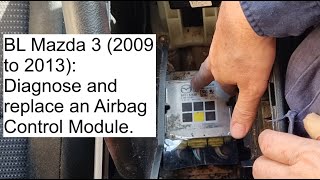
The 2012-2013 Mazda3 (second generation, or 'BL') shares its platform with the Ford Focus. On the related Ford, a B3000 code has been noted as an internal Restraints Control Module (RCM) 🎬 Watch this walkthrough on how to remove and replace the module. fault, which requires dealer-level tools to program or reset. While unconfirmed for the Mazda3, this suggests a generic scanner might misinterpret a similar module fault as B3000. The most critical point for this platform is the high likelihood of the code being a 'ghost' or phantom code from a non-professional scan tool. It's also crucial not to confuse this diagnostic code with the Mazda B3000 pickup truck, which is an entirely different vehicle mentioned in official Mazda service bulletins like MT-002-21a, adding to potential confusion.
Diagnostic Flowchart
Tap your situation to follow the diagnostic path that matches what you're seeing on this vehicle.
Symptoms You May Notice
- No symptoms directly linked to B3000, as it's often a scanner error.
- If an underlying fault exists, you may see other warning lights on the dashboard (e.g., airbag, ABS, check engine, or a wrench icon).
- Potential for various electrical issues if the Body Control Module (BCM) is the true source: wipers or lights acting erratically, parasitic battery drain, power locks/windows malfunctioning, or even a no-start condition due to immobilizer issues.
- If the Restraints Control Module (RCM) is the source, the airbag warning light will be illuminated. 🎬 See how to diagnose and replace a faulty airbag control module.
- Replacing the Body Control Module (BCM) based only on a B3000 code without further diagnosis.
- Attempting to diagnose an engine or transmission issue when B-codes relate to body electronics.
- Confusing the B3000 trouble code with the Mazda B3000 pickup truck, which is a separate vehicle referenced in Mazda TSBs like MT-002-21a.
Most Likely Causes
- Scan Tool Incompatibility or Error 🔴 High Probability Many consumer-grade OBD-II scanners cannot correctly interpret manufacturer-specific Body (B-series) or Network (U-series) codes for Mazda vehicles of this era, displaying B3000 as a placeholder or 'ghost code'.
How to confirm: Re-scan the vehicle with a different, high-quality scanner or a professional tool like FORScan or the Mazda M-MDS. 🎬 Watch: A step-by-step tutorial on using FORScan like a pro. If the code disappears or is replaced by a more specific code (like a U-code or another B-code with a suffix), the original reading was an error.
Typical fix: No repair is needed on the vehicle. The solution is to use a compatible scan tool for accurate diagnosis.
Est. part cost: $0 - Internal Fault in a Control Module (e.g., BCM, RCM) ⚪ Low Probability While less common, any electronic module can fail due to age, vibration, or internal component degradation. This would be the 'true' meaning of the code if it's not a scanner error.
How to confirm: A professional scan tool will retrieve a more specific code, such as U3000:49 (Control Module Internal Electronic Failure), and identify the module that set it (e.g., BCM, RCM, ABS).
Typical fix: If a module is confirmed to have an internal fault, it will need to be replaced and programmed to the vehicle's VIN. This is not a plug-and-play repair.
Est. part cost: $200-$900
Rare But Worth Checking
- Poor Power or Ground Connection to a Module: Corrosion or a loose connection can cause a module to behave erratically and log a generic internal fault. This is worth checking before replacing an expensive module. On some Ford/Mazda platforms, low module voltage (below 9V) can trigger fault codes.
- Damaged Wiring Harness (CAN Bus): A short or open in the vehicle's communication network can prevent modules from talking to each other, sometimes resulting in generic communication codes that a basic scanner might misinterpret as B3000.
Diagnosis Steps
- Acknowledge that B3000 is an uncertain code. Do not replace parts based on this code alone.
- Re-scan the vehicle with a professional, Mazda-compatible scan tool (like FORScan or a dealer-level tool) to get the true fault code(s). This is the most critical step.
- If no codes appear with the professional scanner, the B3000 was a 'ghost code' and no action is needed.
- If a specific code (e.g., U3000:49 in the BCM) is found, follow the diagnostic procedure for that specific code and module.
- Check for any Technical Service Bulletins (TSBs) related to the specific module and confirmed code. Software updates can sometimes resolve these issues without hardware replacement.
- If a module fault is confirmed, inspect the module's wiring and connectors for power, ground, and signs of damage or corrosion before condemning the module. Check for water intrusion, especially near the BCM in the passenger footwell area.
- If wiring is good, the module itself is likely faulty and requires replacement and programming. This must be done by a dealer or a qualified shop with the correct equipment.
Parts You'll Likely Need
- Body Control Module (BCM)
- Restraints Control Module (RCM)
Related Codes That Often Appear With This One
- U3000 — If B3000 is reported by a generic scanner, a professional tool may find the more specific U3000 code, which directly translates to 'Control Module Internal Electronic Failure'. The :49 suffix (Internal Electronic Failure) is common.
- U0xxx — Various U-codes (e.g., U0100, U0140 'Lost Communication With Body Control Module') indicate a loss of communication with a specific module. A generic scanner might misinterpret these network faults as a B3000.
- U0151 — This code for 'Lost Communication With Restraints Control Module (RCM)' could be misinterpreted by a generic scanner as B3000, especially given the B3000 code's association with the RCM on the Ford Focus platform mate.
Technical Service Bulletins (TSBs) & Recalls
- MT-002-21a: This TSB discusses fuel compatibility and mentions the Mazda B3000 truck, highlighting a common point of confusion with the B3000 trouble code. It does not apply to the Mazda3 vehicle fault.
Mechanic-Grade Diagnostic Values
- CAN Bus Network Resistance — expected: ~60 Ohms. Failure: A reading of ~120 Ohms indicates a missing termination resistor or a break in the wiring. A reading significantly lower than 60 Ohms (e.g., 40 Ohms) suggests an extra termination resistor or a shorted module. An open or very high resistance indicates a break in the CAN wiring.
Hidden / Shadow Codes Worth Checking
- U3000:49: Control Module Internal Electronic Failure. This is a more specific version of a generic internal fault code and is the likely 'true' code a professional scanner will find if B3000 is reported by a basic tool. (see via Mazda M-MDS (dealer tool), FORScan, or other professional-grade scan tools capable of reading manufacturer-specific codes from all vehicle modules (BCM, RCM, ABS, etc.).)
Scan Tool Commands That Help
- Mazda M-MDS / FORScan: Programmable Module Installation (PMI) — When replacing a control module like the BCM or RCM. The PMI process downloads the configuration data from the old module and uploads it to the new one, programming it to the vehicle's specific options and VIN. If the old module is dead, 'As-Built' data must be used.
- FORScan: BCM Reset / Clear DTCs — After addressing a fault or to resolve temporary software glitches. In FORScan, clearing the Diagnostic Trouble Codes (DTCs) within the BCM and cycling the ignition can reset the module's internal Field-Effect Transistor (FET) protection, which may restore functionality to a circuit that was shut down due to a temporary overload.
- Manual Procedure: BCM Hard Reset — To clear temporary memory and resolve minor electrical glitches without a scan tool. Disconnect both battery cables and touch them together for about 30 seconds to drain residual power from the modules' capacitors. This forces a reboot to default settings.
Wiring & Ground Locations
- Body Control Module (BCM) — Located behind a cover on the driver's side of the dashboard, integrated with the interior fuse panel.. The BCM is a primary suspect for an underlying fault when a B3000 code is present. It controls numerous body functions, and a fault here can cause widespread electrical issues.
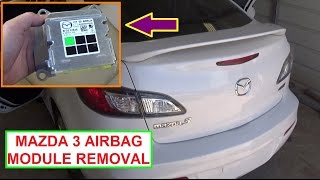
- Restraints Control Module (RCM / ACM) — Located under the center console, accessible by removing the cup holder assembly. It is held in by three 10mm bolts.. Given the link between B3000 and the RCM on the Ford platform mate, this is a potential, though less likely, source of the fault, especially if the airbag light is on.
- CAN Bus Wiring — A twisted pair of wires (CAN-High and CAN-Low) that run throughout the vehicle, connecting all major control modules.. Damage to the CAN bus harness can cause communication failures between modules, which a generic scanner might misinterpret as a B3000 code. Checking resistance across the bus is a key diagnostic step.
Real Owner Repair Stories
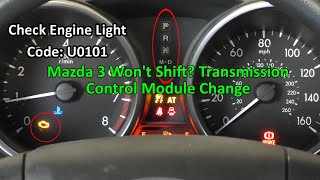
- YouTube channel 'Abdel Car Fix' (Mazda 3 (generation not specified, but similar platform)) — Vehicle came in on a tow truck with a transmission issue, jerking hard when put into gear, and was not drivable. The scanner showed code U0101 'Lost Communication With TCM'.
❌ Tried (didn't work) The owner first purchased a replacement TCM that did not match the part numbers exactly, and it did not fix the problem.
✅ What actually fixed it The Transmission Control Module (TCM), located under the battery tray on top of the transmission, was replaced with a used unit that had matching part numbers. After installation and clearing the codes, the issue was resolved. The mechanic noted this is a common issue due to the TCM overheating in its stock location.
OEM Part Supersession History
BBM5-67-560C, BBM5-67-560H→BBM5-67-560J— Standard part revision and update by the manufacturer.
Heads up: The part number provided in the pass 2 data, BBM5-67-560, is a base number. The final letter (e.g., C, H, J) indicates a revision. While newer revisions often replace older ones, it is critical to verify compatibility by VIN, as different letters can signify different vehicle options (e.g., keyless entry, alarm system). Using the wrong revision can lead to system failures.
Model Year Variations Within This Range
- 2012-2013: The 2012-2013 Mazda3 was offered with two different 2.0L engines: the older port-injected MZR and the newer direct-injected Skyactiv-G. The 'i' trim models have the 2.0L (either MZR or Skyactiv), while the 's' trim models have the larger 2.5L MZR engine. While the B3000 code is not engine-specific, the introduction of the Skyactiv architecture involved different chassis, transmission, and electrical strategies, which could affect module behavior and diagnostics.
Helpful Videos
We Have This Part in Stock

The information in this article is provided for general reference and educational purposes only. Vehicle specifications, procedures, and part compatibility can vary by production date, trim level, and region. Always consult your vehicle's factory service manual and verify part numbers before purchasing or performing repairs. Safety-critical components such as airbags, seat belts, and braking systems should be installed by a qualified professional.
- Mazda MAZDA3:
- 🧭 Diagnostic Flowchart
- 🎬 Helpful Videos
- 🛍️ Shop This Part
- What's Unique About the 2012-2013 Mazda MAZDA3
- Symptoms You May Notice
- Most Likely Causes
- Rare But Worth Checking
- Diagnosis Steps
- Parts You'll Likely Need
- Related Codes That Often Appear With This One
- Technical Service Bulletins (TSBs) & Recalls
- Mechanic-Grade Diagnostic Values
- Hidden / Shadow Codes Worth Checking
- Scan Tool Commands That Help
- Wiring & Ground Locations
- Real Owner Repair Stories
- OEM Part Supersession History
- Model Year Variations Within This Range
- 🎟️ Get 5% Off