

B3055 on 2005-2012 Chevrolet Corvette: No Start, Security Light Causes and Fixes
Code B3055 on a C6 Corvette means the car's security system can't read the key fob, causing a no-start or start-and-stall condition. The most common fixes are replacing a weak key fob battery or, if that fails, using the glove box slot to start the car and diagnose a potential issue with the Remote Control Door Lock Receiver (RCDLR) module.
- Code B3055 on a C6 Corvette means your car's security system isn't recognizing your key fob.
- Before buying any parts, try these
What's Unique About the 2005-2012 Chevrolet CORVETTE
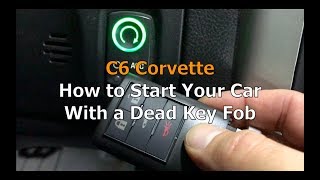
The C6 Corvette uses a keyless access and push-button start system that is sensitive to both key fob battery strength and radio frequency interference (RFI). A unique and critical feature of this platform is the key fob slot located in the glove box. This slot allows the vehicle to start even if the fob's battery is dead or if there's significant RFI, as it uses a direct induction method to read the transponder. 🎬 Watch: How to start your Corvette with a dead key fob. This feature is a key diagnostic step; if the car starts with the fob in the slot but not otherwise, it strongly points away from a faulty key and towards RFI, a weak fob battery, or a failing Remote Control Door Lock Receiver (RCDLR).
Diagnostic Flowchart
Tap your situation to follow the diagnostic path that matches what you're seeing on this vehicle.
Symptoms You May Notice
- Intermittent no-crank, no-start condition.
- Engine starts and immediately stalls.
- "SECURITY" light or message displayed on the Driver Information Center (DIC).
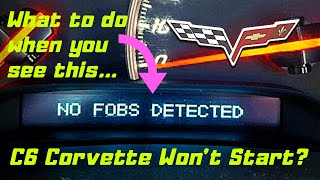
- "No Fob Detected" message on the DIC.
- Passive entry (doors unlocking automatically) may not work.
- Remote Keyless Entry (RKE) functions (lock/unlock buttons) may be inoperative.
- Starter Motor
- Vehicle Battery
- Ignition Switch (Start Button)
Most Likely Causes
- Radio Frequency Interference (RFI) 🔴 High Probability Modern electronics, including aftermarket phone chargers, dash cams, and even some LED interior light bulbs, can emit radio frequencies that jam the 125 kHz signal used by the keyless entry system.
How to confirm: Remove all aftermarket electronic devices (chargers, dash cams, toll passes) from the car. If the problem disappears, reintroduce them one by one to find the culprit. Also, try starting the car in a different location to rule out environmental RFI.
Typical fix: Remove the interfering device from the vehicle.
Est. part cost: $0 - Weak or Dead Key Fob Battery 🔴 High Probability → Shop Vehicle Battery
How to confirm: Try using the spare key fob. If the spare fob works reliably, the primary fob's battery is the likely issue. A multimeter should show 2-3 volts on a healthy battery. The car starting when the fob is in the glove box slot is another strong indicator.
Typical fix: Replace the CR2032 battery inside the key fob.
Est. part cost: $2-$10 - Faulty Remote Control Door Lock Receiver (RCDLR) 🟡 Medium Probability → Shop Keyless Entry Receiver A transistor inside the RCDLR module is a known failure point on C6 Corvettes. This prevents the module from properly energizing and reading the key fob's transponder.
How to confirm: If the car starts with the fob in the glove box slot but not otherwise (and RFI/fob battery are ruled out), the RCDLR is the primary suspect. A diagnostic test involves listening for a series of clicks from the RCDLR (located behind the radio) when pressing the start button; a single click often indicates a faulty module.
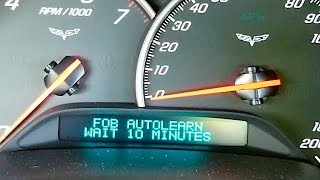
Typical fix: Replace the RCDLR module and perform the 30-minute security relearn procedure.
Est. part cost: $100-$250 - Faulty Key Fob ⚪ Low Probability → Shop Keyless Entry Transmitter
How to confirm: If the fob battery is new, RFI is not present, and the spare fob works perfectly, the internal transponder of the primary fob may have failed. This can also be caused by physical damage to the key.
Typical fix: Replace the key fob and have it programmed to the vehicle by a dealer or locksmith with the proper tools.
Est. part cost: $150-$300
Rare But Worth Checking
- Body Control Module (BCM) Failure: → Shop Body Control Module While less common, the BCM is the central computer for the theft deterrent system. A BCM failure can cause B3055 along with other strange electrical issues. Diagnosis requires advanced scan tools.
- Wiring Harness Issues: Corroded or damaged wiring between the RCDLR and the BCM can interrupt the signal from the key fob. This often requires tracing wires and checking for continuity.
Diagnosis Steps
- Check for other DTCs, especially TPMS codes, which can point to a faulty RCDLR or RFI.
- Remove all aftermarket electronics (phone chargers, dash cams, etc.) from the vehicle.
- Attempt to start the vehicle with your spare key fob.
- Replace the battery (CR2032) in the non-working key fob.
- If the car still won't start, place the key fob into the dedicated slot inside the glove box and attempt to start the engine. If it starts, the issue is with the wireless signal path (RFI, weak fob, or RCDLR).
- If the car starts in the glove box slot, inspect the main vehicle battery terminals for a clean, tight connection. A weak car battery can sometimes cause communication issues.
- If all else fails, the RCDLR module is the next most likely culprit. Professional diagnosis is recommended to confirm before replacement.
Parts You'll Likely Need
- Key Fob Battery — This is the most common and cheapest fix for a weak signal between the fob and the car.
Trusted brands: Energizer, Duracell, Panasonic
OEM price range: $5-$10
Aftermarket price range: $2-$8 - Remote Control Door Lock Receiver
(OEM #25971298)— This module is a known failure point on the C6 platform and is responsible for receiving the key fob signal. Its failure is a common cause of the 'No Fob Detected' message and B3055 code.
Trusted brands: ACDelco (OEM)
OEM price range: $100-$200
Aftermarket price range: $70-$150 - Key Fob — If the internal transponder chip fails, the entire fob must be replaced and programmed.
Trusted brands: ACDelco (OEM)
OEM price range: $150-$250
Aftermarket price range: $50-$120
Related Codes That Often Appear With This One
- B3060 — Indicates an unprogrammed transponder was detected, often appearing with B3055 during communication errors.
- B3935 — Relates to a transponder authentication error, another code pointing to a failure in the key-car handshake.
- C0750, C0755, C0760, C0765, C0775 — These are Tire Pressure Monitoring System (TPMS) codes. The RCDLR module is responsible for receiving signals from both the key fobs and the TPMS sensors, so a fault in the RCDLR or significant RFI can cause both sets of codes to appear simultaneously.
Technical Service Bulletins (TSBs) & Recalls
- PIC5650M: Addresses intermittent no-crank/no-start/stall with security light on, listing B3055 and pointing to Radio Frequency Interference (RFI) from aftermarket devices as a primary cause.
- PIT5030E: Notes that an intermittent no-crank condition setting a B3055 can be caused by the user not allowing the flip-out key blade to fully extend and lock before inserting it into the ignition (on models with a physical key).
Platform-Specific Known Issues
- The C6 Corvette is particularly susceptible to Radio Frequency Interference from aftermarket accessories like phone chargers and LED lights, which can trigger a B3055 code.
- The RCDLR module, which processes signals for both the key fobs and the Tire Pressure Monitoring System (TPMS), is a common point of failure, often leading to both security and TPMS-related trouble codes.
- Using the key fob slot in the glove compartment is a specific and effective workaround and diagnostic step for this generation of Corvette.
Mechanic-Grade Diagnostic Values
- Voltage at RCDLR connector, Pin H (Circuit 2440, Battery Positive Voltage) — expected: Should be close to battery voltage (e.g., 12.4V or higher).. Failure: A significant voltage drop from the battery (e.g., reading 11.9V when the battery is 12.6V) indicates high resistance in the power supply circuit, possibly at the UBEC fuse 11.
- Voltage at RCDLR connector, Pin J (Circuit 3, Ignition 1 Voltage) — expected: Should be ~12V when the ignition is in the ON or RUN position.. Failure: Reading near 0V when the ignition is on points to a problem with the ignition switch signal to the RCDLR.
- Voltage drop on RCDLR ground circuit — expected: Less than 0.1V.. Failure: A reading higher than 0.1V between the RCDLR connector ground pin (Pin S) and the battery negative terminal indicates a poor ground connection, which can cause intermittent issues.
Scan Tool Commands That Help
- Tech 2 / GDS2: Body > Keyless Entry > Module Setup > Program Key Fobs — This is used to program new or existing key fobs to a new RCDLR. The service manual specifies selecting the "New RCDLR ONLY" option if the module has been replaced.
- Tech 2 / GDS2: Body > Keyless Entry > Module Setup > RCDLR Setup — This procedure is required after installing a new RCDLR to marry the module to the vehicle's BCM and VIN.
- Tech 2 / GDS2: Theft Deterrent System Learn (10 or 30-minute procedure) — After a new RCDLR is installed and set up, this procedure must be performed to synchronize the vehicle's immobilizer system with the newly configured security components.
- Tech 2 / GDS2: Important: Remove Radio and HVAC fuses before programming — Service information specifies that the RDO/S'BAND/VICS and HVAC/PWR SND fuses in the passenger floorboard fuse block must be removed before programming the RCDLR to prevent data bus interference.
Wiring & Ground Locations
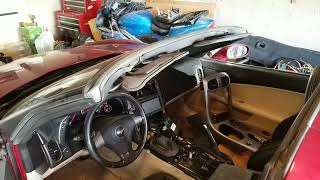
- Remote Control Door Lock Receiver (RCDLR) — Located in the dashboard, above the factory radio head unit. The center console and radio must be removed for access.. This is the primary module responsible for receiving the key fob signal. Its failure or a bad connection here is a direct cause of B3055.
- Body Control Module (BCM) — Located in the passenger side footwell, underneath the carpet.. The BCM is the main computer that communicates with the RCDLR. A bad ground or faulty BCM can mimic RCDLR failure.
- G202 — A ground point located in the passenger side footwell area, near the BCM.. This is a critical ground for the BCM. Corrosion or a loose connection here can cause a wide range of electrical issues, including security system faults.
- RCDLR Connector — The electrical plug connecting to the RCDLR module itself, behind the radio.. Corrosion on the pins of this connector can cause intermittent signal loss from the key fob, triggering B3055. This can be a temperature-sensitive issue.
Real Owner Repair Stories
- CorvetteForum user (2006 Corvette Convertible) — No TPMS, fobs not working remotely, had to use glove box slot to start. Car was essentially 'bricked'.
❌ Tried (didn't work) Replacing the RCDLR with a used unit., Attempting the 30-minute fob relearn process., Attempting the theft deterrent relearn process with a Tech 2.
✅ What actually fixed it A diagnostic expert determined that both key fobs from the previous owner were bad and had no RF output. After replacing the key fobs and performing the 30-minute code reset via the RCDLR section in Vehicle Control Systems, all functions were restored. The original RCDLR may have been good all along. - CorvetteForum user (2007 Corvette) — 'No FOB detection' message, requiring use of the glove box slot to start.
❌ Tried (didn't work) A GM dealer claimed it was not an RCDLR issue., Purchasing two used RCDLRs with different part numbers, which a second dealer was unable to program to the car.
✅ What actually fixed it The owner sourced a used RCDLR from eBay with the correct part number for the model year. The GM dealer was then able to successfully install and program this specific unit, resolving the issue after a six-month process. This highlights the difficulty in sourcing compatible, working modules. - CorvetteForum user (C6 Corvette (year not specified)) — Intermittent 'no fobs detected' message. Fobs would work after a battery disconnect, but fail again after hours or days. Fobs always worked in the glove box slot.
❌ Tried (didn't work) Replacing fob batteries., Reflowing solder on the RCDLR header pins., Cleaning RCDLR connector with Deoxit., Cleaning grounds G104 and G202.
✅ What actually fixed it The user diagnosed a significant voltage drop at the RCDLR. The Tech 2 scanner reported 11.98V at the RCDLR, while probing the connector's power pin showed 12.4V, and the battery itself was at 12.94V. The issue was high resistance in the power supply circuit to the RCDLR, emphasizing the module's sensitivity to low voltage.
"I Checked Everything" — The Actual Cause
- A common pattern is replacing the RCDLR module, only to find the problem persists. In one documented case, after a new RCDLR was installed and programming failed, the root cause was discovered to be that both of the owner's key fobs had failed and were not transmitting a signal. Replacing the fobs and reprogramming them to the car was the final fix.
When the Usual Fixes Don't Work
- While a faulty RCDLR is a very common cause for code B3055, it should not be replaced without thorough diagnosis. Multiple owner accounts confirm that after replacing the RCDLR, the true fault was found to be elsewhere. In one case, the actual problem was that both key fobs had failed internally and were not transmitting a signal. In another, a significant voltage drop in the wiring to the RCDLR was the culprit, not the module itself. Always confirm fob function with an RF tester and verify correct voltage and ground at the RCDLR connector before condemning the module.
OEM Part Supersession History
Multiple→Multiple— GM used different RCDLR modules throughout the C6 generation, and many part numbers have been superseded. The modules are NOT universally interchangeable.
Heads up: There are at least three distinct part number groups: 2005-2007 (e.g., 10372535, 15815693, 25940664), 2008-2009 (e.g., 25882862, 25821056, 25938511), and 2010-2013 (e.g., 25971235). Using a module from the wrong year group will result in a programming failure.
Model Year Variations Within This Range
- 2005-2007 vs 2008-2009 vs 2010-2012: The Remote Control Door Lock Receiver (RCDLR) part numbers are different for these year groups and are generally not cross-compatible. A replacement module must be from the correct group for the vehicle's model year to ensure it can be programmed successfully.
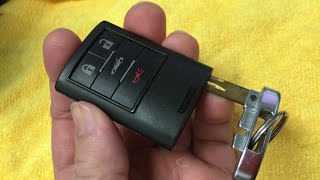
- 2008-2012: Starting in 2008, a new key fob design with an integrated key was introduced, coinciding with the update to the LS3 engine. While the fundamental system operation is the same, the fob itself is physically different from the 2005-2007 models.
Helpful Videos

We Have This Part in Stock

The information in this article is provided for general reference and educational purposes only. Vehicle specifications, procedures, and part compatibility can vary by production date, trim level, and region. Always consult your vehicle's factory service manual and verify part numbers before purchasing or performing repairs. Safety-critical components such as airbags, seat belts, and braking systems should be installed by a qualified professional.
- Chevrolet CORVETTE:
- 🧭 Diagnostic Flowchart
- 🎬 Helpful Videos
- 🛍️ Shop This Part
- What's Unique About the 2005-2012 Chevrolet CORVETTE
- Symptoms You May Notice
- Most Likely Causes
- Rare But Worth Checking
- Diagnosis Steps
- Parts You'll Likely Need
- Related Codes That Often Appear With This One
- Technical Service Bulletins (TSBs) & Recalls
- Platform-Specific Known Issues
- Mechanic-Grade Diagnostic Values
- Scan Tool Commands That Help
- Wiring & Ground Locations
- Real Owner Repair Stories
- "I Checked Everything" — The Actual Cause
- When the Usual Fixes Don't Work
- OEM Part Supersession History
- Model Year Variations Within This Range
- 🎟️ Get 5% Off