

B3055 on 2023-2025 GMC Acadia: Key Not Detected, No-Start Causes and Fixes
Code B3055 on a 2023-2025 GMC Acadia means the anti-theft system can't detect the key, causing a no-start. The most common causes are a dead key fob battery or radio frequency interference (RFI) from phone chargers. Try your spare key or replace the key's battery (around $5) before seeking professional repair. Using the backup transmitter pocket in the center console can often start the car when the fob battery is weak.
- B3055 on your Acadia means the security system has disabled the engine because it cannot detect the key.
- Before seeking repairs, perform the cheapest and most common fixes: unplug all phone chargers/USB devices, try your spare key, and replace the key fob battery.
- The issue is frequently caused by Radio Frequency Interference (RFI), not a broken part, as noted in GM service bulletins.
- Do not replace the starter or main vehicle battery; a no-crank condition with this code is a security feature, not a component failure.
- If simple fixes don't work, professional service is needed as key and module replacement requires special programming tools.
What's Unique About the 2023-2025 Gmc ACADIA
The 2023-2025 Acadia range spans two different vehicle generations (2nd and 3rd), both using a modern keyless immobilizer system that is highly sensitive. As highlighted in GM Technical Service Bulletin PIC5650M, these vehicles and their platform mates (Chevy Traverse, Buick Enclave) are particularly prone to intermittent no-start conditions caused by radio frequency interference (RFI) from common devices like phone chargers, dash cams, or even other RFID cards on the keychain. This often leads to a B3055 code without any actual part failure. 🎬 Watch a technician diagnose a B3055 no-start condition on a GM vehicle. The 2024-2025 models are built on GM's new Vehicle Intelligence Platform (Global B), which requires mandatory online programming for any BCM replacement.
Diagnostic Flowchart
Tap your situation to follow the diagnostic path that matches what you're seeing on this vehicle.
Generation note: The 2023 model year is the last of the second-generation Acadia, while the 2024-2025 models are the beginning of the third generation. Both generations use a keyless start system vulnerable to the issues described. The key fob battery for the 2023 model is a CR2032, while the 2024-2025 model uses a CR2450. The backup starting procedure (placing the fob in a designated pocket) is similar but the pocket location is in the center console for both. A critical difference is that 2024+ models use GM's Global B electrical architecture, meaning a BCM replacement is not plug-and-play and must be programmed online by a dealer or qualified shop.
Symptoms You May Notice
- Engine will not crank (no-crank)
- Engine starts and immediately stalls
- Security indicator light is illuminated or flashing on the dashboard
- "No Key Detected" or "No Remote Detected" message on the driver information center (DIC).
- "Service Theft Deterrent System" message on the DIC.
- Replacing the starter motor. The no-crank symptom is caused by the security system disabling the starter relay, not a faulty starter.
- Replacing the vehicle's 12V battery without testing it first. While a very weak 12V battery can cause various electrical problems, B3055 specifically points to a failure in the key-to-vehicle communication.
Most Likely Causes
- Radio Frequency Interference (RFI) 🔴 High Probability As noted in TSB PIC5650M, the immobilizer system in modern GM vehicles is sensitive to electronic noise from aftermarket accessories like USB chargers, dash cams, LED lighting, and even toll passes.
How to confirm: Unplug all aftermarket devices (phone chargers, dash cams, etc.). Remove all other keys, fobs, and RFID cards from the keychain. If the vehicle starts consistently, RFI was the cause. The interference can be intermittent and hard to duplicate for a technician.
Typical fix: Remove the source of interference. Keep other fobs and cards separate from the vehicle's key fob. One owner on a forum discovered their specific brand of phone charger was the culprit and the issue vanished once it was unplugged.
Est. part cost: $0 - Weak or Dead Key Fob Battery 🔴 High Probability → Shop Vehicle Battery
How to confirm: Try starting the vehicle with your spare key fob. If it works, the battery in the primary fob is the likely culprit. You can also try placing the non-working fob in the vehicle's transmitter pocket (located inside the center console storage bin) and pressing the start button. If the vehicle starts, this confirms the fob battery is too weak for normal transmission.
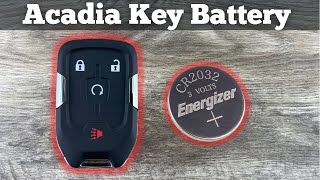
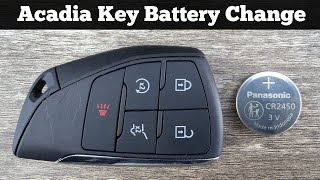
Typical fix: Replace the battery inside the key fob. For the 2023 (2nd Gen) Acadia, this is a CR2032 battery. 🎬 Watch: How to replace the battery in your 2023 Acadia fob. For the 2024-2025 (3rd Gen) Acadia, this is a CR2450 battery. 🎬 See this quick guide for 2024-2025 Acadia key battery replacement.
Est. part cost: $2-$10 - Faulty Key Fob 🟡 Medium Probability → Shop Keyless Entry Transmitter Key fobs can be damaged from being dropped or exposed to moisture, causing the internal transponder chip to fail.
How to confirm: If the vehicle starts with the spare key but not the primary key (even after a battery change and trying the backup slot), the primary key fob is faulty.
Typical fix: A new key fob must be purchased and programmed to the vehicle by a dealership or a qualified automotive locksmith with a scan tool. In some cases, a technician can clone the data from the failing key to a new transponder chip without needing to program the vehicle.
Est. part cost: $100-$350 - BCM or Keyless Entry Module Glitch ⚪ Low Probability → Shop Keyless Entry Module Intermittent electronic glitches can occur, as referenced in TSB PIC5650M. Sometimes the K77 Keyless Entry Control Module (also called the RCDLR) can fail or lose communication, requiring a reset or replacement. In some cases, a simple battery disconnect for 10-15 minutes can reset the modules and resolve the issue temporarily.
How to confirm: This requires a professional scan tool to check for BCM/RCDLR communication errors and available software updates. The issue may be intermittent and hard to duplicate.
Typical fix: A dealership may need to update the Body Control Module (BCM) software, perform a key relearn procedure, or replace the Keyless Entry Control Module (RCDLR).
Est. part cost: $0-$200
Rare But Worth Checking
- Faulty Body Control Module (BCM): → Shop Body Control Module While rare, the BCM itself can fail. This is an expensive last resort and should only be considered after all other causes, especially RFI and key-related issues, have been exhaustively ruled out. Replacement requires professional programming.
- Damaged Wiring or Antenna: Modern vehicles like the Acadia have multiple immobilizer antennas (e.g., in the center console, trunk area) that communicate with the key fob. Damage to the wiring or a disconnected antenna can cause a B3055. A visual inspection and continuity check would be needed for diagnosis.
Diagnosis Steps
- Read all trouble codes from the Body Control Module (BCM) to confirm B3055 is present and check for related codes.
- Unplug ALL aftermarket accessories (phone chargers, dash cams, etc.) from the vehicle's power outlets.
- Remove all other keys, fobs, and RFID cards from the keychain, leaving only the Acadia key fob.
- Attempt to start the vehicle. If it starts, the issue is RFI.
- If it does not start, try the spare key fob. If the spare works, the primary key fob is faulty (likely a dead battery or internal failure).
- If the spare key also fails, try the backup starting procedure: place the key fob in the designated transmitter pocket inside the center console storage bin and attempt to start. If this works, it strongly indicates a weak fob battery.
- Replace the battery in the suspect key fob (CR2032 for 2023, CR2450 for 2024-2025) and re-test.
- If all key-related steps fail, have the vehicle's main 12V battery tested to ensure it is providing adequate voltage.
- If the issue persists, the vehicle requires professional diagnosis with a scan tool to monitor BCM data, check for software updates, and diagnose the immobilizer antennas and wiring.
Parts You'll Likely Need
- Key Fob Battery
(OEM #CR2032 (for 2023 model), CR2450 (for 2024-2025 models))— This is the most common and cheapest fix when the key fob signal is too weak to be detected.
Trusted brands: Energizer, Duracell, Panasonic
OEM price range: $5-$15
Aftermarket price range: $2-$8 - Keyless Entry Remote Fob
(OEM #13514344 or 13560218 (for 2024-2025 models, verify by VIN))— If the key fob's internal transponder has failed, the entire unit must be replaced and programmed.
Trusted brands: ACDelco (OEM), Dorman
OEM price range: $150-$300
Aftermarket price range: $70-$150
Related Codes That Often Appear With This One
- B3060 — This code is for an unprogrammed or unspecified key and often appears with B3055 during a key recognition fault, as noted in TSB PIC5650M.
- B3935 — This code indicates a transponder authentication failure, meaning a signal was received but was incorrect. It is part of the same security event as B3055 and is also mentioned in TSB PIC5650M.
- C0750, C0755, C0760, C0765, C0775 — These codes are related to tire pressure monitor sensors but are listed in TSB PIC5650M as codes that can appear alongside B3055 during intermittent electronic issues, possibly indicating a broader communication problem or RFI affecting multiple systems.
Technical Service Bulletins (TSBs) & Recalls
- PIC5650M: Addresses intermittent no crank, no start, or start/stall with security light on, listing B3055 as a primary code. It emphasizes checking for Radio Frequency Interference (RFI) from aftermarket electronics before replacing any parts.
- PIT5030E: Relevant to some GM models, this TSB explains that an intermittent no-crank with B3055 can be caused by a flip-style key not being fully locked in the open position.
Platform-Specific Known Issues
- A GM Technical Service Bulletin (TSB #PIC5650M) directly addresses an intermittent no crank, no start, or start/stall concern with the security light on, specifically citing DTC B3055. It points to RFI as a common, often overlooked cause across many modern GM vehicles.
- For some older GM models with flip-keys, TSB #PIT5030E notes that a B3055 can be set if the key is not fully extended, causing misalignment with the reader. While less common on push-start models, it highlights the system's sensitivity to positioning.
Mechanic-Grade Diagnostic Values
- Scan Tool BCM Data: 'TDM Transponder Key' or 'Environment Identification' — expected: Should read 'Present' or show a valid key ID when the fob is in the vehicle.. Failure: Reads 'Not Present' or 'No Key Detected'.
- Immobilizer System Operating Frequency — expected: 125 kHz. Failure: Signal not being transmitted by the vehicle's exciter antennas, or not being returned by the key fob.
- High Speed GMLAN Bus Resistance (at DLC) — expected: ~60 ohms (with battery disconnected). Failure: A reading of ~120 ohms indicates an open circuit on one of the terminating resistors or a break in the wiring. A reading near 0 ohms indicates a short between the CAN High and CAN Low wires. An incorrect reading can point to a wiring issue or a failed module (like the BCM) pulling the network down.
Hidden / Shadow Codes Worth Checking
- B3055 00: The '00' is a standard GM symptom byte meaning 'No Sub Type Information'. It indicates that the base DTC (B3055) provides the complete description of the failure ('No Transponder Modulation') and no further detail is available from the module. (see via Dealer-level scan tools like GM GDS2/Tech2 or advanced aftermarket scanners.)
Scan Tool Commands That Help
- GM GDS2 / Techline Connect (SPS2): Immobilizer Learn / Vehicle Theft Deterrent Learn — Used for programming new keys or re-learning existing keys after a module replacement (BCM, RCDLR) or when all keys are lost. For 2024+ models, this requires an online connection via SPS2.
- GM GDS2: Module Diagnostics > Remote Control Door Lock Receiver > Configure/Reset Functions > Add or Replace Key Fobs — This is the specific menu path within the dealer software to access the key fob programming functions for adding or replacing fobs.
- High-End Aftermarket (Autel, Topdon, etc.): IMMO / Key Programming > Add Key / All Keys Lost — Advanced aftermarket tools can often perform the same 10-minute security learn procedure as the factory tool to program new keys.
Wiring & Ground Locations
- Body Control Module (BCM) — For the 2nd Gen (2017-2023), it is typically located under the driver's side of the instrument panel, near the steering column and interior fuse block. For the 3rd Gen (2024-2025), it is also in the passenger cabin, integrated into the new Global B architecture.. The BCM is the master module for the immobilizer system. A bad connection, water intrusion from a clogged HVAC drain, or a poor ground at the BCM can cause a B3055 code.
- Keyless Entry Control Module (K77 / RCDLR) — On many modern GM SUVs, this module (also called the RF Hub) is located in the rear of the vehicle, often behind the driver's side rear quarter panel trim.. This module receives the signal from the key fob. A loose connector or failure of this module will prevent the key from being detected, directly causing a B3055.
- Immobilizer Antennas — Multiple antennas exist. The primary one for starting is located in the center console, inside the transmitter pocket used for backup starting. Others for passive entry are located in the doors and trunk area.. These antennas energize and read the key fob's transponder. A disconnected or faulty antenna will result in a 'No Key Detected' message and a B3055 code.
- GMLAN Junction Connector (e.g., JX205) — Located under the driver's side dash, these are comb-like connectors that bridge multiple serial data lines together.. Corrosion in one of these data line junctions can disrupt communication between the BCM and other essential modules, leading to a variety of faults, including a no-start with security codes like B3055.
Real Owner Repair Stories
- YouTube channel 'ADD AUTOMOBILE SERVICES' (2013 Chevrolet Equinox (similar GM immobilizer system)) — Intermittent no-start with security light on and code B3055.
❌ Tried (didn't work) Using the original key, which would only work sometimes.
✅ What actually fixed it A technician used a VVDI Key Tool to read and clone the data from the intermittently failing original key onto a new 'super chip'. The new chip was then installed into the original key fob housing, resolving the problem without requiring vehicle programming.
"I Checked Everything" — The Actual Cause
- In a documented case on a similar GM platform (2013 Acadia), a no-crank/no-start condition with security codes was traced to a corroded GMLAN serial data junction connector (JX205) under the dashboard. Standard checks of the key, battery, and BCM would not have found this. The corrosion on one pin was pulling down the entire data network, preventing modules from communicating the authorization to start. The fix was to unplug the connector, which immediately restored correct voltage on the data line, and then identify and repair the corroded circuit.
Model Year Variations Within This Range
- 2024-2025: These models use GM's new Vehicle Intelligence Platform (VIP) or 'Global B' architecture. Any replacement of the Body Control Module (BCM) is not plug-and-play. It requires mandatory online programming using GM's Service Programming System (SPS2) through Techline Connect. The vehicle will not start with a new or used BCM until it is programmed to the specific VIN.
Helpful Videos

We Have This Part in Stock

The information in this article is provided for general reference and educational purposes only. Vehicle specifications, procedures, and part compatibility can vary by production date, trim level, and region. Always consult your vehicle's factory service manual and verify part numbers before purchasing or performing repairs. Safety-critical components such as airbags, seat belts, and braking systems should be installed by a qualified professional.
- Gmc ACADIA:
- 🧭 Diagnostic Flowchart
- 🎬 Helpful Videos
- 🛍️ Shop This Part
- What's Unique About the 2023-2025 Gmc ACADIA
- Symptoms You May Notice
- Most Likely Causes
- Rare But Worth Checking
- Diagnosis Steps
- Parts You'll Likely Need
- Related Codes That Often Appear With This One
- Technical Service Bulletins (TSBs) & Recalls
- Platform-Specific Known Issues
- Mechanic-Grade Diagnostic Values
- Hidden / Shadow Codes Worth Checking
- Scan Tool Commands That Help
- Wiring & Ground Locations
- Real Owner Repair Stories
- "I Checked Everything" — The Actual Cause
- Model Year Variations Within This Range
- 🎟️ Get 5% Off