

B3055 on 2007-2010 Hummer H3: Understanding the No-Start and Security Light Issue
Code B3055 on a Hummer H3 almost always means a no-start or start-and-stall condition due to a problem in the Passlock anti-theft system. The most common fix is addressing a faulty ignition key or performing a key relearn procedure. If that fails, the ignition lock cylinder with its integrated Passlock sensor is the next likely part to replace, a very common failure point on this platform.
- B3055 means your Hummer H3's anti-theft system doesn't recognize your key, preventing the engine from starting.
- Before spending any money, try using a spare key and perform the 30-minute key relearn procedure.
- The most common failed parts are the ignition key itself or the ignition lock cylinder that houses the Passlock sensor.
- This is a security system issue, not a mechanical engine problem. Do not replace the starter or battery without first diagnosing the theft deterrent system.
What's Unique About the 2007-2010 Hummer H3
The Hummer H3 uses GM's Passlock vehicle immobilizer system, which was common across many GM trucks and SUVs of this era, including its platform-mates, the Chevy Colorado and GMC Canyon. This system is known for being sensitive and a frequent source of complaints. The issue is so common that GM has issued multiple Technical Service Bulletins (TSBs) for similar platforms describing the exact symptoms of a no-crank or no-start with the security light on, often tied to B3055. The problem is frequently related to the communication between the key and the vehicle, rather than a major mechanical failure. In many cases, the tiny resistor inside the Passlock sensor itself cracks from age and vibration, causing an intermittent open circuit.
Diagnostic Flowchart
Tap your situation to follow the diagnostic path that matches what you're seeing on this vehicle.
Symptoms You May Notice
- Engine will not crank or turn over.
- Engine starts and then immediately stalls.
- Security light is illuminated or flashing on the dashboard.
- "Service Theft System" message may appear on the driver information center.
- Having to wait exactly 10 minutes before the vehicle will allow another start attempt.
- Replacing the starter motor. A bad starter will usually result in a 'click' but no crank, whereas B3055 is a security issue preventing the starter from being commanded to engage at all or disabling fuel after it starts.
- Replacing the battery without addressing the security system. While a low battery can trigger this issue, if the security light remains on after installing a new, fully charged battery, the problem lies within the theft deterrent system itself.
- Replacing the Crankshaft Position Sensor. A failed crank sensor can cause a crank-no-start, but it will typically set different codes (like P0335) and is not directly related to the security light being on.
Most Likely Causes
- Failed Passlock Sensor / Ignition Lock Cylinder 🔴 High Probability → Shop Ignition Switch The Passlock sensor is integrated into the ignition lock cylinder housing. This sensor's internal resistor or wiring can fray or fail from years of use and temperature cycles, preventing it from reading the key's transponder. This is the most widely reported failure mode by H3 and Colorado/Canyon owners.
How to confirm: After ruling out the key, a technician would test the signal circuit from the sensor for proper resistance and voltage. A common DIY confirmation is simply replacing the part, as it is a known high-failure item. One owner on Hummer4x4Offroad found the tiny resistor inside the old sensor had physically cracked.
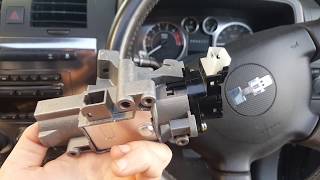
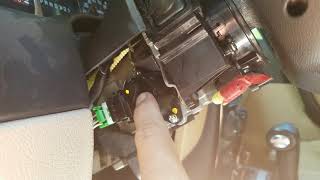
Typical fix: Replace the ignition lock cylinder housing/Passlock sensor. 🎬 Watch this step-by-step guide on replacing the Passlock sensor. This part often comes as an assembly. The vehicle's security system must go through the 30-minute relearn procedure after replacement. Some owners have had success with a temporary fix by shimming the electrical connector 🎬 See how to perform this quick and easy connector fix. at the switch to ensure a better connection.
Est. part cost: $40-$150 - Faulty or Damaged Ignition Key 🟡 Medium Probability → Shop Ignition Switch The transponder chip in the key can be damaged from being dropped or from normal wear and tear. A heavy keychain can also put stress on the ignition cylinder and the key itself over time. Another potential issue is if the key is not fully extended and locked on switchblade-style fobs, which can cause a misread.
How to confirm: Try starting the vehicle with a spare key. If the spare key works reliably, the original key is the problem. Also, ensure the key is fully extended if it's a folding type.
Typical fix: Replace the faulty key and perform the key relearn procedure. A locksmith or dealership will need to cut and program the new key.
Est. part cost: $50-$150 - System Needs Key Relearn Procedure 🟡 Medium Probability A low vehicle battery, disconnecting the battery, or a voltage spike can sometimes cause the BCM to lose its memory of the learned keys, triggering the security system.
How to confirm: Attempt the 30-minute key relearn procedure. If the procedure completes and the vehicle starts, this was the issue.
Typical fix: Perform the key relearn: Turn the key to the 'ON' position (don't start) and wait about 10-11 minutes until the security light stops flashing and turns off or goes solid. Turn the key off for 10-30 seconds. Repeat this process two more times for a total of three cycles (approx. 30 minutes). After the third cycle, the vehicle should start.
Est. part cost: $0 - Wiring Harness Issue ⚪ Low Probability The wiring between the ignition lock cylinder and the BCM can become chafed, loose, or damaged, especially around the tilt-steering column or at the BCM connector itself.
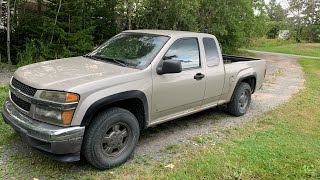
How to confirm: Visually inspect the wiring harness near the ignition switch. A technician would test for continuity and shorts in the signal and ground circuits per the service manual. On platform-mate Chevy Colorados, some owners have found success by cutting and separating a specific wire (often yellow or white with a blue stripe) in the ignition harness *while the vehicle is running* to permanently bypass the Passlock system, though this is an advanced and risky modification. 🎬 Watch a demonstration of the permanent Passlock bypass procedure.
Typical fix: Repair the damaged section of the wiring harness. In some cases, owners bypass the system entirely, but this is not recommended as it permanently disables a security feature.
Est. part cost: $5-$50
Rare But Worth Checking
- Failed Body Control Module (BCM): → Shop Body Control Module This is a last-resort diagnosis. The BCM is the computer that runs the security system. While it can fail, it's much more likely that a key, sensor, or wiring is the root cause. Symptoms of a wider BCM failure could include erratic lights, door locks, and other electrical gremlins happening concurrently. Water intrusion from clogged sunroof drains has been known to damage the BCM in H3s.
- Radio Frequency (RF) Interference: Other electronic devices on your keychain, like other car keys with transponders or office access fobs, can sometimes interfere with the signal. Try starting the vehicle with only the Hummer key, with no other keys or devices nearby.
- Poor Battery Terminal Connection: → Shop Vehicle Battery The OEM battery terminal connectors on the Hummer H3 are a known weak point and can cause a host of random electrical issues, including no-start problems that can be misdiagnosed as a Passlock failure. Before diving into the Passlock system, ensure the battery terminals are clean, tight, and preferably replaced with a quality aftermarket set.
Diagnosis Steps
- Scan for all DTCs in the BCM and other modules. Note any other security-related codes like B3060 or B3935.
- Check the behavior of the security light. Is it on solid, or flashing? A flashing light during a no-start is a classic Passlock symptom.
- Try starting the vehicle with a known-good spare key. If it starts, the primary key is faulty.
- Remove all other keys and electronic fobs from the keychain to eliminate RF interference and try again.
- Check battery voltage and terminal connections. The H3's OEM battery terminals are notoriously problematic and can cause similar symptoms. Ensure connections are clean and tight.
- Attempt the 30-minute key relearn procedure. This often resolves issues caused by a battery change or voltage drop.
- If the relearn fails, inspect the wiring harness around the ignition lock cylinder and steering column for any visible damage.
- If the problem persists, the most likely culprit is the Passlock sensor within the ignition lock cylinder housing. Replacement is the common fix.
- If all wiring and sensors test correctly, the Body Control Module (BCM) may be the issue, but this should be the final step in diagnosis.
Parts You'll Likely Need
- Ignition Lock Cylinder Housing
(OEM #ACDelco D1432D (This is the housing which contains the Passlock sensor))— This part contains the Passlock sensor (exciter coil) that reads the key. The sensor itself is the most common point of failure, often due to a cracked internal resistor. The entire housing is typically replaced.
Trusted brands: ACDelco, Dorman, Standard Motor Products (US-971)
Related Codes That Often Appear With This One
- B3060 — This code often appears with B3055 and relates to a failure in the transponder key system, pointing towards a problem with the key itself or the sensor reading it. [Bulletin #PIC5650M, 41]
- B3935 — This is another GM-specific transponder circuit malfunction code that can be set alongside B3055, indicating a general failure within the immobilizer system. [Bulletin #PIC5650M, 41]
- U0140 — If the Body Control Module (BCM) is failing, you may see this code, indicating 'Lost Communication With Body Control Module', along with B3055 and other erratic electrical issues.
Technical Service Bulletins (TSBs) & Recalls
- PIC5650M: Addresses an intermittent no crank, no start, or start stall concern with the security light coming on, and lists B3055 as a potential DTC.
- PIT5030E: While for other GM models, this TSB is relevant as it describes how an improperly extended switchblade-style key can cause a no-crank and set a B3055 code.
Platform-Specific Known Issues
- The GM Passlock system used in the H3 is notoriously sensitive and a frequent source of no-start complaints across many GM models from this era, especially its platform-mates, the Chevrolet Colorado and GMC Canyon.
- A Technical Service Bulletin (TSB), #PIC5650M, was issued for the 2007-2010 Hummer H3 specifically mentioning an intermittent no-crank or start-stall condition with the security light on, which can be caused by DTC B3055.
- Many owners on forums report that simply turning the key to the 'ON' position and waiting 3-5 seconds before attempting to crank can sometimes prevent the issue, theorizing it gives the aging BCM time to recognize the key.
- The original factory battery terminals are a known weak point that can cause a variety of electrical faults that mimic Passlock issues. Upgrading to quality aftermarket terminals is a highly recommended preventative measure for any H3 owner.
Mechanic-Grade Diagnostic Values
- Passlock Sensor Signal Wire Voltage (Yellow Wire) — expected: Key OFF: ~5V. Key ON: A specific learned voltage value (e.g., drops from 5V to a lower, stable voltage).. Failure: Voltage does not change when the key is turned, or the voltage is unstable. If the security light on the dash does not turn off after 10 minutes during a relearn, the sensor is likely bad.
- Passlock Sensor Power Supply Voltage (White or Red/White Wire) — expected: Greater than 10V with key ON.. Failure: Voltage below 10V indicates a problem with the power feed from the BCM.
- Passlock Sensor Resistance (for bypass purposes) — expected: A fixed value between 400 and 13,700 Ohms, depending on the specific lock cylinder. A common value used for bypass is 2.2k Ohms.. Failure: This is not a standard diagnostic test but a method to determine the value needed for a bypass resistor. The resistance is measured between the yellow signal wire and the black ground wire at the ignition switch connector.
Scan Tool Commands That Help
- GM Tech 2: VTD Re-Learn — Use this function under 'Service Programming' after replacing the BCM, PCM, or ignition lock cylinder to perform a quicker, guided security relearn procedure instead of the manual 30-minute process.
- Topdon / Auto Pro Pad: Vehicle Security Learn / Program Key — Modern aftermarket scan tools can perform the security relearn function, which typically takes about 10 minutes. This is used after key or module replacement to program the new components to the vehicle.
Wiring & Ground Locations
- Body Control Module (BCM) — Located behind the right front passenger kick panel.. The BCM is the control center for the Passlock anti-theft system. All signals from the ignition key and Passlock sensor are sent here. It is also notoriously susceptible to water damage from clogged sunroof drains on the H3.
- BCM Connectors C1 and C2 — The two main harness connectors that plug into the BCM behind the passenger kick panel.. These connectors are the termination point for the Passlock sensor wiring. A poor connection or corrosion here (especially from water intrusion) can cause code B3055.
- Passlock Sensor Wiring Harness — A small three-wire ribbon cable running from the ignition lock cylinder down the steering column.. This harness contains the critical signal wire (Yellow), power (often White or Red/White), and ground (often Black or Orange/Black) for the Passlock sensor. Chafing or damage to these wires, especially the yellow signal wire, will directly cause a B3055 code.
Real Owner Repair Stories
- Hummer Forums user reports (2006-2010 Hummer H3 with sunroof) — Intermittent no-start, security light on, B3055 and other electrical issues (e.g., erratic lights, non-functional remote).
❌ Tried (didn't work) Replacing the battery, Performing the 30-minute relearn procedure (may work temporarily), Replacing the ignition switch/Passlock sensor
✅ What actually fixed it The Body Control Module (BCM) was found to be wet and corroded. The root cause was clogged front sunroof drain tubes, which leak water down the A-pillar directly onto the BCM. The fix required replacing the BCM and clearing the clogged drain tubes to prevent recurrence. - Various GM owner forums (Hummer, Chevy Colorado) (2007-2010 Hummer H3 and platform-mate Chevy Colorado) — Classic B3055 symptoms: No crank or starts then immediately dies, security light illuminated.
❌ Tried (didn't work) Trying a spare key, Multiple 30-minute relearn procedures, Checking battery and terminals
✅ What actually fixed it Replacing the ignition lock cylinder housing (which contains the Passlock sensor). The sensor itself had failed internally, preventing it from sending a stable signal to the BCM. After replacement and a final 30-minute relearn, the issue was permanently resolved.
"I Checked Everything" — The Actual Cause
- The diagnostic equivalent for this electronic code is when all standard component tests pass, but the problem persists. On the Hummer H3, a classic example is a technician testing the key transponder, ignition cylinder wiring continuity, and sensor voltages at the connector, finding them all to be within spec. The actual cause, however, is intermittent failure of the Body Control Module (BCM) due to past or present water intrusion from clogged sunroof drains. The BCM may test fine when dry and cool, but fail when moisture or temperature changes, making it a difficult-to-diagnose root cause that standard wiring and sensor tests would miss.
OEM Part Supersession History
ACDelco D1432D / GM 22670487→This part number appears to be current for the GM Genuine/ACDelco part.— N/A
Heads up: A common aftermarket alternative is the Dorman 924-719. While it is designed as a direct replacement, some professional technicians express a preference for OEM electrical components over aftermarket brands due to concerns about longevity and quality control.
Helpful Videos

The information in this article is provided for general reference and educational purposes only. Vehicle specifications, procedures, and part compatibility can vary by production date, trim level, and region. Always consult your vehicle's factory service manual and verify part numbers before purchasing or performing repairs. Safety-critical components such as airbags, seat belts, and braking systems should be installed by a qualified professional.
- Hummer H3:
- 🧭 Diagnostic Flowchart
- 🎬 Helpful Videos
- What's Unique About the 2007-2010 Hummer H3
- Symptoms You May Notice
- Most Likely Causes
- Rare But Worth Checking
- Diagnosis Steps
- Parts You'll Likely Need
- Related Codes That Often Appear With This One
- Technical Service Bulletins (TSBs) & Recalls
- Platform-Specific Known Issues
- Mechanic-Grade Diagnostic Values
- Scan Tool Commands That Help
- Wiring & Ground Locations
- Real Owner Repair Stories
- "I Checked Everything" — The Actual Cause
- OEM Part Supersession History
- 🎟️ Get 5% Off