

OBD-II Code B3683: Convertible Top Dowel Pin Switch Fault
What B3683 means, why it triggers, and how to fix it
- Code B3683 indicates a failure in the driver's side dowel pin switch (S17) on the 2006-2009 Pontiac G6 convertible top.
- The vehicle remains safe to drive, but the top and trunk release are disabled, accompanied by a constant warning chime.
- Broken wiring in the driver's side trunk hinge harness causes this code just as often as a failed microswitch.
- Diagnosis requires a GM-capable scan tool with live data to monitor the S17 switch state in real-time.
- Test the switch for continuity and inspect the trunk hinge wiring before replacing the $300+ Folding Top Control module.
What Does B3683 Mean?
B3683 is a manufacturer-specific code for the Pontiac G6 convertible indicating a fault in the retractable hardtop system. Specifically, the Folding Top Control (FTC) module detects an issue with the driver's side 'dowel pin' switch (S17). This sensor verifies the roof is properly aligned to latch to the windshield frame. When this switch sends an illogical signal during operation, the computer halts the top to prevent damage.
Technical definition: The SAE/ISO definition for B3683 (per GM TSB 07-08-67-010C) is a 'Folding Top Header Dowel Pin' switch fault. The Folding Top Control (FTC) module detected an illogical signal from the left-hand header dowel pin microswitch (S17) during the operational sequence. The FTC module expects a specific sequence of switch activations; if the S17 signal fails to transition from 'Not in Position' to 'In Position' when closing, the module halts the process and logs the fault.
Can I Drive With B3683?
Yes. The vehicle is safe to drive. This code only disables the convertible top and does not impact the engine, brakes, or steering. Expect a persistent 'Top Not Secure' message and an audible chime while driving.
Common Causes
- Broken or Chafed Wiring (Very Common) — The wiring harness for the top's sensors runs through tight hinge areas. Over years of opening and closing, these wires pinch, stretch, or rub through their insulation, causing an open circuit. This is the most frequent root cause.
- Faulty 'Folding Top Header Dowel Pin' Microswitch (S17) (Very Common) — The microswitch itself wears out from mechanical use, moisture, and temperature fluctuations, causing internal contacts to stick or fail electronically.
- Debris or Obstruction in the Switch Mechanism (Common) — Small pieces of debris, leaves, or dirt enter the receiver hole where the switch is located, preventing the dowel pin from fully depressing the switch plunger.
- Convertible Top Misalignment (Common) — If the retractable top's frame or linkage is slightly bent, the dowel pin misses the switch when the top closes. The computer sees the switch wasn't activated and sets the code.
- Low Battery Voltage / Weak Alternator (Less Common) — The convertible top's control module requires stable system voltage. A weak battery causes insufficient power during the high-load operation of the top, leading to illogical sensor readings and fault codes.
- Corroded or Loose BCM/FTC Connector (Less Common) — The Body Control Module (BCM) and Folding Top Control (FTC) module connectors develop corrosion or loosen over time, causing erratic behavior of the convertible top sensors.
- Hydraulic Fluid Leak (Rare) — A low level in the hydraulic system causes the top to move slowly. 🎬 Watch: How to diagnose and repair the hardtop hydraulic system. This leads to a timeout error where the FTC module doesn't see the S17 switch activate in the expected timeframe.
- Faulty Folding Top Control (FTC) Module (Rare) — The control module itself fails occasionally. GM explicitly warns technicians to rule out the switch and wiring before replacing this expensive module.
Symptoms
- Convertible top halts mid-cycle — The operational sequence begins and the windows lower, but the top itself stops moving partway through its cycle or refuses to unlatch.
- 'Top Not Secure' Message on Display — The Driver Information Center (DIC) shows a persistent warning message indicating the top is not locked in place.
- Constant Warning Chime — An audible warning chime sounds continuously while driving to alert the driver of the top fault.
- Trunk release disabled — The trunk release is disabled as a safety measure to prevent the reverse-opening trunk lid and the top from colliding.
Diagnostic Flowchart
Tap your situation to follow the diagnostic path that matches what you're seeing on this code.
Common Fixes & Costs
- Repair Damaged Wiring — Parts: $5-$20, Labor: $150-$300, ~2 hr book time (Intermediate)
- Replace the Folding Top Front Locating Pin Guide Assembly — Parts: $50-$150, Labor: $250-$500, ~2.5 hr book time (Professional)
- Clean Debris from Switch Mechanism — Parts: $0, Labor: $0-$50, ~0.5 hr book time (DIY)
- Replace Battery and/or Alternator — Parts: $150-$250, Labor: $50-$100, ~1.0 hr book time (Intermediate)
- Adjust Convertible Top Linkage/Alignment — Parts: $0, Labor: $300-$600, ~4 hr book time (Professional)
Used vs. New Parts: Buying Guide
When a used part is worth it: New OEM stock for the switch assembly (GM Part #25878351) is frequently discontinued. A used part from a salvage yard is often the only viable option. It makes sense when the donor vehicle has low mileage or was taken off the road for reasons unrelated to the top mechanism.
Donor-vehicle mileage cap: roughly under 60000 miles for the part to have meaningful remaining life.
Donor quality checklist:
- Avoid parts from cars with known top issues.
- Visually inspect the used part for physical damage, cracks in the plastic housing, or corrosion on the connector pins.
- Manually actuate the microswitch; you must hear and feel a distinct 'click'.
- Match the part number exactly.
Decision logic:
- If A new OEM part is available and affordable (e.g., under $150) → Buy new for the longest potential lifespan.
- If New parts are discontinued or the budget is extremely tight → A used part is an acceptable risk.
- If The failure is confirmed to be the wiring, not the switch → Neither new nor used is needed; perform a quality wire repair.
Warranty tradeoff: Used parts from a salvage yard typically come with a 30-90 day warranty covering only the part, not the labor. A new OEM part carries a longer warranty, often 1 year.
Worst-case if a used part fails: $300-$600 if a used part fails shortly after the warranty period, requiring a second part purchase and repeat installation labor.
What Happens If You Wait — Timeline
- Immediate: Code B3683 is stored. The 'Top Not Secure' message appears, a chime sounds, and the top and trunk release are completely disabled. (MPG impact: 0%% · Added cost: $0)
- Weeks to Months: If the issue is a chafed wire, continued vibration causes the wire to short against the chassis, potentially damaging the Folding Top Control (FTC) module. (MPG impact: 0%% · Added cost: $100 - $500 (Cost of a used FTC module if damaged by a short circuit).)
- Months (If User Attempts to Force Operation): Attempting to manually force a misaligned top bends delicate linkage arms, breaks plastic trim, or damages the trunk's reverse-opening mechanism. (MPG impact: 0%% · Added cost: $200 - $1500+ (Cost to replace bent linkages or damaged trunk components).)
- Long-Term (6+ months): The vehicle is effectively a coupe with a persistent warning chime. Resale value plummets. Seals compressed in the 'closed' position permanently deform, leading to leaks. (MPG impact: 0%% · Added cost: Significant loss in vehicle resale value, plus $100-$400 in new seals.)
Cost of Not Fixing It
- Immediate: Complete inability to use the retractable hardtop. The 'Top Not Secure' message and audible chime act as a constant annoyance while driving. (Added cost: $0)
- Short-Term: Attempting to force the top to move breaks plastic trim panels, bends the top's linkage, or damages the trunk mechanism. (Added cost: $200 - $1500)
- Long-Term: A G6 with an inoperable convertible top suffers a massive decrease in usability and resale value. (Added cost: Significant loss in vehicle resale value.)
Diagnosis Steps
- Check the Basics
Ensure the vehicle's battery is fully charged (at least 12.4V) and the engine is running before operating the top. Verify the trunk cargo partition is correctly latched, as this is a primary interlock.
Tools: Multimeter or Battery Tester (Beginner) - Scan for Codes
Connect an OBD-II scanner capable of reading manufacturer-specific Body ('B') codes. Confirm B3683 is present. Always diagnose specific switch codes before a general 'System Sensors Data Mismatch' code like B1010.
Tools: Advanced OBD-II Scanner (GM Tech 2 or equivalent) (Beginner) - Visually Inspect the Switch Area
Locate the receiver hole on the driver's side of the windshield frame where the top's guide pin locks in. Look for debris or damage preventing the pin from fully entering the hole and activating the switch.
Tools: Flashlight (Beginner) - Monitor Live Switch Data
Navigate to the FTC module's live data stream on your scan tool. Find the parameter for the 'Folding Top Header Dowel Pin' switch (S17). The status must change when you manually press the switch plunger with a small tool. If it doesn't, the switch or wiring is faulty.
Tools: Advanced OBD-II Scanner, Pen or small non-marring tool (Intermediate) - Test Switch Continuity
Disconnect the S17 switch. Set a multimeter to resistance (Ohms). Connect the leads to the two pins on the switch. The meter should read 'OL'. Press the switch plunger; the reading must drop to near 0 Ohms. If it does not change, replace the switch.
Tools: Multimeter (Advanced) - Test the Switch Wiring for Continuity
If the switch tests good, disconnect the switch and the FTC module connector. Use a multimeter to check for an open circuit on the signal and ground wires between the two connectors. A reading of 'OL' indicates a broken wire, likely near the trunk hinges.
Tools: Multimeter, Vehicle-specific wiring diagram (Advanced) - Test the Switch Circuit Voltage
Turn the ignition on. Probe the 12-volt reference circuit on the harness-side connector with a 12V test lamp connected to ground. The lamp must illuminate brightly. If not, there is an open or short in the 12V reference circuit from the FTC module.
Tools: 12V Test Lamp, Vehicle-specific wiring diagram (Advanced) - Test the Switch Signal Circuit
With the ignition on, probe the signal circuit of the switch harness with a test lamp connected to the positive battery terminal. The lamp must illuminate. If not, it indicates an open in the signal wire going back to the FTC module.
Tools: 12V Test Lamp, Vehicle-specific wiring diagram (Advanced) - [PRO TIP] Perform a Switch Bypass Test
Use a fused jumper wire to momentarily jump the signal and ground pins at the harness connector while monitoring the S17 parameter on the scan tool. If the live data changes state, the wiring and FTC module are good, proving the switch itself is faulty.
Tools: Fused jumper wire, Advanced OBD-II Scanner (Professional) - Check for Mechanical Binding or Misalignment
Observe the top as it attempts to close. Watch if the driver's side dowel pin aligns perfectly with the receiver hole. If it hits the side, the top's linkage requires professional adjustment.
Tools: None (visual inspection) (Advanced)
When This Code Triggers (Freeze-Frame Conditions)
- System Voltage: 13.5V - 14.5V (Engine running to provide stable power to the FTC module.)
- Vehicle Speed: 0 mph (Vehicle must be stationary for the top to operate.)
- Top Operation Command: Active (Driver is actively pressing the 'Open' or 'Close' top button.)
- S17 Switch State: Illogical (The FTC module sees a state from the switch (e.g., 'Not in Position') when it expects to see the opposite state ('In Position') during the closing sequence.)
Related Codes
- B3685 — This code is for the adjacent 'Folding Top Header Latch' switch (S18). B3683 confirms the top is ALIGNED, while B3685 confirms it is LATCHED. A wiring issue in the shared harness triggers both codes.
- B1307 — This code points to a fault with the 'Folding Top Bell Crank Switch' (S14) in the central header latch mechanism. Diagnosis is location-specific: live data for S14 fails for B1307, while S17 fails for B3683.
- B1010 — This generic code means 'System Sensors Data Mismatch'. It indicates the FTC module received an illogical sequence of signals. Always diagnose primary switch codes like B3683 FIRST.
- B1000 — This is a generic Electronic Control Unit (ECU) fault code. If B3683 is present along with B1000, diagnose the B3683 fault first, as unresolved sensor issues trigger generic module faults.
Climate & Environmental Factors
- Cold Weather: Metal and plastic components contract in cold temperatures, causing slightly misaligned parts to bind or preventing a switch from making full contact.
- High Humidity / Moisture: The S17 microswitch is located in the windshield header. Humidity leads to corrosion on the internal contacts of the switch or at the electrical connector pins, causing an open circuit.
How to Talk to a Mechanic About This Code
Say this: "I have a Pontiac G6 convertible with a 'Top Not Secure' light and a B3683 code. I need a diagnosis, and I'd like you to use a scan tool to check the live data for the S17 dowel pin switch in the Folding Top Control module. Please also visually inspect the wiring harnesses in the trunk hinges."
This directs the technician to perform the correct diagnostic steps (checking live data and wiring) rather than guessing or starting with the most expensive part (the control module). It establishes you as an informed consumer.
Avoid saying:
- 'My convertible top is broken.'
- 'The car is beeping at me, can you fix it?'
- 'Just replace the sensor.'
Questions to ask before authorizing the repair:
- Did the live data for the S17 switch change state when you manually activated it?
- Did you perform a continuity test on the wiring from the switch back to the control module?
- If the switch needs to be replaced, is the part available as a new OEM part or will it be a used part?
- What is the warranty on your parts and labor for this specific repair?
Where to Take It: Dealer vs Independent vs Chain
- Dealer:
A strong, but expensive, option. They have the correct tools and information, but you pay a premium.
Best for: Complex electrical issues where factory tools (GM Tech 2) and specific service bulletins are critical., If you've exhausted options at independent shops and suspect a rare module failure.
Downsides: Highest labor rates., More inclined to replace larger assemblies rather than perform a detailed wiring repair. (Typical cost: +50% vs. baseline) - Independent Shop:
The best value, IF you find the right shop. Seek out a convertible top specialist or a well-regarded auto electrical specialist with a GM-capable scanner.
Best for: A shop specializing in automotive electrical systems or convertible tops., Out-of-warranty vehicles where cost is a major factor.
Downsides: A general mechanic lacks the specific GM-capable scanner or experience with this complex Karmann top system., You MUST vet the shop to ensure they have the right diagnostic equipment. (Typical cost: +0% vs. baseline) - Chain Shop:
AVOID. This is a specialized, manufacturer-specific body code related to a complex electro-mechanical system far outside the scope of a chain repair shop.
Best for: Tires, brakes, and oil changes.
Downsides: Technicians lack the specialized tools or training for this system., High risk of misdiagnosis, leading to unnecessary parts replacement. (Typical cost: -10% vs. baseline)
When to Walk Away From the Repair
If the estimated repair cost for the top exceeds 40-50% of the car's current private-party value, seriously consider selling the car as-is.
- Car worth $3000, fix is $650: Fix it. The repair cost is well below the threshold and restores a key feature of the car, preserving its value.
- Car worth $2500, fix is $1500: Walk away. The repair cost is over 50% of the car's value and indicates more complex issues.
What Scan Tool You Need for This Code
Minimum: A scanner that reads manufacturer-specific Body ('B') codes for General Motors and displays LIVE DATA from the Folding Top Control (FTC) or Body Control Module (BCM).
A basic $20 engine code reader will NOT see B-codes. You must see the live data for the 'S17' switch to determine if the fault is the switch itself, the wiring, or a mechanical alignment issue.
Budget: BlueDriver Pro (~$100) — Reads enhanced codes (like B, C, U) for GM vehicles and provides live data, allowing you to monitor the switch's status in real-time.
Mid-range: Foxwell NT510 Elite for GM (~$180) — Offers dedicated GM system support, including full access to the BCM and FTC modules for reading codes and viewing live data PIDs.
Professional: Autel MaxiCOM MK808S (~$400) — Provides professional-level, all-system diagnostics with full live data, graphing, and bi-directional control to command other top functions.
Rent vs buy: Auto parts store loaner tools are typically basic engine code readers and will NOT work for this B-code. You must either buy a capable scanner or pay for a professional diagnosis.
How to Clear the Code After You Fix It
- Use an advanced OBD-II scan tool to access the Body Control Module (BCM) or Folding Top Control (FTC) module.
- Select the option to clear Diagnostic Trouble Codes (DTCs).
- With the engine running, attempt to cycle the convertible top through one full open and close sequence to verify the repair.
Drive cycle (~2 minutes): A traditional engine 'drive cycle' is not required. The reset procedure is confirmed by successfully operating the convertible top. If the underlying fault remains, the code reappears instantly upon the next attempt to operate the top.
Readiness monitors affected: None
Watch out for:
- Using a basic engine code reader that cannot communicate with the BCM/FTC module to clear the code.
- Clearing the code without fixing the root cause, resulting in the code immediately returning.
- Disconnecting the battery, which clears the code temporarily but causes other modules to lose settings.
Will This Fail Emissions / State Inspection?
No — by itself this code doesn't fail OBD inspection (but it can keep readiness monitors from setting, which causes a separate fail).
- California: This is a Body ('B') code and does not illuminate the Check Engine Light. California's Smog Check program focuses on powertrain codes. B3683 will not cause a smog test failure.
- New York: The NYS inspection checks for an illuminated Check Engine Light. Since B3683 does not trigger the CEL, it passes.
- Texas: Texas OBD-II scans check for powertrain-related faults that command the Check Engine Light on. A BCM code like B3683 is ignored.
Most Commonly Affected Vehicles
- Pontiac G6 Convertible (2006-2009) — This code is specifically designated for the complex retractable hardtop system on these vehicles, designed by Karmann. The system's numerous microswitches are a known failure point.
Manufacturer-Specific Notes
- General Motors (Pontiac): This is a manufacturer-specific code, unreadable by basic code readers. An advanced scan tool capable of accessing the Body Control Module (BCM) and Folding Top Control (FTC) module is required.
- General Motors (Pontiac): GM TSB #07-08-67-010C specifically warns against replacing the expensive Folding Top Control (FTC) module unless all other possibilities have been exhausted.
- Karmann (System Designer): The G6's retractable hardtop relies on a precise sequence of events from over a dozen sensors. Any single sensor failure halts the entire operation to prevent mechanical damage.
Real Owner Stories
2008 Pontiac G6 Convertible with 'Top Not Secure' message.
Owner received the 'Top Not Secure' message and audible chime. The top would not operate and the trunk release was disabled.
What they tried:
- Visual inspection of the wiring harnesses in the trunk hinge area.
Outcome: The owner discovered a single broken wire in the harness running along the driver's side trunk hinge. A simple solder repair restored full top and trunk functionality.
Lesson: Always perform a thorough visual inspection of the wiring harnesses near the trunk hinges before assuming a costly switch or module failure.
2009 Pontiac G6 GT with persistent beeping and a non-reporting sensor.
The car was left unused due to a constant beeping from the 'Top Not Secure' fault. The top was completely inoperable.
What they tried:
- Connected an advanced diagnostic computer to read live sensor values.
- Identified one sensor was not reporting the correct value.
- Inspected wiring and found factory zip ties were replaced incorrectly, pinching the wires.
Outcome: A single wire was severed, held on only by its insulation jacket. The wire was repaired using a solder connector and heat shrink, fixing the issue.
Lesson: An advanced scan tool that reads live data pinpoints exactly which switch or circuit is failing, saving hours of guesswork.
2007 Pontiac G6 where the top cycle completes but the hydraulic motor keeps running.
The convertible top opened and closed fully, but the hydraulic pump motor continued to run indefinitely after the cycle finished.
What they tried:
- The owner theorized it was a final position sensor not registering.
Outcome: The root cause was a faulty final-stage microswitch (header latch switch S18, code B3685) failing to send the 'latched' signal to shut off the pump.
Lesson: A motor that won't shut off is a clear sign a sensor isn't reporting 'home.' This requires live data analysis to see which switch is stuck in the wrong state.
How to Prevent This Code From Triggering
- Lubricate Top's Hinge and Pivot Points (Once per year) — Lubricating metal-on-metal pivot points with white lithium grease reduces friction and strain on the hydraulic system, preventing binding that stresses the wiring harnesses.
- Clean and Treat Rubber Seals (Twice per year (Spring and Fall)) — Water bypassing dry rubber seals reaches connectors and switches, causing corrosion. Dedicated rubber care products keep seals pliable and watertight.
- Inspect and Secure Wiring Harnesses (Every 2 years) — Wire chafing at hinge points is a primary failure cause. Periodically inspect the harnesses along the trunk hinges and add protective wire loom or anti-abrasion tape.
- Clear Body and Top Drains (Once per year) — Clogged drains cause water to back up and overflow into areas containing electronics, including the FTC module, leading to corrosion and failure.
- Operate the Top Regularly (At least once a month) — Regularly cycling the top keeps hydraulic fluid moving, lubricates internal seals, and prevents mechanical parts from seizing.
Frequently Asked Questions
Can I drive my car with a B3683 code?
Yes, it is safe to drive. The code only disables the convertible top and does not interfere with the engine, brakes, or safety systems.
Why is my trunk not opening with this code?
The computer disables the trunk release when it detects a top fault. This prevents the reverse-opening trunk lid and the top from colliding and causing expensive damage.
What are common misdiagnosis mistakes for a B3683 code?
A frequent mistake is replacing the dowel pin switch assembly without testing the wiring, as a broken wire mimics a failed switch. Another error is replacing the expensive Folding Top Control (FTC) module before confirming the switch and wiring are good. Technicians must also check for a weak battery, which causes false codes.
Can I just clear the code to fix the problem?
No. Clearing the code only makes the warning light and chime go away temporarily. As soon as you try to operate the top again, the FTC module detects the persistent physical fault and the code immediately returns.
What is the 'S17' switch?
S17 is the designation used in GM's official service manuals for the 'Folding Top Header Dowel Pin' microswitch on the driver's side. It is the specific sensor that triggers the B3683 code.
Is it better to repair the wiring or replace the switch?
If live data shows an unresponsive switch and continuity tests confirm good wiring, replace the switch. If the wiring is broken, a solder and heat-shrink repair is a permanent, cost-effective fix. Wire breaks almost always occur right at the trunk hinge point.
How much does it cost to fix code B3683?
Repairing a broken wire typically costs $150-$300 at a shop. Replacing the switch assembly (GM Part #25878351) costs between $300 and $650, with labor making up the majority of the expense.
Key Takeaways
- Code B3683 indicates a failure in the driver's side dowel pin switch (S17) on the 2006-2009 Pontiac G6 convertible top.
- The vehicle remains safe to drive, but the top and trunk release are disabled, accompanied by a constant warning chime.
- Broken wiring in the driver's side trunk hinge harness causes this code just as often as a failed microswitch.
- Diagnosis requires a GM-capable scan tool with live data to monitor the S17 switch state in real-time.
- Test the switch for continuity and inspect the trunk hinge wiring before replacing the $300+ Folding Top Control module.
Helpful Videos
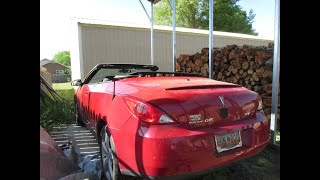
Shop the Parts Behind B3683
Below are the parts most often responsible for code B3683, ranked by how frequently each one is the actual culprit (per the diagnosis above). Tap any to see what we have for your vehicle.



The information in this article is provided for general reference and educational purposes only. Vehicle specifications, procedures, and part compatibility can vary by production date, trim level, and region. Always consult your vehicle's factory service manual and verify part numbers before purchasing or performing repairs. Safety-critical components such as airbags, seat belts, and braking systems should be installed by a qualified professional.
- 🧭 Diagnostic Flowchart
- 🎬 Helpful Videos
- 🛍️ Shop This Part
- What Does B3683 Mean?
- Can I Drive With B3683?
- Common Causes
- Symptoms
- Common Fixes & Costs
- Used vs. New Parts: Buying Guide
- What Happens If You Wait — Timeline
- Cost of Not Fixing It
- Diagnosis Steps
- When This Code Triggers (Freeze-Frame Conditions)
- Related Codes
- Climate & Environmental Factors
- How to Talk to a Mechanic About This Code
- Where to Take It: Dealer vs Independent vs Chain
- When to Walk Away From the Repair
- What Scan Tool You Need for This Code
- How to Clear the Code After You Fix It
- Will This Fail Emissions / State Inspection?
- Most Commonly Affected Vehicles
- Manufacturer-Specific Notes
- Real Owner Stories
- 2008 Pontiac G6 Convertible with 'Top Not Secure' message.
- 2009 Pontiac G6 GT with persistent beeping and a non-reporting sensor.
- 2007 Pontiac G6 where the top cycle completes but the hydraulic motor keeps running.
- How to Prevent This Code From Triggering
- Frequently Asked Questions
- Can I drive my car with a B3683 code?
- Why is my trunk not opening with this code?
- What are common misdiagnosis mistakes for a B3683 code?
- Can I just clear the code to fix the problem?
- What is the 'S17' switch?
- Is it better to repair the wiring or replace the switch?
- How much does it cost to fix code B3683?
- Key Takeaways
- 🎟️ Get 5% Off