

B3894 on 2007-2013 Chevrolet Avalanche: Cruise Control and Trailer Brake Fixes
Code B3894 on a 2007-2013 Avalanche typically means the cruise control is disabled because of a 'Stop Lamp Switch Circuit Plausibility Failure.' The most common fix is cleaning the brake light switch connector and applying dielectric grease, as recommended in GM service bulletin PIT5144. If that doesn't work, a new brake light switch costs about $15-$30. This is a very common issue on this platform, and the fix is usually simple.
- Code B3894 means the cruise control won't work because of a fault detected by the Trailer Brake Control Module.
- Before buying any parts, try the easiest and most common fix: apply dielectric grease to the brake light switch connector above the brake pedal.
- If grease doesn't work, the next step is to replace the inexpensive brake light switch.
- This is a common, well-documented issue on 2007-2013 GM trucks and SUVs and is usually a simple DIY fix.
- Do not assume the expensive Trailer Brake Control Module is bad; it is rarely the cause.
What's Unique About the 2007-2013 Chevrolet AVALANCHE
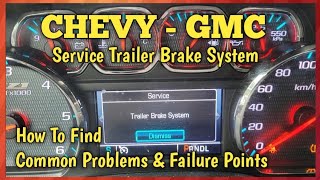
On this generation of GM trucks and SUVs (the GMT900 platform), the cruise control system is closely integrated with the Trailer Brake Control Module (TBCM). A fault that seems related only to trailer braking, like B3894, will disable the cruise control even if you never tow a trailer. This design choice confuses many owners. 🎬 Watch: Common failure points and how to fix the warning message. GM issued technical service bulletin PIT5144 acknowledging that this code is frequently caused by minor fretting corrosion on the brake light switch connector, not a major component failure.
Diagnostic Flowchart
Tap your situation to follow the diagnostic path that matches what you're seeing on this vehicle.
Symptoms You May Notice
- Cruise control is inoperative or will not engage.
- "Service Trailer Brake System" message appears on the Driver Information Center (DIC).
- The red LED on the integrated trailer brake controller may stay on or flicker.
- Intermittent warnings that appear and disappear, sometimes for weeks at a time.
- Replacing the steering wheel cruise control buttons. These buttons are rarely the cause of the problem when code B3894 is present.
- Replacing the Trailer Brake Control Module (TBCM) first. This is an expensive part, and the issue is far more likely to be a simple switch or wiring connection problem.
- Replacing the brake light switch without first trying the dielectric grease fix, as recommended by GM TSB PIT5144.
Most Likely Causes
- Fretting Corrosion at Brake Light Switch Connector 🔴 High Probability → Shop Brake Light Switch GM TSB PIT5144 specifically identifies fretting corrosion—a buildup of insulating oxidized debris from micro-vibrations—at the brake light switch connector as the primary cause. The bulletin notes that many switches were being replaced unnecessarily when the real issue was just a poor connection. Fretting looks like small, dark smudges on the electrical terminals.
How to confirm: Visually inspect the electrical connector at the brake light switch, located above the brake pedal. Look for dark smudges or discoloration on the electrical terminals. The condition may be difficult to see without a magnifying glass.
Typical fix: Disconnect the connector, apply a small amount of dielectric lubricant (GM Part No. 12345579) to both the switch and harness side terminals using a small nylon brush, and reconnect. This is the official GM-recommended repair and often resolves the code immediately.
Est. part cost: $5-$15 - Faulty Brake Light Switch (Stop Lamp Switch) 🟡 Medium Probability → Shop Brake Light Switch The switch is a high-use component that can fail internally, sending erratic signals. It's a very common failure point on this platform for various cruise control issues. Some owners report that the original switch was made in China and failed prematurely.
How to confirm: If applying dielectric grease doesn't solve the issue, the switch is the next most likely culprit. A scan tool can monitor the brake switch status in both the BCM and TBCM data streams to look for discrepancies. If the modules show conflicting states (e.g., one 'Applied' while the other is 'Released'), the switch is bad.
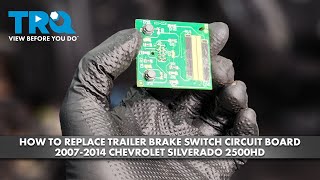
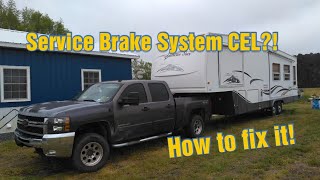
Typical fix: Replace the brake light switch. It is located above the brake pedal and is typically held by a clip and a small bolt. It is an accessible DIY repair. 🎬 See this walkthrough for diagnosing and fixing the trailer brake system.
Est. part cost: $15-$40 - Corroded Wiring at the Trailer Brake Control Module (TBCM) ⚪ Low Probability → Shop Trailer Brake Control Module The TBCM is located on the driver's side frame rail, often above the spare tire. 🎬 Watch: How to inspect the module and wiring for corrosion. This location exposes its wiring harness to road salt, water, and debris, leading to corrosion (green/white crust) and broken wires over time.
How to confirm: Lower the spare tire for access. Unplug the TBCM connector and inspect the terminals and wiring harness for green or white corrosion, swelling, or broken wires. Also check the ground wire connection near the module.
Typical fix: Clean the connector terminals. If wires are broken or corroded, they will need to be repaired with new wire, solder, and heat shrink tubing.
Est. part cost: $10-$50 - Corrosion in 7-Pin Trailer Connector ⚪ Low Probability → Shop Trailer Wiring Harness The 7-pin connector at the rear bumper is exposed to the elements. Moisture and road debris can cause corrosion inside the connector, leading to shorts or high resistance that can trigger the 'Service Trailer Brake System' message.
How to confirm: Visually inspect the pins inside the truck's 7-pin connector for green or white crusty deposits. Use a test light to check for proper signals. A simple cleaning procedure can often resolve the issue.
Typical fix: Spray the connector with electrical contact cleaner, scrub the pins with a small brush, and blow it dry with compressed air. Apply a thin coat of dielectric grease to the pins before reconnecting.
Est. part cost: $5-$10
Rare But Worth Checking
- Faulty Master Cylinder Pressure Sensor: TSB #PIT4508C points to this as a possibility if other diagnostics fail. On vehicles with StabiliTrak (RPO JL4), this sensor is internal to the expensive Electronic Brake Control Module (EBCM), so it should be diagnosed carefully. A scan tool is needed to check for pressure readings in the TBCM data list when the pedal is not being pressed.
- Faulty Trailer Brake Control Module (TBCM): → Shop Trailer Brake Control Module If all wiring, connectors, and switches test good, the module itself may have failed internally. This should be the last part to be replaced due to its cost. Several aftermarket options are available.
Diagnosis Steps
- Verify the primary symptoms are an inoperative cruise control and/or a 'Service Trailer Brake System' message on the DIC.
- Scan the Trailer Brake Control Module (TBCM) for codes. Confirm B3894 is present.
- Follow TSB PIT5144: Inspect the brake light switch connector above the brake pedal. Disconnect it, apply dielectric lubricant to the terminals, and reconnect securely. This is the most common fix.
- Clear the codes with a scan tool and test drive the vehicle to see if cruise control is restored.
- If the code returns, replace the brake light switch (Part No. 25981009).
- If the issue persists, inspect the 7-pin trailer connector at the bumper for corrosion. Clean and apply dielectric grease as needed.
- Next, lower the spare tire and inspect the wiring and connector at the Trailer Brake Control Module (TBCM) on the driver's side frame rail for corrosion or damage.
- Using an advanced scan tool, monitor the 'Master Cylinder Pressure' data in the TBCM. If it shows pressure with no pedal input, investigate the master cylinder pressure sensor circuit per TSB PIT4508C.
- If all other steps fail, the TBCM itself may be faulty.
Parts You'll Likely Need
- Brake Light Switch / Stop Lamp Switch
(OEM #25981009)— This switch is the most common component to fail or cause a signal conflict, triggering code B3894 and disabling the cruise control. It is often replaced after the dielectric grease fix fails.
Trusted brands: ACDelco (GM Genuine), Standard Motor Products
OEM price range: $25-$45
Aftermarket price range: $15-$30 - Dielectric Grease
(OEM #12345579)— Recommended by GM in TSB PIT5144 to fix the most common cause of this code: fretting corrosion on the brake light switch connector. This should be the first attempted fix.
Trusted brands: Permatex, CRC
OEM price range: $10-$20
Aftermarket price range: $5-$10
Technical Service Bulletins (TSBs) & Recalls
- PIT4508C: Addresses inoperative cruise control with DTC B3894, pointing towards diagnostics for the Master Cylinder Pressure Sensor if initial checks fail.
- PIT5144: Identifies fretting corrosion at the brake switch connector as a primary cause for B3894 and recommends applying dielectric lubricant as the first step in the repair.
Platform-Specific Known Issues
- TSB PIT4508C notes that an inoperative cruise control with DTC B3894 can be caused by a faulty Master Cylinder Pressure Sensor, which on StabiliTrak-equipped models is integrated into the EBCM.
- TSB PIT5144 explicitly calls out fretting corrosion on the brake light switch connector as a widespread issue causing B3894. It states that many switches were returned to GM with no fault found, confirming the issue was the connection itself.
- Owners on forums frequently share their success stories, with many confirming that either applying dielectric grease to the brake switch connector or replacing the switch itself resolved both the 'Service Trailer Brake System' message and the inoperative cruise control.
Mechanic-Grade Diagnostic Values
- TBCM Scan Tool Data: 'Brake Switch Status' — expected: Should change from 'Inactive' or 'Off' to 'Active' or 'On' immediately when the brake pedal is pressed.. Failure: If the status does not change, or changes intermittently, it points to a fault in the brake switch circuit.
- TBCM Scan Tool Data: 'Master Cylinder Pressure' — expected: 0 psi (or equivalent value) with no brake pedal input.. Failure: If the parameter displays pressure with no brake pedal input, it suggests a fault with the Master Cylinder Pressure Sensor or its circuit.
- Voltage at TBCM harness connector, ignition circuit (Pin 15) — expected: Greater than 11 V with ignition ON.. Failure: Less than 11 V indicates a short to ground or an open/high resistance in the ignition feed circuit to the TBCM.
- TCC Brake Signal Circuit (Pin 37 at TBCM) — expected: With a test lamp connected between pin 37 and ground, the lamp should turn ON when the brake pedal is pressed and OFF when released.. Failure: If the lamp is always ON, there is a short to voltage. If always OFF, there is an open/high resistance in the signal circuit.
- Brake Switch Signal at ECM Connector X1 (Pin 9) — expected: This pin carries the Light Blue/White wire (Circuit 6311) for the brake switch signal to the ECM.. Failure: Testing at this pin can help determine if the signal from the brake switch is reaching the ECM correctly.
Hidden / Shadow Codes Worth Checking
- B3894 5A: Symptom byte '5A' specifically indicates a 'Stop Lamp Switch Circuit Plausibility' failure. This means the TBCM has compared the hardwired brake switch input to the BCM's serial data input and found they do not match. (see via A professional scan tool like a GM Tech2 or GDS2 that can read manufacturer-specific codes and their symptom bytes.)
Scan Tool Commands That Help
- GDS2 (Global Diagnostic System 2): TBCM Data Display -> 'Trailer Brake Control Output Circuit' — When a trailer is connected, this parameter helps diagnose faults in the trailer's brake wiring. It will display 'Okay', 'Short to Ground', or 'Short to Power', helping to isolate the issue to the truck or the trailer.
- GDS2 (Global Diagnostic System 2): BCM Data Display -> 'Brake Pedal Applied' — To verify the Body Control Module is correctly seeing the brake pedal status as 'Active' when pressed and 'Inactive' when released. This is one of the two signals the TBCM compares.
Wiring & Ground Locations
- TBCM (Trailer Brake Control Module) — On the driver's side frame rail, typically located directly above or near the spare tire.. This module is the central unit that sets code B3894. Its location makes its wiring harness highly susceptible to corrosion and damage from road debris, a common cause of the fault.
- G401 — This ground is associated with the trailer connector and is located at the rear of the vehicle, near the bumper and 7-pin connector.. A poor ground at G401 can cause erratic behavior in the trailer brake system, leading to various faults including B3894.
- BCM Ground — The BCM ground path passes through the Left Instrument Panel Junction Block. A GM bulletin warns that the negative battery cable MUST be disconnected before servicing this junction block to prevent damage to the BCM.. The BCM provides one of the two brake switch signals used for the plausibility check. A compromised BCM ground could lead to incorrect signal transmission.
- TBCM Connector (Harness Side) — On the driver's side frame rail, connecting to the TBCM.. Pin 15 (Ignition 1 Voltage) and Pin 37 (TCC Brake Signal Circuit) are critical for TBCM operation and can be tested here for proper voltage.
Real Owner Repair Stories
- YouTube video by 'K-Dogg' (2009 Chevrolet Avalanche) — Cruise control would not work or would disengage intermittently. A scan tool revealed a code for the 'brake switch circuit'.
❌ Tried (didn't work) The video directly proceeds to the fix, implying no other parts were tried first.
✅ What actually fixed it Replacing the brake light switch located on the brake pedal assembly. After replacement and clearing the codes, the cruise control functioned properly and the code did not return.
OEM Part Supersession History
25981009→25981009 (current as of early 2026)— This part number appears to be stable for the specified model years.
Heads up: This part is listed for vehicles *without* power adjustable pedals. Ensure the correct part is ordered for the vehicle's specific options.
Model Year Variations Within This Range
- 2007-2014: GM Service Bulletin 07-08-45-001H notes that on these model years, the auxiliary power circuit (#742, Red/Black wire) for the 7-way trailer connector was left disconnected at the factory. If a customer needs this power for trailer accessories, the wire must be manually located below the master cylinder and connected to a stud on the underhood fuse block. While not a direct cause of B3894, it's a notable wiring variation in the trailer system.
Helpful Videos

The information in this article is provided for general reference and educational purposes only. Vehicle specifications, procedures, and part compatibility can vary by production date, trim level, and region. Always consult your vehicle's factory service manual and verify part numbers before purchasing or performing repairs. Safety-critical components such as airbags, seat belts, and braking systems should be installed by a qualified professional.
- Chevrolet AVALANCHE:
- 🧭 Diagnostic Flowchart
- 🎬 Helpful Videos
- What's Unique About the 2007-2013 Chevrolet AVALANCHE
- Symptoms You May Notice
- Most Likely Causes
- Rare But Worth Checking
- Diagnosis Steps
- Parts You'll Likely Need
- Technical Service Bulletins (TSBs) & Recalls
- Platform-Specific Known Issues
- Mechanic-Grade Diagnostic Values
- Hidden / Shadow Codes Worth Checking
- Scan Tool Commands That Help
- Wiring & Ground Locations
- Real Owner Repair Stories
- OEM Part Supersession History
- Model Year Variations Within This Range
- 🎟️ Get 5% Off