

OBD-II Code C0034: Right Front Wheel Speed Sensor Circuit
What C0034 means, why it triggers, and how to fix it
- Code C0034 instantly disables your ABS and stability control, increasing your stopping distance and risk of skidding during emergency braking.
- Over 80% of C0034 codes stem from a dead right front wheel speed sensor, corroded wiring near the wheel well, or a failing wheel hub assembly.
- Start diagnosis by removing the right front wheel to visually inspect the sensor wiring for chafing and the hub mounting surface for rust buildup.
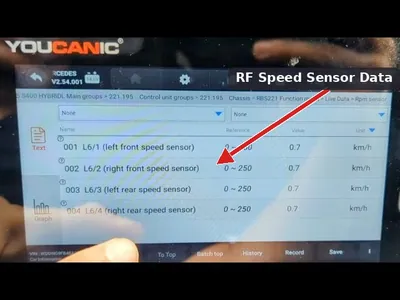
- Use an OBD-II scanner with ABS live data capabilities to monitor the right front wheel speed while driving; a reading stuck at 0 MPH confirms a dead sensor or broken wire.
- Check for manufacturer Technical Service Bulletins (TSBs) before buying parts, as vehicles like the 2013-2014 Ford Fusion have documented wiring pinhole defects that mimic a bad sensor.
What Does C0034 Mean?

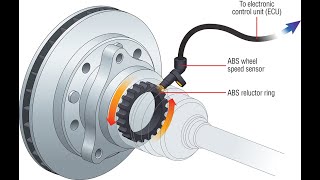
Code C0034 means the Anti-lock Brake System (ABS) module detected a problem with the right front wheel speed sensor's electrical circuit. This sensor tells the computer how fast the wheel turns. If the signal is lost, erratic, or mismatched with other wheels, the computer logs the fault and triggers warning lights.
Technical definition: The ABS or Electronic Stability Control (ESC) module detected a fault in the right front wheel speed sensor's signal. The fault is a complete loss of signal, an erratic/implausible signal, or a mismatch with other wheel speed sensors. Specific sub-codes like C0034-2F (Signal Erratic), C0034-1D (Circuit Current Out of Range), or C0034-62 (Signal Compare Failure) provide precise diagnostic clues.
Can I Drive With C0034?

Yes, But With Caution. Yes, but drive with extreme caution. This code disables your Anti-lock Braking System (ABS) and Traction/Stability Control. Standard hydraulic brakes still work, but the risk of wheel lock-up and skidding during hard braking or on wet/icy surfaces increases significantly. Repair this immediately to restore emergency safety systems.
Common Causes

- Faulty Right Front Wheel Speed Sensor (Very Common) — Constant exposure to heat, vibration, water, and salt causes the sensor's internal electronics to fail, producing a weak, erratic, or nonexistent signal.
- Damaged or Corroded Wiring/Connector (Common) — The exposed wiring harness sustains damage from road debris, suspension rubbing, or moisture corrosion. On some Ford models, a microscopic pinhole in the insulation allows moisture intrusion, causing a dead short.
- Failing Wheel Bearing or Hub Assembly (Common) — A worn wheel bearing creates excessive play in the wheel hub, altering the air gap between the sensor and tone ring. This generates an erratic signal (often sub-code C0034-2F) and requires replacing the entire hub assembly on modern vehicles.
- Contaminated Sensor Tip or Tone Ring (Common) — Metallic brake dust, rust scale, or road grime builds up on the sensor's magnetic tip or the tone ring, physically blocking or distorting the magnetic signal.
- Damaged or Cracked Tone Ring (Less Common) — The tone ring cracks, loses teeth, or swells with rust, providing an inconsistent signal as the wheel rotates. On some axles, a split ring floats independently of wheel speed.
- Impact from Pothole or Curb (Uncommon) — A sharp impact physically shatters the sensor, severs the wiring harness, or damages the wheel bearing, triggering the code immediately after the strike.
- Incorrect Part Installed / Aftermarket Incompatibility (Uncommon) — Low-quality aftermarket sensors often possess incorrect resistance values. The ABS module rejects the incompatible signal, flagging a fault even with a brand-new part.
- Faulty ABS Control Module (Rare) — Internal circuit board failures or software corruption prevent the ABS computer from processing a valid sensor signal. Consider this only after eliminating all sensor, wiring, and mechanical faults.
Symptoms

- ABS Warning Light On — The ABS light illuminates on the dashboard and remains solid.
- Traction Control / Stability Control Light On — Systems relying on wheel speed data disable themselves, illuminating warning lights or displaying messages like 'Service AdvanceTrac' or 'ESC Off'.
- ABS System Inoperative — During a hard stop, the brake pedal will not pulsate, and the wheels lock up and skid on wet or loose surfaces.
- Cruise Control Disabled — The vehicle disables cruise control as a safety precaution when a wheel speed fault is active.
- Cascading System Warnings — Modern vehicles trigger warnings for Hill Start Assist, Parking Aids, and All-Wheel Drive, as these systems require ABS module data.
Diagnostic Flowchart
Tap your situation to follow the diagnostic path that matches what you're seeing on this code.
Common Fixes & Costs
- Replace the Right Front Wheel Speed Sensor — Parts: $30-$100, Labor: $120-$180, ~1.2 hr book time (DIY)
- Repair or Replace Damaged Wiring/Connector — Parts: $20-$60, Labor: $150-$250, ~1.5 hr book time (Intermediate)
- Replace the Front Wheel Hub Assembly — Parts: $150-$450, Labor: $250-$500, ~2 hr book time (Intermediate)
- Clean Sensor Mounting Surface and Tone Ring — Parts: $5-$15, Labor: $50-$100, ~0.5 hr book time (DIY)
- Replace ABS Control Module — Parts: $400-$1200, Labor: $200-$450, ~2 hr book time (Advanced)
DIY vs Professional
- Clean Sensor & Tone Ring — Beginner:
- Replace Wheel Speed Sensor — Beginner:
- Repair Wiring/Connector — Beginner:
- Replace Wheel Hub Assembly — Beginner:
- Replace ABS Module — Beginner:
Used vs. New Parts: Buying Guide
When a used part is worth it: Buying a used wheel speed sensor or hub assembly is never recommended. The sensor is a sensitive electronic component and the hub assembly contains a wear-and-tear bearing. The low cost of a new aftermarket part makes used parts a poor value.
Donor-vehicle mileage cap: roughly under 10000 miles for the part to have meaningful remaining life.
Donor quality checklist:
- Avoid used parts for this repair. The labor to replace a faulty used part negates any initial savings.
- If forced to use a used part, source from a very low-mileage vehicle wrecked due to rear-end damage.
Decision logic:
- If The fault is the wheel speed sensor. → Buy a new OEM or high-quality OE-supplier (e.g., Bosch, NTK, Denso) sensor. Avoid the cheapest online options.
- If The fault is the wheel hub assembly. → Buy a new, reputable brand (e.g., Timken, SKF, MOOG). A used bearing has an unknown lifespan and is a significant safety risk.
- If Budget is the absolute primary concern. → A new, value-line aftermarket part is still a better choice than a used part from a junkyard.
Warranty tradeoff: Used parts typically have a 30-day warranty. New aftermarket parts carry a 1-year to lifetime warranty. The peace of mind favors buying new.
Worst-case if a used part fails: $300-$600 if a used part fails, including repeat labor and the cost of the second part.
What Happens If You Wait — Timeline
- 0-2 weeks: Code C0034 is set. ABS, Traction Control, and Stability Control lights are on. Safety systems are disabled, but standard braking is unaffected. No physical symptoms are noticeable. (MPG impact: 0-1%% · Added cost: $0)
- 2 weeks - 4 months: If the underlying cause is a failing wheel bearing, a faint humming or growling noise begins at speeds above 40 mph. The safety risk of disabled systems remains the primary concern. (MPG impact: 1-3%% · Added cost: $0-$50)
- 4-8 months: The wheel bearing noise progresses to a distinct grinding audible at most speeds. Bearing play becomes significant, causing slight steering wander or uneven tire wear. The risk of the bearing overheating increases. (MPG impact: 3-8%% · Added cost: $350-$900)
- 8+ months: Catastrophic failure of the wheel bearing is imminent. The bearing seizes, locking up the wheel, or completely separates from the vehicle, causing a total loss of control. (MPG impact: N/A% · Added cost: $2000-$5000)
Cost of Not Fixing It
- Immediately: Loss of Anti-lock Brakes (ABS), Traction Control (TCS), and Electronic Stability Control (ESC). Increased risk of skidding and loss of control during hard braking or on slippery surfaces. (Added cost: 0)
- 0-6 months: Continued operation without key safety features. A minor issue like a dirty sensor masks a more serious underlying problem like a failing wheel bearing. (Added cost: $0 - $5000+)
- 6+ months: Ignoring a noisy wheel bearing eventually leads to catastrophic failure, potentially causing an accident and extensive damage to the suspension and axle. (Added cost: Potential for total vehicle loss or major accident-related costs.)
Diagnosis Steps
- Read the Trouble Codes
Use an ABS-capable OBD-II scanner to confirm C0034. Note sub-codes: C0034-2F ('Signal Erratic') indicates a mechanical bearing/ring issue, while C0034-1D ('Circuit Current Out of Range') indicates an electrical sensor/wiring fault.
Tools: OBD-II Scanner (with ABS capability) (Beginner) - Watch Live Data & Perform 'Wiggle Test'
View the live data stream for 'Right Front Wheel Speed'. Drive slowly; it should match the other wheels. If it reads 0 MPH or drops out, the fault is active. Wiggle the sensor's wiring harness while stopped; if the reading flickers, you found a broken wire.
Tools: OBD-II Scanner (with live data) (Intermediate) - Perform a Detailed Visual Inspection
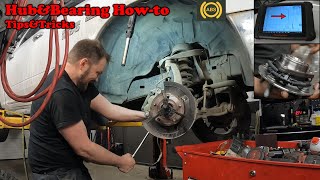
Safely raise the vehicle and remove the right front wheel. Inspect the sensor, connector, and wiring harness for broken wires, melted insulation, or green corrosion on the connector pins.
Tools: Jack, Jack Stands, Lug Wrench (Beginner) - Check for Wheel Bearing Play
With the wheel suspended, grab the tire at 12 and 6 o'clock and rock it. Significant play or a grinding noise when spinning indicates a bad wheel bearing causing an erratic signal.
Tools: None (DIY) - Inspect and Clean the Sensor and Tone Ring
Remove the sensor mounting bolt and extract the sensor. Clean the magnetic tip and the tone ring with brake cleaner and a wire brush to remove signal-blocking rust and debris.
Tools: Socket Set, Brake Cleaner, Rag, Wire Brush (DIY) - Test Passive Sensor with a Multimeter
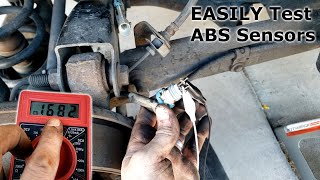
Disconnect a 2-wire passive sensor and measure resistance (Ohms). A good sensor reads 800-2500 Ω. 'OL' means an open circuit. Switch to AC Volts, reconnect, backprobe the wires, and spin the wheel; it must generate at least 0.25V AC.
Tools: Multimeter, Backprobe Kit, Vehicle Wiring Diagram (Advanced) - Test Active Sensor with a Multimeter
For an active (Hall-effect) sensor, backprobe the connected plug with the ignition ON. Verify reference voltage (5V or 12V) on the power wire and <0.1V on the ground wire. Never perform a resistance test on an active sensor.
Tools: Multimeter, Backprobe Kit, Vehicle Wiring Diagram (Advanced) - Test the Sensor Circuit
Disconnect the sensor and ABS module connectors. Measure resistance between the two points to verify continuity (<1.0 Ω) and check for shorts to ground. This isolates a wiring harness failure.
Tools: Multimeter, Vehicle Wiring Diagram (Advanced) - Analyze Signal with an Oscilloscope
Backprobe the signal wire. A passive sensor produces an AC sine wave; an active sensor produces a digital square wave. A distorted or missing waveform confirms a bad sensor, damaged tone ring, or loose bearing.
Tools: Oscilloscope, Backprobe Kit, Wiring Diagram (Advanced)
When This Code Triggers (Freeze-Frame Conditions)
- Fault Trigger: Key On or Driving (A circuit fault is detected at key-on; a signal fault is detected while driving.)
- Vehicle Speed: 0 MPH or >10 MPH (Code sets at startup (0 MPH) if a circuit integrity check fails, or during driving when the signal from the right front wheel is lost or mismatched.)
- RPM: 0 or 1200-2500 (Occurs at engine off (key-on) or during steady-state cruise.)
- ABS/TCS/ESC Status: Active, then Disabled (The system is active at startup, detects the fault, logs the code, and then disables the ABS, traction, and stability control systems.)
Related Codes
- C0031 — This is the identical code but for the Left Front Wheel Speed Sensor. If you see both C0031 and C0034, suspect a problem common to both front wheels, such as a damaged central wiring harness or an ABS module connector issue.
- U0415 — This code means 'Invalid Data Received From Anti-Lock Brake System (ABS) Control Module.' It is a secondary code set by other computers because the ABS module is broadcasting faulty information due to the C0034 fault. Fixing C0034 resolves U0415.
- C0037 / C003A — These are the codes for the rear wheel speed sensors. Multiple wheel speed sensor codes appearing at once indicate a larger problem like a failing ABS module, systemic water intrusion, or a known manufacturer defect.
- C0051 — This code relates to the Steering Wheel Position Sensor. The stability control system compares steering angle with wheel speeds; an irrational wheel speed signal flags the steering angle data as implausible. Diagnose the wheel speed code first.
Climate & Environmental Factors
- Cold Climates / Road Salt: Road salt and brine accelerate corrosion of the sensor wiring and connector pins. Salt causes rust to build up on the hub mounting surface under the sensor, increasing the air gap and weakening the signal.
- High Humidity / Water Intrusion: Moisture penetrates wiring through microscopic breaks in the insulation or seeps into non-sealed connectors, causing corrosion and short circuits over time.
How to Talk to a Mechanic About This Code
Say this: "I have an ABS light on and my scanner is showing a C0034 code for the right front wheel speed sensor circuit. I'd like to schedule a diagnostic to confirm if the failure is the sensor itself, the wiring, or the wheel bearing assembly."
This signals you understand the common failure points. It directs the technician to perform a specific diagnosis rather than starting from scratch, and discourages them from suggesting unrelated repairs.
Avoid saying:
- 'My ABS light is on, can you just fix it?'
- 'I'm not sure what's wrong, just do whatever you think is needed.'
- 'My friend said it's probably the sensor, can you just replace it?'
Questions to ask before authorizing the repair:
- What was the specific point of failure you found during diagnosis?
- Did you test the sensor's signal and the circuit wiring, or just read the code?
- If you're recommending a wheel hub replacement, was there physical play in the bearing or did the live data show an erratic signal?
- Is the replacement part OEM or aftermarket, and what is the warranty on both the part and the labor?
Where to Take It: Dealer vs Independent vs Chain
- Dealer:
Recommended only if the vehicle is under warranty or if initial diagnosis from an independent shop is inconclusive.
Best for: Vehicles under warranty, Complex electrical issues involving the ABS module, Repairs covered by a specific Technical Service Bulletin (TSB)
Downsides: Significantly higher labor rates and parts costs., Often recommends a more expensive assembly replacement when a smaller component suffices. (Typical cost: +50% vs. baseline) - Independent Shop:
Best fit. A reputable independent shop easily diagnoses and repairs the common causes of C0034 at a much lower cost than a dealer.
Best for: Most out-of-warranty C0034 repairs., Cost-conscious owners wanting quality service., Building a long-term relationship with a mechanic.
Downsides: Quality and expertise vary greatly; look for ASE certifications., May lack the latest manufacturer-specific diagnostic tools for very new models. (Typical cost: +0% vs. baseline) - Chain Shop:
Use with caution. Acceptable if you already diagnosed the problem and just need a new sensor installed. AVOID for initial diagnosis.
Best for: Simple, straightforward parts replacement when you are certain of the diagnosis.
Downsides: Technician skill varies dramatically., High pressure to upsell services; pushes for a wheel hub replacement when only cleaning is needed., Lacks advanced diagnostic tools to differentiate between a sensor, wiring, or mechanical fault. (Typical cost: -10% vs. baseline)
When to Walk Away From the Repair
If the estimated repair cost exceeds 40-50% of the car's private-party value, seriously consider selling or trading in the vehicle instead of repairing it.
- Car worth $3500, fix is $1100: Borderline. A $1100 hub assembly replacement is a significant portion of the car's value. Get a second opinion to confirm the hub is truly necessary before proceeding.
- Car worth $15000, fix is $950: Fix it. The repair cost is well below the threshold and restores critical safety features.
- Car worth $2000, fix is $1400: Walk away. A potential ABS module replacement costing $1400 on a $2000 car is not economically viable.
What Scan Tool You Need for This Code
Minimum: A scanner that reads and displays LIVE DATA for the ABS (Anti-lock Braking System).
A basic $20 engine code reader will NOT see 'C' (Chassis) codes like C0034. You need a tool that specifically supports ABS diagnostics. Without live data, you cannot see if the sensor signal is dropping out, erratic, or completely gone.
Budget: Autel AutoLink AL619 (~$80) — Reads and clears ABS codes, shows code definitions, and displays live data for all four wheel speed sensors to compare the faulty one to the good ones.
Mid-range: Topdon ArtiDiag500S / Foxwell NT630 Plus (~$150-250) — Offers everything the budget pick does, plus a better interface, wider vehicle coverage, and bidirectional controls to command ABS solenoids.
Professional: Autel MaxiCOM MK808 / Launch CRP919 (~$450-700) — Provides full bidirectional control, advanced data graphing, and dealer-level diagnostic functions. Performs automated ABS bleed procedures and system calibrations.
Rent vs buy: Most auto parts stores loan out basic OBD-II engine code readers for free, but these usually CANNOT read ABS codes. For a one-time C0034 diagnosis, buying a budget pick like the AL619 is more practical than trying to find a rental with ABS capabilities.
How to Clear the Code After You Fix It
- Use an ABS-capable OBD-II scan tool to clear the code.
- Perform a short test drive that includes speeds above 15 mph and at least one stop.
- Re-scan the ABS module to confirm the code does not return.
Drive cycle (~15 minutes): After clearing the code, start the vehicle and drive for 10-15 minutes, including a mix of city speeds (above 15 mph) and a brief period of highway driving. The ABS module continuously monitors the sensors, so a successful test drive without the light returning confirms the fix.
Readiness monitors affected: Not applicable to emissions readiness monitors.
Watch out for:
- Disconnecting the battery will not reliably clear an ABS code.
- The code immediately returns if the root cause (bad sensor, wiring, hub) was not correctly identified and fixed.
- Forgetting to perform a test drive to validate the repair.
Will This Fail Emissions / State Inspection?
No — by itself this code doesn't fail OBD inspection (but it can keep readiness monitors from setting, which causes a separate fail).
- California: Will NOT fail a smog check. California's emissions test is only concerned with the Check Engine Light and emissions-related systems.
- New York: Will NOT fail the safety inspection. According to NY DMV regulations, an illuminated ABS warning light is an advisory item, not a cause for rejection.
- Texas: Will NOT fail the safety inspection. The Texas Department of Public Safety explicitly states that an illuminated ABS lamp is not a cause for rejection.
Most Commonly Affected Vehicles
- Chevrolet / GMC Silverado / Sierra, Tahoe / Suburban (2007-2014) — Heavy corrosion building up on the hub surface where the sensor mounts is a very common cause. This rust increases the air gap between the sensor and tone ring. Cleaning the mounting surface is a critical first step.
- Dodge / Ram Ram 1500 (2013-2018) — C0034-2F (Signal Erratic) often points to a failing wheel bearing/hub assembly causing excessive movement. Replacing the entire hub assembly is a frequent and effective fix.
- Ford F-150 (2015-2020) — The wiring harness for the sensor is prone to rubbing on the tire or suspension components if not clipped correctly, causing an open or short.
- Ford Fusion / MKZ (2013-2014) — Per Ford Special Service Message (SSM 44504), a small pinhole develops in the wiring insulation 1-3 inches from the connector, allowing moisture to corrode the wire.
- Ford Transit (2015-2019) — Ford TSBs (SSM 47785 & 47468) state that metallic debris buildup between the sensor and the wheel bearing surface is a primary cause. Clean the sensor and mounting hole before replacing parts.
- Honda Accord, CR-V (2008-2017) — The cause is typically a failed sensor due to age and exposure, or corrosion in the electrical connector.
- Hyundai / Kia Sonata / Optima (2011-2016) — The cause is often the sensor itself failing, or damage to the exposed wiring harness leading to the sensor.
- BMW 3-Series (E90/E91/E92) (2006-2013) — A failed sensor causes ABS, DSC, Brake, and 4x4 lights to illuminate. The sensor frequently seizes in the steering knuckle, making removal difficult.
- Jeep Compass / Renegade (2018-2020) — TSB 05-003-21 addresses water intrusion or oxidation in the wheel speed sensors causing this code. The bulletin recommends replacing all four sensors.
Manufacturer-Specific Notes
- Ford: For F-150s, check for harness rubbing. For 2013-2014 Fusions, look for pinhole corrosion in the harness near the connector per SSM 44504. On Transits, TSBs point to debris buildup, recommending cleaning before part replacement.
- Dodge / Ram / Jeep: On Ram trucks, the code is often caused by a bad wheel hub assembly. A C0034-2F sub-code strongly suggests a mechanical hub/bearing issue, while C0034-1D points to wiring/sensor electrical failure.
- General Motors (Chevy/GMC): On GMT900 platform trucks and SUVs, rust and corrosion building up on the face of the wheel hub where the sensor mounts pushes the sensor away from the tone ring, weakening the signal. Cleaning this surface is critical.
- Mercedes-Benz: Recall NHTSA 21V-042 was issued for 2012-2018 Sprinter vans where moisture intrusion into the wheel speed sensors causes ESP failure, indicating a known issue with sensor sealing.
Real Owner Stories
2013 Ford Fusion at 110K miles - Misdiagnosis Story
ABS and Traction Control lights illuminated with code C0034. Replacing the right front wheel speed sensor did not fix the issue.
What they tried:
- Replaced the right front wheel speed sensor.
- Inspected wiring harness based on Ford SSM 44504.
Outcome: Found a tiny pinhole in the wire insulation two inches from the sensor connector. The internal wire was green with corrosion. Splicing and sealing the wire permanently fixed the code.
Lesson: Do not assume the sensor is bad. On specific models, known wiring defects are the primary cause. Always check for TSBs and inspect the wiring harness closely.
2015 Ram 1500 at 85K miles - The 'Erratic Signal' Fix
ABS light on, scanner showed C0034-2F (Signal Erratic) and C0034-1D (Circuit Current Out of Range).
What they tried:
- Replaced the right front speed sensor.
- Replaced the entire wheel hub bearing assembly.
Outcome: Replacing the wheel hub assembly, which includes the integrated tone ring and bearing, resolved the issue. The old bearing had developed slight play, causing the erratic signal.
Lesson: The sub-code provides a massive clue. 'Signal Erratic' points to a mechanical issue like a bad wheel bearing, not just an electrical sensor fault.
2008 Chevy Silverado at 130K miles - The 'Easy' Rust Belt Fix
ABS light appeared with code C0034 in a northern state with heavy road salt use.
What they tried:
- Removed the right front wheel speed sensor.
- Cleaned significant rust scale from the hub surface where the sensor mounts.
- Reinstalled the original sensor.
Outcome: Cleaning the rust restored the correct air gap between the sensor and the tone ring. The code cleared and did not return.
Lesson: In 'Rust Belt' regions, rust buildup between the sensor and hub is a primary cause. Clean this surface before buying any parts.
2010 BMW E90 3-series - The Seized Sensor
Dashboard lit up with ABS, DSC, and Brake warning lights. Code C0034 was present.
What they tried:
- Attempted to replace the right front wheel speed sensor.
Outcome: The sensor seized into the steering knuckle due to corrosion and broke off during removal. The technician drilled out the remaining plastic piece before installing the new sensor.
Lesson: Sensors fuse to the knuckle in rust-prone areas. Apply penetrating oil beforehand, but be prepared to drill out a broken sensor.
How to Prevent This Code From Triggering
- Wash the vehicle's undercarriage. (Monthly during winter in salt-belt states.) — Removes road salt and grime that accelerate corrosion on wiring, connectors, and the hub/sensor mounting surface.
- Apply dielectric grease to the wheel speed sensor connector. (Whenever the connector is disconnected.) — Seals the electrical pins from moisture and oxygen, preventing the formation of corrosion that interrupts the signal.
- Inspect and secure the sensor wiring harness. (During every tire rotation or brake service.) — Ensures the wiring is properly clipped in place and not rubbing against suspension components or the tire.
- Address noisy wheel bearings immediately. (As soon as a humming or grinding noise is heard.) — A failing wheel bearing is a common cause of C0034. Replacing it proactively prevents the erratic signal fault and avoids catastrophic bearing failure.
Frequently Asked Questions
Can I fix code C0034 myself?
Yes, this is often a DIY-friendly repair. Replacing the wheel speed sensor or cleaning the sensor and tone ring requires only basic hand tools and a jack.
Will the C0034 code clear itself?
Rarely. The code indicates a hard fault detected by the ABS module. Warning lights remain illuminated until the underlying problem is fixed and the code is cleared with a scan tool.
What does the sub-code like C0034-2F or C0034-1D mean?
The sub-code provides specific diagnostic clues. C0034-2F means 'Signal Erratic,' pointing to a mechanical issue like a bad wheel bearing or dirty tone ring. C0034-1D means 'Circuit Current Out of Range,' suggesting an electrical problem like a broken wire.
I replaced the sensor, but the code came back. What now?
This is a common pitfall. If a new sensor fails to fix it, meticulously inspect the wiring harness for damage, check for wheel bearing play, and ensure the tone ring is clean. The replacement sensor might also be faulty or an incompatible aftermarket part.
Is it better to use an OEM sensor or a cheaper aftermarket one?
Aftermarket sensors are cheaper but frequently cause comebacks because the ABS module requires specific electrical characteristics. An incompatible part produces an incorrect signal output, causing the module to reject it. Spend the extra money on an OEM or high-quality OE-supplier part for a guaranteed fix.
Can a bad alignment cause code C0034?
No, a bad alignment itself will not cause a C0034 code. However, severely worn suspension components that lead to bad alignment could cause enough hub movement to create an erratic wheel speed signal.
I hit a curb and now the ABS light is on with code C0034. What happened?
A hard impact from a curb or pothole directly causes this code. The force damages the wheel bearing, cracks the sensor, or severs the sensor's wiring harness. Perform a thorough visual inspection of these components after an impact.
Can code C0034 prevent my car from starting?
This is extremely rare and not a typical symptom. A C0034 code will not cause a no-start condition in standard vehicles. Diagnose the no-start condition as a completely separate issue first.
Key Takeaways
- Code C0034 instantly disables your ABS and stability control, increasing your stopping distance and risk of skidding during emergency braking.
- Over 80% of C0034 codes stem from a dead right front wheel speed sensor, corroded wiring near the wheel well, or a failing wheel hub assembly.
- Start diagnosis by removing the right front wheel to visually inspect the sensor wiring for chafing and the hub mounting surface for rust buildup.
- Use an OBD-II scanner with ABS live data capabilities to monitor the right front wheel speed while driving; a reading stuck at 0 MPH confirms a dead sensor or broken wire.
- Check for manufacturer Technical Service Bulletins (TSBs) before buying parts, as vehicles like the 2013-2014 Ford Fusion have documented wiring pinhole defects that mimic a bad sensor.
Helpful Videos
Shop the Parts Behind C0034
Below are the parts most often responsible for code C0034, ranked by how frequently each one is the actual culprit (per the diagnosis above). Tap any to see what we have for your vehicle.

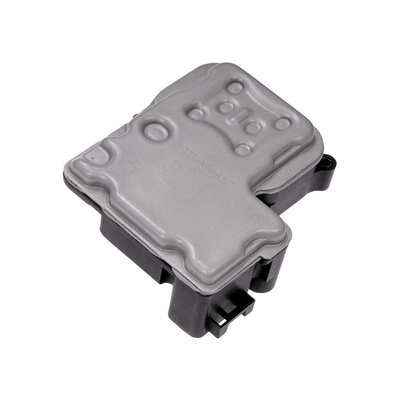



The information in this article is provided for general reference and educational purposes only. Vehicle specifications, procedures, and part compatibility can vary by production date, trim level, and region. Always consult your vehicle's factory service manual and verify part numbers before purchasing or performing repairs. Safety-critical components such as airbags, seat belts, and braking systems should be installed by a qualified professional.
- 🧭 Diagnostic Flowchart
- 🎬 Helpful Videos
- 🛍️ Shop This Part
- What Does C0034 Mean?
- Can I Drive With C0034?
- Common Causes
- Symptoms
- Common Fixes & Costs
- DIY vs Professional
- Used vs. New Parts: Buying Guide
- What Happens If You Wait — Timeline
- Cost of Not Fixing It
- Diagnosis Steps
- When This Code Triggers (Freeze-Frame Conditions)
- Related Codes
- Climate & Environmental Factors
- How to Talk to a Mechanic About This Code
- Where to Take It: Dealer vs Independent vs Chain
- When to Walk Away From the Repair
- What Scan Tool You Need for This Code
- How to Clear the Code After You Fix It
- Will This Fail Emissions / State Inspection?
- Most Commonly Affected Vehicles
- Manufacturer-Specific Notes
- Real Owner Stories
- 2013 Ford Fusion at 110K miles - Misdiagnosis Story
- 2015 Ram 1500 at 85K miles - The 'Erratic Signal' Fix
- 2008 Chevy Silverado at 130K miles - The 'Easy' Rust Belt Fix
- 2010 BMW E90 3-series - The Seized Sensor
- How to Prevent This Code From Triggering
- Frequently Asked Questions
- Can I fix code C0034 myself?
- Will the C0034 code clear itself?
- What does the sub-code like C0034-2F or C0034-1D mean?
- I replaced the sensor, but the code came back. What now?
- Is it better to use an OEM sensor or a cheaper aftermarket one?
- Can a bad alignment cause code C0034?
- I hit a curb and now the ABS light is on with code C0034. What happened?
- Can code C0034 prevent my car from starting?
- Key Takeaways
- 🎟️ Get 5% Off