

GMC Terrain C0035 (2010-2017): Left Front Wheel Speed Sensor Fault Causes & Fixes
On a 2010-2017 GMC Terrain, code C0035 is most often caused by metallic debris on the left front wheel hub's magnetic encoder ring or a faulty wheel speed sensor harness. Cleaning the ring (free) or replacing the harness (~$25-$50) often fixes it. If the hub itself is bad, expect to pay $100-$250 for the part.
- Code C0035 on a 2010-2017 GMC Terrain means there's a problem with the left front wheel speed sensor circuit.
- Before buying any parts, inspect and clean the magnetic ring on the left front wheel hub. GM issued a TSB stating that metallic debris is a very common cause.
- If cleaning the hub doesn't work, the most likely culprits are a bad wiring harness or a failed wheel hub assembly.
- Driving with this code is not recommended as it disables ABS, traction control, and stability control, compromising safety.
- A scan tool that can read ABS codes and live data is essential for accurate diagnosis.
What's Unique About the 2010-2017 Gmc TERRAIN
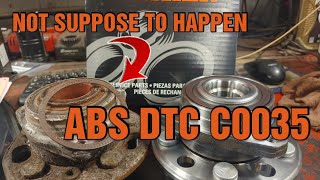
The GMC Terrain and its sister platform, the Chevy Equinox, use a specific type of wheel bearing that has a magnetic encoder ring integrated into the hub's seal. A very common issue, highlighted in GM Technical Service Bulletin PIC5428G, is that ferrous metallic debris gets stuck to this magnetic ring, disrupting the wheel speed sensor's reading and triggering code C0035. This debris often looks like a metallic 'fuzz' or paste. Often, simply cleaning this debris with a brush and brake cleaner can resolve the fault without needing to replace any parts.
Diagnostic Flowchart
Tap your situation to follow the diagnostic path that matches what you're seeing on this vehicle.
Symptoms You May Notice
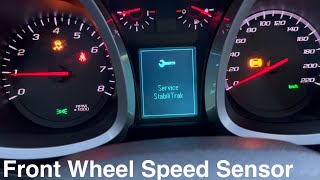
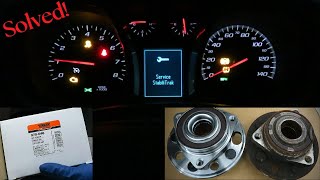
- "Service StabiliTrak" message on the dashboard
- ABS warning light is on
- Traction Control warning light is on
- ABS may feel like it's activating at low speeds during normal braking (a brief grind or ratchet noise)
- In some cases with electric power steering, a "Service Steering" message may appear and steering may feel heavy at low speeds
- Replacing the wheel speed sensor without first inspecting and cleaning the magnetic encoder ring on the hub. Many owners and even shops replace the sensor only to have the code return because the issue was debris on the hub.
- Replacing the wheel hub assembly without first checking the wiring harness pigtail for internal breaks, which is a cheaper and simpler repair.
Most Likely Causes
- Debris on Left Front Wheel Hub Magnetic Encoder Ring 🔴 High Probability The hub assembly uses an exposed magnetic nitrile rubber ring that attracts ferrous metallic debris from brake wear and road grime. This is a well-documented issue in GM TSB PIC5428G. Forum users frequently report fixing the code by cleaning this 'fuzz' off the ring.
How to confirm: Remove the left front wheel speed sensor (one 10mm bolt). Use a borescope or phone camera to visually inspect the brown, rubber-like magnetic ring on the wheel hub for metallic shavings or rust buildup. The debris can look like a dark paste.
Typical fix: Carefully clean the debris from the magnetic ring using a non-magnetic tool like a plastic brush, cloth, and brake cleaner. Do NOT use magnets or sharp metal tools for cleaning as they can permanently damage the encoder ring's magnetic poles.
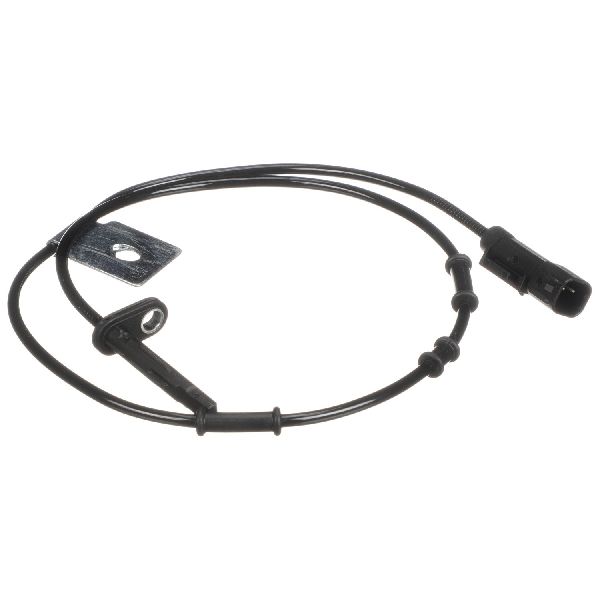
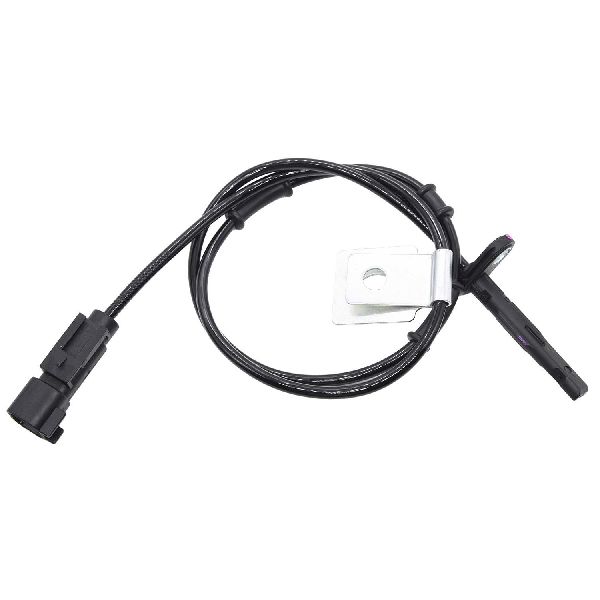
Est. part cost: $0-$10 - Faulty Left Front Wheel Speed Sensor Harness 🟡 Medium Probability → Shop ABS Wheel Speed Sensor The wiring harness is exposed to weather, road debris, and constant movement from the suspension and steering. Wires can break internally near the connector with no visible damage to the insulation, a common failure mode on GM vehicles.
How to confirm: Visually inspect the harness for chafing or corrosion. A common field test is to gently pull on the wires near the connector; if the insulation stretches like a rubber band, the copper wire inside is broken. Also check for continuity with a multimeter.
Typical fix: Replace the sensor harness pigtail. This is often sold as a separate, repair-friendly part. Splicing in the new pigtail with heat-shrink butt connectors is the standard repair.
Est. part cost: $25-$50 - Failed Left Front Wheel Hub Bearing Assembly 🟡 Medium Probability → Shop Hub Assembly The magnetic encoder ring can become damaged, cracked, or delaminate from the hub. Also, a worn bearing can develop excessive play (wobble), which changes the air gap between the sensor and the ring, causing an erratic signal.
How to confirm: After cleaning the ring and checking the wiring, if the problem persists, check the wheel bearing for play by trying to rock the wheel at the 12 and 6 o'clock positions. A damaged encoder ring may be visibly cracked or separated. A dial indicator can be used to measure end play, which should not exceed 0.005 inches.
Typical fix: Replace the entire wheel hub bearing assembly. The hub contains the integrated magnetic encoder ring. This is a common fix reported by owners on forums after cleaning the ring did not solve the issue.
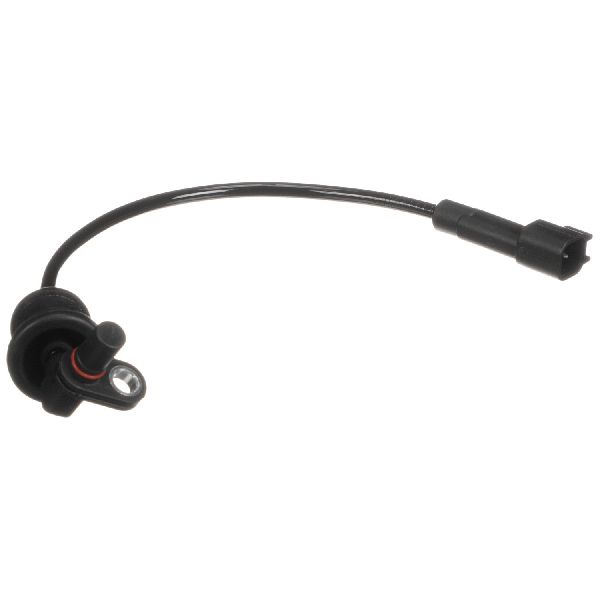
Est. part cost: $100-$250 - Failed Left Front Wheel Speed Sensor ⚪ Low Probability → Shop ABS Wheel Speed Sensor While the sensor itself can fail, it is often less likely to be the root cause on this platform compared to the encoder ring or wiring. It is frequently misdiagnosed as the primary failure.
How to confirm: Use a scan tool to monitor live data from the left front wheel speed sensor while driving. If it reads 0, is erratic compared to the other wheels, or shows dropouts on a lab scope, and the wiring/hub have been ruled out, the sensor is likely bad. The sensor can also be tested for voltage output while spinning the wheel.
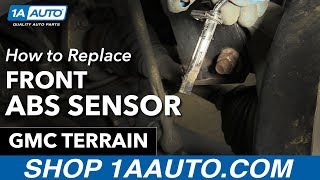
Typical fix: Replace the wheel speed sensor. It is typically held in by a single 10mm bolt. 🎬 Watch: Step-by-step guide to replacing the wheel speed sensor
Est. part cost: $20-$60
Rare But Worth Checking
- Electronic Brake Control Module (EBCM) Failure: → Shop ABS Control Module This is uncommon. An EBCM failure usually triggers multiple wheel speed sensor codes or other communication codes, not just a single corner fault. Diagnostics should rule out all other possibilities before condemning the EBCM. If replaced, the new module requires programming.
Diagnosis Steps
- Connect a scan tool capable of reading ABS codes to confirm C0035 is present. Note any symptom bytes (e.g., 18, 5A, 0F) as they confirm the specific fault type addressed in GM TSBs.
- Use the scan tool's live data feature to monitor all four wheel speeds while driving. Confirm that the Left Front sensor reads 0 mph, erratically, or differently from the other three.
- Raise and secure the vehicle. Remove the left front wheel.
- Visually inspect the wheel speed sensor harness for any signs of damage, chafing, or corrosion at the connectors. Perform a 'pull test' on the wires near the connector to check for internal breaks.
- Remove the 10mm bolt holding the wheel speed sensor and pull the sensor out of the steering knuckle.
- Crucial Step: Thoroughly inspect the brown magnetic encoder ring on the wheel hub assembly. Use a light and a small brush (non-magnetic) to look for and clean off attached metallic debris.
- While the sensor is out, inspect the encoder ring for cracks, swelling, or signs of it separating from the hub.
- If cleaning the ring doesn't solve the issue, test the wiring harness for continuity and proper voltage from the EBCM at the connector. Test for a signal at the EBCM connector Pin 21 (Light Blue wire) and Low Reference at Pin 20 (Orange wire).
- If the wiring and hub ring are good, the sensor itself is a possible culprit. If the wheel bearing has excessive play (wobble) greater than 0.005 inches, the entire hub assembly needs replacement.
- After any repair, clear the codes with the scan tool and perform a test drive to ensure the warning lights do not return.
Parts You'll Likely Need
- Front Wheel Hub Bearing Assembly
(OEM #ACDelco FW413 (GM 22845381))— Required if the integrated magnetic encoder ring is damaged or if the bearing itself has failed, causing excessive play. This is a complete unit.
Trusted brands: ACDelco, Timken, MOOG, SKF, Detroit Axle
OEM price range: $180-$250
Aftermarket price range: $80-$150 - Front Wheel Speed Sensor Harness
(OEM #ACDelco 10340314)— This wiring is a common failure point due to internal wire breaks or corrosion and is often the fix if the hub is clean and intact.
Trusted brands: ACDelco, Dorman (e.g., 645-204), Standard Motor Products
OEM price range: $40-$60
Aftermarket price range: $25-$45 - Left Front Wheel Speed Sensor
(OEM #ACDelco 84622323 (GM 20811372))— Replaced if the sensor itself has failed internally, after ruling out the more common hub and wiring issues.
Trusted brands: ACDelco, Bosch, Delphi
OEM price range: $45-$70
Aftermarket price range: $20-$40
Related Codes That Often Appear With This One
- U0415 — On models with electric power steering, a loss of a valid wheel speed sensor signal can cause the Power Steering Control Module to set this code and default to a higher-effort steering mode. This is noted in GM TSB 17-NA-047.
- C0040, C0045, C0050 — These are the codes for the other three wheel speed sensors (Right Front, Left Rear, Right Rear). While C0035 can appear alone, seeing multiple codes may point towards a more systemic issue like a problem with the EBCM or its main power/ground connections.
Technical Service Bulletins (TSBs) & Recalls
- PIC5428G
- 17-NA-047
Platform-Specific Known Issues
- Owner Experience: Cleaning the Hub Ring Fixes C0035: A user on equinoxforum.net with a 2011 Equinox reported the classic 'Service StabiliTrak' and ABS lights with code C0035. Instead of replacing parts, they followed advice to first inspect the hub. They removed the wheel speed sensor and found a significant amount of 'metallic gunk' on the magnetic encoder ring. After cleaning the ring with brake cleaner and a small brush, they cleared the codes and the problem was resolved without returning, saving hundreds of dollars on a new hub or sensor.
- Repair Story: Broken Wire Inside Harness Insulation: A YouTube video focusing on GM C0035 codes demonstrates a common failure where the copper wire inside the wheel speed sensor pigtail breaks due to constant flexing with the suspension. The key diagnostic shown is that the outer wire insulation appears intact, but when pulled, it stretches like a rubber band, indicating the broken wire within. The fix was to splice in a new harness pigtail (ACDelco P/N 10340314).
Mechanic-Grade Diagnostic Values
- Wheel Hub Bearing End Play — expected: Less than 0.005 inches. Failure: A measurement exceeding 0.005 inches indicates a worn bearing, which can cause an erratic signal.
- Sensor AC Voltage Output (Passive Sensor Test) — expected: At least 200 millivolts (0.2 VAC). Failure: A reading below 200 mV while spinning the wheel at approximately 1 revolution per 2 seconds suggests a weak or failed sensor.
- Sensor Supply Voltage at Connector — expected: Approximately 12V (Battery Voltage). Failure: Significantly low or no voltage indicates a problem with the EBCM or the wiring between the module and the sensor.
Hidden / Shadow Codes Worth Checking
- C0035 0F: Indicates the EBCM has detected that the wheel speed sensor signal is erratic. (see via A professional scan tool capable of reading manufacturer-specific symptom bytes, such as a GM Tech2 or GDS2.)
- C0035 18: Indicates the signal amplitude from the wheel speed sensor is too low, often pointing to an excessive air gap or debris. (see via A professional scan tool capable of reading manufacturer-specific symptom bytes, such as a GM Tech2 or GDS2.)
- C0035 5A: Indicates the sensor signal is 'not plausible,' meaning it doesn't correlate with the signals from other vehicle sensors (e.g., other wheel speeds). (see via A professional scan tool capable of reading manufacturer-specific symptom bytes, such as a GM Tech2 or GDS2.)
Scan Tool Commands That Help
- GM Service Programming System (SPS): EBCM Programming and Setup — This is required if the Electronic Brake Control Module (EBCM) is replaced. The new module must be programmed with the vehicle's correct software and VIN to function.
Wiring & Ground Locations
- EBCM Connector Pin 21 — On the main connector of the Electronic Brake Control Module (EBCM), located in the left rear of the engine compartment.. This is the specific pin for the Left Front Wheel Speed Sensor Signal (Light Blue wire). It can be back-probed to test the sensor's signal directly at the module.
- EBCM Connector Pin 20 — On the main connector of the Electronic Brake Control Module (EBCM), located in the left rear of the engine compartment.. This is the Low Reference (ground) circuit for the Left Front Wheel Speed Sensor (Orange wire). It can be tested for continuity back to the sensor.
- G110 — A primary ground point located on the right rear of the engine.. Poor engine and body grounds can cause intermittent and difficult-to-diagnose voltage issues for sensitive electronics like the EBCM, potentially leading to false sensor codes.
Real Owner Repair Stories
- JL's Auto Solution on YouTube (2016 Chevrolet Equinox (sister vehicle)) — ABS light on with code C0035. Live data showed an erratic signal from the left front sensor.
❌ Tried (didn't work) Visual inspection of wiring and connector showed no obvious issues.
✅ What actually fixed it A lab scope confirmed an erratic signal. A dial indicator then measured wheel hub end play that exceeded the 0.005-inch specification. Replacing the entire left front wheel hub assembly, which includes the bearing and integrated encoder ring, resolved the issue. - YouTube video by 'Chris Fixes' (Chevrolet Impala (demonstrates common GM issue)) — ABS and Traction Control lights on with codes C0035/C0040.
❌ Tried (didn't work) Replacing the sensor or hub without checking the harness first.
✅ What actually fixed it The wire for the wheel speed sensor was broken internally inside the insulation at a harness flex point. The break was confirmed by pulling on the wire and seeing the insulation stretch without the wire inside. The fix was to splice in a new harness pigtail.
Helpful Videos
We Have This Part in Stock



The information in this article is provided for general reference and educational purposes only. Vehicle specifications, procedures, and part compatibility can vary by production date, trim level, and region. Always consult your vehicle's factory service manual and verify part numbers before purchasing or performing repairs. Safety-critical components such as airbags, seat belts, and braking systems should be installed by a qualified professional.
- Gmc TERRAIN:
- 🧭 Diagnostic Flowchart
- 🎬 Helpful Videos
- 🛍️ Shop This Part
- What's Unique About the 2010-2017 Gmc TERRAIN
- Symptoms You May Notice
- Most Likely Causes
- Rare But Worth Checking
- Diagnosis Steps
- Parts You'll Likely Need
- Related Codes That Often Appear With This One
- Technical Service Bulletins (TSBs) & Recalls
- Platform-Specific Known Issues
- Mechanic-Grade Diagnostic Values
- Hidden / Shadow Codes Worth Checking
- Scan Tool Commands That Help
- Wiring & Ground Locations
- Real Owner Repair Stories
- 🎟️ Get 5% Off