

C0035 on 2010-2013 Mazda 3: Front Wheel Speed Sensor Circuit Fault Causes and Fixes
C0035 indicates a fault with a front wheel speed sensor circuit. The most common fix is replacing the faulty sensor, which costs about $40-$90 for the part. However, it is critical to use an ABS-capable scan tool to confirm whether the fault is on the left or right side before buying parts, as generic definitions are conflicting.
- C0035 means there is a problem with a front wheel speed sensor circuit on your Mazda 3.
- Crucially, you MUST use a scan tool with live data to confirm if the fault is on the LEFT or RIGHT side before buying parts, as generic definitions are unreliable and conflicting.
- The most likely cause is a failed wheel speed sensor, followed by damaged wiring near the wheel.
- This is a safety-critical repair; driving with this fault means your ABS and stability control will not work.
- The repair is DIY-friendly for those with basic tools, provided the correct side has been identified. The sensor is held by one bolt but may be seized in the knuckle.
What's Unique About the 2010-2013 Mazda 3
The 2010-2013 Mazda 3 belongs to the second generation (BL), which is based on the Ford C1 platform. For this model, the C0035 code is a prime example of why generic code definitions are unreliable. While the issue is clearly a front wheel speed sensor circuit, the specific side (left vs. right) is not consistently defined in public documentation. This makes professional-level diagnostics (or a high-quality scanner that provides manufacturer-specific definitions) a near necessity to avoid buying the wrong part.
Symptoms You May Notice
- ABS warning light is on
- Traction Control System (TCS) or Dynamic Stability Control (DSC) warning light is on
- ABS system is disabled
- Traction and stability control are disabled
- Cruise control may not function
- Brake pedal may feel firm or pulse unusually during stops
- Replacing the wrong side wheel speed sensor due to relying on generic code definitions instead of vehicle-specific diagnostics.
- Replacing the ABS module when the actual fault is a simple wiring break or a failed sensor. 🎬 See how to diagnose ABS and ESP warning lights
- Replacing the wheel speed sensor when the actual problem is metallic debris on the magnetic encoder ring of the wheel hub.
Most Likely Causes
- Failed Front Wheel Speed Sensor 🔴 High Probability → Shop ABS Wheel Speed Sensor Wheel speed sensors are exposed to harsh conditions (water, dirt, heat, vibration) at the wheel hub, leading to eventual internal failure. This is the most common cause for this code.
How to confirm: Use an ABS-capable scan tool to monitor live data from all four wheel speed sensors while driving. The sensor that shows an erratic or 0 MPH reading when the car is moving is the faulty one. You can also test the sensor's internal resistance with a multimeter; an open (infinite resistance) or shorted (near zero resistance) circuit indicates failure. However, the Mazda service manual specifically warns that a resistance check with a standard multimeter may damage the sensor's internal circuit.
Typical fix: Replace the faulty wheel speed sensor. The sensor is typically held in by a single E-Torx bolt to the steering knuckle and can become seized, requiring care during removal.
Est. part cost: $40-$90 - Damaged Wiring or Corroded Connector 🟡 Medium Probability The wiring harness leading to the sensor is subject to stress from steering and suspension movement, and connectors can corrode from road salt and moisture. Wires can chafe or break internally near the connector.
How to confirm: Visually inspect the wiring harness from the sensor to the chassis for any signs of chafing, breaks, or stretched wires. Unplug the connector and check for green or white corrosion on the pins. A voltage test at the sensor connector with the ignition on should show a 4.5-5.5V reference voltage.
Typical fix: Repair the broken section of wire with solder and heat shrink. Clean corroded connectors with electrical contact cleaner or replace the connector pigtail if damage is severe.
Est. part cost: $5-$30 - Damaged Wheel Bearing Encoder Ring ⚪ Low Probability The magnetic encoder ring is integrated into the wheel hub/bearing assembly. If the bearing fails or is damaged during a separate repair (like a CV axle replacement), the ring can be compromised. It can also accumulate metallic debris which disrupts the signal.
How to confirm: After removing the wheel speed sensor, visually inspect the magnetic ring on the wheel hub for cracks, rust, or metallic debris. A damaged or obstructed ring will provide an erratic signal.
Typical fix: Clean debris from the ring. If the ring itself is damaged, the entire wheel hub and bearing assembly must be replaced as the ring is not serviced separately.
Est. part cost: $70-$150
Rare But Worth Checking
- Faulty ABS Control Module: → Shop ABS Control Module This is rare and should only be considered after definitively ruling out the sensor, wiring, and wheel bearing. A failure of the ABS module will often be accompanied by other wheel speed sensor codes or communication errors. A TSB for 2010-2011 models (SB-04-002-13) notes that the ABS light can come on due to an internal module issue in high heat and humidity, suggesting module vulnerability.
Diagnosis Steps
- Connect an ABS-capable OBD-II scanner. Confirm C0035 is the active code and check for any manufacturer-specific sub-codes or descriptions.
- Access the live data stream for all four wheel speed sensors. The Mazda diagnostic system (M-MDS) uses the PIDs 'WSPD_LF' and 'WSPD_RF' for the front sensors.
- Drive the vehicle slowly (5-10 MPH) and observe the readings. The sensor that reads 0 MPH or has an erratic signal is the source of the fault. This step is critical to confirm which side (left or right) is failing. 🎬 Watch: Real-world ABS diagnosis and repair walkthrough
- Raise and secure the vehicle and remove the wheel on the affected side.
- Visually inspect the wheel speed sensor and its wiring harness for any obvious damage, chafing, or corrosion.
- Unplug the sensor. Inspect the connector pins for corrosion or damage.
- If no visual faults are found, test the sensor and circuit. With the ignition on, back-probe the sensor connector to verify a reference voltage of approximately 4.5-5.5V. The Mazda service manual explicitly warns *against* performing a resistance test with a standard multimeter as it can damage the sensor's internal circuitry.
- If the sensor, wiring, and encoder ring are all confirmed to be good, the fault may lie within the ABS control module, which requires more advanced diagnostics. Check for relevant TSBs like SB-04-002-13.
Parts You'll Likely Need
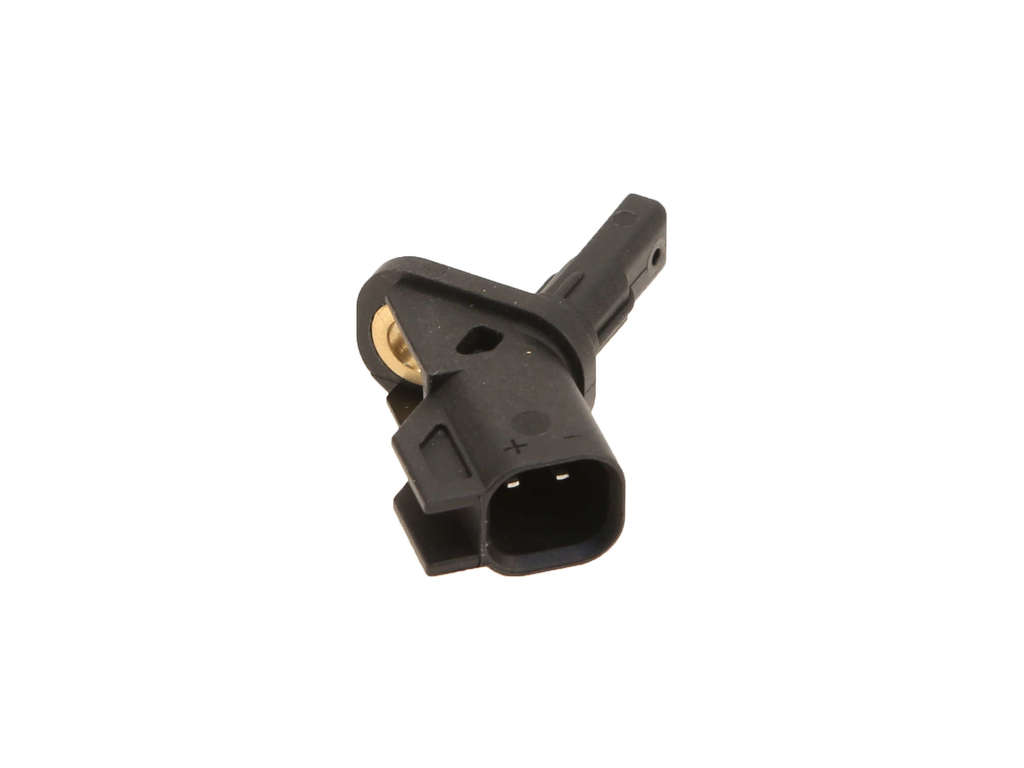
- Front Wheel Speed Sensor (Right)
(OEM #BJS7-43-70XA)— This is the most common failure point for a C0035 code, assuming diagnostics confirm the right side. The sensor itself fails internally from heat, vibration, and age.
Trusted brands: Bosch, NTK, Delphi, Standard Motor Products (SMP)
OEM price range: $50-$70
Aftermarket price range: $40-$90 - Front Wheel Speed Sensor (Left)
(OEM #BP4N-67-SH0D)— This is the most common failure point for a C0035 code, assuming diagnostics confirm the left side. The sensor itself fails internally from heat, vibration, and age.
Trusted brands: Bosch, NTK, Delphi, Standard Motor Products (SMP)
OEM price range: $60-$80
Aftermarket price range: $40-$90
Technical Service Bulletins (TSBs) & Recalls
- SB-04-002-13: Mentions the ABS warning light coming on in high heat and humidity on 2010-2011 Mazda3s, related to the ABS module.
Platform-Specific Known Issues
- TSB Regarding ABS Module in High Heat/Humidity: → Shop ABS Control Module Mazda issued TSB SB-04-002-13 for 2010-2011 Mazda 3s, noting that the ABS warning light may illuminate in areas with high ambient temperatures and humidity due to an internal ABS module fault. While not a direct cause for all C0035 codes, it points to a known weakness in the ABS module for this generation that could be a rare root cause.
Mechanic-Grade Diagnostic Values
- Sensor Supply Voltage — expected: 4.5 - 5.5 Volts DC. Failure: Voltage below 4.5V or absent.
- Sensor Resistance (Passive Sensor General Spec) — expected: 800 - 2000 Ohms. Failure: Open circuit (infinite resistance) or short circuit (near-zero resistance).
- Sensor Resistance (Mazda-Specific Warning) — expected: N/A - Test not recommended.. Failure: The official Mazda service manual for this generation warns: 'Resistance inspection using other testers may cause damage to the ABS wheel-speed sensor internal circuit. Be sure to use the M-MDS to inspect'.
- Sensor AC Voltage Output (while spinning wheel) — expected: Greater than 100-200 millivolts AC. Failure: No AC voltage generated while the wheel is spinning.
Scan Tool Commands That Help
- Mazda M-MDS (or equivalent like FORScan): Live Data PID Monitoring — This is the primary diagnostic step. Monitor PIDs 'WSPD_LF' (Left Front) and 'WSPD_RF' (Right Front) while driving to definitively identify which sensor is providing an erratic or zero-speed signal.
- Advanced Scan Tool: ABS Module Self-Test — If the sensor and wiring test good, a module self-test can help confirm if the fault is internal to the ABS control module, though this is a rare cause.
Wiring & Ground Locations
- ABS HU/CM Connector — The main electrical connector on the ABS hydraulic unit/control module, typically located in the engine bay near the brake master cylinder.. Allows for testing the entire sensor circuit from the module side. For example, by checking for continuity or shorts on the pins leading to the suspect wheel speed sensor, you can validate the integrity of the wiring harness without having to trace its entire length.
- Sensor-to-Harness Connector — Located in the wheel well, connecting the sensor's pigtail to the main body harness.. This is a common point of failure due to exposure to water, salt, and debris. Corrosion on the pins or a loose connection here will interrupt the signal and trigger the code. It is the first place to check for supply voltage and signal.
Real Owner Repair Stories
- Reddit user macdaddy335 on r/mazdaspeed3 (2012 Mazdaspeed 3) — After breaking the original sensor during a wheel bearing replacement, a new cheap sensor was installed. The ABS and traction control lights would illuminate after driving for a minute, preceded by a 'very jittery' brake feel.
❌ Tried (didn't work) Replacing the broken OEM sensor with a cheap aftermarket sensor from carparts.com.
✅ What actually fixed it The issue was the poor quality of the cheap aftermarket sensor. The user was advised by others that OEM or a high-quality OEM supplier like NTK is necessary for electronic components like ABS sensors to function correctly. The cheap sensor, while physically fitting, did not provide a proper signal.
OEM Part Supersession History
BP4N-67-SH0B, BP4N-67-SH0C→BP4N-67-SH0D— Part revision/update.
Heads up: This part number is for the wiring harness pigtail ('Cord Short'), not the sensor itself. It is often misidentified in catalogs.BP4K-43-701→BP4K-43-701A— Part revision/update.
Heads up: This appears to be the correct OEM part number for the front sensor for 2010-2013 models, but due to catalog inconsistencies, verifying with a dealer via VIN is highly recommended before purchase.
Model Year Variations Within This Range
- 2012-2013: A mid-cycle facelift occurred for the 2012 model year, introducing revised front-end styling and the new, more fuel-efficient 2.0L Skyactiv-G engine alongside the existing MZR engines. The ABS module TSB (SB-04-002-13) only applies to the pre-facelift 2010-2011 models.
Diagnostic Flowchart
Other Known Issues on This Vehicle
Issues unrelated to this code that are worth knowing about as an owner of this generation:
- Premature Clutch Failure (Manual Transmission) 🔴 High — Commonly reported on 2010-2012 models, sometimes with mileage as low as 12,000-40,000 miles. It was the subject of a class-action lawsuit. (Ref: CSP09 (Reimbursement Program))
- Melting/Sticky/Warping Dashboard 🟡 Low — Very common on 2010-2013 models, especially in hot, humid climates. The dashboard surface becomes sticky or warps near the info display. (Ref: SSP 99 / SSPA9 (Warranty Extension Program))
- Failing Passenger Side Engine Mount 🟠 Medium — The hydraulic passenger-side engine mount is known to leak and fail, causing excessive engine vibration and noise, particularly at idle or when shifting into gear.
- Failing Transmission Control Module (TCM) (Automatic Transmission) 🔴 High — A known issue where the TCM, mounted on top of the hot transmission, fails due to heat. This can cause harsh shifting, getting stuck in gear, or a no-start condition.
- Broken Driver's Seat Lifter Link 🟠 Medium — A weld on the seat height adjuster can fail, causing the seat to rock back and forth. (Ref: Recall 0917B)
- Corroding Rear Liftgate Supports 🟠 Medium — The gas struts that hold the rear liftgate (on hatchback models) can corrode and fail, causing the liftgate to drop unexpectedly. (Ref: Recall 9916H)
Used vs. New Parts: Buying Guide for This Vehicle
When a used part is the smart pick: For this repair, a used part is generally not recommended for the sensor itself due to its low cost when new and high exposure to wear and the elements. However, if diagnosis points to a damaged encoder ring, purchasing a complete, low-mileage used steering knuckle/hub assembly from a reputable salvage yard can be a cost-effective alternative to buying a new hub assembly.
Donor-vehicle mileage cap: roughly under 80000 miles for the part to have meaningful remaining life.
What to inspect on the donor part:
- Check for minimal rust on the hub and backing plate.
- Ensure the sensor wiring pigtail (if included) is not cracked, frayed, or brittle.
- Spin the hub by hand; it should be smooth and silent with no grinding or excessive play.
- Visually inspect the magnetic encoder ring (if visible through the sensor hole) for cracks or heavy contamination.
OEM-only on this vehicle (don't cheap out):
- While not strictly 'OEM-only', it is strongly recommended to use either a genuine Mazda sensor or one from a known OEM supplier for electronic parts to avoid functional issues.
Aftermarket brands forum-validated for this vehicle:
- NTK (often an OEM supplier for Japanese vehicles)
- Bosch
- Beck/Arnley
Brands owners have reported issues with on this vehicle:
- Unbranded, 'white-box' sensors from online marketplaces have a higher reported failure or malfunction rate, sometimes causing incorrect ABS behavior even if they clear the code initially.
Real Owner Stories
Aggregated from forums and TSBs cited above. Mileages and costs reflect what owners reported in those sources.
2010 Mazda 3 GT
Symptoms: Owner reported general wear in the front suspension area, including failed engine mounts and suspension links, which are located near the ABS sensor and wiring paths.
What fixed it: Replacement of front suspension links and sway bars as part of general front-end maintenance.
Source hint: Reddit r/mazda3 - General Reliability Discussion
2010-2011 Mazda 3
Symptoms: ABS warning light illuminates specifically in conditions of high ambient temperature and humidity.
What fixed it: Diagnostic focus on the ABS control module rather than the wheel speed sensor, as per manufacturer technical guidance.
Source hint: SB-04-002-13
Related OBD-II Codes
Frequently Asked Questions
Does TSB SB-04-002-13 apply to my 2010 Mazda 3 regarding the ABS light?
Can I check the resistance of the front wheel speed sensor on my 2012 Mazda 3 with a multimeter?
Is there a recall for the ABS system on the 2010-2013 Mazda 3?
My dashboard is sticky and warping near the display; is this related to my ABS code?
Could a bad engine mount cause my ABS sensor wiring to fail?
Helpful Videos
We Have This Part in Stock


The information in this article is provided for general reference and educational purposes only. Vehicle specifications, procedures, and part compatibility can vary by production date, trim level, and region. Always consult your vehicle's factory service manual and verify part numbers before purchasing or performing repairs. Safety-critical components such as airbags, seat belts, and braking systems should be installed by a qualified professional.
- Mazda 3:
- 🧭 Diagnostic Flowchart
- 🎬 Helpful Videos
- 🛍️ Shop This Part
- What's Unique About the 2010-2013 Mazda 3
- Symptoms You May Notice
- Most Likely Causes
- Rare But Worth Checking
- Diagnosis Steps
- Parts You'll Likely Need
- Technical Service Bulletins (TSBs) & Recalls
- Platform-Specific Known Issues
- Mechanic-Grade Diagnostic Values
- Scan Tool Commands That Help
- Wiring & Ground Locations
- Real Owner Repair Stories
- OEM Part Supersession History
- Model Year Variations Within This Range
- Other Known Issues on This Vehicle
- Used vs. New Parts: Buying Guide for This Vehicle
- Real Owner Stories
- 2010 Mazda 3 GT
- 2010-2011 Mazda 3
- Related OBD-II Codes
- Frequently Asked Questions
- 🎟️ Get 5% Off