

C0040 on 2013-2017 Honda Accord: Brake Light Switch Failure, NOT Wheel Speed Sensor
On a 2013-2017 Honda Accord, C0040 is almost always caused by a small, brittle plastic stopper on the brake pedal arm that has disintegrated. This causes the brake lights to stay on and triggers multiple warning lights. The fix is a very inexpensive part and is simple to replace.
- For a 2013-2017 Honda Accord, C0040 means there is a problem with the brake light switch circuit, NOT the right front wheel speed sensor.
- The most common cause is a tiny, inexpensive plastic stopper on the brake pedal arm that has broken apart.
- Symptoms include multiple dashboard warning lights (ABS, VSA, EPS), brake lights stuck on, and potentially being unable to shift out of Park.
- Before buying any parts, check the driver's side floor for broken plastic bits and look at the brake pedal arm for a missing stopper pad.
- This is a very easy and cheap DIY fix; do not let a shop charge you for diagnosing a wheel speed sensor.
What's Unique About the 2013-2017 Honda Accord
This is a critical manufacturer-specific code definition. Misdiagnosing this as a wheel speed sensor issue will lead to unnecessary and expensive repairs. The root cause is a design choice by Honda to use a small plastic stopper pad that becomes brittle and fails over time. When this pad crumbles, it creates a gap between the brake pedal arm and the brake light switch plunger, causing the switch to remain in the 'on' position, which the car's computer logs as a C0040 fault. This issue is widespread across many Honda and Acura models spanning decades, as the same stopper pad part is used.
Symptoms You May Notice
- Multiple warning lights on the dashboard, including ABS, VSA (Traction Control), and Electric Power Steering (EPS).
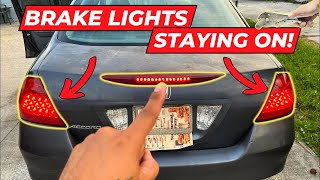
- Brake lights stay on even when the car is off, leading to a drained battery. 🎬 See this quick video on fixing brake lights that won't turn off
- Inability to shift the transmission out of Park without using the manual shift-lock override.
- Cruise control will not engage.
- Finding small, broken pieces of blue, green, or white plastic on the driver's side floor mat.
- Replacing the Right Front Wheel Speed Sensor. This is the most common mistake due to the generic C0040 definition and will not fix the issue on this Honda.
- Replacing the ABS module. This is an expensive and unnecessary step when the problem is a simple mechanical failure at the pedal.
Most Likely Causes
- Disintegrated Brake Pedal Stopper Pad 🔴 High Probability → Shop Brake Pedal The original plastic material used for the stopper becomes brittle with age and exposure to heat cycles, leading to inevitable failure. This is a well-documented failure point across a vast range of Honda and Acura vehicles.
How to confirm: Visually inspect the brake pedal arm for a missing stopper. Look for a small hole on the metal arm above where it would contact the brake light switch. Check the driver's side floor mat for crumbled plastic fragments. The presence of these fragments is a definitive sign.
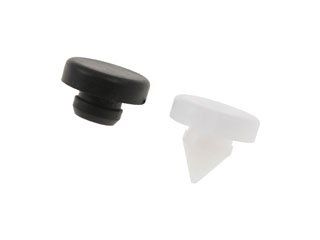
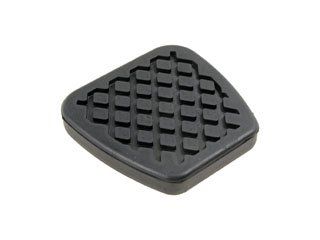
Typical fix: Replace the brake pedal stopper pad. This is a small, grommet-like part that pushes into the hole on the brake pedal arm. Some owners use temporary fixes like a bolt and nut or even a coin taped in place, but the OEM part is the correct, long-term solution.
Est. part cost: $1-$10 - Faulty Brake Light Switch ⚪ Low Probability → Shop Brake Light Switch
How to confirm: If the stopper pad is intact, the switch itself may have failed. Use a multimeter to test for continuity. The switch should change state (from open to closed, or vice-versa) when the plunger is depressed.
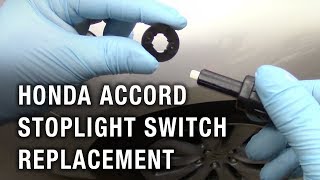
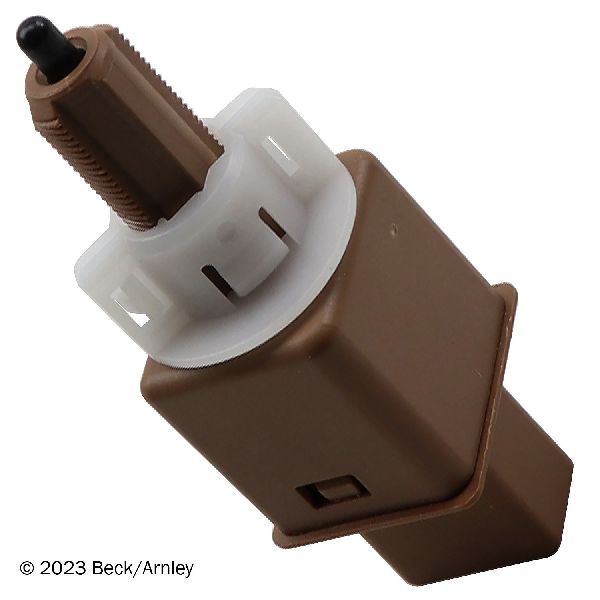
Typical fix: Replace the brake light switch. It is typically removed by twisting it counter-clockwise to unlock it from its bracket. 🎬 Watch: How to replace the brake light switch
Est. part cost: $15-$40 - Failed Brake Light Relay ⚪ Low Probability
How to confirm: If the stopper and switch are good, the relay that controls the brake lights could be stuck in the closed position. In a V6 Accord, this relay is located in the under-hood fuse box. Test the relay by checking for continuity between the load terminals without the control circuit being energized.
Typical fix: Replace the brake light relay.
Est. part cost: $10-$30
Rare But Worth Checking
- Wiring Harness Issue: A short or open in the wiring between the brake light switch and the control module can mimic a switch failure. This is unlikely unless other electrical work has been performed recently. Check for chafed wires near the pedal assembly.
Diagnosis Steps
- Confirm the symptoms: Are multiple warning lights on (ABS, VSA, EPS)? Are the brake lights stuck on?
- Check the driver's side floor mat for small, broken plastic pieces. This is the strongest indicator of the root cause.
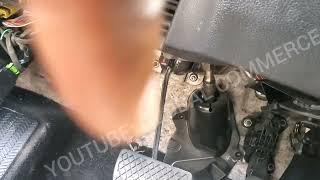
- Visually inspect the brake pedal assembly. Look up at the metal arm of the pedal. You will see one or two switches contacted by the arm. The upper one is typically the brake light switch. Check for an empty hole on the pedal arm directly in line with this switch's plunger.
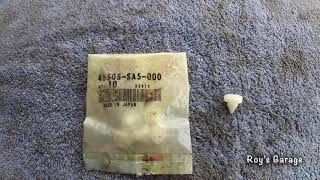
- If the hole is empty and there are plastic bits on the floor, the diagnosis is a failed brake pedal stopper. Purchase a new stopper (OEM part 46505-SA5-000) and insert it into the hole. It can be difficult to push in by hand; using pliers may help seat it fully.
- If the stopper is present and intact, the issue is likely electrical. Disconnect the brake light switch and see if the brake lights turn off. If they do, the switch is likely faulty.
- Test the brake light switch itself. Disconnect it and use a multimeter to verify it changes state when the plunger is pressed and released.
- If the switch tests good, locate and test the brake light relay, which may be stuck internally. For V6 models, this is in the under-hood fuse box.
- After replacing the faulty component (most likely the stopper), the warning lights may turn off on their own after a short drive, or you may need to clear the codes with an OBD-II scanner.
Parts You'll Likely Need
- Brake Pedal Stopper Pad
(OEM #46505-SA5-000)— This is the component that fails in over 95% of cases for this specific code on this vehicle. It is a consumable part that becomes brittle and disintegrates.
Trusted brands: Honda Genuine, Dorman (Help! line), Various aftermarket
OEM price range: $5-$10
Aftermarket price range: $1-$5 - Brake Light Switch
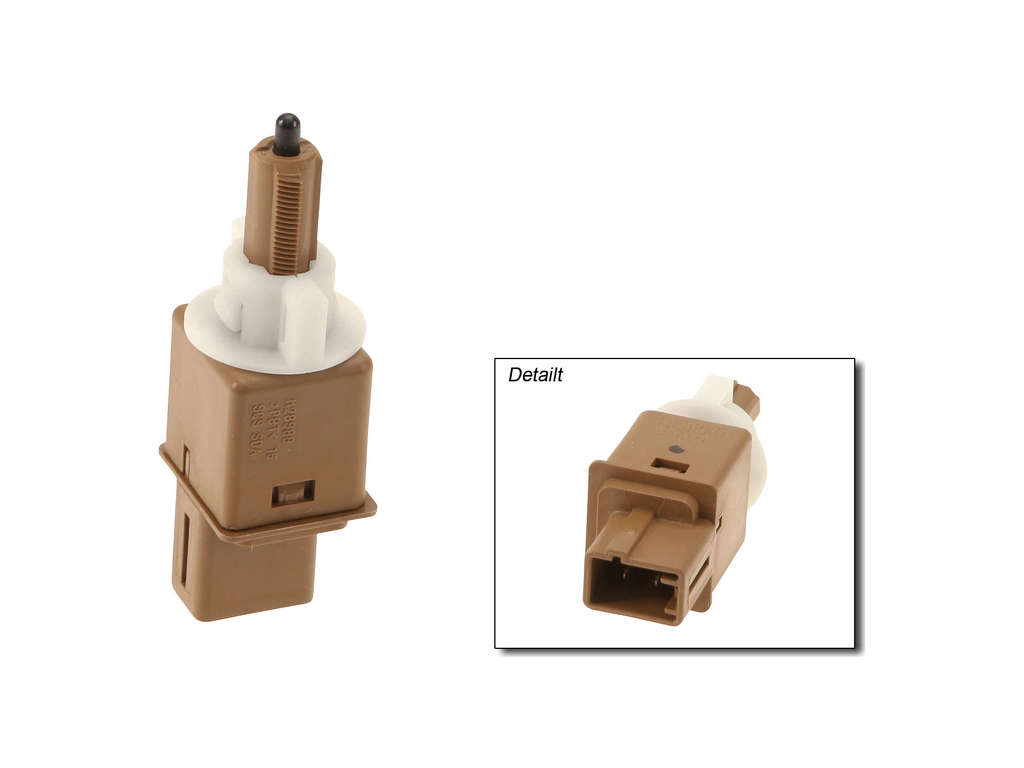
(OEM #36750-T2A-A01)— In the rare event the stopper pad is intact, the switch itself may have failed internally.
Trusted brands: Honda Genuine, Standard Motor Products, Intermotor
OEM price range: $25-$40
Aftermarket price range: $15-$30
Platform-Specific Known Issues
- Owner Experience: A Simple Fix: Numerous owners on forums like DriveAccord.net and Reddit report the sudden appearance of multiple dashboard lights. After initial confusion and concern about major ABS or steering failure, they discover small plastic fragments on their floor mat. The repair is consistently described as being extremely easy and cheap, involving simply pushing the new stopper into the pedal arm. Many express frustration at how such a tiny, cheap part can cause a cascade of seemingly serious warnings.
- Temporary Roadside Fix: Some owners have shared temporary fixes to get home without draining the battery. A common trick is to use a small bolt and nut through the hole, or even taping a coin over the hole to depress the switch plunger. While not recommended for long-term use, it demonstrates the simple mechanical nature of the failure.
Mechanic-Grade Diagnostic Values
- Brake Light Switch 'A' Circuit Voltage — expected: Should toggle from 0V to battery voltage (approx. 12V) when the pedal is pressed and released.. Failure: Voltage that is stuck high (12V), stuck low (0V), or shows inconsistent readings indicates a fault in the switch or circuit.
- Brake Light Switch Continuity — expected: For a normally open switch, should show continuity (near zero ohms) when the plunger is depressed and an open circuit (infinite resistance) when released.. Failure: Continuity in both states or an open circuit in both states indicates a failed switch.
Hidden / Shadow Codes Worth Checking
- C0040-62: This is the Honda-specific sub-code for 'Brake Lamp Switch Failure (Stuck On)'. The '-62' suffix is critical for distinguishing it from the generic wheel speed sensor definition. (see via A professional-level scanner or the Honda Diagnostic System (HDS) is required to see the sub-code.)
- U0416-68: VSA System Malfunction. This code often appears alongside C0040-62 as the Vehicle Stability Assist system relies on a valid brake signal. Its presence helps confirm the issue is brake-related. (see via A professional-level scanner or the Honda Diagnostic System (HDS).)
Scan Tool Commands That Help
- Honda Diagnostic System (HDS): Clear DTCs — Used to clear the C0040-62 and any related codes after the physical repair (e.g., stopper pad replacement) is complete.
- Honda Diagnostic System (HDS): Check for DTCs / Problem Verification — After clearing the code, a specific drive cycle is required to confirm the fix. The HDS is used to re-check for the DTC after driving at 12 mph (20 km/h) or more for 6 minutes, accelerating to 25 mph (40 km/h), stopping, and repeating this three times.
- Professional Scan Tool (Live Data): Brake Pedal Switch Status — To confirm a faulty switch or a successful repair without test driving. The live data stream should show the status changing from 'Off' to 'On' as the brake pedal is pressed.
Wiring & Ground Locations
- Brake Pedal Position Switch Connector — Located on the brake pedal support bracket, directly above the brake pedal arm in the driver's footwell.. This is the main connector for the switch. Testing for power and signal at its pins is a primary diagnostic step. For example, on some models, the White/Yellow wire is power from a fuse.
- G501 / G502 — These are primary dashboard area ground points. G501 is often located at the driver's side A-pillar/kick panel area. G502 is often at the upper left end of the dash.. A poor ground at these locations can cause a variety of electrical issues in the cabin, including erratic behavior from control modules and sensors related to the brake system, potentially mimicking a component failure.
- VSA Modulator-Control Unit 46P Connector — The VSA modulator is located in the engine compartment, typically on the right side.. If the stopper, switch, and relay are all good, Honda's official diagnostic tree points to checking for loose terminals and poor connections at this main VSA module connector before considering module replacement.
Real Owner Repair Stories
- YouTube user 'Repairs and Reviews' (2016 Honda Accord V6) — Multiple warning lights on the dash (skid, lane assist, power steering) and brake lights stuck on.
❌ Tried (didn't work) Unplugging the brake light switch connector at the pedal did not turn the brake lights off, ruling out a bad switch or stopper pad.
✅ What actually fixed it The brake light relay, located in the under-hood fuse box, had failed and was internally bridged/stuck in the 'on' position. Replacing the relay resolved all symptoms. - YouTube user 'Roy's Garage 808' (2006 Honda Accord (demonstrates identical failure mode)) — Brake lights would not turn off, even with the car off.
✅ What actually fixed it Found broken plastic pieces of the stopper pad on the driver's floor mat. Replacing the stopper pad (Part No. 46505-SA5-000) by pushing it into the hole on the brake pedal arm immediately fixed the issue. - NHTSA ODI #11645269 — An owner of a similar Honda model reported that the vehicle became hard to steer and was diagnosed with code C0040-62, indicating a brake lamp switch failure (stuck).
- NHTSA ODI #11191073 — A report involving a related Honda platform noted that the brake switch was stuck on, leading to a C0040-12 code and causing the left front brakes to become extremely heated with smoke coming from the area.
OEM Part Supersession History
46505-SA5-010, 46505-SH3-000, 46505-579-000, 46505-659-000→46505-SA5-000— Part consolidation and potentially minor material updates over decades of use.
Heads up: All listed part numbers are interchangeable. 46505-SA5-000 is the most current and widely available version for this repair.36750-T2A-A01→36750-T2A-A02— Standard part revision by the manufacturer.
Heads up: The new part number 36750-T2A-A02 is the direct replacement and is fully compatible.
Model Year Variations Within This Range
- 2013-2017 (V6 Models): The location of the brake light relay is confirmed to be in the under-hood fuse/relay box for V6 models. Its location may differ on 4-cylinder models.
Diagnostic Flowchart
Other Known Issues on This Vehicle
Issues unrelated to this code that are worth knowing about as an owner of this generation:
- Failing Starter Motor 🟠 Medium — Common issue, especially on earlier models of the generation. Symptoms include intermittent no-start conditions or grinding noises. (Ref: TSB 16-002 (for V6 models with grinding noise).)
- VTC Actuator Rattle on Cold Start (2.4L Engine) 🟠 Medium — A very common and well-documented issue on the K24W engine. Causes a brief, loud rattle for 1-2 seconds on cold startup. Can eventually lead to timing chain issues if ignored. (Ref: TSB 16-012 (Addresses issue on similar models, principle applies).)
- Dim or Failed LED Daytime Running Lights (DRL) 🟡 Low — Widespread on 2016-2017 models. The LED strip in the headlight assembly fails, usually starting from the inner side and progressing outward. (Ref: Warranty Extension (10 years/unlimited miles) covered under TSB 19-042.)
- Torque Converter Judder (Automatic Transmission) 🟠 Medium — A shudder or vibration may be felt while driving between 20-60 mph. Caused by deteriorated transmission fluid. (Ref: TSB 17-017 and 17-018 (Involves a software update and transmission fluid flush).)
- Undersized/Weak Battery (4-cylinder models) 🟡 Low → Shop Vehicle Battery — The OEM battery in 4-cylinder models is known to have a shorter lifespan and can cause various electrical gremlins as it weakens.
Used vs. New Parts: Buying Guide for This Vehicle
When a used part is the smart pick: For this specific repair, using a used part is generally not recommended. The primary failure component, the stopper pad, is a consumable item that costs only a few dollars new. A used brake light switch could be considered if sourced from a very low-mileage donor, but its low new price ($15-$40) makes buying new a much safer and more reliable option.
Donor-vehicle mileage cap: roughly under 30000 miles for the part to have meaningful remaining life.
What to inspect on the donor part:
- For a brake light switch, ensure the plastic housing is not cracked and the connector pins are clean and straight.
- Never use a used brake pedal stopper pad. It will have the same age-related brittleness as the one that failed.
OEM-only on this vehicle (don't cheap out):
- Brake Pedal Stopper Pad (46505-SA5-000)
Aftermarket brands forum-validated for this vehicle:
- Dorman (HELP! line) for the stopper pad.
- Standard Motor Products (Intermotor) for the brake light switch.
Brands owners have reported issues with on this vehicle:
- No-name, unbranded stopper pads from online marketplaces may be made of inferior plastic that fails prematurely.
Real Owner Stories
Aggregated from forums and TSBs cited above. Mileages and costs reflect what owners reported in those sources.
2013-2017 Honda Accord
Symptoms: Sudden appearance of multiple dashboard lights including ABS, VSA, and EPS. Discovered small plastic fragments on the driver's side floor mat.
What fixed it: Replacing the brake pedal stopper pad by pushing a new one into the pedal arm.
Source hint: vehicle_specific_issues: 'Owner Experience: A Simple Fix'
Honda Accord
Symptoms: Brake switch stopper broke; needed advice on the best replacement part.
What fixed it: Replacing the broken stopper pad.
Source hint: https://www.reddit.com/r/MechanicAdvice/comments/110t8j3/brake_switch_stopper_broke_best_thing_to_use/
Honda Pilot
Symptoms: The car was hard to steer. A technician identified code C0040-62, indicating a brake lamp switch failure (stuck), alongside other internal electronic failures.
What fixed it: Diagnosis confirmed a stuck brake lamp switch.
Source hint: NHTSA ODI #11645269
Honda CR-V
Symptoms: Left front brakes became extremely heated with smoke coming from the area. A technician found code C0040-12 present, indicating the brake switch was stuck on.
What fixed it: Technician cleared the code and investigated the stuck brake switch.
Source hint: NHTSA ODI #11191073
Related OBD-II Codes
Frequently Asked Questions
Why are my brake lights staying on even when my 2013-2017 Accord is turned off?
I found small blue and green plastic pieces on my driver's side floor mat; what are these?
Can I use a temporary fix if I'm stranded with brake lights that won't turn off?
Which specific replacement part should I buy for my Honda Accord's brake pedal?
Why can't I shift my Accord out of Park, and why is my Cruise Control disabled?
Is there a TSB for the LED daytime running lights on my 2016-2017 Accord?
Helpful Videos
We Have This Part in Stock


The information in this article is provided for general reference and educational purposes only. Vehicle specifications, procedures, and part compatibility can vary by production date, trim level, and region. Always consult your vehicle's factory service manual and verify part numbers before purchasing or performing repairs. Safety-critical components such as airbags, seat belts, and braking systems should be installed by a qualified professional.
- Honda Accord:
- 🧭 Diagnostic Flowchart
- 🎬 Helpful Videos
- 🛍️ Shop This Part
- What's Unique About the 2013-2017 Honda Accord
- Symptoms You May Notice
- Most Likely Causes
- Rare But Worth Checking
- Diagnosis Steps
- Parts You'll Likely Need
- Platform-Specific Known Issues
- Mechanic-Grade Diagnostic Values
- Hidden / Shadow Codes Worth Checking
- Scan Tool Commands That Help
- Wiring & Ground Locations
- Real Owner Repair Stories
- OEM Part Supersession History
- Model Year Variations Within This Range
- Other Known Issues on This Vehicle
- Used vs. New Parts: Buying Guide for This Vehicle
- Real Owner Stories
- 2013-2017 Honda Accord
- Honda Accord
- Honda Pilot
- Honda CR-V
- Related OBD-II Codes
- Frequently Asked Questions
- 🎟️ Get 5% Off