

C0040 on 2013-2019 Honda Civic: Brake Light Switch Failure Fix
On a 2013-2019 Honda Civic, code C0040 is almost always caused by a disintegrated plastic brake pedal stopper pad, not a wheel speed sensor. This is a very cheap part (under $15) and an easy DIY fix that takes minutes.
- For a 2013-2019 Honda Civic, C0040 means there is a problem with the brake light switch circuit, NOT the right front wheel speed sensor.
- The cause is almost always a small, cheap plastic stopper pad on the brake pedal arm that has broken.
- Symptoms include multiple dash warning lights (ABS, VSA, Power Steering), brake lights stuck on, and a car that won't shift out of Park.
- The fix is extremely easy and cheap: snap a new stopper pad (Part No. 46505-SA5-000) into the brake pedal arm.
- Do not waste money replacing the wheel speed sensor or the brake light switch before checking for the broken stopper pad.
What's Unique About the 2013-2019 Honda Civic
This is a classic case of a manufacturer-specific code causing confusion. Honda repurposed code C0040 to refer to a brake switch circuit issue. The problem is rarely the switch itself, but a tiny, brittle plastic stopper pad on the brake pedal arm that shatters with age. When this pad breaks, the switch plunger passes through the now-empty hole, making the car think the brakes are always applied. Ignoring this specific Honda definition leads many to mistakenly diagnose and replace the right front wheel speed sensor, which is the generic definition for C0040.
Generation note: This issue affects both the ninth generation (2013-2015) and tenth generation (2016-2019) Honda Civic. The cause, symptoms, and repair process involving the brake pedal stopper pad are identical for both generations. The same part number is used across a vast range of Honda and Acura models for decades.
Symptoms You May Notice
- Multiple warning lights on the dashboard, including ABS, VSA (traction control), and Power Steering.
- Brake lights are stuck on, even when the car is turned off. 🎬 Watch: Quick tip on Honda brake lights staying on
- Dead battery, caused by the brake lights staying on overnight.
- Cannot shift the transmission out of Park without using the manual override.
- Cruise control does not work.
- Finding small, broken pieces of blue, yellow, or white plastic on the driver's side floor mat.
- Replacing the Right Front Wheel Speed Sensor. This is the generic definition for C0040 and is incorrect for this specific Honda application.
- Replacing the Brake Light Switch when only the stopper pad is broken.
Most Likely Causes
- Disintegrated Brake Pedal Stopper Pad 🔴 High Probability → Shop Brake Pedal The plastic material used for the original stopper pad (part #46505-SA5-000) becomes brittle over time due to heat cycles and age, eventually shattering. This is a well-documented failure point across nearly all Honda and Acura models from the 1990s through the 2020s.
How to confirm: Look at the brake pedal arm under the dashboard. You will see a small switch with a plunger. The pedal arm should have a small, solid plastic pad that presses this plunger when the pedal is released. If you see an empty hole where the plunger goes through, and/or plastic debris on the floor, the stopper has failed.
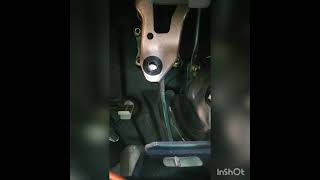
Typical fix: Replace the stopper pad by snapping a new one into the hole on the brake pedal arm. 🎬 See this step-by-step brake pedal stopper replacement walkthrough It can be helpful to press the brake pedal down with your hand to get better access to the hole.
Est. part cost: $5-$15
Rare But Worth Checking
- Faulty Brake Light Switch: → Shop Brake Light Switch While possible, this is far less common than the stopper pad failure. If the stopper pad is intact and properly depressing the switch plunger, but the symptoms persist, the switch itself may have failed internally. This would require testing the switch for continuity.
- Faulty Brake Light Relay: In some Honda models, a stuck brake light relay can cause the lights to stay on. If the stopper pad and switch are confirmed to be good, the relay in the under-hood fuse box could be the culprit.
- VSA/ABS Modulator Fault: In very rare cases, after all other possibilities are exhausted, the VSA/ABS control unit could be the source of the problem. This is an expensive and unlikely cause.
Diagnosis Steps
- Check the driver's side floor mat for small, broken pieces of colored plastic.
- With the car off, observe the rear of the vehicle to see if the brake lights are illuminated.
- Look under the driver's side dashboard at the top of the brake pedal arm.
- Identify the brake light switch, which has a small white or black plunger that points towards the pedal arm.
- Observe the point on the pedal arm that contacts the switch plunger. If there is an empty hole instead of a solid surface, the stopper pad has failed.
- If the stopper pad is intact, have an assistant watch the brake lights while you manually depress and release the switch plunger to see if the switch is functioning correctly.
- If the stopper pad is intact and the switch tests good, consider checking the brake light relay.
- If all other components test good, further diagnosis of the VSA/ABS module by a professional may be needed.
Parts You'll Likely Need
- Brake Pedal Stopper Pad
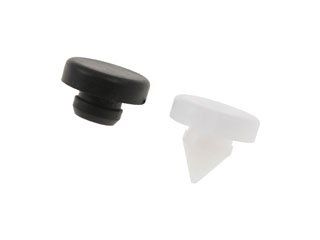
(OEM #46505-SA5-000)— This is the component that fails 99% of the time for this code on this vehicle. It is designed to press the brake light switch plunger, and it disintegrates with age.
Trusted brands: Genuine Honda, Dorman (HELP! line, part #74015)
OEM price range: $5-$10
Aftermarket price range: $5-$15
Platform-Specific Known Issues
- As a temporary fix while waiting for the part, some owners have used a small bolt and nut, or even stacked coins taped into the hole to depress the switch plunger. This is not recommended for long-term use as an improper object can damage the switch or fall out, but it can prevent the battery from draining. One owner reported overheating their brakes after an improperly sized bolt caused slight, constant brake application on the highway.
Mechanic-Grade Diagnostic Values
- Brake Light Switch Continuity (Brake Light Circuit) — expected: With the switch plunger extended (simulating brake pedal pressed), there should be continuity (near 0 Ω resistance). With the plunger depressed (pedal released), the circuit should be open (infinite resistance).. Failure: Continuity when the plunger is depressed, or an open circuit when the plunger is extended, indicates a faulty switch.
- Brake Light Switch Continuity (Cruise Control/ECU Circuit) — expected: Many Honda switches have a second, separate circuit for the cruise control and ECU that works in the opposite way. With the plunger extended (pedal pressed), the circuit is open. With the plunger depressed (pedal released), there is continuity.. Failure: If this circuit fails, it can prevent cruise control from working but may not trigger the C0040 code, which is specific to the brake lights being stuck on.
Hidden / Shadow Codes Worth Checking
- C0040-62: This is the full Honda-specific DTC, which translates to 'Brake Lamp Switch Failure (Stuck)'. The '-62' suffix provides the specific failure mode information that is often not visible on generic OBD-II scanners. (see via A professional-grade scanner or the Honda Diagnostic System (HDS) is required to view the full sub-code.)
Scan Tool Commands That Help
- Honda Diagnostic System (HDS): VSA System DTC Check / Clear — Used to retrieve and clear specific VSA system codes like C0040-62 after a repair has been completed.
- Honda Diagnostic System (HDS): VSA Modulator-Control Unit Update — In rare cases, a software glitch can cause VSA issues. HDS can check if the VSA module has the latest software and update it if necessary. This is typically performed after replacing the VSA modulator itself.
- Honda Diagnostic System (HDS) or advanced scanner: VSA Sensor Neutral Position Memorization — This calibration procedure is required after replacing the VSA modulator-control unit or yaw rate-lateral acceleration sensor to ensure the system has a correct baseline. It may also be required after clearing certain complex VSA faults.
Wiring & Ground Locations
- Brake Light Switch Connector — Directly on the brake light switch, located at the top of the brake pedal arm under the driver's side dashboard.. This 4-pin connector provides power to the switch and sends the signal to the brake lights and various control modules. A poor connection here could mimic a switch failure.
- Ground Point G401 — On some Honda models, this is a common ground point located far up behind the left side of the dashboard, near the driver's kick panel area.. A loose or corroded ground connection for the brake light circuit could potentially cause erratic behavior, although it is a much rarer cause than the stopper pad failure.
Real Owner Repair Stories
- YouTube channel 'Global Commerce CA' (2016 Honda Accord V6) — Multiple warning lights on the dash including skid control, lane assist (LKAS), and power steering. Scan revealed code C0040 for brake switch stuck on.
❌ Tried (didn't work) Unplugging the brake light switch connector did not turn the brake lights off, indicating the problem was further down the circuit.
✅ What actually fixed it The brake light relay, located in the under-hood fuse box, had failed internally. The contacts were permanently bridged, causing the brake lights to stay on regardless of the switch's position. Replacing the relay resolved the issue. - Reddit user on r/MechanicAdvice (Honda Civic (year not specified, but behavior is identical)) — Dead battery from brake lights staying on overnight. Found broken plastic stopper pieces on the floor mat.
❌ Tried (didn't work) A temporary fix using a 10mm bolt that was too small. It worked for a few days in the city.
✅ What actually fixed it The issue was the broken stopper pad. However, the temporary bolt fix led to a secondary, severe problem: on the highway, the bolt caused the brakes to drag constantly, leading to extreme overheating of the entire brake system (pads, rotors, calipers, fluid), smoking, and a spongy pedal feel requiring replacement of multiple brake components. This story serves as a cautionary tale against improper temporary fixes.
OEM Part Supersession History
46505-SA5-000→This part number remains the primary active number, but it also replaces several older, discontinued numbers.— Part consolidation over decades of use.
Heads up: Replaces older part numbers 46505-SA5-010, 46505-579-000, 46505-SH3-000, and 46505-659-000. All are interchangeable for this application.
Diagnostic Flowchart
Other Known Issues on This Vehicle
Issues unrelated to this code that are worth knowing about as an owner of this generation:
- Oil Dilution (1.5L Turbo Engine) 🔴 High — Common on 2016-2018 models, especially in cold climates with frequent short trips. Can occur at low mileage (<30,000 mi). (Ref: Honda issued software updates and extended warranties (e.g., TSB 18-137) to address the issue.)
- A/C System Failures (Condenser/Compressor) 🟠 Medium — Widespread on 10th gen (2016-2019) Civics. Condensers are prone to leaks and compressors can fail. Honda extended the warranty on condensers for many models. (Ref: Warranty extensions issued for A/C condensers on certain models.)
- Sticky Steering (10th/11th Gen) 🔴 High — Affects some 10th gen (2016-2019) and is more prominent on 11th gen (2022+) Civics, often at low mileage. Causes momentary increased steering effort at highway speeds. (Ref: TSB 23-037 instructs dealers to replace the electronic power steering gearbox.)
- Bad Engine Mounts (9th Gen) 🟠 Medium — Common on 9th gen (2012-2015) models, causing vibrations at idle, roughness, and clunking noises when shifting.
- Carbon Buildup on Intake Valves (1.5L Turbo Engine) 🟠 Medium — A long-term issue inherent to direct-injection engines like the 1.5T. Typically requires cleaning every 50,000-70,000 miles to prevent misfires and performance loss.
- Harsh Shifting (9th Gen Automatic/CVT) 🟡 Low — Some 9th gen (2012-2015) owners report harsh 1-2 shifts in the 5-speed automatic, potentially related to a shift solenoid. The 2014-2015 CVT had a recall for a software update to prevent pulley damage. (Ref: Recall for 2014-2015 CVT software.)
Used vs. New Parts: Buying Guide for This Vehicle
When a used part is the smart pick: For this specific repair, buying a used part is strongly discouraged. The primary failure part, the plastic stopper pad, fails due to age and heat-induced brittleness; a used one would be just as likely to fail. A used brake light switch or relay could be considered in a pinch, but their low cost new makes it an impractical choice.
What to inspect on the donor part:
- Not applicable, as new parts are inexpensive and recommended.
OEM-only on this vehicle (don't cheap out):
- Brake Pedal Stopper Pad (46505-SA5-000): While aftermarket versions exist (like Dorman 74015), the Genuine Honda part is extremely inexpensive and is guaranteed to fit and be made of the most current material specification. Given the low cost, there is little reason to use an alternative.
Brands owners have reported issues with on this vehicle:
- Unknown/no-name brands for the brake light switch or relay. Stick to Genuine Honda or a reputable OEM supplier if not buying from the dealer.
Documented NHTSA Reports
NHTSA ODI #11645269
Symptoms: An owner reported that the car was hard to steer. A dealer diagnosis identified code C0040-62 (Brake lamp switch failure stuck) along with other internal electronic failures in the camera and radar systems.
What fixed it: Not specified, but the report confirms the presence of the Honda-specific C0040-62 sub-code in conjunction with steering difficulties.
NHTSA ODI #11191073
Symptoms: A driver reported that the left front brakes became extremely heated with smoke coming from the area. A technician found the brakes had gotten hot and cleared code C0040-12 for the brake switch being stuck on.
What fixed it: While the technician was unable to duplicate the fault during the visit, the record highlights the severe risk of brake overheating when the system detects the brake switch is stuck.
Real Owner Stories
Aggregated from forums and TSBs cited above. Mileages and costs reflect what owners reported in those sources.
2002 Honda Civic
Symptoms: Used a temporary bolt fix for a broken stopper pad which caused the brakes to drag and eventually overheat while driving on the highway.
What fixed it: Replacing the temporary bolt with the correct plastic stopper part.
Source hint: Reddit r/MechanicAdvice: A user with a 2002 Civic detailed how a temporary bolt fix went wrong
1992-2000 Honda Civic
Symptoms: Brake light pedal stopper failed; discussed using alternative items like a screw, nut, or even a penny to press the brake light sensor down.
What fixed it: Replacing the rubber tab/stopper pad.
Source hint: Honda-Tech.com: Thread titled 'Brake Light Pedal Stopper'
Related OBD-II Codes
Frequently Asked Questions
Why are my brake lights staying on even after I turn off my 2013-2019 Honda Civic?
I found small pieces of blue and yellow plastic on my driver's side floor mat; what is this?
Can I use a bolt and nut as a temporary fix for the brake pedal stopper?
Is there a TSB for the CVT transmission issues on 2014-2015 Civics?
My 10th Gen Civic has sticky steering at highway speeds; is there a fix?
Which specific part number should I use to fix the C0040-related brake switch issue?
Helpful Videos
We Have This Part in Stock

The information in this article is provided for general reference and educational purposes only. Vehicle specifications, procedures, and part compatibility can vary by production date, trim level, and region. Always consult your vehicle's factory service manual and verify part numbers before purchasing or performing repairs. Safety-critical components such as airbags, seat belts, and braking systems should be installed by a qualified professional.
- Honda Civic:
- 🧭 Diagnostic Flowchart
- 🎬 Helpful Videos
- 🛍️ Shop This Part
- What's Unique About the 2013-2019 Honda Civic
- Symptoms You May Notice
- Most Likely Causes
- Rare But Worth Checking
- Diagnosis Steps
- Parts You'll Likely Need
- Platform-Specific Known Issues
- Mechanic-Grade Diagnostic Values
- Hidden / Shadow Codes Worth Checking
- Scan Tool Commands That Help
- Wiring & Ground Locations
- Real Owner Repair Stories
- OEM Part Supersession History
- Other Known Issues on This Vehicle
- Used vs. New Parts: Buying Guide for This Vehicle
- Documented NHTSA Reports
- NHTSA ODI #11645269
- NHTSA ODI #11191073
- Real Owner Stories
- 2002 Honda Civic
- 1992-2000 Honda Civic
- Related OBD-II Codes
- Frequently Asked Questions
- 🎟️ Get 5% Off