

C0045 on 2005-2014 Ford Mustang: Left Rear Wheel Speed Sensor Circuit Causes and Fixes
This code means there's a fault in the left rear wheel speed sensor circuit. The most common causes are a failed sensor, a damaged wiring harness near the rear axle, or a broken tone ring. Expect to pay $30-$80 for a new sensor.
- Code C0045 on a 2005-2014 Mustang points to an issue in the left rear wheel speed sensor circuit, which disables ABS and traction control.
- Before replacing the sensor, visually inspect the wiring harness for damage above the axle and check that the sensor bolt is tight.
- If you replace the sensor and it's physically damaged, the tone ring on the axle is likely the root cause and must be inspected.
- If you install a new aftermarket sensor and the code remains, check if the sensor's wiring polarity is reversed compared to the original part.
What's Unique About the 2005-2014 Ford Mustang
On the S197 Mustang platform, while a failed sensor is common, the issue is often more complex. Mechanics have found that a rust-prone metal ring (tone ring) on the axle shaft can break apart and physically damage the new sensor, leading to repeat failures if not diagnosed correctly. Additionally, owners have reported that some aftermarket sensors are manufactured with reversed polarity and require cutting and splicing the wires to function properly. Finally, the wiring harness is known to chafe or break in the area above the rear axle.
Generation note: The 2005-2014 Ford Mustang belongs to a single generation (S197), but it had a significant body and interior refresh for the 2010 model year. The rear ABS sensor part number BRAB290 is listed for 2005-2010 models. The sensor part number changed for the 2011-2014 refresh. Always verify the part for your specific year, as harness connectors or other minor details may have changed with the 2010 refresh.
Symptoms You May Notice
- ABS warning light is on
- Traction control (TCS) or stability control (AdvanceTrac) warning light is on
- Traction and stability control systems are disabled
- Cruise control may be inoperative
- Unwanted, intermittent ABS activation at low speeds (grinding or pulsing pedal)
- Replacing the ABS sensor without checking for a damaged tone ring. If the tone ring is broken, it will destroy the new sensor, and the problem will return immediately.
- Replacing the ABS module when the actual fault is a simple wiring break or a bad sensor.
- Assuming an aftermarket sensor is good out of the box, when it may have reversed polarity.
Most Likely Causes
- Failed Left Rear Wheel Speed Sensor 🔴 High Probability → Shop ABS Wheel Speed Sensor The sensor is exposed to road debris, moisture, and heat from the brakes, leading to internal failure or physical damage over time.
How to confirm: Use a scan tool with live data to observe the wheel speed signal from the left rear wheel while driving or spinning the wheel by hand. If the reading is zero, erratic, or doesn't match the other wheels, the sensor is likely bad. You can also test the sensor's internal resistance with a multimeter; passive sensors typically have a resistance between 800-1700 Ω.
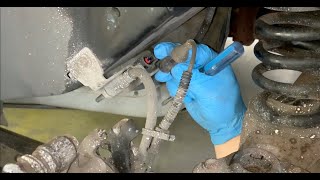
Typical fix: Replace the left rear wheel speed sensor. 🎬 Watch: How to diagnose and replace the rear speed sensor. The sensor is held in by a single bolt.
Est. part cost: $30-$80 - Damaged Wiring Harness 🟡 Medium Probability The harness can be damaged by road debris, improper routing after suspension work, or chafing against the chassis or suspension components. A common failure point is where the harness routes over the rear axle.
How to confirm: Visually inspect the entire length of the wiring harness from the sensor to where it enters the cabin. Look for breaks, chafing, melting, or corrosion. Perform a continuity test on the wires between the sensor connector and the ABS module connector.
Typical fix: Repair the broken or shorted section of wire. In severe cases, a new harness pigtail or section may be needed. 🎬 Watch: Finding common corrosion issues in the rear sensor wiring.
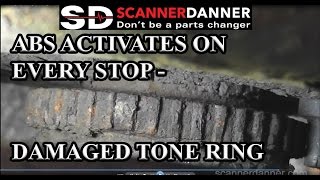
Est. part cost: $10-$50 for repair materials - Damaged or Debris-Covered Tone Ring ⚪ Low Probability The metal tone ring pressed onto the axle shaft is susceptible to rust. A documented case on a Mustang showed this ring rusting, breaking apart, and then striking the tip of the ABS sensor, causing physical damage and an incorrect signal.
How to confirm: Remove the ABS sensor and use a light to visually inspect the tone ring through the sensor mounting hole. Rotate the axle to check the entire ring for missing teeth, cracks, heavy rust, or debris. If a new sensor is physically damaged or shows scrape marks after installation, the tone ring is the prime suspect. 🎬 See how a damaged tone ring causes unwanted ABS activation.
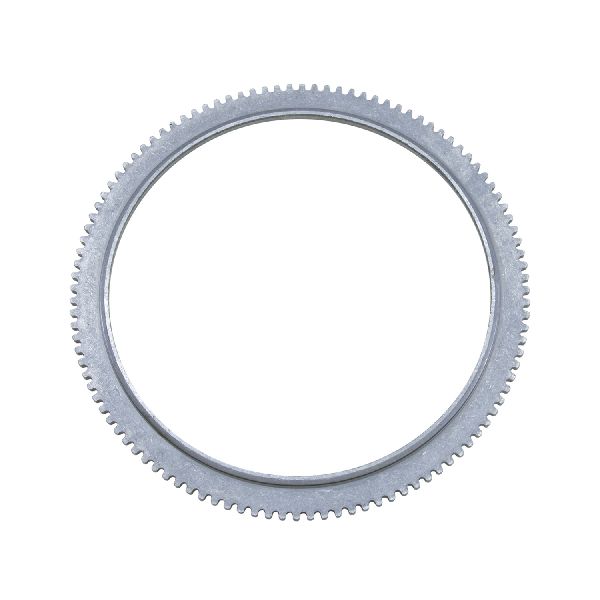
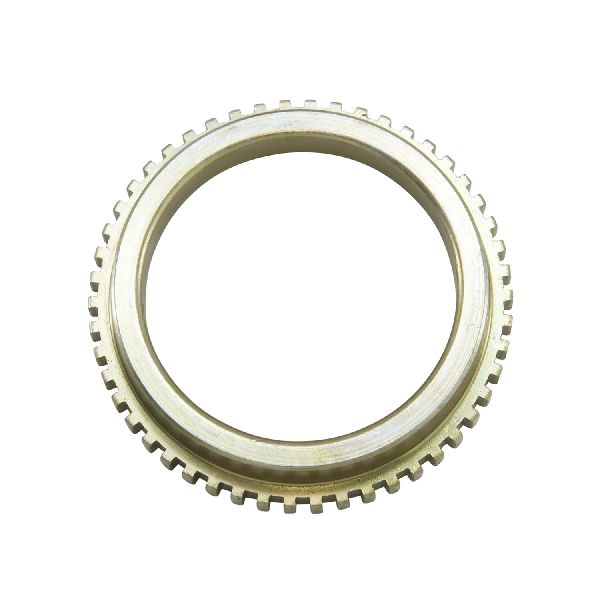
Typical fix: This is a complex repair. The tone ring is part of the axle shaft, so fixing it typically requires replacing the entire rear axle shaft.
Est. part cost: $150-$400 for a new axle shaft - Loose Sensor Mounting Bolt ⚪ Low Probability Vibration or improper torque during a previous repair can cause the bolt to back out.
How to confirm: Physically check if the ABS sensor is seated firmly in its mounting hole and that the retaining bolt is present and tight. A loose sensor will create an incorrect air gap with the tone ring, leading to an erratic or lost signal.
Typical fix: Tighten or replace the sensor's retaining bolt.
Est. part cost: $1-$5
Rare But Worth Checking
- Incorrectly Wired Aftermarket Sensor: A detailed forum post for an S197 Mustang confirmed that a new aftermarket sensor from RockAuto was wired with reversed polarity. The owner confirmed this by comparing the new part to a working used part with a multimeter. The fix was to cut the two wires on the new sensor and solder them in reverse order. If you replace the sensor and the code persists, this is a valid diagnostic step.
- Faulty ABS Control Module: → Shop ABS Control Module This is rare and should be considered a last resort. A faulty module typically triggers multiple wheel speed sensor codes or a U-code for communication failure. Some companies offer a repair service for these modules, which is more cost-effective than a new unit from the dealer. If replaced with a new or used unit, the module will require initialization using a tool like Ford IDS or FORScan.
- Poor Ground Connection (G101/G103): While a specific TSB for C0045 is not cited, poor grounds can cause myriad electrical issues, including ABS faults. On the S197, ground G103 (passenger side, near hood prop) and G100 (right side of radiator support) are major chassis grounds for front-end components. A corroded ground for the ABS module itself is also a known issue on these models. A visual inspection for corrosion and tightness at major grounding points is a wise step in any electrical diagnosis.
- Failing Alternator or Low System Voltage: A failing alternator can cause voltage spikes or drops that lead to various warning lights, including ABS and TCS. One owner noted that the first sign of his alternator failing was the ABS and TCS lights coming on, followed by other electrical system failures. If the C0045 code appears with other seemingly unrelated electrical symptoms or a battery light, the charging system should be tested.
Diagnosis Steps
- Read the trouble codes with an ABS-capable scan tool to confirm C0045 is the active code.
- Use the scan tool's live data feature to monitor the wheel speed of all four wheels while driving slowly. Compare the Left Rear (LR) reading to the others. A reading of zero or one that is erratic confirms a problem in that circuit.
- Raise and safely support the vehicle. Remove the left rear wheel.
- Inspect the ABS sensor's mounting bolt to ensure it is tight and the sensor is secure.
- Visually inspect the wiring harness leading from the sensor. Look for any signs of chafing, melting, or physical damage, especially in the area above the axle and where it connects to the main harness.
- Disconnect the sensor. Inspect the connector pins for corrosion, moisture, or damage.
- Remove the sensor (one bolt). Inspect the sensor tip for damage or metal debris. A damaged tip points towards a problem with the tone ring.
- With the sensor removed, use a flashlight and a small mirror to inspect the tone ring on the axle shaft through the mounting hole. Rotate the axle to check the entire ring for cracks, missing teeth, or heavy rust/debris.
- If the sensor and wiring appear okay, test the sensor's resistance with a multimeter. A typical passive sensor should read between 800-1700 Ω. An open (infinite resistance) or shorted (near zero resistance) reading indicates a bad sensor.
- Test the harness for continuity and for shorts to power or ground between the sensor connector and the ABS module connector (C135).
- If a new aftermarket sensor is installed and does not fix the code, use a multimeter to compare its pin-to-pin resistance polarity to the original sensor or a known-good sensor. If reversed, the sensor wires may need to be swapped.
Parts You'll Likely Need
- Rear ABS Wheel Speed Sensor
(OEM #BRAB290 (Motorcraft))— This is the most common component to fail in the circuit due to its exposed location and harsh operating environment.
Trusted brands: Motorcraft, Standard Motor Products (SMP), Delphi, Dorman
OEM price range: $60-$90
Aftermarket price range: $30-$60
Related Codes That Often Appear With This One
- C0050 - Right Rear Wheel Speed Sensor Circuit. If both rear codes appear together, it strongly suggests a problem with a shared component, like the wiring harness where it runs over the axle, or a faulty ABS module.
Technical Service Bulletins (TSBs) & Recalls
- TSB 19296 (August 2006) - While not for C0045 specifically, it notes that an ABS warning light on 2006 models can be caused by a poor ground at G101, located below the airbox.
Platform-Specific Known Issues
- A rusted tone ring on the axle shaft can break and physically destroy the wheel speed sensor. Always inspect the tone ring if the old sensor shows signs of physical impact.
- The wiring harness is known to chafe or break in the area above the rear axle.
- Some aftermarket sensors may have their polarity reversed, requiring the wires to be swapped for the sensor to function correctly. A forum user confirmed this was the fix on their S197 Mustang.
Mechanic-Grade Diagnostic Values
- Passive ABS wheel speed sensor resistance — expected: 800 - 1700 Ω. Failure: A reading of infinity (open circuit) or near zero (short circuit).
- Passive ABS wheel speed sensor AC voltage output — expected: >100 mV (0.1V) AC while spinning the wheel by hand. Failure: No voltage or very low voltage produced when the wheel is spinning.
Scan Tool Commands That Help
- Ford IDS / FORScan: Module Initialization (ABS) — This function is required after replacing the ABS control module. It allows the new module to be recognized and configured by the vehicle's other systems. Failure to perform this step after replacement will likely result in multiple error codes.
- ABS-Capable Scan Tool (e.g., Autel, Ford IDS): Live Data / Data Logger — This is the primary diagnostic step. Monitor the wheel speed PIDs for all four wheels simultaneously while driving. This will clearly show if the Left Rear sensor is dropping out, reading erratically, or not reading at all compared to the other three.
Wiring & Ground Locations
- C135 — The main electrical connector on the ABS control module, located in the engine bay.. This is the termination point for the wheel speed sensor harness. Testing for continuity and shorts should be done between the sensor connector and the pins on C135.
- C135 Pins (Left Rear Sensor) — On the ABS module connector.. Based on wiring diagrams, the Left Rear Wheel Speed Sensor connects to Pin 31 (Signal, YE-BU wire) and Pin 32 (Return, GY-BN wire) on the C135 connector. These are the specific pins to test for continuity and shorts back to the sensor.
- G400 — In the trunk area on the driver's side.. This ground point serves multiple rear components, including the fuel pump driver module and rear lamps. While not directly the ABS module ground, a poor connection here can introduce electrical noise or issues with shared circuits in the rear of the vehicle.
- Engine-to-Firewall Ground Strap — Connects from a stud on the back of the driver's side cylinder head to the firewall.. This is a major secondary power ground. A loose or corroded connection here can cause a wide range of difficult-to-diagnose electrical problems across multiple systems, including the ABS.
OEM Part Supersession History
5R3Z-2C190-AA, 6R3Z-2C190-A, 7R3Z-2C190-A, 8R3Z-2C190-A, 9R3Z-2C190-A→BRAB-290 (Motorcraft)— Standard part evolution and consolidation by the manufacturer.
Heads up: BRAB-290 is the correct service part for the rear of 2005-2010 models.
Model Year Variations Within This Range
- 2005-2010 vs 2011-2014: The rear ABS wheel speed sensors are different parts between the pre-refresh (05-10) and post-refresh (11-14) S197 models. The 2005-2010 models use Motorcraft part BRAB-290. The 2011-2014 models use a different part, such as Motorcraft BRAB-402. The connectors and wiring may also differ. Ordering the wrong part for the year will result in it not fitting or functioning.
Diagnostic Flowchart
Other Known Issues on This Vehicle
Issues unrelated to this code that are worth knowing about as an owner of this generation:
- Clogged Cowl Drains & Water Leaks 🔴 High — Very common across all years. Debris clogs rubber drain plugs under the cowl panel, causing water to back up and leak into the passenger-side footwell through the cabin air filter opening, potentially damaging the Smart Junction Box (SJB).
- Premature Alternator Failure 🟠 Medium — Common on 2005-2009 models, particularly GTs. Alternators can fail under 50,000 miles, sometimes causing voltage spikes or drops that trigger other electrical warnings (like ABS/TCS lights) before complete failure.
- Variable Cam Timing (VCT) Solenoid Failure (4.6L & 5.4L 3V) 🟠 Medium — Common on GT models with the 3-valve V8. Solenoids get clogged or stick, causing a rough idle, stalling, and rattling noises (cam phaser knock) when the engine is warm. Often triggers codes like P0012 or P0022.
- Aluminum Hood Corrosion 🟡 Low — Affects many models, appearing as bubbling paint along the leading edge of the hood and around the hood scoop. Caused by contamination during manufacturing. (Ref: TSB 19-2026)
- Manual Transmission (TR-3650) Issues 🟠 Medium → Shop Transmission Assembly — Early 2005-2006 models were known for a 2nd to 3rd gear shift problem and grinding noises. Later models were improved but can still have issues. (Ref: TSB 05-8-8)
Used vs. New Parts: Buying Guide for This Vehicle
When a used part is the smart pick: A used part is a smart choice for the complete rear axle shaft if the tone ring is confirmed to be cracked or damaged. This is often more cost-effective than buying a new axle shaft from the dealer. A used ABS control module is also a possibility, but only if you have access to a tool like FORScan or Ford IDS to perform the required module initialization.
Donor-vehicle mileage cap: roughly under 100000 miles for the part to have meaningful remaining life.
What to inspect on the donor part:
- For an axle shaft, inspect the tone ring itself for any cracks, rust jacking, or missing teeth. Ensure the splines are in good condition.
- For an ABS module, look for a donor vehicle from a dry climate to minimize the chance of corrosion on the housing and connector pins.
- Verify the part number on the used component exactly matches the one you are replacing, especially considering the 2010/2011 model year split.
OEM-only on this vehicle (don't cheap out):
- While not strictly 'OEM-only', using a Motorcraft (OEM) ABS sensor is highly recommended. Aftermarket sensors are known to have quality control issues, including reversed polarity that will prevent them from working without modification.
Aftermarket brands forum-validated for this vehicle:
- Motorcraft (OEM)
Brands owners have reported issues with on this vehicle:
- Be cautious with any non-OEM brand due to documented cases of reversed polarity. If using an aftermarket sensor, be prepared to test its polarity against the original part.
Real Owner Stories
Aggregated from forums and TSBs cited above. Mileages and costs reflect what owners reported in those sources.
2005-2014 Ford Mustang
Symptoms: The owner installed a new aftermarket rear ABS sensor, but the system still did not function correctly.
What fixed it: The owner confirmed the aftermarket sensor had reversed polarity compared to the factory unit and swapped the sensor wires to fix the signal.
Source hint: s197forum.com thread titled 'rear abs sensor'
2005-2009 Ford Mustang GT — ~45000 miles
Symptoms: The ABS and TCS lights were the first symptoms to appear before the car experienced charging issues.
What fixed it: Replacement of the failed alternator, which was causing voltage issues that triggered the ABS/TCS lights.
Source hint: s197forum.com thread titled 'alternator out'
2005-2014 Ford Mustang
Symptoms: The ABS sensor was physically damaged; upon inspection, the tone ring was found to be rusting and breaking apart.
What fixed it: Replacement of the entire rear axle shaft because the tone ring is pressed onto the shaft and not serviced separately.
Source hint: vehicle_specific_issues
Related OBD-II Codes
Frequently Asked Questions
I replaced the left rear sensor on my S197 Mustang with an aftermarket part, but the C0045 code is still there. What could be wrong?
Does TSB 19296 apply to the ABS light on my 2006 Mustang?
My Mustang's ABS and Traction Control lights came on, but my battery seems okay. Could it be the alternator?
Can a damaged tone ring cause physical damage to my new ABS sensor?
I have water in my passenger footwell and my ABS light is on. Are these related?
Is there a specific area where the rear ABS wiring fails on these cars?
Helpful Videos

We Have This Part in Stock

The information in this article is provided for general reference and educational purposes only. Vehicle specifications, procedures, and part compatibility can vary by production date, trim level, and region. Always consult your vehicle's factory service manual and verify part numbers before purchasing or performing repairs. Safety-critical components such as airbags, seat belts, and braking systems should be installed by a qualified professional.
- Ford Mustang:
- 🧭 Diagnostic Flowchart
- 🎬 Helpful Videos
- 🛍️ Shop This Part
- What's Unique About the 2005-2014 Ford Mustang
- Symptoms You May Notice
- Most Likely Causes
- Rare But Worth Checking
- Diagnosis Steps
- Parts You'll Likely Need
- Related Codes That Often Appear With This One
- Technical Service Bulletins (TSBs) & Recalls
- Platform-Specific Known Issues
- Mechanic-Grade Diagnostic Values
- Scan Tool Commands That Help
- Wiring & Ground Locations
- OEM Part Supersession History
- Model Year Variations Within This Range
- Other Known Issues on This Vehicle
- Used vs. New Parts: Buying Guide for This Vehicle
- Real Owner Stories
- 2005-2014 Ford Mustang
- 2005-2009 Ford Mustang GT — ~45000 miles
- 2005-2014 Ford Mustang
- Related OBD-II Codes
- Frequently Asked Questions
- 🎟️ Get 5% Off