

C0045 on 2003-2007 Honda Accord: Left Rear Wheel Speed Sensor Fault Causes and Fixes
On a 2003-2007 Honda Accord, code C0045 almost always means the left rear wheel speed sensor has failed. This will turn on your ABS and VSA warning lights. Replacing the sensor is the typical fix, but be aware that it often seizes in the wheel knuckle and can be difficult to remove, sometimes requiring it to be drilled out.
- Code C0045 on a 7th-gen Accord means there is a fault in the left rear wheel speed sensor circuit, which disables your ABS and VSA systems.
- The most likely cause is a failed wheel speed sensor itself.
- Before buying parts, inspect the wiring and connector for visible damage or corrosion.
- Be prepared for the old sensor to be seized in the wheel knuckle. Soaking it with penetrating oil before attempting removal is highly recommended.
- You must use an OBD-II scanner that can read ABS codes to diagnose this issue; a basic engine code reader will not see C-codes.
What's Unique About the 2003-2007 Honda Accord
For the 7th generation Honda Accord, the C0045 code is a very common and straightforward fault pointing to the left rear wheel speed sensor circuit. A well-documented issue on this specific platform is that the sensor body, made of plastic and metal, tends to rust and corrode, seizing it inside the iron wheel knuckle. This can make a seemingly simple replacement much more difficult, often requiring the old sensor to be broken and drilled out piece by piece. This specific problem is frequently discussed in owner forums.
Symptoms You May Notice
- ABS warning light is illuminated on the dashboard.
- VSA warning light is illuminated on the dashboard. 🎬 Watch: How to reset your VSA and ABS lights at home.
- The VSA system activation light (a triangle with an exclamation mark) may also be on.
- In some cases, the brake or parking brake light may stay on erroneously.
- Brake pedal may feel like it's pulsating at very low speeds as the faulty sensor sends erratic signals.
- Replacing the ABS/VSA module before thoroughly testing the sensor and its wiring.
- Ignoring a damaged or corroded wiring harness and only replacing the sensor, leading to the code returning.
- Damaging the new wheel bearing's magnetic encoder ring during installation, causing the code to persist even after replacing parts.
Most Likely Causes
- Failed Left Rear Wheel Speed Sensor 🔴 High Probability → Shop ABS Wheel Speed Sensor The sensor is exposed to harsh environmental conditions (water, salt, debris) at the wheel hub, leading to internal electronic failure or severe corrosion that seizes it in the knuckle.
How to confirm: Use an ABS-capable scan tool to view live data; the left rear wheel speed should read 0 MPH or be erratic while the other wheels show speed. You can also test the sensor's internal resistance with a multimeter; an open (infinite resistance) or shorted (zero resistance) reading indicates failure. A good sensor typically has a specific resistance range, though this can vary by manufacturer.
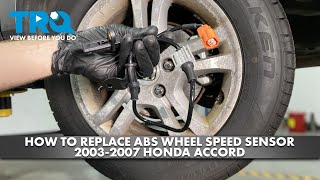
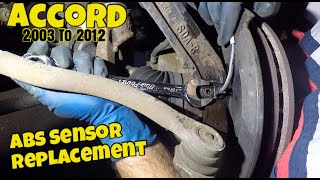
Typical fix: Replace the left rear wheel speed sensor. This involves removing one 10mm bolt and unplugging the electrical connector. If seized, the old sensor will likely break and require being carefully drilled out.
Est. part cost: $30-$80 - Damaged Wiring or Corroded Connector 🟡 Medium Probability The wiring harness runs along the suspension and can be damaged by road debris, chafing against components, or improper repairs. The electrical connector is also susceptible to water intrusion and corrosion, causing poor signal transmission.
How to confirm: Visually inspect the entire length of the wiring from the sensor to where it enters the cabin. Check for frayed wires, breaks, or green/white corrosion inside the connector pins. Perform a continuity test on the two wires between the sensor connector and the ABS module connector to check for breaks.
Typical fix: Repair the broken section of wire or replace the damaged connector. In severe cases, a new sensor pigtail or harness section may be needed.
Est. part cost: $10-$50 - Damaged or Contaminated Tone Ring ⚪ Low Probability The tone ring (or magnetic encoder) is integrated into the wheel bearing/hub assembly. While durable, it can accumulate metallic debris or heavy rust that obstructs the sensor's reading. It can also be damaged during other repairs, like axle or bearing replacement.
How to confirm: This is difficult to inspect directly as it's part of the sealed wheel bearing. If a new sensor and verified wiring do not fix the code, the bearing is the next logical suspect. Damage to the bearing seal can allow debris to enter and affect the encoder ring.
Typical fix: The entire wheel bearing/hub assembly must be replaced as the ring is integrated. This is a more involved repair than replacing the sensor alone.
Est. part cost: $70-$150 for a new hub assembly
Rare But Worth Checking
- Faulty ABS/VSA Control Module: This is the least likely cause. Before condemning the module, all other possibilities (sensor, wiring, tone ring) must be exhaustively ruled out. A faulty module will often set multiple or nonsensical wheel speed sensor codes, not just a single, consistent one like C0045.
Diagnosis Steps
- Connect an OBD-II scanner capable of reading ABS/Chassis codes to confirm C0045 is the active fault.
- Using the scanner's live data function, monitor the speed of all four wheels while driving slowly or spinning the wheels with the vehicle raised. Confirm that the Left Rear (LR) wheel speed reads zero, is erratic, or does not match the other wheels.
- Safely raise and support the vehicle and remove the left rear wheel.
- Visually inspect the wheel speed sensor and its wiring harness for any obvious signs of damage, such as cracks, chafing, or melted sections.
- Disconnect the sensor's electrical connector and inspect the pins for corrosion, moisture, or damage. Clean as necessary.
- With the connector unplugged, use a multimeter set to Ohms (Ω) to measure the resistance across the two pins on the sensor side. Compare this reading to the manufacturer's specification. An infinite (OL) or zero reading confirms a bad sensor.
- If the sensor resistance is within spec, test the wiring harness. Check for continuity on both wires from the sensor connector back to the ABS control module connector. Wiggle the harness during the test to check for intermittent breaks.
- If the sensor, wiring, and tone ring appear fine, a specialized scan tool can be used to perform a 'pulser test' which actively commands the sensor to check its function without driving the vehicle.
- Inspect the tone ring area on the wheel hub for heavy rust, debris, or physical damage if possible, though it is internal to the bearing.
Parts You'll Likely Need
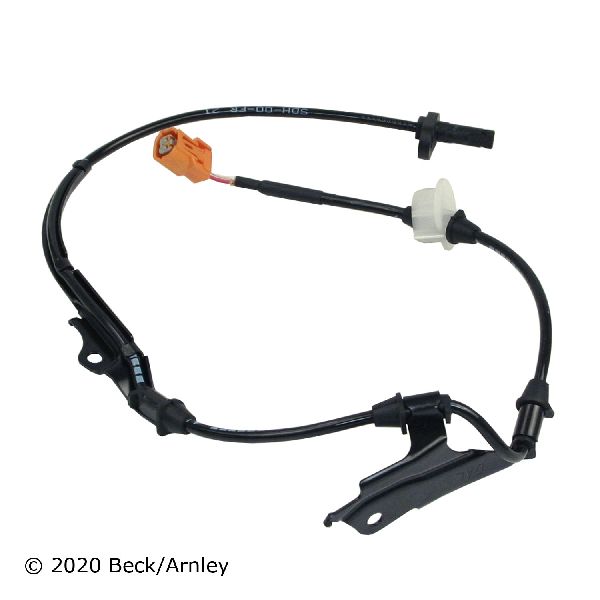
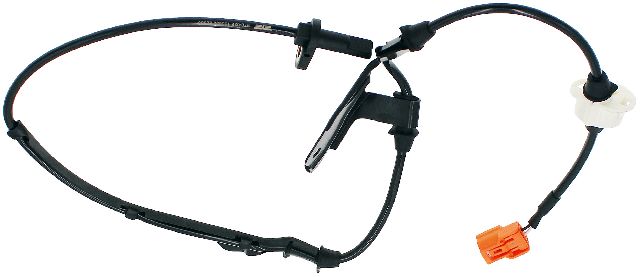
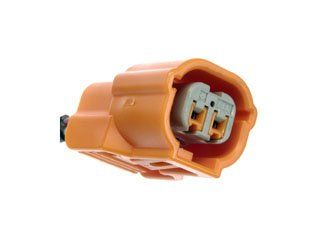
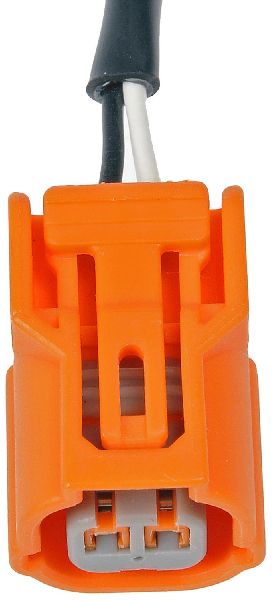
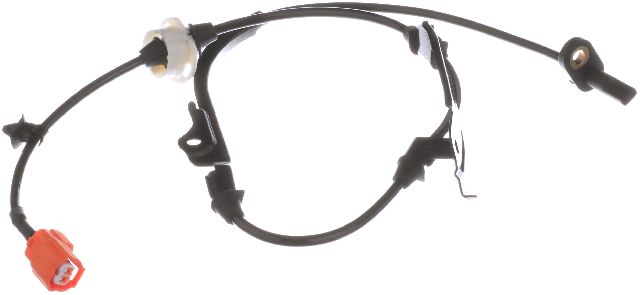
- Rear Left ABS Wheel Speed Sensor
(OEM #57475-SDA-A03)— This is the most common component to fail, triggering the C0045 code. The OEM part number 57475-SDA-A03 supersedes previous part numbers 57475-SDA-A01 and 57475-SDA-A02.
Trusted brands: Honda (OEM), NTK, Dorman, Standard Motor Products (SMP), Holstein, WVE
OEM price range: $60-$90
Aftermarket price range: $20-$50
Technical Service Bulletins (TSBs) & Recalls
- While no TSB directly addresses C0045, Honda TSB 07-086 is relevant for owners experiencing a whining noise from the engine bay, which is often misdiagnosed. The TSB points to a faulty power steering pump O-ring, a cheap and easy fix.
- Honda issued a major safety recall for the power steering feed hose on V6 models, which can leak and cause a fire. This is a critical issue for all 2003-2007 Accord V6 owners to be aware of.
Platform-Specific Known Issues
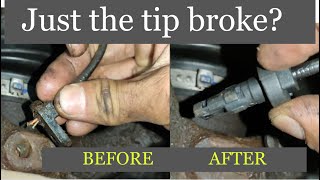
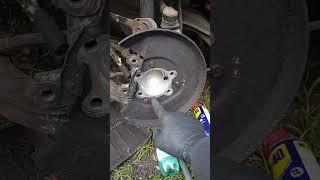
- Sensor Seizure: The most significant issue for the 2003-2007 Accord is the ABS sensor body corroding and seizing in the iron wheel knuckle. Applying penetrating oil beforehand is highly recommended, but it is very common for the sensor to break during removal. This requires the remaining plastic and metal to be carefully drilled out. Forum users on TypeAccord and Reddit describe this process in detail, often starting with smaller drill bits and gradually increasing size, being extremely careful not to drill too deep and damage the magnetic encoder on the wheel bearing. Some users recommend snapping the bottom of the sensor off first to make drilling easier. 🎬 See how to carefully drill out a rusted, broken sensor head.
Documented NHTSA Reports
While the C0045 code is specific to the left rear wheel speed sensor on the Honda Accord, other manufacturers have documented similar failures that reinforce common diagnostic paths. For instance, NHTSA ODI #11219167 describes a case where the C0045 code was caused by a broken left rear wheel speed sensor encoder ring, requiring replacement of both the sensor and the hub assembly. Similarly, NHTSA ODI #11165895 notes a service center report where the solution for a C0045 code was to replace the left rear hub bearing assembly. In some cross-manufacturer cases, such as NHTSA ODI #10382746, the code appeared alongside others like C0057 and C0231, leading to a recommendation for software reprogramming. Additionally, NHTSA ODI #11399819 highlights that C0045 can sometimes appear in conjunction with fuel system codes like P0463 and P069E on certain platforms.
Mechanic-Grade Diagnostic Values
- Passive Wheel Speed Sensor Resistance — expected: Approximately 1.4-1.5 kΩ. A general acceptable range is 800-1,700 Ω.. Failure: A reading of OL (infinite resistance) or near 0 Ω indicates an internal open or short in the sensor.
- Passive Wheel Speed Sensor AC Voltage Output — expected: Greater than 100mV AC while spinning the wheel by hand.. Failure: No AC voltage is generated, indicating a dead sensor or a problem with the magnetic tone ring.
Hidden / Shadow Codes Worth Checking
- C0045-06: Left Rear Wheel Speed Sensor Circuit Low Voltage / Open. This sub-code specifically points to a broken wire, unplugged connector, or an internal open circuit within the sensor. (see via A dealer-level scanner like the Honda HDS or an advanced professional scan tool capable of reading manufacturer-specific symptom bytes.)
- C0045-0F: Left Rear Wheel Speed Sensor Circuit Signal Erratic. This suggests the module is receiving a signal, but it is unstable or illogical, often pointing to a damaged tone ring, excessive wheel bearing play, or electromagnetic interference. (see via A dealer-level scanner like the Honda HDS or an advanced professional scan tool.)
Scan Tool Commands That Help
- Honda HDS (or equivalent): VSA Sensor Neutral Position Memorization — This procedure is required after replacing the VSA modulator-control unit or yaw rate sensor to recalibrate the system's zero points. It is not typically needed for a simple wheel speed sensor replacement.
- Paperclip / Jumper Wire: Manual ABS/VSA System Reset — To clear stubborn ABS/VSA lights after a repair when a scan tool fails to do so. It involves a two-step process of shorting pins 4 and 9 of the OBD-II port, followed by grounding pin 9, in sequence with brake pedal and VSA switch presses. This should only be performed after the root cause of the fault has been fixed.
Wiring & Ground Locations
- VSA Modulator-Control Unit — In the engine compartment, on the right (passenger) side, near the firewall. It's an aluminum block with multiple brake lines and a large electrical connector.. This is the computer that receives the signal from the left rear wheel speed sensor. The wiring harness from the sensor terminates here, making its connector the primary location for testing circuit continuity and shorts back from the module.
- VSA Modulator 37-Pin Connector — The main electrical connector on the VSA Modulator-Control Unit.. Testing can be performed directly at this connector to isolate a fault between the sensor, wiring, and the module itself. A pinout diagram for a 2006 Accord is available, which is crucial for targeted diagnostics.
- G401 — Behind the driver's side dash, above the kick panel.. This is a major chassis ground point for multiple interior components, including parts of the VSA system like the VSA OFF switch. A poor connection here can cause various intermittent electrical issues.
- G305 (on earlier models) — Not specified for 7th gen, but on the previous generation, it served as the direct ground for the ABS control unit.. Illustrates that the ABS/VSA module relies on a dedicated, clean ground. Verifying the main ground wires at the VSA modulator connector for integrity is a critical diagnostic step.
Real Owner Repair Stories
- Honda-Tech Forum User 'BillD123' (2005 Honda Accord EX 2.4L) — CEL and ABS lights were on, and there was no communication at the DLC (OBD-II port).
❌ Tried (didn't work) Initial diagnosis was difficult due to the no-communication issue.
✅ What actually fixed it A failed VSA (ABS) modulator was internally shorted, which in turn destroyed the MICU (Multiplex Integrated Control Unit / under-dash fuse box). When the dealer unplugged the faulty ABS modulator, communication was restored to the DLC. The final fix required replacing both the VSA modulator and the MICU, an expensive repair quoted at $2600 by the dealer.
OEM Part Supersession History
57475-SDA-A01, 57475-SDA-A02→57475-SDA-A03— Standard manufacturer revisions, likely for improved durability or material changes.
Heads up: None. All part numbers are interchangeable for the 2003-2007 Accord.
Model Year Variations Within This Range
- 2003-2007: The 2006-2007 models received a mid-cycle refresh with revised front and rear styling. However, there is no evidence of significant changes to the ABS/VSA system, wheel speed sensors, or related wiring that would alter the diagnosis or repair of code C0045.
Diagnostic Flowchart
Other Known Issues on This Vehicle
Issues unrelated to this code that are worth knowing about as an owner of this generation:
- Automatic Transmission Failure (V6 Models) 🔴 High → Shop Transmission Assembly — Very common, especially on 2003-2004 models. Can occur under 100,000 miles. Complaints describe harsh downshifts, slipping, and complete failure. (Ref: Multiple TSBs were issued regarding diagnostic criteria and fluid replacement, such as TSB #10013607 and #04-026, but no widespread recall for the failure itself.)
- Power Steering Hose Leak (V6 Models) 🔴 High — Common enough to warrant a major safety recall. The hose deteriorates from engine heat, leaking fluid onto the hot catalytic converter. (Ref: Yes, NHTSA campaign for recall. Honda expanded the recall in September 2012 to cover ~572,000 2003-2007 Accord V6 models.)
- EGR Valve/Port Clogging (V6 Models) 🟠 Medium — Common at higher mileage, leading to rough idle, hesitation, and codes like P0401. The intake manifold passages for the EGR system become blocked with carbon.
- Excessive Oil Consumption (4-Cylinder K24) 🟠 Medium — Frequently reported by owners, though severity varies. Can start at any mileage.
- Failing Stereo Backlight / HVAC Display 🟡 Low — Extremely common on 2003-2004 models. The circuit board for the radio and climate control display fails, causing the backlight to go dark.
- Power Steering Pump Whine 🟡 Low — A common noise complaint, especially on cold starts. Often caused by a simple O-ring on the power steering pump inlet allowing air into the system. (Ref: Honda issued TSB 07-086 for this issue.)
Used vs. New Parts: Buying Guide for This Vehicle
When a used part is the smart pick: A used wheel speed sensor is generally not recommended due to the high failure rate, low cost of new aftermarket parts, and the labor involved in replacement. A used VSA/ABS modulator assembly is a viable option to save significant money over a new unit, but it is a last resort after confirming the module is faulty.
Donor-vehicle mileage cap: roughly under 75000 miles for the part to have meaningful remaining life.
What to inspect on the donor part:
- For a VSA Modulator, ensure the part number matches your original unit exactly.
- Inspect the donor part for any signs of external damage, heavy corrosion, or fluid leaks from the pump or valve body.
- Whenever possible, choose parts from vehicles in dry, salt-free climates to minimize the risk of hidden corrosion.
- Ensure the electrical connector pins are clean, straight, and free of any green or white corrosion.
OEM-only on this vehicle (don't cheap out):
- While not strictly OEM-only, the VSA modulator is a complex electronic part. A new OEM unit offers the highest reliability. If buying used, an OEM unit from a low-mileage donor is preferable to an unknown aftermarket rebuild.
Aftermarket brands forum-validated for this vehicle:
- NTK (often an OE supplier)
- Beck/Arnley
- Standard Motor Products (SMP)
- Delphi
Brands owners have reported issues with on this vehicle:
- Some forum users report premature failures with Dorman sensors on Honda applications, though experiences vary.
Real Owner Stories
Aggregated from forums and TSBs cited above. Mileages and costs reflect what owners reported in those sources.
2003-2007 Honda Accord
Symptoms: The ABS sensor was stuck in the knuckle and would not come out using standard methods.
What fixed it: The sensor had to be broken off and the remaining plastic and metal were carefully drilled out, starting with small bits and increasing in size.
Source hint: TypeAccord - Thread 'Wheel Sensors - My Experience of drilling out.'
2004-2008 Acura TSX
Symptoms: Repeatedly failing aftermarket sensors and suspected damage to the bearing surface.
What fixed it: Highlighting the need for careful installation and verifying the bearing surface/encoder ring integrity.
Source hint: Acurazine - Thread 'ABS Wheel Speed Sensor'
2003-2007 Honda Accord
Symptoms: ABS sensor stuck in the knuckle.
What fixed it: Twisting the sensor back and forth to break it free before resorting to drilling.
Source hint: Reddit r/AskMechanics - A user with a stuck sensor on a Honda
2003-2004 Honda Accord V6 — ~95000 miles
Symptoms: Harsh downshifts and transmission slipping.
What fixed it: Diagnostic criteria and fluid replacement per TSB #10013607 and #04-026, though many required complete transmission replacement.
Source hint: Known Issues: Automatic Transmission Failure (V6 Models)
Related OBD-II Codes
Frequently Asked Questions
My 2003-2007 Accord V6 has a whining noise in the engine bay; is this related to the C0045 ABS code?
I'm trying to remove the left rear sensor on my Accord but it won't budge. Is this common?
Can I just replace the magnetic tone ring if it's contaminated?
Is there a recall for the ABS sensors on the 7th Gen Accord?
Will a 2004-2008 Acura TSX sensor work for my Accord?
Why is my brake pedal pulsating at low speeds when the ABS light is on?
Helpful Videos
We Have This Part in Stock


The information in this article is provided for general reference and educational purposes only. Vehicle specifications, procedures, and part compatibility can vary by production date, trim level, and region. Always consult your vehicle's factory service manual and verify part numbers before purchasing or performing repairs. Safety-critical components such as airbags, seat belts, and braking systems should be installed by a qualified professional.
- Honda Accord:
- 🧭 Diagnostic Flowchart
- 🎬 Helpful Videos
- 🛍️ Shop This Part
- What's Unique About the 2003-2007 Honda Accord
- Symptoms You May Notice
- Most Likely Causes
- Rare But Worth Checking
- Diagnosis Steps
- Parts You'll Likely Need
- Technical Service Bulletins (TSBs) & Recalls
- Platform-Specific Known Issues
- Documented NHTSA Reports
- Mechanic-Grade Diagnostic Values
- Hidden / Shadow Codes Worth Checking
- Scan Tool Commands That Help
- Wiring & Ground Locations
- Real Owner Repair Stories
- OEM Part Supersession History
- Model Year Variations Within This Range
- Other Known Issues on This Vehicle
- Used vs. New Parts: Buying Guide for This Vehicle
- Real Owner Stories
- 2003-2007 Honda Accord
- 2004-2008 Acura TSX
- 2003-2007 Honda Accord
- 2003-2004 Honda Accord V6 — ~95000 miles
- Related OBD-II Codes
- Frequently Asked Questions
- 🎟️ Get 5% Off