

C0045 on 2016-2021 Honda Civic: Left Rear Wheel Speed Sensor Fault Causes and Fixes
Code C0045 on a 10th-gen Honda Civic almost always means the left rear wheel speed sensor has failed or its wiring is damaged. Expect to pay $50-$70 for an OEM sensor and about an hour of labor for a straightforward replacement.
- C0045 means there's a problem with the left rear wheel speed sensor circuit, which will disable your ABS and traction control.
- The most likely cause is a failed sensor, which is a relatively inexpensive part and simple to replace for a DIYer with basic tools.
- Before buying any parts, use a scan tool to watch the live wheel speed data to confirm the left rear sensor is the one not reporting speed.
- Always inspect the wiring and connector for damage before replacing the sensor, as a broken wire or corroded pin is a common and cheaper fix.
What's Unique About the 2016-2021 Honda Civic
While this is a common code across many brands, Honda has a history of addressing wheel speed sensor and hub issues, as seen in recalls for previous Civic generations (2006-2007) where improperly sealed sensors could lead to bearing failure. For the 10th generation Civic (2016-2021), the issue is typically a straightforward failure of the sensor itself or its wiring, rather than a systemic design flaw. The magnetic encoder ring the sensor reads is integrated into the rear wheel hub/bearing assembly, so severe bearing wear or rust jacking could potentially cause this code, but it's less common than a simple sensor failure.
Symptoms You May Notice
- ABS warning light is on
- Vehicle Stability Assist (VSA) or traction control warning light is on
- Brake System warning light is on
- Anti-lock braking and traction control systems are disabled
- Brake pedal feels different or pulsates at low speeds if the signal is intermittent.
- Replacing the wheel hub/bearing when only the sensor is bad. Always diagnose the sensor and wiring first before assuming the more expensive hub is the problem.
- Replacing the sensor when the wiring harness is chafed or corroded a few inches away from the connector.
Most Likely Causes
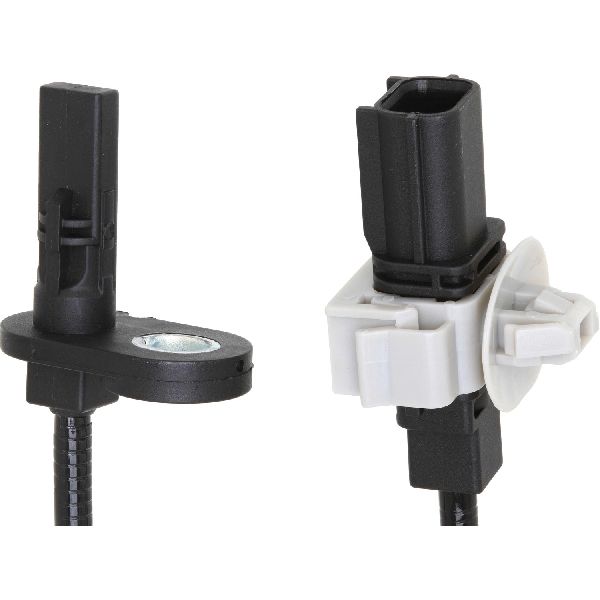
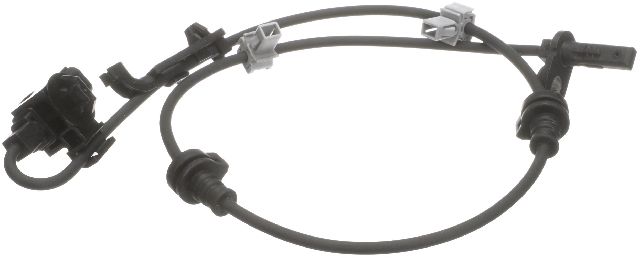
- Failed Left Rear Wheel Speed Sensor 🔴 High Probability → Shop ABS Wheel Speed Sensor The sensor is an exposed electronic component subject to road salt, moisture, heat, and vibration, which leads to internal corrosion and eventual electronic failure.
How to confirm: Using a scan tool with live data, observe the wheel speed for the left rear wheel. If it reads 0 MPH or is erratic while the other three wheels show correct speed, the sensor is the likely culprit. You can also test the sensor's internal resistance with a multimeter and compare it to factory specifications or the sensor on the opposite side. An open circuit (infinite resistance) or short circuit (near-zero resistance) indicates a bad sensor.
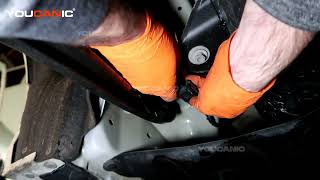
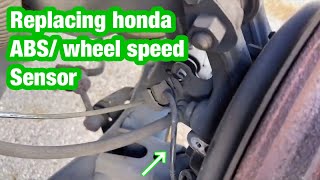
Typical fix: Replace the left rear wheel speed sensor. It is typically held in by a single 10mm bolt and has an electrical connector located in the wheel well. 🎬 Watch: Step-by-step rear ABS wheel speed sensor replacement guide.
Est. part cost: $45-$150 - Damaged Wiring or Connector 🟡 Medium Probability The wiring harness runs along the suspension and is vulnerable to damage from road debris, improper jacking, or corrosion from road salt and moisture, especially in 'Salt Belt' regions. The insulation can become brittle and crack in extreme cold.
How to confirm: Visually inspect the entire length of the wiring from the sensor to where it enters the car body. Check the connector for green or white corrosion, bent pins, or a loose fit. Perform a continuity test on the wires between the sensor connector and the ABS module connector to find any open circuits or shorts. Wiggle the harness during testing to identify intermittent breaks.
Typical fix: Repair the broken or corroded section of wire. If the connector is damaged, it may need to be replaced with a new pigtail.
Est. part cost: $10-$40 - Damaged Wheel Hub Bearing Assembly ⚪ Low Probability → Shop Hub Assembly The magnetic encoder ring (tone ring) is integrated into the wheel hub. Severe corrosion can cause 'rust jacking,' pushing the encoder ring out of alignment, or damage from a worn bearing can disrupt the sensor's reading.
How to confirm: After confirming the sensor and wiring are good, inspect the wheel hub. Check for excessive play in the wheel bearing by rocking the tire at the 12 and 6 o'clock positions. If the hub is removed, inspect the magnetic ring for cracks, rust buildup, or missing sections.
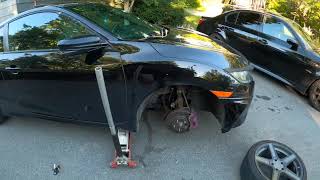
Typical fix: Replace the entire rear wheel hub and bearing assembly. Unlike the front, the rear is a bolt-on assembly. 🎬 Watch this quick walkthrough on changing the rear speed sensor.
Est. part cost: $100-$250
Rare But Worth Checking
- Faulty VSA/ABS Control Module: → Shop ABS Control Module This is very uncommon. Before condemning the module, exhaust all other diagnostic possibilities. A faulty module often triggers multiple wheel speed sensor codes (e.g., C0045 and C0050) or communication codes, not just a single one.
- Software Calibration: In some cross-manufacturer instances, such as described in NHTSA ODI #10382746 for a Subaru, dealers were instructed to erase codes and re-program software when C0045 appeared alongside multiple other chassis codes.
Diagnosis Steps
- Connect an OBD-II scanner capable of reading ABS/Chassis codes to confirm C0045 is the active code.
- Access the live data stream for the wheel speed sensors.
- Drive the vehicle slowly (or safely raise the vehicle and spin the wheel by hand) and observe the speed readings from all four wheels. Confirm that the Left Rear (LR) sensor reads 0 or provides an erratic signal compared to the other three.
- Perform a thorough visual inspection of the left rear wheel speed sensor, its connector, and the wiring harness for any obvious signs of damage, corrosion, or chafing. Pay close attention to the section of harness that flexes with suspension travel.
- Disconnect the sensor and test its internal resistance with a multimeter. Compare the reading to the manufacturer's specification or the reading from the right rear sensor. An open circuit (infinite resistance) or short circuit (zero resistance) indicates a bad sensor.
- If the sensor tests good, inspect the wiring harness. Check for continuity on the signal and ground wires from the sensor connector back to the VSA/ABS control module. Wiggle the harness during testing to check for an intermittent break.
- If the sensor and wiring are confirmed to be good, inspect the wheel hub/bearing assembly for excessive play or damage to the integrated magnetic encoder ring.
- If all other components are good, the VSA/ABS control module may be at fault, though this is rare. Professional diagnosis is recommended at this stage.
Parts You'll Likely Need
- Left Rear ABS Wheel Speed Sensor
(OEM #57475-TGN-G01)— This is the most frequent failure point for a C0045 code. It is an electronic component that fails over time due to heat, vibration, and environmental exposure.
Trusted brands: Honda (OEM), Bosch, NTK, Dorman, Standard Motor Products
OEM price range: $46-$70
Aftermarket price range: $30-$150
Related Codes That Often Appear With This One
- U0415 - Invalid Data Received From Electronic Brake Control Module: This code is often set in other modules (like power steering) as a consequence of C0045, because the ABS module is broadcasting that its data is unreliable.
- P0463 and P069E: While typically unrelated to braking, NHTSA ODI #11399819 notes a case on a Chevrolet where these fuel system codes appeared simultaneously with C0045.
Platform-Specific Known Issues
- OEM Part Number Specificity: The OEM part number 57475-TGN-G01 is listed specifically for the 2017-2020 Honda Civic Si models (Coupe and Sedan). While it may fit other trims, it's crucial to verify the correct part number for non-Si models using the vehicle's VIN, as base models may use a different part.
- Owner Repair Experience: An owner of a 2018 Honda CR-V, a platform mate, experienced multiple warning lights and codes related to the all-wheel-drive system, all of which were traced back to a faulty left rear wheel speed sensor. This highlights how a single sensor failure can cause a cascade of seemingly unrelated warnings. 🎬 See how a faulty sensor triggers multiple dashboard warning lights.
Mechanic-Grade Diagnostic Values
- Active Sensor Voltage Test — expected: The sensor operates on a reference voltage from the VSA module (typically 5-12V). The signal wire should produce a digital square wave (e.g., 0-5V or 0-12V) when the wheel is spinning, viewable with an oscilloscope.. Failure: No square wave signal, or a flat line at the reference voltage or 0V, indicates a failed sensor or a problem with the magnetic encoder ring in the hub bearing.
- Sensor Resistance (Comparative Test) — expected: While specific Ohm values are not reliably documented for OEM, a practical test is to measure the resistance of the suspect sensor and compare it to the known-good sensor on the other side of the vehicle (right rear). The values should be very close (within ~5%).. Failure: A reading of OL (Open Loop/infinite resistance) or 0.0 ohms indicates an internal short or open in the sensor. A significant deviation from the known-good sensor also points to failure.
Scan Tool Commands That Help
- Autologic DrivePRO (or similar advanced scanner): Pulser Test — This is a non-intrusive service function to test the wheel speed sensor's ability to count pulses as the wheel is rotated by hand. The scan tool compares the actual pulse count to a target value for one full revolution, confirming if the sensor and magnetic encoder are working without having to test drive the vehicle.
Wiring & Ground Locations
- VSA/ABS Module Connector — Located in the engine bay, typically on the driver's side, it's the metal block with multiple brake lines and a large electrical connector attached.. This is the central point for all sensor inputs and system power. All diagnostic wiring tests (continuity, voltage, ground) will terminate at this connector.
- Rear Wheel Speed Sensor Wires (at VSA Module) — In a 2017 Civic, the rear sensor wires are found in the main VSA module connector. One pair is Light Green and White; the other is Pink and Green. You would need a model-specific diagram to confirm which pair is for the left side.. Knowing these colors allows for continuity testing of the harness from the module to the wheel well without having to trace the entire wire loom.
- VSA/ABS Power and Ground Pins — On the 2017 Civic VSA module connector, Pin 4 (WHT) and Pin 1 (RED) are main power sources, while Pin 2 (BLK) is the main ground. Pins 20 and 21 are the F-CAN High and Low communication lines.. Loss of power or ground to the module can cause various codes, including C0045. Verifying these pins have correct voltage and ground is a critical step before condemning the module.
- ABS Fuses — There are multiple fuses. In the interior fuse box (driver's side dash), check fuse #34. In the under-hood fuse box, check the multi-block fuse positions #4 (40A) and #5 (40A) which power the ABS motor and fail-safe relays.. A blown fuse will kill power to the entire VSA/ABS system, often logging multiple codes, but should be checked as a preliminary step.
OEM Part Supersession History
57475-TGN-G01→No supersession found.— This appears to be the current and only part number for the specified application (2017-2020 Civic Si).
Heads up: Be aware this part is specifically listed for Si models. Non-Si trims likely use a different part number (e.g., 57475-TBA-A01 for some models), and they may not be interchangeable. Always verify with VIN.
Diagnostic Flowchart
Other Known Issues on This Vehicle
Issues unrelated to this code that are worth knowing about as an owner of this generation:
- A/C Condenser Failure 🔴 High — Very common across all 2016-2021 models. Can fail at low mileage due to a manufacturing defect causing small leaks. (Ref: Honda Service Bulletin 19-091; Honda extended the warranty for this part to 10 years with unlimited mileage.)
- 1.5L Turbo Engine Oil Dilution 🔴 High — Common in 2016-2018 models with the 1.5T engine, especially in cold climates with frequent short trips. Fuel mixes with engine oil, raising the oil level and reducing lubrication. (Ref: Honda offered software updates and a warranty extension to six years with unlimited mileage for certain engine components.)
- Sticky Electric Power Steering (EPS) 🔴 High — Primarily reported in later models of the generation (2020-2021) and more widespread in the following 11th generation, but complaints exist for 10th gen. The steering can feel 'stuck' or 'notchy' at highway speeds. (Ref: NHTSA investigation opened for 2022-2023 models, but owners of earlier models have reported similar issues.)
- Head Gasket Failure (1.5T) 🟠 Medium — A known, but less frequent, issue on the 1.5T engine where a weak head gasket can lead to coolant consumption and cold start misfires, sometimes between 40,000-70,000 miles.
- Carbon Buildup on Intake Valves (1.5T) 🟠 Medium — As a direct-injection engine, the 1.5T is prone to carbon buildup over time (typically 50,000-70,000 miles), which can cause reduced performance and rough idling.
Used vs. New Parts: Buying Guide for This Vehicle
When a used part is the smart pick: A used OEM wheel speed sensor from a reputable salvage yard is a reasonable choice, as it's a simple electronic part. A used VSA/ABS modulator is also a significant cost-saver ($100-$200 used vs. $1500+ new) if the module itself is diagnosed as faulty.
Donor-vehicle mileage cap: roughly under 75000 miles for the part to have meaningful remaining life.
What to inspect on the donor part:
- For a sensor, inspect the pigtail for cracks or brittleness and check connector pins for corrosion.
- For a VSA module, ensure the donor vehicle was not in a major front-end collision and check that none of the brake line ports or the electrical connector are damaged.
- Ask for the donor vehicle's VIN to check its history and ensure it's from a non-salt-belt state if possible to minimize corrosion risk.
OEM-only on this vehicle (don't cheap out):
- VSA/ABS Modulator: While a used OEM unit is viable, avoid new unbranded aftermarket modules. They often have software incompatibility or programming issues that can be difficult to resolve.
Aftermarket brands forum-validated for this vehicle:
- Bosch
- NTK / NGK
- Standard Motor Products (SMP)
Brands owners have reported issues with on this vehicle:
- No-name, unbranded sensors from online marketplaces. While cheap, they have a higher reported failure rate and may not have the same signal precision as OEM, potentially causing intermittent issues.
Real Owner Stories
Aggregated from forums and TSBs cited above. Mileages and costs reflect what owners reported in those sources.
2017 Honda Civic
Symptoms: ABS and brake system light on; multiple warning lights appeared on the dashboard.
What fixed it: The owner confirmed with a scan tool that the left rear wheel speed sensor was faulty and replaced the sensor.
Source hint: civicx.com thread titled 'ABS and brake system light on'
2018 Honda CR-V (Platform Mate)
Symptoms: Experienced multiple warning lights and codes related to the all-wheel-drive system.
What fixed it: Traced back to and fixed by replacing a faulty left rear wheel speed sensor.
Source hint: Vehicle Specific Issues - Owner Repair Experience
Documented NHTSA Reports
Cross-Manufacturer Diagnostic Reports
NHTSA ODI #11219167: An owner reported that the C0045 code was caused by a broken left rear wheel speed sensor encoder ring. The repair required replacing both the speed sensor and the rear hub assembly.
Hub and Bearing Complications
NHTSA ODI #11165895: A service center reported that code C0045 required replacing the left rear hub bearing assembly, noting that warning messages would vary in duration before lights extinguished.
Related OBD-II Codes
Frequently Asked Questions
Which specific part number should I use for my 2017-2020 Honda Civic Si to fix the C0045 code?
Why is my 2016-2021 Civic prone to wheel speed sensor failure in the 'Salt Belt' regions?
Can a bad wheel hub cause the C0045 code on my Civic even if the sensor is new?
Will a faulty left rear wheel speed sensor affect my Civic's steering or traction systems?
Is there a TSB for the A/C or engine issues that I should check while fixing my ABS code?
Helpful Videos
We Have This Part in Stock


The information in this article is provided for general reference and educational purposes only. Vehicle specifications, procedures, and part compatibility can vary by production date, trim level, and region. Always consult your vehicle's factory service manual and verify part numbers before purchasing or performing repairs. Safety-critical components such as airbags, seat belts, and braking systems should be installed by a qualified professional.
- Honda Civic:
- 🧭 Diagnostic Flowchart
- 🎬 Helpful Videos
- 🛍️ Shop This Part
- What's Unique About the 2016-2021 Honda Civic
- Symptoms You May Notice
- Most Likely Causes
- Rare But Worth Checking
- Diagnosis Steps
- Parts You'll Likely Need
- Related Codes That Often Appear With This One
- Platform-Specific Known Issues
- Mechanic-Grade Diagnostic Values
- Scan Tool Commands That Help
- Wiring & Ground Locations
- OEM Part Supersession History
- Other Known Issues on This Vehicle
- Used vs. New Parts: Buying Guide for This Vehicle
- Real Owner Stories
- 2017 Honda Civic
- 2018 Honda CR-V (Platform Mate)
- Documented NHTSA Reports
- Cross-Manufacturer Diagnostic Reports
- Hub and Bearing Complications
- Related OBD-II Codes
- Frequently Asked Questions
- 🎟️ Get 5% Off