

C0050 on 2009-2014 Ford F-150: Right Rear Wheel Speed Sensor Fault Causes and Fixes
Code C0050 on a 2009-2014 F-150 means there's a fault in the right rear wheel speed sensor circuit. This almost always points to a failed sensor or damaged wiring. A new sensor is the most common fix, costing around $25-$75 for an aftermarket part, and is a straightforward DIY repair.
- C0050 means your F-150's computer has lost the signal from the right rear wheel, disabling ABS and traction control.
- The most likely cause is a bad wheel speed sensor, which is an affordable part and a manageable DIY replacement for most owners.
- Before buying parts, inspect the wiring harness for visible damage—especially near the connector—and use a scan tool that can read live ABS data to confirm the right rear wheel is the one with the problem.
- Unlike some trucks, the tone ring is separate from the wheel hub on this F-150. Check it for damage through the sensor hole before assuming a more complex repair is needed.
What's Unique About the 2009-2014 Ford F-150
On the 12th generation F-150 (2009-2014), the C0050 code is most often a simple fix related to the sensor or its wiring. Unlike some other trucks where the magnetic encoder is built into the wheel hub assembly, this F-150 uses a separate, press-on tone ring on the axle shaft. This means that if the tone ring is damaged, you don't necessarily need to replace the entire wheel bearing and hub, although it does require pulling the axle shaft for replacement.
Symptoms You May Notice
- ABS warning light is on
- Traction control or AdvanceTrac warning light is on
- Stability control system is disabled
- "Check Brake System" message on the instrument cluster.
- ABS system does not activate during hard braking (wheels may lock up)
- Cruise control may be disabled.
- Replacing the wheel hub/bearing assembly. Unlike on some other vehicles, the tone ring on the 2009-2014 F-150 is not integrated into the hub, so replacing the hub will not fix a damaged tone ring.
Most Likely Causes
- Failed Right Rear Wheel Speed Sensor 🔴 High Probability → Shop ABS Wheel Speed Sensor The sensor is exposed to road debris, water, and salt under the vehicle, leading to corrosion and electronic failure over time. The sensor body can also become seized in its mounting bore due to rust, making removal difficult and sometimes leading to breakage.
How to confirm: Use a scan tool with live data capability to monitor all four wheel speeds while driving. If the right rear sensor reads 0 MPH or shows an erratic signal while the others read correctly, the sensor is the likely culprit. A multimeter can also be used to check resistance; while exact specs are not consistently published, a reading that is wildly different from the other rear sensor (or open/shorted) indicates a bad sensor. A forum post for a similar F-150 generation noted a range of 780-1900 ohms.
Typical fix: Replace the right rear wheel speed sensor. The sensor is typically held in by a single 10mm bolt. Applying penetrating oil before removal is highly recommended.
Est. part cost: $25-$75 - Damaged Wiring or Corroded Connector 🟡 Medium Probability The wiring harness runs along the rear axle and frame, where it is susceptible to damage from road debris, moisture intrusion, or chafing. A common failure point is right behind the connector on the axle, where moisture can cause corrosion and wire breaks that may not be immediately visible.
How to confirm: Visually inspect the wiring harness from the sensor up to the main connector on the frame for any cuts, abrasions, or signs of melting. Disconnect the sensor and check the connector terminals for green or white corrosion or pushed-out pins. Pay close attention to the section of harness within a few inches of the sensor connector.
Typical fix: Repair the damaged section of wire using solder and heat-shrink tubing or a weatherproof butt connector. Clean corroded connectors with electrical contact cleaner or replace the connector pigtail if severely damaged.
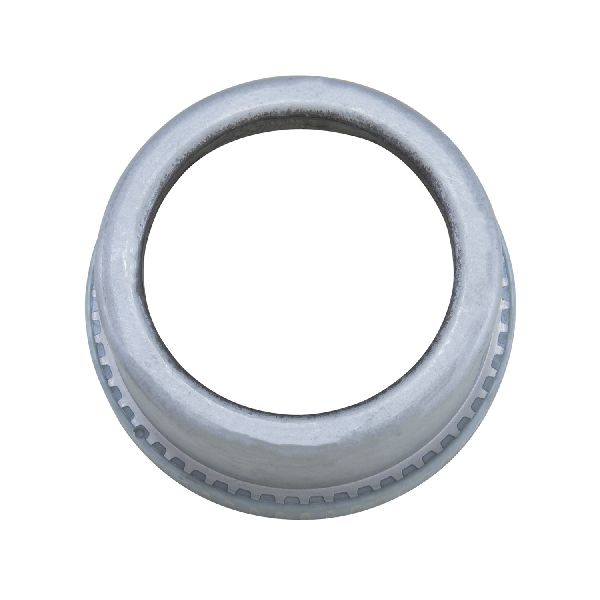
Est. part cost: $10-$40 - Damaged or Dirty ABS Tone Ring ⚪ Low Probability The tone ring is a toothed metal ring pressed onto the axle shaft. While generally protected, it can be damaged by road debris or become covered in thick rust or metallic brake dust, which prevents the sensor from getting a clean reading.
How to confirm: After removing the wheel speed sensor, use a flashlight and a small mirror to look into the sensor hole. Have a helper slowly rotate the rear wheel and inspect the teeth of the tone ring for cracks, missing teeth, or heavy contamination.
Typical fix: If dirty, cleaning the tone ring with a brush and brake cleaner may resolve the issue. If damaged, the tone ring must be replaced, which requires removing the rear axle shaft.
Est. part cost: $20-$50
Rare But Worth Checking
- Failed ABS Control Module: → Shop ABS Control Module This is the least likely cause. Before condemning the module, all other possibilities (sensor, wiring, tone ring) must be exhaustively tested. A failed module will typically not provide the necessary voltage to the sensor circuit or may set multiple sensor codes at once.
Diagnosis Steps
- Connect an ABS-capable scan tool to the OBD-II port.
- Confirm C0050 is the active code 🎬 Watch: Understanding the C0050 brake system fault code and check for any other related codes.
- View the live data stream for all four wheel speed sensors.
- Drive the vehicle slowly (above 5 MPH) and observe the speed readings. Confirm that the Right Rear (RR) sensor reads 0 MPH or is erratic compared to the other three.
- Safely raise and support the rear of the vehicle. Remove the right rear wheel.
- Locate the wheel speed sensor on the rear axle housing, near the brake backing plate.
- Visually inspect the sensor and its wiring harness for obvious signs of damage, such as cuts, chafing, or melting. Trace the wire along the axle to the main connector.
- Unbolt the sensor (typically a single 10mm bolt) and carefully pry it out of its housing. It may be seized; use penetrating oil and gentle prying to avoid breaking it.
- With the sensor removed, inspect the ABS tone ring through the mounting hole for damage, debris, or heavy rust. A small brush can be used to clean it.
- If the visual inspection reveals no issues, use a multimeter to test the sensor and circuit. Check for resistance across the sensor pins and compare it to the left side sensor. An open or shorted sensor needs replacement.
- If the sensor tests good, check for voltage at the harness connector (with key on) and test for continuity on both wires from the sensor connector to the main ABS module connector.
- If the sensor is confirmed bad, replace it. If the wiring is damaged, repair it. If the tone ring is damaged, replace it.
Parts You'll Likely Need
- Rear Wheel Speed Sensor
(OEM #Motorcraft BRAB292 (AL3Z-2C190-A) or BRAB293 (AL3Z-2C190-B) - Note: Left and Right are often different lengths, verify by VIN.)— This is the most common failure point for the C0050 code due to its exposed location and electronic nature.
Trusted brands: Motorcraft, Standard Motor Products (SMP), Dorman, Bosch
OEM price range: $60-$100
Aftermarket price range: $25-$75
Related Codes That Often Appear With This One
- C0045 (Left Rear Wheel Speed Sensor Circuit): If both rear sensor codes appear together, it strongly suggests a wiring harness issue common to both, such as at the main connector on the frame, rather than two simultaneous sensor failures.
Platform-Specific Known Issues
- Wiring Breakage Near Axle Connector: A user on Ford-Trucks.com reported finding a break in the wire just 1 inch behind the connector on the rear end. It appeared as a small, green, corroded hole in the insulation, which was causing a C1165 code (an equivalent circuit failure code). This highlights the need for a very close inspection of the harness.
- Seized Sensor Removal: Multiple DIY videos show that the sensor often gets seized in the axle housing due to rust. Technicians recommend using a pry bar or large screwdriver to gently wiggle it out. It's common to break the old sensor during removal, but care must be taken not to damage the housing. Cleaning the bore with sandpaper or a small cylindrical brush before installing the new sensor is critical.
Mechanic-Grade Diagnostic Values
- Wheel Speed Sensor Resistance — expected: 780 - 1900 Ohms (approximated based on current draw specs). Failure: A reading of OL (infinite resistance) for an open circuit, or near zero for a short circuit. The most practical test is comparing the reading to the sensor on the opposite side.
- Wheel Speed Sensor Circuit Current — expected: 6.3 - 15.4 mA. Failure: Current outside of this range indicates a fault in the sensor or wiring.
- ABS Module Pump Motor Fuse — expected: 60A. Failure: Blown fuse indicates a shorted pump motor or wiring.
- ABS Module Control Circuit Fuse — expected: 30A. Failure: Blown fuse indicates a short in the control side of the module or its wiring.
Hidden / Shadow Codes Worth Checking
- C0050:00: General circuit malfunction, indicating a potential short to ground, open circuit, or high resistance. (see via Professional scan tool capable of reading Ford-specific symptom bytes (e.g., Ford IDS, FORScan, high-end Autel/Snap-on scanners).)
- C0050:18: Signal Amplitude Less Than Minimum. This indicates a weak signal, often caused by an excessive air gap between the sensor and ring, a damaged tone ring, or an internal sensor failure. (see via Professional scan tool capable of reading Ford-specific symptom bytes (e.g., Ford IDS, FORScan, high-end Autel/Snap-on scanners).)
- C0050:5A: Signal is not plausible. The signal is inconsistent with other wheel speed sensors, often seen during turns or when one wheel loses traction. (see via Professional scan tool capable of reading Ford-specific symptom bytes (e.g., Ford IDS, FORScan, high-end Autel/Snap-on scanners).)
Scan Tool Commands That Help
- Ford IDS (Integrated Diagnostic System): Self Test > ABS Module — To command the ABS module to run an internal diagnostic check on all its circuits and components, which can help confirm if the module itself is reporting the fault correctly.
- Ford IDS (Integrated Diagnostic System): Datalogger > Wheel Speed Sensor PIDs — To graph all four wheel speeds simultaneously while driving. This is the primary method to visually confirm if the right rear sensor signal is dropping out, erratic, or reading zero compared to the other three.
- Ford IDS (Integrated Diagnostic System): Programmable Module Installation (PMI) — This function is required if the ABS module itself is replaced. It copies the as-built data from the old module (or retrieves it from Ford's database) and programs it into the new module to ensure compatibility with the truck's specific features.
Wiring & Ground Locations
- ABS Module Connector — On the ABS hydraulic unit, located on the driver's side of the engine bay, below the air filter housing.. This is the termination point for the wheel speed sensor circuits. Corrosion or pushed-out pins in this main connector can cause a C0050 code even if the sensor and harness along the axle are good.
- G108 — On the driver's side (Left) fender, near the air intake tube.. This is a primary engine bay ground point. While not the dedicated ground for the sensor circuit itself, a poor connection at G108 can introduce electrical noise or voltage issues for the entire ABS module, potentially causing various faults.
- Under-hood Fuse Box Fuses — In the power distribution box located in the engine compartment, above the radiator.. The ABS system uses multiple fuses. Specifically for 2009-2014 models, Fuse #47 (60A) for the pump and Fuses #36 (30A) and #54 for the module are critical power inputs. While a blown fuse typically causes more than just a single sensor code, checking them is a fundamental step.
Documented NHTSA Reports
While C0050 is a standard wheel speed sensor code for Ford, other manufacturers use this identifier for different systems. For example, on some vehicles, NHTSA ODI #10763888 describes C0050 as identifying a problem with a faulty power steering control module (PSCM), requiring replacement of the steering column. Additionally, NHTSA ODI #11228687 shows C0050 appearing alongside a wide array of other communication and sensor codes (C0035, C0040, U0077) on different truck platforms. In some cases, as noted in NHTSA ODI #11649367, the code may be set after brake service if extra fluid is required to return caliper piston contact to the brake pad, disabling the ABS and supporting systems. Another report, NHTSA ODI #11693418, mentions C0050-00 appearing when rear rotors, pads, and adapter plates required replacement.
Real Owner Repair Stories
- Ford Truck Enthusiasts Forum (2005 Ford F-150 (similar architecture and wiring path)) — ABS light came on after hitting a bump while the truck bed was heavily loaded.
❌ Tried (didn't work) Initial visual inspection of the sensor and visible wiring revealed no obvious problems.
✅ What actually fixed it The user discovered the ABS sensor wires had been pinched flat between the top of the rear differential housing and the underside of the truck bed due to the excessive load. Repairing the crushed section of the harness resolved the fault.
OEM Part Supersession History
AL3Z-2C190-A (Right Rear)→N/A— This is the current part number for the right rear sensor.
Heads up: This is the passenger side sensor.AL3Z-2C190-B (Left Rear)→AL3Z-2C190-C— Part revision by Ford.
Heads up: This is the driver's side sensor. Do not use for the right side, as the wire length or connector angle may differ.
Diagnostic Flowchart
Other Known Issues on This Vehicle
Issues unrelated to this code that are worth knowing about as an owner of this generation:
- Ford 5.4L 3V Cam Phaser Failure 🔴 High — Very common, especially on trucks with over 75,000 miles. Often presents as a diesel-like ticking or knocking sound at idle that may quiet down with higher RPM. (Ref: While no specific recall exists for this, it is a widely documented engine problem.)
- 6R80 Transmission Molded Leadframe Failure 🔴 High — Common enough to prompt a Customer Satisfaction Program (19N01). Can cause sudden, unexpected downshifts, loss of speed signal, or the wrench light to illuminate. (Ref: Ford Customer Satisfaction Program 19N01 extended warranty coverage for this part to 10 years/150,000 miles.)
- Electronic Power Assist Steering (EPAS) Failure 🔴 High — Affects 2011-2014 models. Can result in a sudden loss of power steering assist, making the vehicle very difficult to steer at low speeds. (Ref: Safety Recall 14S05 was issued for some 2014 models for a specific sensor magnet issue, but failures are reported across the 2011-2014 range.)
- Spark Plug Breakage (5.4L 3V Engine) 🟠 Medium — Primarily affects 2004-2008 models but can still be a concern on early 2009 models. The two-piece spark plug design can cause the plug to separate during removal, requiring a special extraction tool. (Ref: Ford TSB 08-7-6 outlines the updated procedure and recommended extraction tool.)
- Rear Window Defroster Failure 🟡 Low — Commonly reported. The electrical tabs for the defroster grid on the sliding rear window can detach or break, rendering the defrost function inoperable.
Used vs. New Parts: Buying Guide for This Vehicle
When a used part is the smart pick: A used wiring harness pigtail from a junkyard can be a cost-effective fix if only the connector is damaged. A used ABS module can also be an option, but it's a gamble as they are a known failure item and will require reprogramming (PMI) by a dealer or specialized shop, which adds cost.
Donor-vehicle mileage cap: roughly under 80000 miles for the part to have meaningful remaining life.
What to inspect on the donor part:
- For wiring: Inspect for any signs of corrosion, brittleness, or previous repairs. Ensure the locking tabs on connectors are intact.
- For an ABS module: Look for a donor vehicle from a dry, salt-free region to minimize the chance of external corrosion. Check the part number meticulously to ensure it matches the original.
OEM-only on this vehicle (don't cheap out):
- ABS Control Module: While repair services are a good option, if buying a replacement, OEM is strongly advised. Used modules are risky, and aftermarket modules are not commonly available or recommended due to programming complexities.
Aftermarket brands forum-validated for this vehicle:
- Standard Motor Products (SMP)
- Bosch
- Dorman
Brands owners have reported issues with on this vehicle:
- No-name, unbranded sensors sold on online marketplaces are a gamble; they may have a short lifespan or produce a weak signal out of the box.
Real Owner Stories
Aggregated from forums and TSBs cited above. Mileages and costs reflect what owners reported in those sources.
2009-2014 Ford F-150
Symptoms: The user found a small, green, corroded hole in the wire insulation just 1 inch behind the connector on the rear end.
What fixed it: Repairing the damaged section of the wiring harness near the axle connector.
Source hint: Ford-Trucks.com - Thread: 'Rear wheel speed sensor check/replace'
2009-2014 Ford F-150
Symptoms: A cluster of warning lights appeared on the dashboard, including the ABS and AdvanceTrac lights.
What fixed it: Replacement of the faulty wheel speed sensor.
Source hint: Reddit r/f150 - Thread: 'Failures'
Related OBD-II Codes
Frequently Asked Questions
My 2011-2014 F-150 is suddenly very hard to steer at low speeds; is this related to the C0050 code?
I'm getting a 'Check Brake System' message and my AdvanceTrac light is on. Could this be a simple sensor fix?
Is there an extended warranty for the transmission issues on my 2009-2014 F-150?
What resistance should I look for when testing the rear wheel speed sensor on my F-150?
The sensor is stuck in the axle housing. How should I remove it without damaging the truck?
Can a bad wheel speed sensor disable my cruise control?
Helpful Videos
We Have This Part in Stock

The information in this article is provided for general reference and educational purposes only. Vehicle specifications, procedures, and part compatibility can vary by production date, trim level, and region. Always consult your vehicle's factory service manual and verify part numbers before purchasing or performing repairs. Safety-critical components such as airbags, seat belts, and braking systems should be installed by a qualified professional.
- Ford F-150:
- 🧭 Diagnostic Flowchart
- 🎬 Helpful Videos
- 🛍️ Shop This Part
- What's Unique About the 2009-2014 Ford F-150
- Symptoms You May Notice
- Most Likely Causes
- Rare But Worth Checking
- Diagnosis Steps
- Parts You'll Likely Need
- Related Codes That Often Appear With This One
- Platform-Specific Known Issues
- Mechanic-Grade Diagnostic Values
- Hidden / Shadow Codes Worth Checking
- Scan Tool Commands That Help
- Wiring & Ground Locations
- Documented NHTSA Reports
- Real Owner Repair Stories
- OEM Part Supersession History
- Other Known Issues on This Vehicle
- Used vs. New Parts: Buying Guide for This Vehicle
- Real Owner Stories
- 2009-2014 Ford F-150
- 2009-2014 Ford F-150
- Related OBD-II Codes
- Frequently Asked Questions
- 🎟️ Get 5% Off