

C0050 on 2007-2018 Freightliner Sprinter: Right Rear Wheel Speed Sensor Causes and Fixes
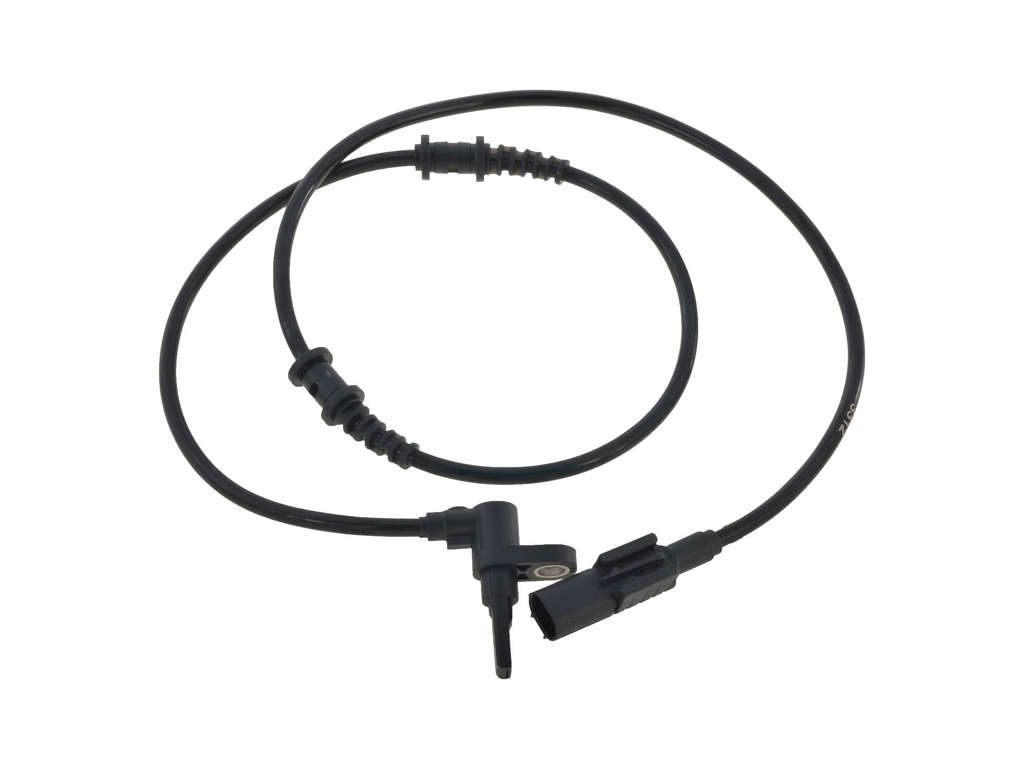
Code C0050 on a 2007-2018 Sprinter almost always points to a failed right rear ABS wheel speed sensor. The sensor itself is the most common failure point, often due to moisture damage, which prompted a recall (NHTSA 21V-042) for some 3500 models. Expect to pay $50-$150 for a new sensor, and it's a DIY-friendly job for those with basic tools, though the sensor can seize in the hub.
- C0050 on a Freightliner Sprinter means there is a problem with the right rear wheel speed sensor circuit, which will disable your ABS and ESP systems.
- The most likely culprit is the wheel speed sensor itself, which is known to fail from moisture intrusion. A replacement part is relatively inexpensive.
- Before replacing parts, always check the wiring and connector for visible damage or corrosion, as this is a common and cheaper fix.
- Use a scan tool that can display live data to confirm that the right rear wheel is not reporting speed correctly before starting repairs.
What's Unique About the 2007-2018 Freightliner Sprinter
On the NCV3 generation Sprinter (2007-2018), the wheel speed sensors are a known weak point, particularly susceptible to failure from moisture and corrosion. The issue is common enough that a federal investigation was launched, leading to recall NHTSA 21V-042 for some 2012-2018 3500 models, especially those upfitted as RVs which may sit for long periods, allowing moisture to intrude. The official remedy is a replacement sensor with improved robustness against moisture. While wiring or hub issues can occur, the sensor itself is the primary suspect on this specific van.
Generation note: The 2007-2018 model years cover the second generation of the Sprinter, commonly known as the NCV3 (New Concept Van 3). While sold under Dodge, Freightliner, and Mercedes-Benz brands, the underlying platform and its components are the same for this code.
Symptoms You May Notice
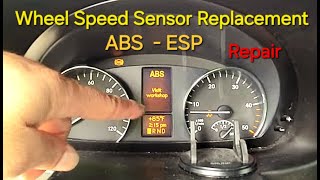
- ABS warning light is on
- ESP (Electronic Stability Program) or Traction Control (ASR) warning light is on
- Cruise control is disabled
- The vehicle may feel like it has normal braking under regular conditions, but ABS will not activate in an emergency stop
- In some cases, owners have reported erratic shifting or acceleration as the vehicle enters a failsafe mode
- Replacing the ABS module when the fault is in the wiring or the sensor itself.
- Replacing the wheel hub/bearing when the issue is just a simple wiring fault or a failed sensor.
- Not checking for a broken wire right at the sensor connector before ordering parts.
Most Likely Causes
- Failed Right Rear Wheel Speed Sensor 🔴 High Probability → Shop ABS Wheel Speed Sensor The sensors are exposed to the elements and are a known failure point on this platform, often due to moisture intrusion or internal failure. This is the subject of NHTSA recall 21V-042. The plastic body of the sensor also tends to seize in the metal hub due to corrosion, making removal very difficult.
How to confirm: Use a scan tool capable of reading live ABS data. Drive the vehicle and observe the wheel speed readings. A faulty sensor will typically read 0 mph or show an erratic, jumpy signal compared to the other three wheels.
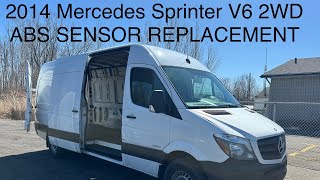
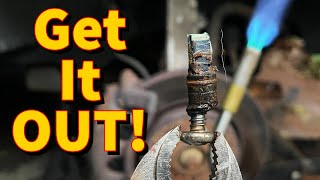
Typical fix: Replace the right rear wheel speed sensor. 🎬 Watch: Step-by-step rear ABS sensor replacement on a Sprinter The seized sensor may need to be drilled out, requiring care to avoid damaging the hub or encoder ring. 🎬 See how to safely remove a stuck or broken sensor
Est. part cost: $50-$150 - Damaged or Corroded Wiring/Connector 🟡 Medium Probability The wiring harness runs down to the wheel hub and is susceptible to damage from road debris, corrosion from salt and water, or becoming brittle over time. Wires can break right at the connector where they are most stressed.
How to confirm: Visually inspect the wiring harness from the sensor up into the wheel well. Look for chafed wires, melted insulation, or green/white corrosion inside the connector. Perform a continuity or resistance test on the wires between the sensor connector and the ABS module if no visible damage is found.
Typical fix: Repair the damaged section of wire with solder and heat shrink, or replace the pigtail connector if available. In some cases, replacing the rear harness section is the most reliable fix.
Est. part cost: $15-$40 - Dirty or Damaged Magnetic Encoder Ring ⚪ Low Probability The encoder ring, which is part of the wheel hub/bearing assembly, can accumulate metallic debris or rust, obscuring the signal. It can also be damaged during other repairs like axle or bearing work.
How to confirm: Remove the wheel speed sensor. Use a flashlight to look into the sensor mounting hole and slowly rotate the wheel. Look for heavy rust, caked-on debris, or any cracks/damage to the ring. Do not use a magnet to clean the ring as it can demagnetize it.
Typical fix: Attempt to clean the ring carefully with a soft brush and brake cleaner. If the ring is cracked or damaged, the entire wheel hub and bearing assembly must be replaced.
Est. part cost: $150-$300 for a hub assembly
Rare But Worth Checking
- Failed ABS Control Module: → Shop ABS Control Module This is rare and should only be considered after all other possibilities (sensor, wiring, hub) have been definitively ruled out. A faulty module will typically trigger multiple wheel speed sensor codes or other internal error codes, not just C0050 alone.
Diagnosis Steps
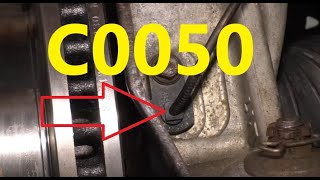
- Connect a diagnostic scanner capable of reading ABS codes. Confirm C0050 is present and note any other codes or symptom bytes (e.g., 18, 5A, 0F). 🎬 Watch: Understanding C0050 diagnostic codes and common fixes
- Access the live data stream for the ABS module.
- Graph the outputs of all four wheel speed sensors.
- Safely drive the vehicle in a straight line above 10 mph. Observe the readings. The right rear sensor will likely read 0 mph, be erratic, or lag significantly behind the others.
- If the signal is bad, raise and secure the rear of the vehicle. Remove the right rear wheel.
- Visually inspect the wheel speed sensor and its wiring harness for any obvious damage, corrosion, or loose connections, paying close attention to the area where the wire enters the connector.
- If no damage is visible, remove the sensor. This may be difficult if it is seized. Inspect the sensor tip and the magnetic encoder ring inside the hub for metallic debris or damage. Clean as necessary with a non-magnetic tool.
- If the sensor, wiring, and ring appear visually okay, the most probable cause is an internal failure of the sensor. Replace the right rear wheel speed sensor.
- Clear the fault codes and perform another road test while monitoring live data to confirm the repair was successful.
Parts You'll Likely Need
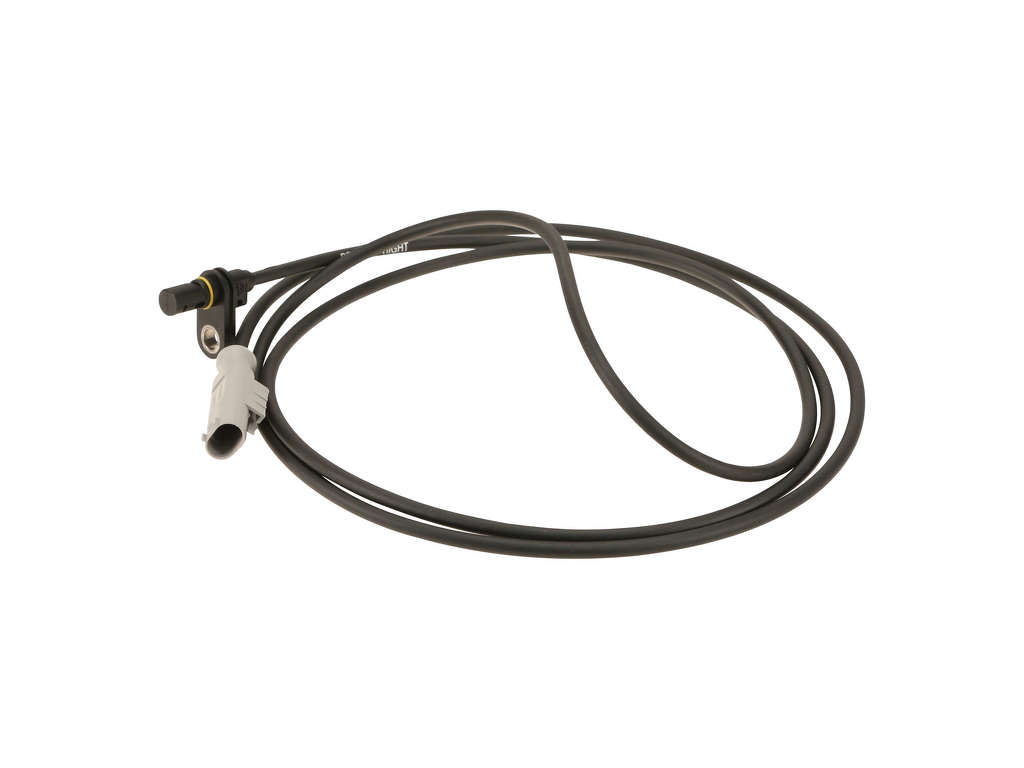
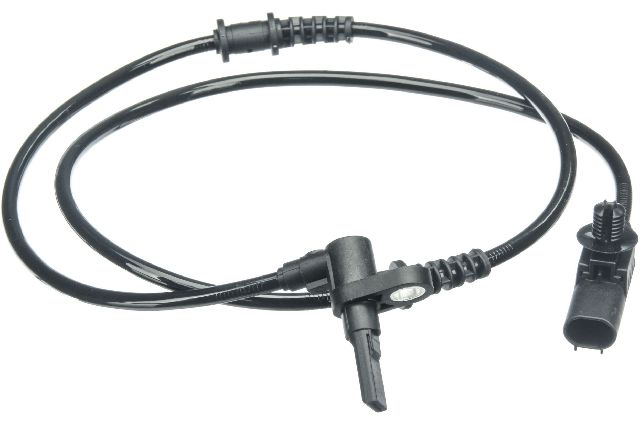
- Right Rear ABS Wheel Speed Sensor
(OEM #A9069050901 (superseded by A9069053601))— This is the most common failure component for code C0050 on this platform, often failing due to age and moisture exposure. The original part was superseded by an improved version as part of a recall.
Trusted brands: Bosch, ATE, Delphi, Standard Motor Products
OEM price range: $100-$180
Aftermarket price range: $50-$120
Related Codes That Often Appear With This One
- C0050 18 —
- C0050 5A —
- C0050 0F —
- U140C —
Platform-Specific Known Issues
- NHTSA Recall 21V-042 (Mercedes-Benz campaign #2021070007) was issued for certain 2012-2018 Sprinter 3500 models for a rear wheel speed sensor issue that could lead to unintended ESP activation or deactivation. The cause was identified as moisture intrusion into the sensor, and the fix is a replacement with a more robust part.
- Sensors are notoriously difficult to remove due to galvanic corrosion, seizing the plastic sensor body inside the metal hub. Owners often report having to drill out the old sensor in pieces.
Documented NHTSA Reports
While C0050 is a common Sprinter fault, it is important to note that this code can have different meanings on other vehicle platforms. For example, NHTSA ODI #10763888 describes a case where a Chevrolet HHR was diagnosed with C0050, identifying a faulty power steering control module (PSCM) rather than a wheel speed sensor. Similarly, on some Jeep platforms, an owner reported in NHTSA ODI #11649367 that C0050 was set after brake service, suggesting the code was triggered by the extra brake fluid required to return the caliper piston to the pad. Another Jeep report, NHTSA ODI #11693418, noted C0050-00 appearing alongside the need to replace rotors, pads, and adapter plates. Furthermore, NHTSA ODI #11228687 shows C0050 appearing on a Chevrolet Silverado 1500 in conjunction with several other communication and sensor codes (C0035, C0040, U0077, etc.).
Mechanic-Grade Diagnostic Values
- Wheel Speed Sensor Power Supply Voltage — expected: Approximately 12V (battery voltage) at the sensor connector with key on.. Failure: A reading of less than 7.6V indicates a fault in the power supply from the ABS module or wiring.
- Harness Continuity Check (at ABS module connector) — expected: Less than 1.0 ohm between specified pins for the right rear sensor.. Failure: Resistance greater than 1.0 ohm indicates high resistance or an open circuit in the harness.
- Active Wheel Speed Sensor Output Signal (Current) — expected: A standardized square-wave output signal switching between 7mA and 14mA.. Failure: A flat or non-switching signal indicates a failed sensor.
- Passive Wheel Speed Sensor AC Voltage Output — expected: 0.5 - 2.0 VAC when spinning the wheel at a steady speed.. Failure: No AC voltage or very low voltage suggests a failed sensor or excessive air gap.
Hidden / Shadow Codes Worth Checking
- C0050 00: General circuit malfunction. This often points to an open circuit, short to ground, or high resistance in the wiring harness. (see via Professional scan tools like Mercedes XENTRY or high-end Snap-on/Autel scanners.)
- C0050 18: Low signal amplitude. This indicates the signal from the sensor is weak or erratic, often caused by a failing sensor, excessive air gap, or debris on the magnetic ring. (see via Professional scan tools like Mercedes XENTRY or high-end Snap-on/Autel scanners.)
- C0050 5A: Signal not plausible. The sensor signal is illogical compared to other wheel speed sensors, often due to a damaged tone ring or incompatible sensor. (see via Professional scan tools like Mercedes XENTRY or high-end Snap-on/Autel scanners.)
Scan Tool Commands That Help
- Mercedes XENTRY, iCarsoft CR Max, Autel MaxiCOM: Live Data Graphing for all four wheel speed sensors. — This is the primary diagnostic step. While driving, a faulty sensor circuit will show a reading of 0 mph or an erratic signal compared to the other three functioning sensors.
- Mercedes XENTRY or equivalent professional scanner: Read Fault Codes from A207 ESP Control Module. — To retrieve the C0050 code and any associated symptom bytes (sub-codes) that can help pinpoint the exact nature of the electrical fault (e.g., open circuit, low amplitude).
Wiring & Ground Locations
- Factory Ground Point (Driver's Seat) — Under the driver's seat pedestal. There are two M6 ground studs available for body builder connections.. The main ABS/ESP module is often grounded nearby. A poor ground connection at this location can cause various difficult-to-diagnose electrical issues, including intermittent sensor faults.
- Factory Ground Point (Frame) — Under the floor on the vehicle frame, sometimes near the rear axle area.. This is a primary chassis ground. Corrosion or looseness at this point can affect the entire vehicle's electrical system, including the ABS module's reference ground, potentially leading to fault codes.
- ABS Module Connector — On the ABS hydraulic unit/control module, typically located in the engine bay on the driver's side.. This is the termination point for the wheel speed sensor harness. Testing for continuity and voltage should be done here to confirm if a wiring fault exists between the sensor and the module. A user on Reddit reported difficulty finding the correct 38-pin diagram for a 2016 model, indicating potential variations.
Real Owner Repair Stories
- Sprinter-Source.com forum user 'Midwestdrifter' (2004 T1N Sprinter (Note: While a T1N, the diagnostic principle is identical for NCV3)) — ABS/ESP light on, wheel speed sensor code present.
❌ Tried (didn't work) Replacing the wheel speed sensor.
✅ What actually fixed it The user noted that if a new sensor and good wiring don't fix the issue, the next step is to inspect the tone ring for excessive runout (wobble) or damage, and to check the air gap. In another context, the user had the rear axle apart for bearings, which is when the tone ring is accessible. This implies a damaged or improperly seated tone ring from previous work can be a root cause.
OEM Part Supersession History
A9069050901→A9069053601— Improved design for better resistance to moisture intrusion, which was the cause of the failures leading to NHTSA recall 21V-042.
Heads up: The original part number A9069050901 was also superseded by 9065404217 before the final A9069053601 part was released. All are physically compatible, but A9069053601 is the most current and robust version.9069050601→906-905-33-01— Part number update for the FRONT wheel speed sensor. Included for clarification as it can be confused with the rear.
Heads up: This is for the front axle only and will not fit the rear.
Diagnostic Flowchart
Other Known Issues on This Vehicle
Issues unrelated to this code that are worth knowing about as an owner of this generation:
- Injector Seal Leak ('Black Death') 🔴 High — Common on the OM642 V6 diesel engine, especially over 100,000 miles. Caused by failure of the copper injector seals, leading to a hard, tar-like carbon buildup around the injectors.
- Diesel Particulate Filter (DPF) Clogging 🟠 Medium — Very common, particularly for vans used for short trips or with extended idle time, which prevents the DPF from reaching temperatures needed for regeneration. Onset can be as early as 100,000 miles.
- Transmission 'Rumble Strip' Noise 🟠 Medium — A shudder or vibration felt between 1500-2500 RPM, often caused by wear in the torque converter lock-up clutch. Can occur at various mileages.
- Oil Cooler Seal Leaks 🔴 High — A known issue on the OM642 V6 engine where the oil cooler seals, located deep in the engine valley, degrade and leak oil. This is a labor-intensive and costly repair. Often occurs after 120,000 miles.
- Turbo Resonator & Intercooler Hose Leaks 🟠 Medium — The plastic turbo resonator is known to crack, and rubber intercooler hoses can split, causing a loss of boost pressure, reduced power, and a loud whooshing sound under acceleration.
- Body Rust 🟠 Medium — NCV3 Sprinters are known for rust issues, particularly around seam sealers, wheel arches, and rocker panels, especially in regions with road salt.
Used vs. New Parts: Buying Guide for This Vehicle
When a used part is the smart pick: A used wiring harness pigtail can be a good value if the connector is in excellent condition with no corrosion and a few inches of flexible wire. A used wheel hub/bearing assembly from a low-mileage, non-salt-belt donor can be a cost-effective fix if the tone ring is the confirmed point of failure.
Donor-vehicle mileage cap: roughly under 60000 miles for the part to have meaningful remaining life.
What to inspect on the donor part:
- For a hub: Spin the bearing by hand to feel for any roughness or grinding.
- For a hub: Visually inspect the magnetic encoder ring for any cracks, chips, or heavy rust.
- For a wiring pigtail: Check that the connector's locking tab is intact and not brittle.
- For a wiring pigtail: Inspect the pins for any green or white corrosion.
OEM-only on this vehicle (don't cheap out):
- ABS Wheel Speed Sensor: Given the known high failure rate of the original design and the subsequent recall, using a cheap, unbranded aftermarket sensor is a significant risk. It may fail quickly or be dead-on-arrival. Stick to the latest OEM part (A9069053601) or a trusted OEM supplier.
- ABS Control Module: Due to the critical safety function and potential need for programming, a new OEM or professionally remanufactured unit is strongly recommended over a used one.
Aftermarket brands forum-validated for this vehicle:
- Bosch (often the OEM supplier)
- ATE
- Delphi
- Standard Motor Products (SMP)
Brands owners have reported issues with on this vehicle:
- Unbranded, generic sensors from online marketplaces are frequently reported by mechanics to have high DOA (dead on arrival) rates or premature failure.
Real Owner Stories
Aggregated from forums and TSBs cited above. Mileages and costs reflect what owners reported in those sources.
2012-2018 Sprinter 3500
Symptoms: ABS three stooges lamps (ABS, ESP, and Traction Control) and check engine light were on. Two aftermarket sensors failed to fix the problem.
What fixed it: Replacement with a Mercedes OEM (right rear) speed sensor.
Source hint: r/Sprinters
2012-2018 Sprinter 3500 RV Conversion
Symptoms: Unintended ESP activation or deactivation due to moisture intrusion in the rear sensor.
What fixed it: Replacement of the sensor with a more robust part under NHTSA recall 21V-042.
Source hint: sprinter-source.com: 'Wheel Speed Sensor and NHTSA'
Related OBD-II Codes
Frequently Asked Questions
Is there a recall for the rear wheel speed sensors on my 2012-2018 Sprinter 3500?
Why did my cruise control stop working along with the ABS light?
I've tried two aftermarket sensors for C0050 and the light is still on. What should I do?
Why is it so difficult to remove the old sensor from the hub?
Can I use a magnet to clean the area inside the hub while the sensor is out?
Does this C0050 issue affect the Dodge-branded Sprinters as well?
Helpful Videos
We Have This Part in Stock


The information in this article is provided for general reference and educational purposes only. Vehicle specifications, procedures, and part compatibility can vary by production date, trim level, and region. Always consult your vehicle's factory service manual and verify part numbers before purchasing or performing repairs. Safety-critical components such as airbags, seat belts, and braking systems should be installed by a qualified professional.
- Freightliner Sprinter:
- 🧭 Diagnostic Flowchart
- 🎬 Helpful Videos
- 🛍️ Shop This Part
- What's Unique About the 2007-2018 Freightliner Sprinter
- Symptoms You May Notice
- Most Likely Causes
- Rare But Worth Checking
- Diagnosis Steps
- Parts You'll Likely Need
- Related Codes That Often Appear With This One
- Platform-Specific Known Issues
- Documented NHTSA Reports
- Mechanic-Grade Diagnostic Values
- Hidden / Shadow Codes Worth Checking
- Scan Tool Commands That Help
- Wiring & Ground Locations
- Real Owner Repair Stories
- OEM Part Supersession History
- Other Known Issues on This Vehicle
- Used vs. New Parts: Buying Guide for This Vehicle
- Real Owner Stories
- 2012-2018 Sprinter 3500
- 2012-2018 Sprinter 3500 RV Conversion
- Related OBD-II Codes
- Frequently Asked Questions
- 🎟️ Get 5% Off