

C0050 on 2011-2017 Honda Odyssey: Right Rear Wheel Speed Sensor Fault Causes and Fixes
Code C0050 on a 2011-2017 Honda Odyssey means there is a fault in the right rear wheel speed sensor circuit. This will disable your ABS and VSA systems. The most common fix is replacing the faulty right rear wheel speed sensor, which costs about $35-$75 for an aftermarket part. Verifying the fault with a scanner and checking wiring first is crucial.
- Code C0050 on your 2011-2017 Odyssey means your ABS and VSA safety systems are offline due to a fault with the right rear wheel speed sensor.
- The most likely cause is a failed sensor itself, which is a relatively inexpensive part and a manageable DIY repair for those with basic tools.
- Before buying parts, always inspect the sensor's wiring and connector for visible damage or corrosion, as this is another common cause.
- Use an ABS-capable scan tool to confirm the fault is with the right rear wheel before starting any repairs to save time and money.
- Be prepared for the old sensor to be seized in the knuckle; use penetrating oil and be patient to avoid breaking it.
What's Unique About the 2011-2017 Honda Odyssey
For the fourth-generation Honda Odyssey (2011-2017), the C0050 code is a straightforward chassis fault. The ABS and VSA systems are interconnected, so a fault in one sensor will disable both, illuminating their respective warning lights on the dashboard. While there were no major recalls for this specific issue on the 2011-2017 models, the repair is very common. The sensor often seizes in the steering knuckle due to corrosion, making removal difficult. The fix is almost always related to the sensor, its wiring, or the magnetic ring on the wheel hub.
Symptoms You May Notice
- ABS warning light is on
- VSA (Vehicle Stability Assist) warning light is on
- Brake system warning light may be on
- ABS and VSA systems are inoperative
- Traction control light may be on
- Replacing the wrong wheel speed sensor due to not using a scan tool to confirm the fault location.
- Replacing the ABS/VSA module when the actual problem is a simple wiring or sensor issue.
- Replacing the wheel hub/bearing when the issue was only debris on the magnetic ring.
Most Likely Causes
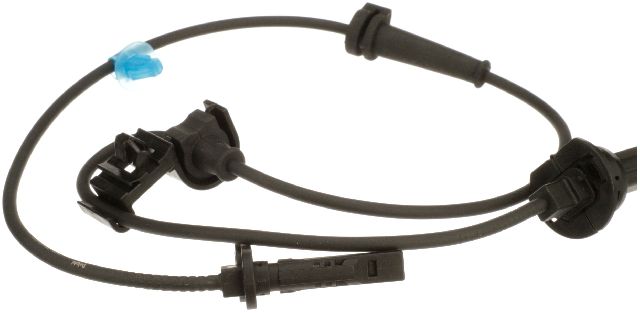
- Failed Right Rear Wheel Speed Sensor 🔴 High Probability → Shop ABS Wheel Speed Sensor The sensor is exposed to harsh conditions behind the wheel, including water, road salt, and vibrations, which can lead to internal failure over time. Corrosion can also cause the sensor to seize in its bore, making replacement difficult.
How to confirm: Use an ABS-capable scan tool to monitor live data. The right rear wheel speed sensor will read 0 MPH or show an erratic signal while the other three sensors report speed correctly. You can also test the sensor's internal resistance with a multimeter; an open or out-of-spec reading (typically should be 700-1100 ohms) confirms failure.
Typical fix: Replace the right rear wheel speed sensor. The sensor is held in by a single 10mm bolt. Soaking the sensor and bolt with penetrating oil before removal is highly recommended.
Est. part cost: $35-$75 - Damaged Wiring or Connector 🟡 Medium Probability The wiring harness runs along the suspension and can be damaged by road debris, improper jacking, or corrosion building up inside the connector pins. The damage is often found within a few inches of the sensor connector.
How to confirm: Visually inspect the entire length of the wiring from the sensor to where it enters the vehicle body. Check for frayed wires, chafing, or green/white corrosion on the connector pins. Perform a continuity test on the wires between the sensor connector and the ABS module connector.
Typical fix: Repair the damaged section of wire with solder and heat shrink tubing, or replace the connector pigtail if it is corroded.
Est. part cost: $15-$40 - Debris on Magnetic Encoder Ring ⚪ Low Probability The wheel bearing has an integrated magnetic ring that the sensor reads. Metallic dust from brakes and road grime can accumulate on this ring, disrupting the magnetic signal.
How to confirm: Remove the wheel speed sensor and use a flashlight and a small mirror to inspect the magnetic ring on the back of the wheel hub assembly. Look for a build-up of metallic shavings or heavy rust.
Typical fix: Carefully clean the magnetic ring with a soft brush, a rag, or compressed air. Avoid using harsh tools that could damage the ring's surface.
Est. part cost: $0
Rare But Worth Checking
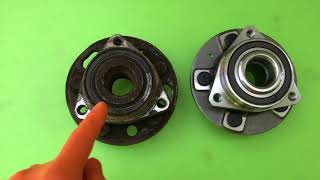
- Damaged Wheel Hub / Bearing Assembly: → Shop Hub Assembly The magnetic encoder ring is part of the wheel hub assembly. If the ring is cracked or the bearing has excessive play, it can cause an erratic signal. This is usually accompanied by a grinding or humming noise from the rear of the vehicle while driving that changes with speed. 🎬 Watch this guide on replacing the rear wheel hub assembly.
- Faulty ABS/VSA Control Module: This is very rare. The module is the computer that processes all the sensor inputs. A failure here would typically set multiple wheel speed sensor codes or other communication faults, not just C0050.
Diagnosis Steps
- Connect an ABS-capable scan tool to the OBD-II port.
- Confirm that C0050 is the active code. Note any other codes present.
- Access the live data stream for the ABS system.
- Monitor the speeds of all four wheels while driving the vehicle slowly (above 5 mph) in a straight line. Confirm that the Right Rear (RR) sensor reads 0 or shows a signal that is erratic compared to the other three.
- Raise and safely support the rear of the vehicle. Remove the right rear wheel.
- Visually inspect the wheel speed sensor and its wiring harness for any obvious signs of damage, such as cracks, fraying, or melting.
- Disconnect the sensor and inspect the electrical connector for corrosion or bent pins.
- Spray the sensor's mounting bolt and the body of the sensor with penetrating oil and let it soak to ease removal.
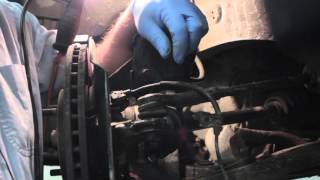
- Remove the sensor's 10mm retaining bolt and carefully try to pull the sensor out of the steering knuckle. It may be stuck; gently twisting it with pliers can help break it free. If it breaks, the remaining piece will need to be carefully drilled and extracted.
- Inspect the magnetic encoder ring on the wheel hub for metallic debris or physical damage. Clean as necessary.
- If no visual faults are found, use a multimeter to test the old sensor's resistance. Compare it to the specification (often in the 700-1100 ohm range). If the reading is infinite (open) or zero (shorted), the sensor is bad.
- If the sensor tests good, check for power and ground at the vehicle-side harness connector.
Parts You'll Likely Need
- Right Rear ABS Wheel Speed Sensor
(OEM #57470-TK8-A01)— This is the most common failure point for the C0050 code, as the sensor is a sensitive electronic component exposed to the elements.
Trusted brands: Honda (OEM), NTK (NGK) - Part# AB2021, Standard Motor Products (SMP) - Part# ALS2590, Dorman
OEM price range: $60-$90
Aftermarket price range: $35-$75
Technical Service Bulletins (TSBs) & Recalls
- While no TSBs directly address code C0050, several are critical for owners of this platform:
- TSB 11-033: Addresses engine oil consumption and related DTCs P3400/P3497 by updating PCM software to change VCM engagement.
- TSB 13-081: Warranty extension for 2011-2013 models for piston ring replacement due to VCM-induced oil consumption and spark plug fouling.
- TSB 17-043 / 17-044: Addresses torque converter judder in 2014-2017 models with a software update and transmission fluid flush procedure.
Platform-Specific Known Issues
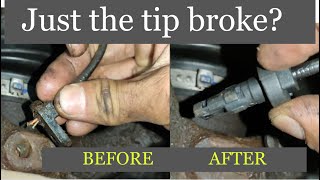
- Seized Sensor Removal: Owners on forums like OdyClub and Honda-Tech frequently report that the rear speed sensor becomes seized in the knuckle due to rust and corrosion. Successfully removing it often requires extensive soaking with penetrating oil, careful twisting with pliers, and in many cases, drilling out the old plastic sensor body after it breaks off during removal. 🎬 See how to handle a rusted sensor that breaks off.
- Aftermarket Sensor Quality: While many aftermarket sensors work well, some owner experiences suggest that very cheap, unbranded sensors can be dead-on-arrival or fail prematurely. Sticking with OEM or a reputable OE-supplier like NTK is often recommended for longevity.
Documented NHTSA Reports
While C0050 is a wheel speed sensor fault on the Honda Odyssey, it is important to note that this code can have different meanings on other vehicle platforms. For example, NHTSA ODI #10763888 describes a case where C0050 identified a faulty power steering control module (PSCM) on a different make, requiring a steering column replacement. On other platforms, such as in NHTSA ODI #11228687, C0050 appeared alongside multiple other communication and sensor codes (C0035, C0040, U0077) during a stability system failure. Furthermore, NHTSA ODI #11649367 notes that C0050 can be triggered after brake service if the system detects issues returning caliper piston contact to the brake pad, while NHTSA ODI #11693418 reports the code appearing when rotors, pads, and adapter plates required replacement.
Mechanic-Grade Diagnostic Values
- Wheel Speed Sensor Resistance — expected: 1000-1500 Ohms is a general expected range. More importantly, the resistance should be very close to the reading from the sensor on the opposite side (Left Rear).. Failure: An open circuit (infinite resistance), a short (near zero resistance), or a value significantly different from the opposing sensor indicates failure.
- Sensor Harness Connector Voltage (Key On, Engine Off) — expected: Using a multimeter set to DC volts, probe the two pins on the vehicle's harness connector. You should see two slightly different voltage readings (e.g., 3.25V and 3.22V).. Failure: If you get no voltage, the problem is upstream in the wiring or the ABS module. If both pins read the exact same voltage, it may indicate a short in the wiring harness.
- AC Voltage Output (while spinning wheel) — expected: For passive 2-wire sensors, setting a multimeter to AC Volts and connecting to the sensor's pins should produce a fluctuating voltage of approximately 50-700mV as the wheel is spun by hand.. Failure: No AC voltage signal or a very weak signal while the wheel is spinning points to a failed sensor.
Hidden / Shadow Codes Worth Checking
- C0050 00: General circuit malfunction. This suggests an open circuit, short to ground, or high resistance in the sensor circuit. (see via Honda HDS (Honda Diagnostic System) or other professional-grade scan tool capable of reading manufacturer-specific codes.)
- C0050 5A: Signal not plausible. The module is receiving a signal, but it doesn't make sense compared to the other wheel speed sensors (e.g., one wheel reading 30 MPH while others read 5 MPH). (see via Honda HDS or other professional-grade scan tool.)
- C0050 18: Signal amplitude less than minimum. This indicates a weak or erratic signal, often caused by an excessive air gap, debris, or a failing sensor. (see via Honda HDS or other professional-grade scan tool.)
Scan Tool Commands That Help
- Honda HDS (or equivalent): VSA Sensor Neutral Position Memorization — This procedure is mandatory after replacing the VSA modulator/ABS pump assembly. It calibrates the yaw rate and lateral acceleration sensors. Failure to perform this will result in other VSA-related codes and improper system function.
- Scan Tool with Live Data + Signal Generator: Circuit Integrity Test via Signal Injection — This advanced technique is used when you suspect a wiring or module issue. Disconnect the sensor, inject a known-good signal (e.g., a 500 Hz sine wave) into the vehicle-side harness with a signal generator, and watch the live data on the scan tool. If the scan tool shows a corresponding wheel speed, the wiring and ABS module are confirmed to be good, definitively isolating the fault to the sensor or tone ring.
Wiring & Ground Locations
- VSA Modulator Connector — The VSA modulator is located in the engine bay, typically on the driver's side, with brake lines running into and out of it. It has a large, multi-pin electrical connector (e.g., 46-pin).. The two wires from the right rear wheel speed sensor terminate at specific pins in this connector. Testing for continuity and voltage should be done here if a wiring fault is suspected between the wheel and the module.
- G401 / G402 — These are chassis ground points. Wiring diagrams show them located in the center console area, near the Electric Parking Brake switch and VSA OFF switch.. While not the primary ground for the sensor circuit itself, a poor ground connection for related switches or the VSA module can cause erratic behavior and communication issues within the stability system.
Real Owner Repair Stories
- YouTube channel 'Haze Mobile Auto Repair' (Chevrolet Malibu (demonstrates a common failure pattern applicable to many vehicles)) — Intermittent stability track light, code C0050 with an 'erratic signal' descriptor.
❌ Tried (didn't work) Replacing the wheel speed sensor did not fix the problem.
✅ What actually fixed it The problem was a damaged magnetic encoder ring on the wheel hub/bearing assembly. Several pieces of the magnetic ring were missing, causing the erratic signal. Replacing the entire wheel hub assembly resolved the code. - Mitchell1 SureTrack Community Fix (2014 Chevrolet Tahoe (demonstrates an edge-case diagnosis)) — ABS light on, code C0050.
❌ Tried (didn't work) Visual inspection of wiring and connector showed no faults., Testing the sensor with a lab scope showed no signal.
✅ What actually fixed it A multimeter test revealed no 12V supply voltage at the sensor connector. Probing the ABS module connector confirmed the module itself was not sending voltage out on that circuit. The final fix was replacing both the faulty ABS module and the wheel speed sensor.
OEM Part Supersession History
57470-TK8-A01→57470-TK8-A01— No supersession found. This part number appears to be consistent for the entire 2011-2017 generation.
Heads up: The sensor for the next generation (2018+, RL6) Odyssey is a different part number (e.g., 57455-THR-A01) and is not compatible.
Model Year Variations Within This Range
- 2011-2015: A software issue can cause false VSA warning lights and set codes like 81-1 or 61-1 due to sensitivity to low voltage. Honda TSB 16-005 addresses this with a VSA modulator software update, which may be required instead of hardware replacement.
- 2011-2013: The VSA modulator assembly itself has different part numbers for lower trims (LX, EX, EX-L) versus higher trims (Touring, Touring Elite). While this doesn't affect the C0050 sensor directly, it's critical information if the entire module is suspected to be faulty.
Diagnostic Flowchart
Other Known Issues on This Vehicle
Issues unrelated to this code that are worth knowing about as an owner of this generation:
- Variable Cylinder Management (VCM) Oil Consumption & Fouled Plugs 🔴 High — Very common, particularly on 2011-2013 models. Can lead to misfire codes (P0301-P0304) and catalytic converter damage. (Ref: TSB 11-033 (software update to alter VCM logic), TSB 13-081 (warranty extension for piston ring repair).)
- Automatic Transmission Torque Converter Judder/Shudder 🟠 Medium — Common on 2014-2017 models, typically felt between 20-60 mph under light throttle. (Ref: TSB 17-043, TSB 17-044. Fix involves a PCM software update and potentially multiple transmission fluid drain-and-fills.)
- Power Sliding Door Failures 🟠 Medium — Widespread across the generation. Caused by failing motors, frayed cables, or bad rollers, preventing doors from opening or closing properly. (Ref: Multiple dealer messages and a recall for some model years where the door could open while driving.)
- Premature Front Lower Control Arm Bushing Wear 🟠 Medium — The large rear 'compliance' bushing on the front lower control arm is known to tear, causing clunking noises over bumps and alignment issues.
- Spool Valve (VTEC) Oil Leak 🟡 Low — A common oil leak from the VTEC spool valve assembly, located near the alternator. If left unchecked, the leaking oil can drip onto and destroy the alternator.
Used vs. New Parts: Buying Guide for This Vehicle
When a used part is the smart pick: A used wiring harness pigtail from a junkyard is a smart choice if only your connector is damaged. A complete used VSA modulator assembly can be a cost-effective option, but it is critical to know it will require a 'VSA Sensor Neutral Position Memorization' procedure with a professional scan tool to function.
Donor-vehicle mileage cap: roughly under 80000 miles for the part to have meaningful remaining life.
What to inspect on the donor part:
- For wiring, ensure there are no cuts, brittleness, or corrosion on the connector pins.
- For a VSA module, check for any physical damage to the housing or connector block.
- For a wheel hub, check for excessive rust on the magnetic encoder ring and ensure the bearing spins smoothly with no play.
OEM-only on this vehicle (don't cheap out):
- ABS/Wheel Speed Sensor
Aftermarket brands forum-validated for this vehicle:
- NTK (often the OE supplier for Honda)
- Standard Motor Products (SMP)
- Delphi
Brands owners have reported issues with on this vehicle:
- Unbranded, low-cost sensors from eBay or Amazon.
- Dorman and BWD (Broke When Delivered) are cited in forums as having a higher failure rate for electronic components like these.
Real Owner Stories
Aggregated from forums and TSBs cited above. Mileages and costs reflect what owners reported in those sources.
2015 Honda Odyssey
Symptoms: The owner noticed a transmission judder between 20-60 mph under light throttle and discussed missing the warranty window for the related software update.
What fixed it: A PCM software update that changes shift logic (per TSB 17-043).
Source hint: reddit.com/r/HondaOdyssey
2011-2017 Honda Odyssey
Symptoms: ABS, VSA, and Traction Control warning lights are all illuminated simultaneously.
What fixed it: Replacement of the right rear wheel speed sensor after confirming the old one was seized in the knuckle and required careful extraction.
Source hint: odyclub.com
2011-2017 Honda Odyssey
Symptoms: ABS/VSA lights on; the owner was advised to check the sensor and tone ring for debris.
What fixed it: Cleaning the sensor and magnetic tone ring (encoder ring) or replacing the sensor if resistance is outside the 700-1100 ohms range.
Source hint: honda-tech.com - A thread titled 'Replacing right rear ABS wheel sensor'
Related OBD-II Codes
Frequently Asked Questions
My 2014 Odyssey has a transmission shudder; is there a TSB for this while I'm fixing my ABS light?
I'm seeing C0050 on my 2012 Odyssey along with oil consumption issues. Are these related?
Can I use a cheap aftermarket sensor to fix the C0050 code on my Odyssey?
The right rear sensor is stuck in the knuckle of my 2011 Odyssey. How should I remove it?
What is the correct resistance for a new right rear wheel speed sensor on a 2011-2017 Odyssey?
Helpful Videos


We Have This Part in Stock


The information in this article is provided for general reference and educational purposes only. Vehicle specifications, procedures, and part compatibility can vary by production date, trim level, and region. Always consult your vehicle's factory service manual and verify part numbers before purchasing or performing repairs. Safety-critical components such as airbags, seat belts, and braking systems should be installed by a qualified professional.
- Honda Odyssey:
- 🧭 Diagnostic Flowchart
- 🎬 Helpful Videos
- 🛍️ Shop This Part
- What's Unique About the 2011-2017 Honda Odyssey
- Symptoms You May Notice
- Most Likely Causes
- Rare But Worth Checking
- Diagnosis Steps
- Parts You'll Likely Need
- Technical Service Bulletins (TSBs) & Recalls
- Platform-Specific Known Issues
- Documented NHTSA Reports
- Mechanic-Grade Diagnostic Values
- Hidden / Shadow Codes Worth Checking
- Scan Tool Commands That Help
- Wiring & Ground Locations
- Real Owner Repair Stories
- OEM Part Supersession History
- Model Year Variations Within This Range
- Other Known Issues on This Vehicle
- Used vs. New Parts: Buying Guide for This Vehicle
- Real Owner Stories
- 2015 Honda Odyssey
- 2011-2017 Honda Odyssey
- 2011-2017 Honda Odyssey
- Related OBD-II Codes
- Frequently Asked Questions
- 🎟️ Get 5% Off