

C0050 on 2000-2002 Honda Passport: Right Rear Wheel Speed Sensor Circuit Fault Guide
This code indicates a fault with the right rear wheel speed sensor circuit, which will disable your ABS. The most common causes are a failed sensor or, more frequently on this platform, damaged wiring leading to the sensor. Expect to pay $40-$90 for a new sensor and 1-2 hours of labor for diagnosis and replacement.
- C0050 means your ABS is disabled due to a fault in the right rear wheel speed sensor circuit.
- This Honda Passport is an Isuzu Rodeo; its problems are Isuzu problems. The wiring harness to the rear sensor is a very common failure point and should be inspected carefully before buying parts.
- The most common fixes are repairing a broken wire in the harness or replacing the sensor itself.
What's Unique About the 2000-2002 Honda Passport
It is critical to know that the 2000-2002 Honda Passport is a rebadged Isuzu Rodeo. Its chassis, electronics, and ABS are all Isuzu-based, not Honda. Therefore, troubleshooting and parts are specific to the Isuzu platform. Forum discussions among Isuzu Rodeo owners frequently point to the wiring harness for the rear ABS sensors as a common failure point. The harness is often cited as being too short, causing it to stretch and break with suspension travel, or it chafes against the frame or rear differential, leading to an open or short circuit.
Symptoms You May Notice
- ABS warning light is illuminated on the dashboard
- Traction control or stability control light may also be on
- ABS system does not activate during hard braking (wheels may lock and skid)
- Possible pulsation or unusual behavior from the brake pedal at low speeds
- Replacing the wheel speed sensor without first thoroughly inspecting the wiring harness. On this specific vehicle, the wiring is a very common point of failure and is often overlooked.
Most Likely Causes
- Damaged or Corroded Wiring Harness 🔴 High Probability The wiring for the rear sensor is exposed and runs along the suspension. On the Isuzu Rodeo platform, this harness is a known weak point, susceptible to damage from road debris, moisture, and suspension movement. It often breaks internally near the connector or chafes on the frame above the rear axle. A specific bulletin for 1998-1999 models points to corrosion and fraying near the left upper link arm of the rear suspension, a problem area that likely persists into the 2000-2002 models.
How to confirm: Visually inspect the entire length of the wiring from the right rear wheel up to the main harness. Pay close attention to areas where it's secured to the frame or axle, especially where it flexes. Gently tug on the wires near connectors to check for internal breaks. Use a multimeter to check for continuity between the sensor connector and the ABS module connector.
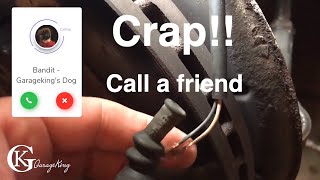
Typical fix: Repair the broken or corroded section of wire using solder and heat-shrink tubing. If the connector is damaged, it will need to be replaced with a new pigtail. Isuzu offered an updated, longer harness for earlier models to resolve this issue, which involved splicing in the new part. 🎬 Watch this guide on how to repair a damaged harness.
Est. part cost: $10-$30 - Failed Right Rear Wheel Speed Sensor 🔴 High Probability → Shop ABS Wheel Speed Sensor The sensor is located in a harsh environment behind the wheel, exposed to water, dirt, and vibrations, which can cause it to fail electronically over time.
How to confirm: Disconnect the sensor and measure its internal resistance with a multimeter. A good sensor on this platform should typically read between 1200 and 2700 ohms. A reading of 'OL' (open loop) or zero resistance indicates a failed sensor. A scan tool that can display live data will show the right rear wheel speed as zero or erratic while the other wheels show speed.
Typical fix: Unbolt the old sensor from the wheel hub/axle housing, clean the mounting surface, and install the new sensor.
Est. part cost: $40-$90 - Debris on or Damage to the ABS Tone Ring 🟡 Medium Probability
How to confirm: Visually inspect the toothed or magnetic ring that the sensor reads. It is located on the axle shaft. Look for heavy buildup of metallic debris (from brake dust), rust, or any broken/missing teeth on the ring.
Typical fix: Clean the tone ring thoroughly with a brake cleaner and a non-metallic brush. If the ring is cracked or part of the axle and is damaged, the axle will need replacement.
Est. part cost: $0 for cleaning, $150-$300+ for an axle shaft if required.
Rare But Worth Checking
- Faulty ABS Control Module: → Shop ABS Control Module This is the least likely cause. The module is the computer for the brake system. Before condemning the module, all other possibilities (sensor, wiring, tone ring) must be exhaustively ruled out.
Diagnosis Steps
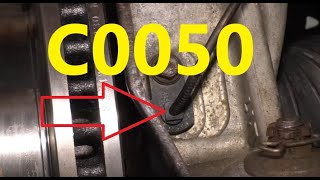
- Connect an OBD-II scanner capable of reading ABS codes to confirm C0050 is the active fault. 🎬 Watch: A breakdown of C0050 causes and common fixes. Alternatively, use the paperclip method: jumper pins 4 and 12 of the OBD-II connector, turn the ignition to 'ON', and count the flashes of the ABS light to read the two-digit code (Code 32 corresponds to a rear speed sensor fault).
- Use a scanner's live data function to monitor the speed of all four wheels while driving slowly in a straight line. Confirm that the right rear wheel speed reads 0 mph or is erratic compared to the other three.
- Raise and safely support the vehicle. Be aware of the potential for severe frame rust in the rear suspension area on these vehicles.
- Remove the right rear wheel.
- Perform a thorough visual inspection of the wheel speed sensor, its connector, and the entire wiring harness leading from it. Look for frayed wires, melted insulation, corrosion in the connector, or breaks where the harness flexes with the suspension, particularly near the left upper link arm.
- Inspect the ABS tone ring (reluctor ring) on the axle for heavy debris, rust, or physical damage.
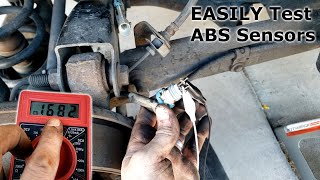
- If no visual faults are found, disconnect the sensor. Use a multimeter set to Ohms to test the resistance across the sensor's two pins. A healthy sensor should measure between 1200-2700 Ohms. An open circuit (OL) or short (near 0 Ohms) indicates a faulty sensor.
- With the sensor disconnected and the key on, check the harness-side connector for the AC voltage signal while spinning the wheel by hand. You should see a small, fluctuating AC voltage that increases with wheel speed (a minimum of 0.25V AC is a good target). Lack of a signal points 🎬 See how to test sensor resistance and AC voltage. to a wiring problem or a faulty module.
- If the sensor, wiring, and tone ring are all confirmed to be good, the final possibility is an internal fault in the ABS control module.
Parts You'll Likely Need
- Rear ABS Wheel Speed Sensor
(OEM #Isuzu: 8-97096-410-0; GM: 8970964100)— This sensor is the most commonly replaced part for this code, as it can fail electronically from age and exposure to the elements. Note that the left and right rear sensors are often the same part.
Trusted brands: Delphi (p/n ALS1297), Standard Motor Products (SMP) (p/n ALS1297), NTK (p/n VB0037), Beck/Arnley
OEM price range: $70-$120
Aftermarket price range: $40-$90 - ABS Sensor Connector Pigtail — If the wiring fault is corrosion or damage right at the connector, replacing the connector with a new pigtail is the most reliable repair.
Trusted brands: Dorman, Standard Motor Products (SMP)
OEM price range: $25-$40
Aftermarket price range: $15-$30
Technical Service Bulletins (TSBs) & Recalls
- Honda Recall R10-071 / NHTSA Campaign 10V626000: Addresses severe frame corrosion on 1998-2002 Passports in salt-belt states, specifically where the rear suspension lower link bracket attaches to the frame. While not directly for the C0050 code, it highlights a critical safety issue in the exact physical location where the ABS sensor and wiring are located.
- Brake Parts Inc Bulletin BPI 04-08: While for 1998-1999 models, this bulletin details a known issue of the rear speed sensor harness corroding or fraying near the left upper link arm, requiring a repair kit (Isuzu P/N 8-97233-422-0). This issue is highly relevant to the 2000-2002 models.
Platform-Specific Known Issues
- The wiring harness for the rear ABS sensors on the Isuzu Rodeo/Honda Passport platform is a known weak point. The original harness was sometimes too short, causing stress and breakage over time with normal suspension travel.
- A major recall (NHTSA 10V626000) was issued for severe frame corrosion in the rear suspension area. Any diagnostic work in this area should include a thorough inspection of the frame for safety, as the lower link bracket can detach from the frame.
Documented NHTSA Reports
While the C0050 code on the Honda Passport platform is almost exclusively related to the rear wheel speed sensor circuit, it is important to note how other manufacturers define this code. For example, NHTSA ODI #10763888 describes a case where a technician identified C0050 as a faulty power steering control module (PSCM) on a different make. Additionally, NHTSA ODI #11228687 shows C0050 appearing alongside multiple other communication and sensor codes (C0035, C0040, U0077) following suspension-related issues on a different vehicle platform. In some modern brake-by-wire systems, an owner reported in NHTSA ODI #11649367 that C0050 was set after a service required extra brake fluid to return caliper piston contact to the brake pad, while NHTSA ODI #11693418 notes the code appearing when rear rotors, pads, and adapter plates required replacement.
Mechanic-Grade Diagnostic Values
- Rear Wheel Speed Sensor Resistance — expected: 1200 - 2700 Ohms. Failure: A reading of 'OL' (open loop/infinite resistance) or near zero Ohms indicates a failed sensor.
- Rear Wheel Speed Sensor AC Voltage Output — expected: Greater than 0.25 Volts AC. Failure: Voltage below 0.25V AC while spinning the wheel by hand (at least 0.5 rev/sec) indicates a faulty sensor or excessive air gap.
Hidden / Shadow Codes Worth Checking
- Flash Code 32: Corresponds to a rear wheel speed sensor circuit fault (C0267/C0268), which is the pre-OBDII equivalent of C0050 on this system. It indicates an open motor circuit or stalled motor. (see via Without a scanner, by jumping pins 4 and 12 on the Data Link Connector (DLC) with a paperclip or jumper wire, turning the ignition to 'ON', and counting the flashes of the ABS warning light. The light will flash three times for the first digit, pause, then twice for the second digit.)
Wiring & Ground Locations
- ABS Fuse #18 — In the fuse/relay box on the right side of the engine compartment.. This 50A main fuse powers the entire ABS system. While not specific to one wheel, a poor connection here could cause intermittent system-wide issues.
- Stop Light Fuse #6 — In the fuse/relay box on the right side of the engine compartment.. This 15A fuse provides a critical input signal to the ABS module via the brake switch. A fault here can cause other ABS codes but is worth checking.
- Connector H-26 — The rear ABS sensor harness connector, located near the left upper link arm of the rear suspension.. This is a known point of corrosion and wire fraying according to a service bulletin for the Isuzu Rodeo platform, directly causing rear wheel speed sensor codes.
- ABS Module Connector — The Electronic Brake Control Module (EBCM) is located on the right rear corner of the engine compartment.. This is the termination point for the wheel speed sensor wiring. Testing for continuity, shorts, and voltage should be done between the sensor connector and the pins at this module. For the right rear sensor, the relevant pins are 2 and 3.
Real Owner Repair Stories
- Isuzu-Forums user 'ISUZUGURU' (2001 Isuzu Rodeo 2WD (platform equivalent)) — Intermittent ABS light.
❌ Tried (didn't work) Owner visually inspected wiring under driver's seat.
✅ What actually fixed it The user was advised that the wiring harness for the rear sensor was a known issue, often being too short and breaking near the connector at the left rear wheel. The fix is to splice in a new, longer harness section provided by Isuzu for this problem, although this was more common on '98-'99 models, it is still a primary suspect.
OEM Part Supersession History
N/A→Isuzu P/N 8-97233-422-0— To fix a known defect where the original rear ABS sensor harness was too short, leading to fraying and breakage from normal suspension movement.
Heads up: This is a repair kit, not a direct replacement part. It includes an extension harness and terminals for splicing into the existing wiring.
Diagnostic Flowchart
Other Known Issues on This Vehicle
Issues unrelated to this code that are worth knowing about as an owner of this generation:
- Severe Frame Rust/Corrosion 🔴 High — Very common in 'Salt Belt' states, leading to a major recall. The rear chassis area, particularly around the rear suspension lower link mounts, is critically affected. (Ref: NHTSA Campaign ID: 10V626000 (Honda Recall 10-071). Affects 1998-2002 Passports.)
- 4L30-E Automatic Transmission Failure 🔴 High — The GM-sourced 4L30-E automatic transmission is a known weak point, prone to failure of solenoids, slipping, harsh shifting, or complete loss of forward gears, often before 120,000 miles.
- Oil Consumption (3.2L V6) 🟠 Medium — The 3.2L V6 engine (6VD1) can consume excessive amounts of oil between changes, often attributed to piston ring or valve stem seal issues. Owners must monitor oil levels closely.
- Brittle Internal Transmission Wiring Harness (4L30-E) 🟠 Medium — The internal wiring harness for the transmission solenoids becomes brittle from heat and age, causing cracks in the insulation. This can lead to short circuits against the valve body, resulting in erratic shifting, wrong gear starts, and fault codes.
Used vs. New Parts: Buying Guide for This Vehicle
When a used part is the smart pick: A used wheel speed sensor from a low-mileage donor vehicle is a reasonable and cost-effective choice, as they are not a high-wear item. Sourcing a section of the rear wiring harness from a junkyard vehicle can also be a viable repair if your harness is damaged in multiple places, provided the donor harness is in excellent condition.
Donor-vehicle mileage cap: roughly under 120000 miles for the part to have meaningful remaining life.
What to inspect on the donor part:
- For a sensor, ensure the plastic housing is not cracked and the connector pins are clean and free of corrosion.
- For a wiring harness section, inspect it meticulously for any signs of brittleness, cracking insulation, previous repairs (look for tape or butt connectors), or chafing. Bend the harness to ensure it is still flexible.
- Check the donor vehicle's location. A part from a dry, non-salt-belt state is far less likely to have corrosion issues.
Aftermarket brands forum-validated for this vehicle:
- Delphi
- Standard Motor Products (SMP)
- NTK
Brands owners have reported issues with on this vehicle:
- Avoid unbranded, 'white-box' sensors from online marketplaces, as their internal components and resistance values can be inconsistent, leading to persistent or intermittent codes.
Real Owner Stories
Aggregated from forums and TSBs cited above. Mileages and costs reflect what owners reported in those sources.
2000-2002 Honda Passport 3.2L V6
Symptoms: ABS light on, code 32. Owner was looking for the location of the sensor and suspected wiring issues.
What fixed it: Splicing in new wire to repair the harness near the gas tank and along the frame rail where it frequently breaks.
Source hint: PlanetIsuzoo.com Thread: 'ABS light on, code 32... where is the sensor?'
Related OBD-II Codes
Frequently Asked Questions
My ABS light is on and I heard there is a major recall for the rear suspension on the 2000-2002 Honda Passport. Is this related to my C0050 code?
I'm getting a 'Code 32' using the paperclip method on my Passport. Is that the same as C0050?
Is there a specific repair kit for the rear ABS wiring harness issues on this platform?
What should the resistance be for a replacement right rear wheel speed sensor on a 2002 Passport?
Can I use parts from an Isuzu Rodeo to fix the C0050 code on my Honda Passport?
Helpful Videos
We Have This Part in Stock




The information in this article is provided for general reference and educational purposes only. Vehicle specifications, procedures, and part compatibility can vary by production date, trim level, and region. Always consult your vehicle's factory service manual and verify part numbers before purchasing or performing repairs. Safety-critical components such as airbags, seat belts, and braking systems should be installed by a qualified professional.
- Honda Passport:
- 🧭 Diagnostic Flowchart
- 🎬 Helpful Videos
- 🛍️ Shop This Part
- What's Unique About the 2000-2002 Honda Passport
- Symptoms You May Notice
- Most Likely Causes
- Rare But Worth Checking
- Diagnosis Steps
- Parts You'll Likely Need
- Technical Service Bulletins (TSBs) & Recalls
- Platform-Specific Known Issues
- Documented NHTSA Reports
- Mechanic-Grade Diagnostic Values
- Hidden / Shadow Codes Worth Checking
- Wiring & Ground Locations
- Real Owner Repair Stories
- OEM Part Supersession History
- Other Known Issues on This Vehicle
- Used vs. New Parts: Buying Guide for This Vehicle
- Real Owner Stories
- 2000-2002 Honda Passport 3.2L V6
- Related OBD-II Codes
- Frequently Asked Questions
- 🎟️ Get 5% Off