

C0050 on 2011-2015 Kia Optima: Right Rear Wheel Speed Sensor Fault Causes and Fixes
Code C0050 on a 2011-2015 Kia Optima means the right rear wheel speed sensor circuit is malfunctioning. This usually turns on the ABS and traction control lights. The most common fix is replacing the faulty right rear wheel speed sensor, which is an affordable part and a straightforward DIY repair. In some cases, the issue can be wiring damage or a damaged magnetic ring on the wheel hub assembly.
- C0050 means there's a problem with the right rear wheel speed sensor circuit, which will disable your ABS and stability control.
- The most likely cause is a failed sensor, which is relatively easy and inexpensive to replace yourself.
- Before replacing parts, always inspect the wiring for damage and check the magnetic ring on the wheel hub for debris or cracks.
- If the magnetic ring on the hub is damaged, the entire wheel hub and bearing assembly will need to be replaced.
- Check if your vehicle is affected by Kia Safety Recall SC197, which relates to a potential fire risk in the ABS module on 2013-2015 models.
What's Unique About the 2011-2015 Kia Optima
For the 2011-2015 Optima (third generation, TF), the wheel speed sensor is a simple magnetic Hall effect sensor, but the component it reads is critical. Unlike older cars with separate toothed 'tone rings,' this Optima integrates the magnetic encoder ring directly into the rear wheel hub and bearing assembly. This means that while the sensor itself is an easy fix, if the problem is a damaged encoder ring, the entire hub assembly must be replaced. A user on a Kia Forum noted that for vehicles with advanced driver-assistance systems, some aftermarket hubs may not transmit the speed signal correctly, forcing the use of a genuine OEM part.
Symptoms You May Notice
- ABS warning light is on
- Electronic Stability Control (ESC) or Traction Control (TCS) warning light is on
- A 'skidding car' icon may be illuminated on the dashboard
- Cruise control may not work
- Forward Collision-Avoidance Assist (if equipped) may be disabled with a warning light
- Replacing the wheel hub/bearing when only the inexpensive sensor has failed.
- Replacing the sensor when the actual problem is a simple wiring break or debris on the hub's magnetic ring.
- Replacing the sensor when an aftermarket hub assembly is incompatible and not sending a readable signal, as noted by an owner on a Kia forum.
Most Likely Causes
- Failed Right Rear Wheel Speed Sensor 🔴 High Probability → Shop ABS Wheel Speed Sensor The sensor is exposed to water, road salt, and debris, which can cause it to fail internally over time. This is the most common failure point for this code across many vehicles.
How to confirm: Use a scan tool to monitor live data from all four wheels while driving. If the right rear sensor reads 0 MPH or shows an erratic signal while the others read correctly, the sensor is the likely culprit. You can also test the sensor's internal resistance with a multimeter after disconnecting it; an open circuit (infinite resistance) or a reading outside the manufacturer's specification indicates failure.
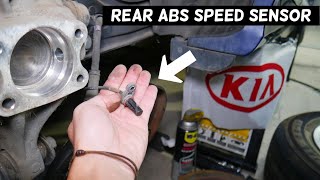
Typical fix: Replace the right rear wheel speed sensor. It is typically held in place by a single 10mm bolt 🎬 See this walkthrough for locating and replacing the rear sensor. and can be accessed after removing the wheel.
Est. part cost: $40-$110 - Damaged Wiring or Connector 🟡 Medium Probability The wiring harness runs near the suspension and wheel, making it vulnerable to damage from road debris, improper jacking, or corrosion at the connector pins. The harness is routed through the rear seat/trunk area, and replacement involves removing interior trim panels.
How to confirm: Visually inspect the entire length of the wiring from the sensor to where it enters the vehicle body. Look for chafing, breaks, or green/white corrosion inside the connector plug. A continuity test with a multimeter from the sensor connector to the HECU connector can confirm a broken wire.
Typical fix: Repair the damaged section of wire with solder and heat-shrink tubing or replace the pigtail connector if it is corroded. In some cases, the entire sensor harness may need to be replaced.
Est. part cost: $15-$40 for a pigtail, $50-$90 for a full harness - Debris on or Damage to the Hub's Magnetic Encoder Ring ⚪ Low Probability Metallic dust from the brakes or road grime can accumulate on the magnetic encoder ring that is built into the wheel hub, causing an erratic signal. A failing wheel bearing can also cause the hub to wobble, damaging the ring or altering the air gap to the sensor. This is a known issue discussed in repair videos.
How to confirm: Remove the wheel speed sensor and use a flashlight to inspect the surface of the hub that the sensor reads. Look for a build-up of metallic shavings or visible cracks/damage on the magnetic ring. Spin the hub and check for runout or play, which would indicate a bad bearing.
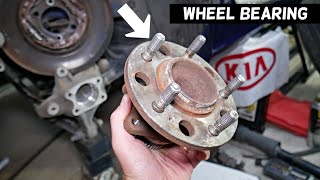
Typical fix: If only debris is present, cleaning the hub surface with a brake cleaner and a soft brush may resolve the issue. If the ring is cracked or damaged, the entire rear wheel hub and bearing assembly must be replaced. 🎬 Watch: Step-by-step guide to replacing the rear wheel hub assembly.
Est. part cost: $100-$250 for a new hub assembly
Rare But Worth Checking
- Faulty ABS/HECU Control Module: This is the least likely cause. Before condemning the module, all other possibilities (sensor, wiring, hub) must be exhaustively ruled out. A recall (SC197) was issued for some 2013-2015 models for HECU issues, but typically for a different failure mode (internal short causing fire risk). A faulty module usually triggers multiple wheel speed sensor codes, not just one.
Diagnosis Steps
- Connect an OBD-II scanner capable of reading ABS codes to confirm C0050 is present. Note any sub-codes (e.g., C0050-00, C0050-5A) which can help pinpoint the fault type.
- Access the live data stream for the ABS system.
- Safely drive the vehicle in a straight line above 10 MPH and observe the speed readings from all four wheel sensors. Confirm that the Right Rear (RR) sensor reads 0 MPH, is erratic, or significantly differs from the other three.
- Raise and safely support the rear of the vehicle. Remove the right rear wheel.
- Locate the wheel speed sensor on the back of the wheel hub assembly. It is held by a single 10mm bolt. Visually inspect the sensor and its wiring harness for any obvious damage, fraying, or loose connections.
- Disconnect the sensor and inspect the connector pins for corrosion or damage.
- Remove the 10mm bolt and gently pry the sensor out of the hub. It may be seized; use penetrating oil if necessary.
- Inspect the magnetic encoder ring on the wheel hub for metallic debris or physical damage like cracks. Clean it with brake cleaner and a soft brush as a precaution.
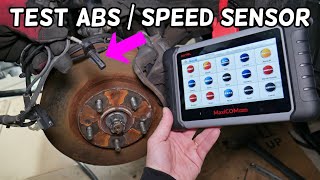
- If the ring is clean and undamaged, test the old sensor. Use a multimeter to check its resistance. Compare the reading to the specification or to a new sensor. An open circuit (infinite resistance) or a reading far from spec confirms a bad sensor. 🎬 Watch: How to test the ABS sensor with a multimeter.
- If the sensor tests good and the hub ring is clean, the fault is likely in the wiring harness. Trace the harness from the wheel well into the trunk/rear seat area to find the next connector. Test for continuity and check for shorts to power or ground between the sensor connector and the ABS module.
- After replacing the faulty component, clear the code with the scan tool and perform another test drive to ensure the warning lights stay off.
Parts You'll Likely Need
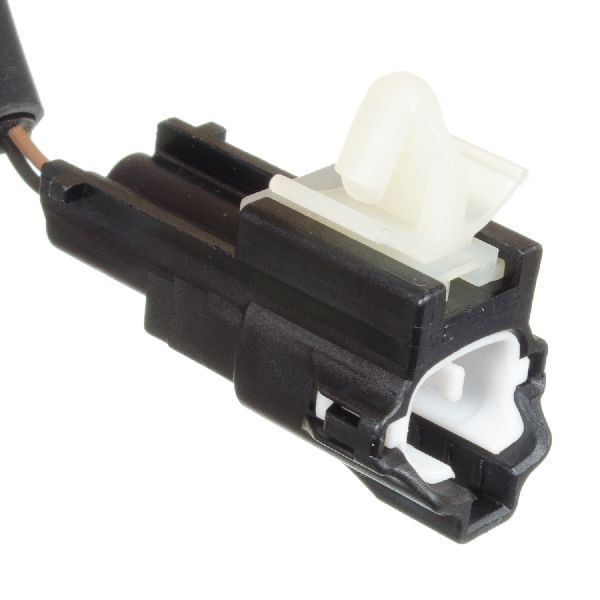
- Right Rear ABS Wheel Speed Sensor
(OEM #59930-2T000)— This is the most common failure point for code C0050, as the sensor is exposed to the elements and fails electronically over time.
Trusted brands: Kia (Genuine), Bosch, Delphi, Standard Motor Products (SMP), Holstein, TRQ
OEM price range: $90-$160
Aftermarket price range: $40-$80 - Rear Wheel Hub and Bearing Assembly
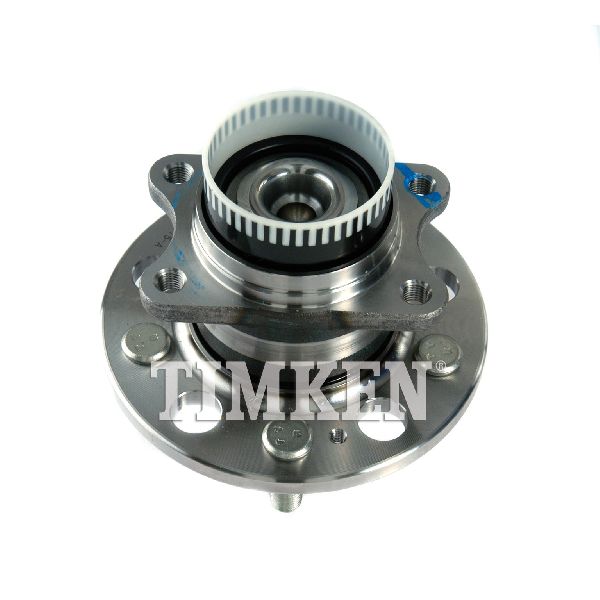
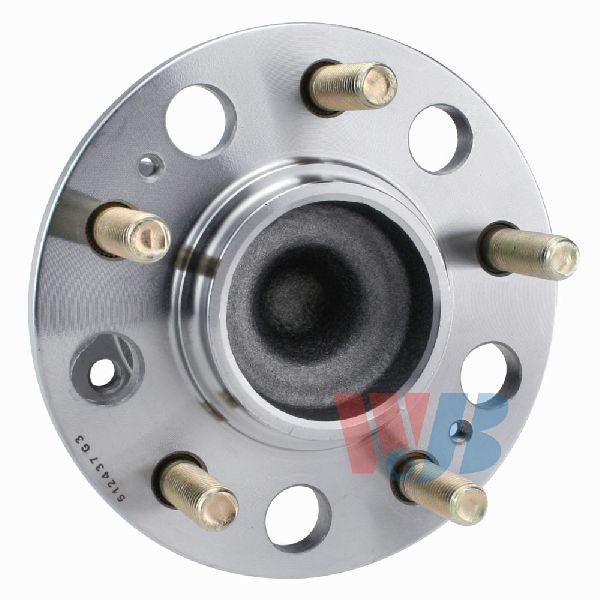
(OEM #52730-3S000)— This part is needed if the magnetic encoder ring, which is integrated into the hub, is found to be cracked, damaged, or if the wheel bearing itself has failed, causing excessive play.
Trusted brands: Kia (Genuine), Timken, SKF, MOOG, SKP
OEM price range: $200-$300
Aftermarket price range: $100-$180
Technical Service Bulletins (TSBs) & Recalls
- CS1604: Customer Satisfaction Program to replace a worn flexible coupler in the Motor Driven Power Steering (MDPS) unit that causes a clicking noise. Warranty was extended to 10 years/unlimited miles.
Platform-Specific Known Issues
- Safety Recall SC197 / NHTSA 20V519: Affects some 2013-2015 Optima models. The ABS/HECU module can leak brake fluid internally, leading to an electrical short and potential fire risk, even when parked. Owners are advised to park outdoors away from structures until the recall is performed. The fix involves dealers inspecting for leaks and replacing the HECU if necessary.
- Safety Recall SC284 / NHTSA 23V652: A broader recall also covering the HECU, which may experience an electrical short, increasing fire risk. The remedy involves replacing the HECU fuse. Owners are again advised to park outdoors.
- Theta II Engine Failure (Recall SC147): Many 2011-2014 Optimas were recalled for engine failures caused by premature bearing wear from manufacturing debris. This can lea
Mechanic-Grade Diagnostic Values
- Rear Wheel Speed Sensor Internal Resistance — expected: Approximately 450 kΩ to 500 kΩ (0.45 to 0.50 MΩ). Failure: An open circuit (infinite resistance, 'OL') or a value significantly outside the expected range indicates a failed sensor.
Hidden / Shadow Codes Worth Checking
- C0050-5A: Signal Plausibility Failure. This sub-code indicates the signal from the right rear sensor is not logical when compared to the other wheel speed sensors (e.g., it's not dropping out completely but is giving an erratic or inconsistent reading while the vehicle is in motion). This often points towards a damaged magnetic encoder ring on the hub or significant debris. (see via A professional-grade scan tool capable of reading manufacturer-specific ABS sub-codes, such as the Kia GDS.)
- C0050-00: General Circuit Malfunction. This is a generic sub-code indicating a fault like an open circuit, short to ground, or high resistance in the sensor's wiring. (see via A professional-grade scan tool capable of reading manufacturer-specific ABS sub-codes.)
Scan Tool Commands That Help
- Kia GDS (Global Diagnostic System) or equivalent advanced scanner: Live Data Graphing (Wheel Speed Sensors) — This is the primary diagnostic step. By graphing all four wheel speeds simultaneously during a test drive, a technician can instantly see if the right rear sensor signal drops out, becomes erratic, or lags behind the others, confirming the fault location without ambiguity.
- Kia GDS (Global Diagnostic System) or equivalent advanced scanner: Read Fault Codes from 'Electronic Stability Control' Module — When diagnosing, it's crucial to pull codes directly from the ESC/ABS module, not just the generic powertrain module. This provides access to critical sub-codes (like C0050-5A) that pinpoint the nature of the circuit failure.
Wiring & Ground Locations
- Rear Wheel Speed Sensor Connector — The wiring harness from the sensor runs up through the wheel well and connects inside the trunk. To access it, the rear seat may need to be folded down and the trunk side liner panel removed.. This connector is a common point for corrosion or loose pins. A video guide shows that after removing four Phillips screws holding a trim piece and pulling the side liner away, the connector is accessible for testing continuity back to the sensor.
- HECU (ABS Module) Connector — Located in the engine bay, typically on the driver's side, with multiple brake lines running into it.. This is the termination point for the wheel speed sensor circuits. If the wiring tests good at the sensor connector in the trunk, the next step is to test for continuity and shorts at the HECU connector pins corresponding to the right rear sensor to isolate a harness break between the trunk and the engine bay. A wiring diagram is required for this step.
Real Owner Repair Stories
- YouTube video by 'Repairs and Rides' (2016 Kia Optima (TF generation, similar design)) — ABS and Traction Control warning lights were on.
❌ Tried (didn't work) The diagnosis went straight to the final fix based on the scan tool code.
✅ What actually fixed it The scan tool showed a code for 'right rear wheel speed sensor signal open or short'. On this model, the sensor is integrated into the wheel hub assembly. The entire right rear wheel hub and bearing assembly was replaced, which resolved the code and extinguished the warning lights.
Documented NHTSA Reports
While C0050 is a standard ABS code for the right rear sensor on the Kia Optima, it is important to note how other manufacturers interpret this code to ensure a thorough diagnosis. For instance, NHTSA ODI #10763888 describes a case where a technician identified C0050 as a faulty power steering control module (PSCM) on a different make, requiring a steering column replacement. Additionally, an owner reported in NHTSA ODI #11228687 that C0050 appeared alongside multiple other communication codes like U0077 and U0126. In some braking system services, as noted in NHTSA ODI #11649367, the vehicle may disable ABS and set C0050 if extra brake fluid is required to return caliper piston contact to the brake pad. Furthermore, NHTSA ODI #11693418 shows a diagnostic path where C0050-00 was present when rotors, rear pads, and adapter plates required replacement.
OEM Part Supersession History
59930-2T000→No official supersession found.
Heads up: This part number (59930-2T000) is specified for models WITHOUT the electronic parking brake (EPB). Models with EPB may use a different sensor. It is crucial to verify fitment by VIN.
Model Year Variations Within This Range
- 2014-2015: The Kia Optima received a facelift for the 2014 model year, which included redesigned front and rear fascias, new tail lights, and interior updates like a redesigned steering wheel and center stack. While the core ABS components and C0050 diagnosis remained the same, there could be minor differences in trim removal for accessing the wiring harness connector in the trunk area due to the interior changes.
Diagnostic Flowchart
Other Known Issues on This Vehicle
Issues unrelated to this code that are worth knowing about as an owner of this generation:
- Theta II Engine Failure 🔴 High — Very common across 2011-2014 models, leading to a massive recall and class-action lawsuit. Can result in complete engine seizure. (Ref: Recall SC147 / NHTSA 17V224)
- Steering Column Coupler Degradation 🟠 Medium — Extremely common; most owners will experience the clicking/clunking noise from the steering wheel over the life of the vehicle. (Ref: Customer Satisfaction Program CS1604 / TSB CHA044)
- HECU (ABS Module) Fire Risk 🔴 High — Widespread enough to trigger multiple large-scale recalls. Poses a fire risk even when the vehicle is parked and turned off. (Ref: Recall SC197 / NHTSA 20V519; Recall SC284 / NHTSA 23V652)
- High-Pressure Fuel Pipe Leak 🔴 High — Affects vehicles that had engines replaced under the SC147 recall. The fuel pipe may have been damaged or misaligned during service, leading to a fuel leak and fire risk. (Ref: Recall SC172 / NHTSA 18V907)
Used vs. New Parts: Buying Guide for This Vehicle
When a used part is the smart pick: A used wheel hub assembly from a low-mileage, non-corroded donor vehicle can be a cost-effective option if the magnetic encoder ring on your original hub is confirmed to be damaged. It is generally not recommended to buy a used wheel speed sensor itself, as it's an inexpensive wear item and its remaining lifespan is unknown.
Donor-vehicle mileage cap: roughly under 60000 miles for the part to have meaningful remaining life.
What to inspect on the donor part:
- Check for a VIN from a donor vehicle in a dry, southern climate to avoid parts with heavy rust.
- Spin the hub by hand; it should be completely silent and smooth with no grinding or roughness.
- Inspect the magnetic encoder ring on the back of the hub for any cracks, chips, or heavy rust buildup.
- Ensure the lug studs are straight and the threads are in good condition.
OEM-only on this vehicle (don't cheap out):
- ABS/HECU Control Module: Due to the complexity, need for potential programming, and the critical safety recalls associated with this part, only a new OEM module from a dealer is recommended if it must be replaced.
Aftermarket brands forum-validated for this vehicle:
- Sensors: Bosch, Delphi, Standard Motor Products (SMP), Holstein.
- Hub Assemblies: Timken, SKF, MOOG.
Brands owners have reported issues with on this vehicle:
- Unbranded, 'white-box' wheel hub assemblies from online marketplaces have a higher risk of having incompatible magnetic encoder rings that can cause the C0050 code to persist even after replacement.
Real Owner Stories
Aggregated from forums and TSBs cited above. Mileages and costs reflect what owners reported in those sources.
2013 Kia Optima
Symptoms: Owner was quoted for a front wheel speed sensor replacement and observed ABS warning lights.
What fixed it: Replacement of the wheel speed sensor.
Cost: $500-$500
Source hint: Reddit: r/kia - '13 Optima Wheel Sensor Replacement
2011-2015 Kia Optima (High-Trim)
Symptoms: Multiple assistant errors and system lights appeared after replacing the hub and bearings with an aftermarket unit.
What fixed it: Replacing the aftermarket hub with a genuine Hyundai/Kia hub assembly to ensure proper signal transmission.
Source hint: Kia Forums: Kia Optima – assistant errors after replacing the hub and bearings
2011-2015 Kia Optima
Symptoms: ABS, TCS, and Collision Avoidance lights all illuminated on the dashboard simultaneously.
What fixed it: Replacement of the failed ABS wheel speed sensor.
Source hint: Reddit: r/kia - Anybody's optima done this before?
Related OBD-II Codes
Frequently Asked Questions
My 2013 Kia Optima has the ABS and ESC lights on; could this be related to the HECU fire recall?
I replaced my rear hub with an aftermarket part and now I have more dashboard errors. Why?
Is there a TSB for the clicking noise I hear in my steering wheel along with these ABS lights?
Can I just clean the sensor, or does it always need replacement?
Does the 2011-2015 Hyundai Sonata share this same Right Rear sensor issue?
Helpful Videos

We Have This Part in Stock


The information in this article is provided for general reference and educational purposes only. Vehicle specifications, procedures, and part compatibility can vary by production date, trim level, and region. Always consult your vehicle's factory service manual and verify part numbers before purchasing or performing repairs. Safety-critical components such as airbags, seat belts, and braking systems should be installed by a qualified professional.
- Kia Optima:
- 🧭 Diagnostic Flowchart
- 🎬 Helpful Videos
- 🛍️ Shop This Part
- What's Unique About the 2011-2015 Kia Optima
- Symptoms You May Notice
- Most Likely Causes
- Rare But Worth Checking
- Diagnosis Steps
- Parts You'll Likely Need
- Technical Service Bulletins (TSBs) & Recalls
- Platform-Specific Known Issues
- Mechanic-Grade Diagnostic Values
- Hidden / Shadow Codes Worth Checking
- Scan Tool Commands That Help
- Wiring & Ground Locations
- Real Owner Repair Stories
- Documented NHTSA Reports
- OEM Part Supersession History
- Model Year Variations Within This Range
- Other Known Issues on This Vehicle
- Used vs. New Parts: Buying Guide for This Vehicle
- Real Owner Stories
- 2013 Kia Optima
- 2011-2015 Kia Optima (High-Trim)
- 2011-2015 Kia Optima
- Related OBD-II Codes
- Frequently Asked Questions
- 🎟️ Get 5% Off