

C0055 on 2007-2011 GMC Yukon Denali: Rear Wheel Speed Sensor Circuit Fault Guide
On a 2007-2011 GMC Yukon Denali, code C0055 almost always indicates a fault with the single rear wheel speed sensor (VSS) or its wiring. The most common fix is replacing the sensor, located on the transfer case (4WD) or transmission (2WD), which costs about $25-$80 for the part. A very common secondary cause is the wiring harness chafing through where it passes over the transmission bellhousing.
- C0055 points to the single rear speed sensor (VSS) on the transmission/transfer case, not the wheel hubs.
- The most likely causes are a failed sensor or, just as commonly, a wiring harness that has chafed through on top of the transmission.
- This fault disables ABS and StabiliTrak, so it should be addressed promptly for safety.
- Always inspect the wiring harness thoroughly before spending money on a new sensor.
- If the code is only in history with no lights on, it could be a harmless glitch per TSB 06-05-25-003.
What's Unique About the 2007-2011 Gmc YUKON DENALI
The GMT900 platform, which includes this generation of Yukon Denali, is unique in its use of a single sensor on the transmission or transfer case for the rear wheel speed signal. This design means a single sensor or wiring failure will disable the ABS and StabiliTrak systems for both rear wheels. A well-documented issue on these trucks is the wiring harness for this sensor chafing and shorting out where it runs over the top of the transmission, making a wiring inspection just as important as checking the sensor itself. This failure point is confirmed in numerous owner forums.
Diagnostic Flowchart
Tap your situation to follow the diagnostic path that matches what you're seeing on this vehicle.
Symptoms You May Notice
- ABS warning light is on
- StabiliTrak or Traction Control warning light is on
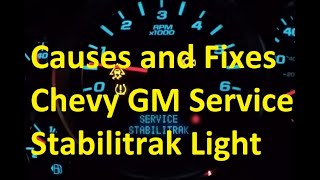
- "Service StabiliTrak" or "Service Anti-lock Brake System" me 🎬 See this guide on common causes for StabiliTrak warning lightsssage in the Driver Information Center
- Cruise control may not work
- Possible erratic or harsh transmission shifting
- Speedometer may be erratic or inoperative at times, as noted in TSB PIP4966B
- Replacing a front wheel hub bearing. The C0055 code specifically refers to the single rear speed sensor circuit, which is not located at the wheels. Front wheel speed sensor codes are typically C0035 (Left Front) or C0040 (Right Front).
Most Likely Causes
- Damaged Wiring or Connector 🔴 High Probability The VSS wiring harness is notoriously prone to rubbing through on a metal bracket on the top, driver's side of the transmission bellhousing. Engine movement causes the loom to chafe, eventually exposing and breaking the wires. The connector pigtail is also a common failure point due to heat and vibration.
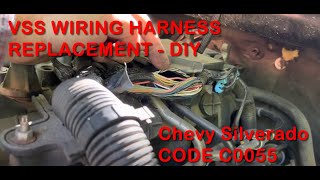
How to confirm: Visually and physically inspect the entire length of the wiring harness from the sensor connector up to the main loom. The primary inspection point is the area between the firewall and the back of the engine 🎬 Watch: How to trace and replace the VSS wiring harness, directly over the transmission. Look for chafed, melted, or broken wires. Often the damage is hidden under the plastic loom and must be felt by hand. Check the connector for corrosion or pushed-out pins.
Typical fix: Repair the damaged section of wire using weatherproof butt connectors and heat shrink tubing. If damage is extensive, some owners build a new, longer harness section to re-route it away from the chafe point. If the connector is damaged, replace the pigtail harness (e.g., Dorman 645-207, ACDelco PT2298).
Est. part cost: $15-$40 - Failed Rear Wheel Speed Sensor (VSS) 🔴 High Probability → Shop ABS Wheel Speed Sensor The sensor is a plastic electronic component exposed to constant heat and vibration from the drivetrain, leading to eventual internal failure of its magnetic coil.
How to confirm: Use a scan tool to monitor the rear wheel speed data while driving; if the signal is erratic, drops to zero, or does not match the front wheels, the sensor is likely faulty. A good sensor should have a resistance typically between 1800-2400 ohms per TSB PIT4815C, though other sources cite a wider 1300-2900 ohm range. A reading of open-loop (infinite resistance) or a dead short confirms failure.
Typical fix: Replace the rear wheel speed sensor. It is held in by a single 13mm bolt on the transfer case (4WD) or transmission tail housing (2WD). Lubricate the new O-ring with transmission fluid before installation.
Est. part cost: $25-$80 - Excessive Tone Wheel Movement ⚪ Low Probability As noted in GM Technical Service Bulletin #PIP4966B, internal wear within the transfer case (such as a worn output shaft rear bushing or dislodged snap ring) can cause the tone wheel (reluctor ring) to have excessive side-to-side movement. This changes the air gap to the sensor, generating an erratic or lost signal.
How to confirm: After removing the speed sensor, look into the mounting hole at the tone wheel. Use a small screwdriver or pry bar to gently check for side-to-side play of the wheel on the shaft. TSB #PIP4966B states that while about 1/8-inch of movement is normal, it should remain centered in the opening. Any significant wobble or off-center position indicates an internal mechanical problem. This is an advanced diagnostic step.
Typical fix: Requires internal transmission or transfer case repair to address the worn components (bushings, bearings, snap rings) causing the movement. This is a major, professional-level repair.
Est. part cost: $500+
Rare But Worth Checking
- Faulty Electronic Brake Control Module (EBCM): → Shop ABS Control Module While possible, EBCM failure is much less common than a sensor or wiring issue. All other possibilities should be exhausted before condemning the module. In some rare cases, a faulty Transmission Control Module (TCM) has been found to corrupt the signal.
- Software Anomaly (History Code): According to TSB #06-05-25-003, a C0055 code can be stored in the module's history without any actual fault if the ignition key is turned from RUN to ACCESSORY for more than one second. If there are no warning lights on and no symptoms, the code can be cleared and may not indicate a real problem.
Diagnosis Steps
- Read the fault codes with a scanner capable of accessing the ABS module.
- Use the scan tool to monitor the 'Rear Wheel Speed' or 'Vehicle Speed' data PID while driving. Watch for dropouts or erratic readings and compare to front wheel speeds.
- Thoroughly inspect the VSS wiring harness for damage, focusing on the area where it runs over the transmission bellhousing between the engine and firewall. Feel for breaks or chafing inside the loom.
- Inspect the sensor connector and the EBCM connector for corrosion, moisture, or pushed-out pins.
- If the signal is faulty and wiring appears intact, disconnect the sensor and test its resistance. A reading should be within 1800-2400 ohms per TSB PIT4815C. Real-world good readings have been reported between 1300-2900 ohms. An open or shorted reading indicates a bad sensor.
- If the sensor tests good, perform a continuity and short-to-ground test on the VSS circuit wires (typically Dark Blue/White and Light Blue/Black) between the sensor connector and the EBCM connector.
- As per TSB PIT4815C, a more advanced test is to check the frequency signal at the EBCM on circuit 817. It should read approximately 1.1 Hz per MPH.
- If wiring and sensor are confirmed good, remove the sensor (one 13mm bolt) and inspect the tone wheel for damage or excessive movement through the sensor mounting hole, as per TSB #PIP4966B.
Parts You'll Likely Need
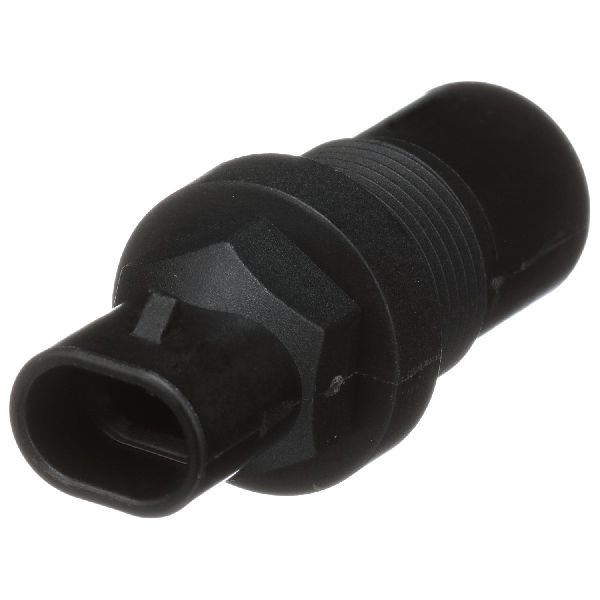
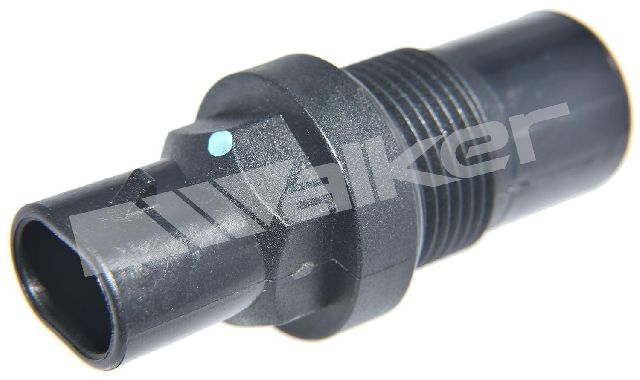
- Rear Wheel Speed Sensor (Vehicle Speed Sensor - VSS)
(OEM #ACDelco 22742460 or 15113945 (supersedes 20938122))— This is the most common component to fail electronically, causing a loss or erratic reading of the rear wheel speed signal.
Trusted brands: ACDelco, Delphi, Dorman (917-615), Standard Motor Products (SC168)
OEM price range: $50-$80
Aftermarket price range: $25-$50 - VSS Connector Pigtail
(OEM #ACDelco PT2298)— The wiring harness connector is a frequent point of failure due to heat, vibration, and environmental exposure. It's often replaced when wiring is damaged close to the connector.
Trusted brands: ACDelco, Dorman (645-207)
OEM price range: $25-$40
Aftermarket price range: $15-$30
Related Codes That Often Appear With This One
- P2771 — TSB #PIP4966B explicitly links C0055 and P2771 (4-Wheel Drive Low Switch Circuit) as potentially appearing together, pointing towards issues with the transfer case components or wiring in that shared area.
- C0055 00 — This is a symptom byte visible with an advanced scan tool. It indicates the EBCM has detected a specific circuit fault like a short to ground, short to voltage, or an open circuit. This points directly to a wiring problem.
- C0055 5A — This symptom byte indicates the EBCM has detected an erratic or implausible signal. This often points to a failing sensor, electrical interference, or the mechanical tone wheel issue described in TSB #PIP4966B.
Technical Service Bulletins (TSBs) & Recalls
- PIP4966B: Details how C0055 (and P2771) can be caused by excessive tone wheel/output shaft movement.
- PIT4815C: Provides diagnostic steps including resistance and frequency testing for the VSS circuit.
- 06-05-25-003: Notes that a history code C0055 can be set without a true fault by cycling the ignition key.
Platform-Specific Known Issues
- TSB #PIP4966B notes that C0055 can be caused by excessive movement of the tone wheel or output shaft, indicating a mechanical issue inside the transmission or transfer case.
- The VSS wiring harness is highly susceptible to chafing and melting where it passes over the transmission bellhousing, between the engine and firewall. This is the most widely reported vehicle-specific failure point in owner communities.
- TSB #06-05-25-003 notes that a history code C0055 can be set without a true fault by simply cycling the key from RUN to ACC.
Mechanic-Grade Diagnostic Values
- VSS Resistance (Ohms) — expected: 1800-2400 Ω (per TSB PIT4815C). Real-world reports show good sensors testing from 1300 Ω to 2900 Ω.. Failure: Open circuit (infinite resistance) or short circuit (near zero resistance).
- VSS Signal Frequency — expected: ~1.1 Hz per MPH at the EBCM.. Failure: No frequency or an erratic frequency that doesn't correspond to vehicle speed.
- VSS Signal Voltage (at sensor) — expected: A square wave signal that switches between ~0V and a high voltage (can be 5V, 9V, or near battery voltage depending on the system) as the wheel turns.. Failure: A flat line (constant voltage) or a noisy/garbled pattern on an oscilloscope.
Hidden / Shadow Codes Worth Checking
- C0055 5A: Plausibility Failure. The EBCM received a signal, but it was erratic, irrational, or did not match other sensor inputs (like front wheel speeds). This often points to a failing sensor that acts up under load, electrical interference, or a mechanical issue like a damaged/loose tone ring. (see via A professional scan tool capable of reading GM-specific chassis codes and their symptom bytes (e.g., Tech2, GDS2, high-end Snap-on/Autel).)
- C0055 00: Circuit Malfunction. The EBCM detected a hard electrical fault: an open circuit (broken wire), a short to ground, or a short to voltage. This points directly to a wiring issue or a completely failed sensor. (see via A professional scan tool capable of reading GM-specific chassis codes and their symptom bytes.)
Scan Tool Commands That Help
- Lab Scope / GDS2 / High-End Scanner: Graphing VSS Signal Input at EBCM — This is an advanced step used when the sensor and wiring have been tested and seem okay. By viewing the square wave signal directly at the EBCM's input pin, a technician can definitively confirm if a good signal is reaching the module. If the signal is clean and present at the module but the code persists, the EBCM itself is the likely culprit.
Wiring & Ground Locations
- EBCM Ground — A bolt on the driver's side frame rail, near the EBCM itself (which is located under the driver's door area).. A poor ground for the Electronic Brake Control Module can cause a host of erratic issues and fault codes, including the inability to correctly process the incoming VSS signal. Cleaning this ground is a common fix for various ABS problems.
- VSS Signal Wire (ECM to EBCM) — Runs from the Engine Control Module (ECM) connector C1 (often blue) at Pin 46, to the main EBCM connector at Pin B3.. This is the final leg of the signal's journey. After the VSS signal is processed by the TCM and/or ECM, this specific wire carries the digital square wave to the EBCM. A continuity or short test on this wire is crucial if the sensor and initial harness section test good.
- G201 — Located at the left end of the dashboard.. Wiring diagrams list G201 as a ground point related to the Anti-Lock Brake system wiring, potentially for indicator lights or switches that share circuits with the EBCM.
Real Owner Repair Stories
- DuramaxDiesels.com forum user (Duramax truck (similar GMT900 platform)) — C0055 code found during data logging, but no ABS light or noticeable driving issues. Speedometer worked correctly.
❌ Tried (didn't work) Sensor tested good with a resistance of 1362 ohms. Wiring checked out okay.
✅ What actually fixed it The root cause was a failed rear bearing in the transfer case. This allowed the output shaft to move excessively, causing the tone ring to physically contact and damage the VSS, generating an erratic signal that set the code. The fix required internal transfer case repair. - YouTube channel 'FreeAutoMechanic' (Chevy/GMC Truck (similar platform)) — Erratic/twitching speedometer, harsh shifting, and code C0055.
❌ Tried (didn't work) Replacing the Vehicle Speed Sensor (VSS) did not solve the problem.
✅ What actually fixed it The wiring harness that runs over the top of the transmission had chafed through. Repairing this section of the harness resolved all symptoms and cleared the code. - YouTube channel 'Fixing cars and stuff' (2008 Chevy Silverado 2500 Duramax) — ABS light on with code C0055. Speedometer was working correctly.
❌ Tried (didn't work) N/A - Advanced diagnosis was performed first.
✅ What actually fixed it Using a lab scope, a clean square wave signal was confirmed at the EBCM input pin. Since the speedometer worked (confirming the signal from the sensor/TCM/ECM was good) and the signal was reaching the EBCM, the EBCM itself was diagnosed as faulty. Replacing the EBCM fixed the issue.
"I Checked Everything" — The Actual Cause
- A common scenario is when the VSS sensor tests good (resistance is in spec) and the wiring harness shows no visible damage or shorts, yet the code C0055 5A (Plausibility Failure) persists. The actual cause, as documented in TSB PIP4966B and owner forums, is often mechanical: a worn output shaft bushing in the transfer case allows the tone ring to move, creating an erratic signal that the EBCM flags as implausible. Electrical tests alone will not find this.
OEM Part Supersession History
25834221, 25989530→20896914— Part consolidation and revision for the Electronic Brake Control Module (EBCM).
Heads up: EBCM modules are often VIN-specific. A used module from another truck, even if the part number is identical, may not work correctly if it was programmed for different vehicle options (e.g., different axle ratio, tire size). Replacement often requires programming with a Tech2/GDS2 tool to match the vehicle's VIN and configuration.
Model Year Variations Within This Range
- 2009-2011 vs 2007-2008: The Electronic Brake Control Module (EBCM) part numbers and associated costs changed significantly around the 2009 model year. Repair estimates for a 2007 EBCM replacement are around $1,000, while the same job for a 2009-2011 model can be over $3,000, indicating a major change in the component.
Helpful Videos
We Have This Part in Stock


The information in this article is provided for general reference and educational purposes only. Vehicle specifications, procedures, and part compatibility can vary by production date, trim level, and region. Always consult your vehicle's factory service manual and verify part numbers before purchasing or performing repairs. Safety-critical components such as airbags, seat belts, and braking systems should be installed by a qualified professional.
- Gmc YUKON DENALI:
- 🧭 Diagnostic Flowchart
- 🎬 Helpful Videos
- 🛍️ Shop This Part
- What's Unique About the 2007-2011 Gmc YUKON DENALI
- Symptoms You May Notice
- Most Likely Causes
- Rare But Worth Checking
- Diagnosis Steps
- Parts You'll Likely Need
- Related Codes That Often Appear With This One
- Technical Service Bulletins (TSBs) & Recalls
- Platform-Specific Known Issues
- Mechanic-Grade Diagnostic Values
- Hidden / Shadow Codes Worth Checking
- Scan Tool Commands That Help
- Wiring & Ground Locations
- Real Owner Repair Stories
- "I Checked Everything" — The Actual Cause
- OEM Part Supersession History
- Model Year Variations Within This Range
- 🎟️ Get 5% Off