

C0196 on 2014-2015 Cadillac ELR: Yaw Rate Sensor and Stabilitrak Issues Explained
On a 2014-2015 Cadillac ELR, code C0196 often sets without a real fault after the vehicle has been transported on a flatbed or car carrier. The first step is to clear the code and see if it returns. If it does, the Yaw Rate Sensor is the most likely culprit.
- Before replacing any parts for a C0196 code on a Cadillac ELR, check if the vehicle was recently transported. If so, simply clearing the code will likely fix the issue.
- A persistent C0196 code points to a problem with the Yaw Rate Sensor, its wiring, or, less commonly, the EBCM.
- Driving with this code is possible, but the Stabilitrak safety system will be inactive, requiring extra caution.
- Any replacement of the Yaw Rate Sensor requires a 'learn' or 'recalibration' procedure with a professional-grade scan tool.
What's Unique About the 2014-2015 Cadillac ELR
The Cadillac ELR (and its sibling, the Chevrolet Volt) is uniquely sensitive to being transported. Manufacturer technical service bulletins confirm that C0196 can be set spuriously after the vehicle has been on a car carrier or flat-towed. The EBCM remains partially active and detects the motion of the transport truck but sees no corresponding input from the ELR's own wheel speed or steering sensors, leading it to mistakenly flag a fault with the Yaw Rate Sensor. This is a well-documented quirk of the platform.
Diagnostic Flowchart
Tap your situation to follow the diagnostic path that matches what you're seeing on this vehicle.
Generation note: The Cadillac ELR was produced for the 2014 and 2016 model years; there was no 2015 model. This guide applies to both years as they belong to the same generation and share the same core architecture. The provided TSBs specifically reference the 2014 model year but also apply to the identical 2011-2015 Chevrolet Volt.
Symptoms You May Notice
- "Service Stabilitrak" message on the driver information center
- Red brake warning lamp illuminated on the instrument panel
- Stabilitrak/traction control system is disabled
- ABS warning light may also be illuminated
- Replacing the Yaw Rate Sensor without first attempting to clear the code, especially if the vehicle was recently transported.
- Replacing the sensor without performing the mandatory 'Yaw Rate Sensor Learn' procedure, which will cause the code to return immediately.
Most Likely Causes
- Spurious Code After Vehicle Transport 🔴 High Probability As documented in GM TSBs PIC5436B and PIC5436C, the EBCM can remain active during transport and log a C0196 code due to conflicting sensor data (vehicle moving, but wheels not turning). This is the most common reason for this code to appear on an otherwise healthy ELR or Volt.
How to confirm: Ask if the vehicle was recently towed, shipped on a car carrier, or transported on a flatbed. If so, this is the most likely cause. A user on gm-volt.com reported this exact scenario: 'My 2014 Volt was flat-bedded to the dealer... they found the C0196 code... they cleared the code and it has not returned.'
Typical fix: Clear the DTC using a capable OBD-II scanner. A specific drive cycle is required by TSB PIC5436C: Perform a Multi-Axis sensor learn, clear DTCs, turn ignition off, open and close the driver's door, and let the vehicle 'sleep' for 3 minutes. Then, start the vehicle, leave it in Park for 10 seconds, and drive straight above 20 mph for 30 seconds.
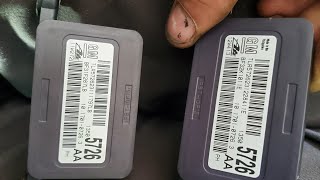
Est. part cost: $0 - Faulty Yaw Rate / Lateral Accelerometer Sensor 🟡 Medium Probability The sensor (a combined unit) can fail internally, sending incorrect or no data to the EBCM. This is the most common hardware failure.
How to confirm: Use a professional scan tool to monitor the Yaw Rate Sensor's live data. The voltage should be near 2.5V when stationary on a flat surface and change smoothly when turning. If the data is erratic, stuck at a fixed value, or doesn't change, the sensor is likely bad. A user on a forum described their dealer's diagnosis: 'Dealer confirmed the sensor was faulty after observing its output on the scan tool. The repair order showed replacement of part #23483374 and a subsequent sensor learn.'
Typical fix: Replace the Yaw Rate Sensor (GM Part #23483374). It is typically located under the front passenger seat, bolted to the floor. After replacement, a 'Yaw Rate Sensor Learn' or 'Multi-Axis Sensor Learn' procedure must be performed with a scan tool.
Est. part cost: $80-$250 - Wiring or Connector Issue ⚪ Low Probability Wiring to the sensor, which is located under the passenger seat or center console, can be damaged by moisture (spilled drinks), corrosion, or physical stress from seat movement or items stored under the seat.
How to confirm: Visually inspect the sensor's connector and harness for damage. Perform continuity and voltage tests on the power, ground, and signal wires between the sensor and the EBCM. The connector pigtail, if damaged, may be replaceable with a part like GM #88988337.
Typical fix: Repair the damaged section of the wiring harness or clean/replace the connector.
Est. part cost: $5-$50 - Chassis CAN Bus Communication Failure ⚪ Low Probability As noted in TSB #PIT5076E, C0196 can appear with other network codes (like U0074, U0126), indicating a broader communication problem on the chassis data bus rather than a single sensor failure. This points away from the sensor itself and towards a network wiring or module issue.
How to confirm: Check for other 'U' codes stored in various modules. This requires advanced network diagnostics beyond a simple code reader.
Typical fix: Diagnose and repair the fault on the CAN bus, which could be a wiring issue or a failing module.
Est. part cost: $100-$1000+
Rare But Worth Checking
- Faulty Electronic Brake Control Module (EBCM): → Shop ABS Control Module This is rare, but if the sensor, wiring, and network all test good, the EBCM itself may be the source of the problem. A recall for the 2014 ELR involved recalibrating the EBCM for ESC diagnostic issues. Always ensure the EBCM has the latest software updates before considering replacement.
Diagnosis Steps
- Check if the vehicle has been recently transported on a flatbed or car carrier. If yes, proceed to step 2. If no, skip to step 3.
- Follow the procedure in TSB #PIC5436C: Use a scan tool to perform a 'Multi-Axis Sensor Learn' and clear the C0196 code. Turn the ignition off, open and close the driver's door, and let the vehicle sit undisturbed for at least 3 minutes for the modules to go to sleep. Start the vehicle, leave it in Park for 10 seconds, then drive straight above 20 mph for 30 seconds. If the code does not return, the issue is resolved.
- If the code returns, use a professional scan tool to check for any other DTCs, especially 'U' codes related to communication.
- Access the live data stream for the Yaw Rate Sensor. The voltage should be near 2.5V when stationary and change smoothly when turning. An erratic, frozen, or absent signal points to a sensor or wiring issue.
- If the live data is bad, locate the Yaw Rate Sensor. On the ELR/Volt, it is most commonly found under the front passenger seat, bolted to the floor cross-member. Inspect its electrical connector and wiring for damage, corrosion, or loose connections.
- Test the sensor's power, ground, and signal circuits using a multimeter, referencing the vehicle's wiring diagram.
- If wiring and power are good but the signal is bad, replace the Yaw Rate Sensor (GM Part #23483374).
- After replacement, perform the 'Yaw Rate Sensor Learn' or 'Multi-Axis Sensor Learn' procedure using a compatible scan tool. This step is mandatory.
- If multiple communication codes are present alongside C0196, perform advanced diagnostics on the Chassis CAN bus as suggested by TSB #PIT5076E.
Parts You'll Likely Need
- Yaw Rate and Lateral Accelerometer Sensor
(OEM #23483374)— This sensor is the most common hardware failure that causes a persistent C0196 code after the 'transport glitch' has been ruled out.
Trusted brands: ACDelco (GM Genuine), Bosch
OEM price range: $150-$250
Aftermarket price range: $80-$180
Related Codes That Often Appear With This One
- U0074 — As per TSB #PIT5076E, this code indicates a Control Module Communication Bus B Off fault, pointing towards a network issue rather than just a sensor failure.
- U0125 — TSB #PIT5076E lists this code for Lost Communication With Multi-axis Acceleration Sensor Module, directly related to the Yaw Rate Sensor.
- U0126 — TSB #PIT5076E lists this code for Lost Communication With Steering Angle Sensor Module. The EBCM uses both yaw and steering angle data, and a network fault can affect both.
Technical Service Bulletins (TSBs) & Recalls
- PIC5436C: Details the C0196 code setting after vehicle transport and provides the specific procedure to clear it.
- PIC5436B: An earlier version of the bulletin, titled 'Service Stabilitrak DTC C0196 After Vehicle Has Been Transported'.
- PIT5076E: Lists C0196 among several other codes that point to a 'Chassis bus' communication network fault.
- PIC5988: Includes C0196 in a long list of codes that may set as 'Passed/Failed', indicating a complex diagnostic situation requiring GM support.
Platform-Specific Known Issues
- TSB #PIC5436C and #PIC5436B directly address that C0196 will set after the vehicle is transported on a car carrier or flatbed, often accompanied by a red brake lamp and a 'Service Stabilitrak' message. The fix is a specific code clearing and drive cycle procedure.
- A recall (#14072) was issued for some 2014 ELR models to recalibrate the Electronic Brake Control Module (EBCM) because certain ESC faults would not illuminate the warning light. While not a direct cause of C0196, it highlights the importance of ensuring the EBCM has the latest software.
Mechanic-Grade Diagnostic Values
- Yaw Rate Sensor Signal Voltage — expected: Approximately 2.5V when stationary on a level surface. Proportional output between 0.25V and 4.75V when turning.. Failure: Voltage is less than 0.15V or greater than 4.85V for more than a second. A reading that is stuck, erratic, or does not change when turning also indicates a failure.
- Yaw Rate Sensor Live Data (Scan Tool) — expected: Should read a steady value near 0 deg/sec when the vehicle is stationary on a level surface.. Failure: The value is erratic, stuck, or does not change smoothly and appropriately during a test drive with turns.
- Sensor Power Supply (at sensor connector) — expected: Battery Voltage (approx. 12V) with key on.. Failure: No voltage or significantly low voltage. Note: The EBCM may cut power to the sensor for a brief moment after key-on if a fault is detected, so back-probing with the connector plugged in is necessary for an accurate test.
- Sensor Ground Circuit (at sensor connector) — expected: Less than 1 Ω resistance to a known good chassis ground.. Failure: High resistance or an open circuit (OL).
Hidden / Shadow Codes Worth Checking
- C0196-5A: Yaw Rate Signal Plausibility Failure. This means the yaw rate sensor's signal does not logically match the data coming from other sensors, such as the steering angle sensor and wheel speed sensors. This is the specific code often set after vehicle transport. (see via GM GDS2 or other professional scan tool capable of reading manufacturer-specific symptom bytes.)
- C0196-71: Invalid Data Received From Multi-Axis Sensor / Offset Out of Range. This indicates the EBCM is receiving data, but it's nonsensical or the sensor's internal zero-point offset has drifted outside the acceptable range, often due to an internal sensor failure. (see via GM GDS2 or other professional scan tool capable of reading manufacturer-specific symptom bytes.)
Scan Tool Commands That Help
- GM GDS2: Multi-Axis Sensor Learn (or Yaw Rate Sensor Learn/Reset) — This is the first step to resolve a code set by vehicle transport, as per TSB PIC5436C. It is also mandatory after replacing the Yaw Rate Sensor or the EBCM to calibrate the new sensor's zero point.
- GM GDS2: Clear DTCs — Used after the 'Learn' procedure is complete and during the specific TSB-directed process to resolve a transport-related fault.
Wiring & Ground Locations
- B119 Multi-Axis Acceleration Sensor — On the ELR and its sister platform, the Chevy Volt, the sensor is located on the floor tunnel, under the center console, often in front of the shifter or under the passenger seat area bolted to a cross-member.. This is the physical location of the component that needs to be tested and potentially replaced. Its location under the console/seat makes its wiring susceptible to damage from spills or items stored under the seat.
Real Owner Repair Stories
- gm-volt.com forum user (2014 Chevrolet Volt (sister platform)) — Service Stabilitrak message and C0196 code appeared after the vehicle was transported to the dealer on a flatbed tow truck.
✅ What actually fixed it The dealer technician cleared the C0196 code. The code did not return, confirming it was a spurious fault caused by the vehicle being transported, exactly as described in TSB PIC5436C.
Helpful Videos

The information in this article is provided for general reference and educational purposes only. Vehicle specifications, procedures, and part compatibility can vary by production date, trim level, and region. Always consult your vehicle's factory service manual and verify part numbers before purchasing or performing repairs. Safety-critical components such as airbags, seat belts, and braking systems should be installed by a qualified professional.
- Cadillac ELR:
- 🧭 Diagnostic Flowchart
- 🎬 Helpful Videos
- What's Unique About the 2014-2015 Cadillac ELR
- Symptoms You May Notice
- Most Likely Causes
- Rare But Worth Checking
- Diagnosis Steps
- Parts You'll Likely Need
- Related Codes That Often Appear With This One
- Technical Service Bulletins (TSBs) & Recalls
- Platform-Specific Known Issues
- Mechanic-Grade Diagnostic Values
- Hidden / Shadow Codes Worth Checking
- Scan Tool Commands That Help
- Wiring & Ground Locations
- Real Owner Repair Stories
- 🎟️ Get 5% Off