

OBD-II Code C0215: Left Rear Wheel Speed Sensor Circuit Malfunction
What C0215 means, why it triggers, and how to fix it
- Inspect the left rear wiring harness first, as broken wires or corroded connectors cause over 50% of C0215 codes.
- Expect stopping distances to increase by up to 25% on slippery surfaces because this code completely disables your ABS and traction control.
- Clean the sensor's magnetic tip and the toothed reluctor ring with brake cleaner before buying parts, as metal shavings frequently block the signal.
- Check for excessive play in the left rear wheel bearing, as a loose hub assembly alters the sensor's air gap and triggers this code.
What Does C0215 Mean?

The engine control unit (ECU) detects a missing or erratic signal from the left rear wheel speed sensor. This sensor measures how fast the wheel spins. Without this data, the vehicle disables the ABS and traction control systems as a safety precaution.
Technical definition: The SAE/ISO definition for C0215 is "Left Rear Wheel Speed Sensor Circuit Malfunction." The powertrain control module (PCM) or ABS control module detects an open circuit, short circuit, or missing signal from the left rear wheel speed sensor for more than 0.5 seconds.
Can I Drive With C0215?
Yes, But With Caution. Yes, but only to a repair shop. Your Anti-lock Braking System (ABS) and Traction/Stability Control are disabled, increasing stopping distances by over 25% on loose or slick surfaces. In many modern vehicles, this fault also causes erratic automatic transmission shifting or disables the speedometer. Long-term driving risks catastrophic wheel bearing failure if a worn bearing is the root cause.
Common Causes

- Damaged Wiring Harness or Pigtail Connector (Very Common) — The wiring harness and its connector are exposed to road debris, moisture, and constant suspension movement. Frayed wires, internal breaks, or corrosion inside the connector plug are the most frequent causes of this circuit failure.
- Contaminated or Damaged ABS Reluctor Ring (Common) — The sensor reads a toothed ring (reluctor ring) that spins with the wheel. Brake dust, grease, metal shavings, or broken teeth block the magnetic signal, triggering the code.
- Faulty Left Rear Wheel Speed Sensor (Common) — The sensor fails internally over time. The internal magnet weakens or the electronics short out due to age and thermal cycling.
- Failing Wheel Hub Bearing Assembly (Less Common) — If the wheel bearing wears out, it creates excessive play or 'wobble'. This movement alters the air gap between the sensor and the reluctor ring, causing an erratic signal.
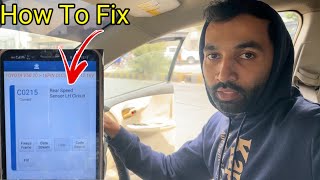
- Rust Buildup Under Sensor Mounting Surface (Less Common) — Rust forms on the hub where the sensor mounts ('rust jacking'). This pushes the sensor away from the reluctor ring, weakening the signal until the ABS module cannot read it. 🎬 Watch: A breakdown of common causes and fixes for C0215.
- Faulty ABS Control Module (Rare) — The ABS control module fails internally, misinterpreting a good sensor signal as a fault. This is usually accompanied by multiple other ABS trouble codes.
Symptoms

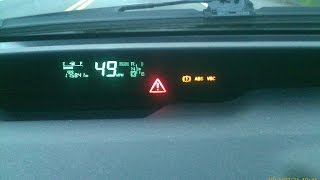
- ABS and Traction Control Lights On — The ABS and traction control (TCS/VSC) warning lights illuminate immediately on the dashboard.
- ABS Activates Incorrectly at Low Speeds — You feel a grinding or pulsating sensation from the brake pedal when coming to a slow stop (under 5 mph), as the ABS module incorrectly assumes the wheel is locking up.
- Harsh Automatic Transmission Shifting — The transmission control module (TCM) uses wheel speed data for shift points. A bad signal causes delayed, hard, or erratic shifts.
- Erratic Speedometer — Vehicles that use ABS sensors for vehicle speed calculation experience a bouncing speedometer needle or a speedometer that drops to zero.
- Loss of Cruise Control — Cruise control, regenerative braking, and advanced driver-assistance systems (ADAS) disable themselves due to the lack of accurate speed data. 🎬 See this step-by-step rear speed sensor replacement walkthrough.
Diagnostic Flowchart

Tap your situation to follow the diagnostic path that matches what you're seeing on this code.
Common Fixes & Costs
- Repair or Replace Wiring Harness Pigtail — Parts: $15-$50, Labor: $75-$150, ~1.0 hr book time (Intermediate)
- Replace Left Rear Wheel Speed Sensor — Parts: $25-$100, Labor: $50-$120, ~0.8 hr book time (DIY)
- Clean Reluctor Ring and Sensor Mounting Surface — Parts: $5-$15, Labor: $50-$100, ~0.7 hr book time (DIY)
- Replace Rear Wheel Hub Bearing Assembly — Parts: $150-$400, Labor: $150-$300, ~2.2 hr book time (Professional)
DIY vs Professional
- Replace Left Rear Wheel Speed Sensor — Beginner: Yes
Tools: Jack, jack stands, socket set, torque wrench, flashlight. - Clean Reluctor Ring and Sensor Mounting Surface — Beginner: Yes
Tools: Socket set, wire brush/file, brake cleaner. - Repair or Replace Wiring Harness Pigtail — Beginner: No
Tools: Soldering iron or quality crimping tool, heat shrink tubing, wire strippers. - Replace Rear Wheel Hub Bearing Assembly — Beginner: No
Tools: Breaker bar, high-torque impact wrench, axle nut socket, hub puller, high-capacity torque wrench.
Used vs. New Parts: Buying Guide
When a used part is worth it: Using a used part is only advisable for a wiring harness pigtail, provided it comes from a low-mileage vehicle and shows no signs of corrosion.
Donor-vehicle mileage cap: roughly under 60000 miles for the part to have meaningful remaining life.
Donor quality checklist:
- Flexible, clean insulation.
- Bright copper at the connector pins.
- No rust or corrosion on the connector housing.
Decision logic:
- If The part is a bolt-in wheel speed sensor → Buy new. The cost savings of a used sensor are minimal and not worth the risk of premature failure.
- If The part is a wheel hub bearing assembly → Always buy new. A used hub is a major gamble, as the bearing is a wear item with an unknown history.
- If The part is a wiring pigtail and the OEM part is unavailable → A used pigtail is acceptable if carefully inspected for brittle plastic and corrosion.
Warranty tradeoff: Used parts typically have a 30-day warranty. New aftermarket parts carry a 1-year warranty. A new OEM part offers the best guarantee of fit and function.
Worst-case if a used part fails: 250-500. If a used sensor or hub fails, you pay for the labor a second time.
What Happens If You Wait — Timeline
- 0-2 weeks: Code sets, ABS and Traction Control lights turn on. The ABS system is disabled. (MPG impact: 0%% · Added cost: 0)
- 2 weeks - 3 months (If caused by wiring/sensor): The issue remains a simple circuit fault. Some vehicles experience erratic shifting from the automatic transmission due to the lack of a valid speed signal. (MPG impact: 0-2%% · Added cost: 0-50)
- 1-4 months (If caused by a failing wheel bearing): A faint hum from the bearing progresses to a noticeable growl. Bearing wear accelerates, generating heat and potentially damaging the hub surface. (MPG impact: 1-3%% · Added cost: 250-500)
- 4+ months (If caused by a failing wheel bearing): Catastrophic bearing failure. The bearing seizes or collapses, leading to the wheel separating from the vehicle and severe suspension damage. (MPG impact: 5-10%% · Added cost: 1500-4000)
Cost of Not Fixing It
- Immediate: Loss of ABS, traction control, and stability control, significantly increasing the risk of skidding and loss of control in an emergency braking maneuver. (Added cost: 0)
- 1-6 Months: If the root cause is a failing wheel bearing, continued driving causes excessive heat and wear, permanently damaging the wheel hub or steering knuckle. (Added cost: 300-800)
- 6+ Months: Catastrophic failure of a worn wheel bearing leads to the wheel separating from the vehicle while driving, resulting in severe suspension and body damage. (Added cost: 2000-5000)
Diagnosis Steps
- Read Codes and Live Data
Use an OBD-II scanner to confirm C0215. View the live data for all four wheel speed sensors while driving slowly in a straight line. The left rear sensor reading will drop to zero intermittently or show a speed inconsistent with the other three wheels.
Tools: Advanced OBD-II Scanner (Beginner) - Visually Inspect the Wiring and Connector
Safely raise the rear of the vehicle. Inspect the entire length of the left rear wheel speed sensor wiring harness. Look for cuts, fraying, melting, or corrosion at the connector plug.
Tools: Jack, Jack Stands, Flashlight (Beginner) - Check for Wheel Bearing Play
With the wheel off the ground, grab the tire at the 12 and 6 o'clock positions and push/pull. Repeat at 3 and 9 o'clock. Any significant play, looseness, or grinding noise indicates a bad wheel bearing is causing the sensor misalignment.
Tools: Jack, Jack Stands (Intermediate) - Inspect and Clean Sensor and Reluctor Ring
Remove the mounting bolt and pull the sensor out of the hub. Check the magnetic tip for metal debris. Look inside the hole to inspect the reluctor ring for dirt, rust, or broken teeth. Clean both with brake cleaner.
Tools: Socket Set, Flashlight, Brake Cleaner, Rag (Intermediate) - Test Sensor Resistance (Passive Sensors)
Disconnect the sensor and set a multimeter to Ohms (Ω). Measure resistance between the two sensor pins. A typical reading is 800-2,000 Ω. A reading of OL (infinite) means an open circuit; near 0 Ω means a short. Both require sensor replacement.
Tools: Multimeter, Vehicle-Specific Repair Manual (Advanced) - Test Circuit Continuity
Disconnect the sensor and the ABS control module. Set the multimeter to Ohms (Ω). Test for continuity on both wires running between the sensor and the module. Resistance must be under 1 Ω. Test each wire against the chassis to ensure there is no short to ground (must read OL).
Tools: Multimeter, Vehicle-Specific Wiring Diagram (Advanced) - Measure Sensor Air Gap
Clean the sensor mounting surface down to bare metal to eliminate 'rust jacking'. Reinstall the sensor and check the gap between the sensor tip and reluctor ring with a non-magnetic feeler gauge. Typical specs are 0.5mm to 1.2mm.
Tools: Feeler Gauge, Wire Brush/File (Advanced) - Analyze Signal with an Oscilloscope
Backprobe the sensor's signal and ground wires at the ABS module. Spin the wheel. A good passive sensor produces a clean sine wave; an active sensor produces a clean square wave. A messy or flat-line pattern confirms a bad sensor or damaged tone ring.
Tools: Oscilloscope, Wiring Diagram (Professional)
When This Code Triggers (Freeze-Frame Conditions)
- Vehicle Speed: 20-55 mph (Sets during steady-state driving when the ABS module detects the left rear sensor's reading is erratic, missing, or deviates from the other three wheels.)
- Brake Pedal: Not Applied (Triggers during normal cruising, not necessarily during a braking event.)
- Engine RPM: 1500-2500 RPM (Typical engine speed during the steady cruise conditions under which the fault is most easily detected.)
- System Voltage: 13.5-14.5V (Normal operating voltage. A voltage spike from a jump start occasionally causes a temporary code.)
Related Codes
- C0210 — Identical code for the Right Rear Wheel Speed Sensor. Seeing both C0210 and C0215 together points to a shared wiring issue or a problem with the rear differential housing where the sensors mount.
- C0205 — Code for the Left Front Wheel Speed Sensor. Multiple wheel speed sensor codes from different corners point to a failing ABS control module or a power/ground supply issue.
- C1239 — Toyota-specific code for 'Foreign Matter is Attached on Tip of Rear Speed Sensor LH'. Confirms the issue is caused by metal shavings or debris on the sensor tip. Remove and clean the sensor.
- C1333 — Toyota-specific code for 'Open Circuit in Left Rear Wheel Speed Sensor Circuit'. Strongly suggests a broken wire, unplugged connector, or a completely failed sensor. Test for continuity.
Climate & Environmental Factors
- Road Salt and Humidity: Salt and moisture accelerate corrosion at wiring harness connectors and sensor mounting surfaces. This makes C0215 extremely common in 'Rust Belt' regions.
- Cold Weather: Extreme cold makes plastic wiring insulation brittle. Suspension movement cracks the insulation, exposing the copper wire to moisture and causing circuit failure.
- Off-Road/Gravel Roads: Rocks and debris physically damage the exposed wiring harness. Dust and mud contaminate the space between the sensor and reluctor ring, disrupting the magnetic signal.
How to Talk to a Mechanic About This Code
Say this: "I have an ABS light on and my scanner shows code C0215 for the left rear wheel speed sensor circuit. I'd like to book a diagnostic appointment. Please start by inspecting the wiring harness and connector for damage, and check for any play in the wheel bearing before quoting a sensor replacement."
This signals to the shop that you're an informed customer. Pointing them toward the most common diagnostic steps (wiring and bearing check) discourages them from immediately quoting an expensive sensor or hub replacement without proper investigation.
Avoid saying:
- 'My ABS light is on, can you fix it?'
- 'My brakes are acting weird.'
- 'Just replace the left rear speed sensor.'
Questions to ask before authorizing the repair:
- What were the results of the wiring inspection? Did you test for continuity and shorts?
- Did you check for play in the wheel bearing? Is it tight?
- If you are recommending a sensor replacement, how did you determine the sensor itself has failed?
- If you are recommending a hub replacement, are you seeing metal debris on the sensor or excessive play in the bearing?
- Is the quote for an OEM or aftermarket part? What is the warranty on the part and the labor?
Where to Take It: Dealer vs Independent vs Chain
- Dealer:
A safe but expensive option. Best for warranty work or if you have a very new vehicle with a specific known issue.
Best for: Vehicles still under warranty, Very new models (0-3 years old) with known TSBs or recalls, Complex electrical issues that an independent shop has failed to diagnose
Downsides: Highest labor rates, often 1.5-2x more than independent shops., May recommend replacing a larger assembly (e.g., entire hub) when only a smaller component (sensor or wiring) is needed. (Typical cost: +50% vs. baseline) - Independent Shop:
Best fit for most drivers. C0215 is a standard job for any competent independent shop. They are more likely to perform a detailed diagnosis of the wiring and bearing, and offer a choice between OEM and quality aftermarket parts.
Best for: Most out-of-warranty vehicles, Common, well-documented problems like C0215, Building a long-term relationship with a mechanic who knows your vehicle
Downsides: Quality and expertise vary greatly; vetting through reviews and ASE certifications is crucial., May lack the advanced diagnostic tools for brand-new or luxury models. (Typical cost: +0% vs. baseline) - Chain Shop:
Use with caution. Acceptable if you have already diagnosed the problem yourself and just need a simple sensor replacement, but avoid them for initial diagnosis of this code.
Best for: Simple, routine jobs like oil changes and tire rotations.
Downsides: Technician skill and experience vary dramatically., High pressure to meet sales targets leads to upselling unnecessary services., May lack the advanced diagnostic skills to differentiate between a sensor, wiring, or bearing failure. (Typical cost: -10% vs. baseline)
When to Walk Away From the Repair
If the estimated repair cost exceeds 50% of the car's private party value, it's time to seriously consider not fixing it. For older, high-mileage cars, use a lower threshold of 30-40%.
- Car worth $3000, fix is $1500: Walk away. The repair cost is 50% of the car's value. It's a money pit.
- Car worth $8000, fix is $700: Fix it. The repair is less than 10% of the car's value and addresses a critical safety system.
- Car worth $5000, fix is $2000: Borderline. The repair is 40% of the car's value. Get a second opinion and consider the car's overall condition before proceeding.
What Scan Tool You Need for This Code
Minimum: An OBD-II scanner that reads ABS/Chassis codes and displays live data.
A basic $20 engine code reader will NOT see ABS codes like C0215; it will show 'No Codes Found'. You need a scanner specifically advertised with ABS diagnostic capabilities. Viewing live data is crucial to watch the wheel speed sensor readings in real-time.
Budget: Innova 5210 or Ancel BD310 (~$80) — Reads and clears ABS codes. Displays live data streams, allowing you to compare the speed readings from all four wheels to identify the faulty one.
Mid-range: Foxwell NT510 Elite or BlueDriver Pro (~$150) — Offers enhanced graphing of live data, manufacturer-specific code definitions, and service functions like ABS brake bleeding. The BlueDriver pairs with a smartphone app for a user-friendly interface.
Professional: Autel MaxiCOM MK808S or Foxwell NT809 (~$400-600) — Provides full bidirectional control to actively test ABS components, advanced data graphing, and access to all vehicle modules.
Rent vs buy: Many auto parts stores have a loaner tool program where you can 'buy' a scanner and get a full refund upon return. You must specifically ask for a scanner with ABS capabilities. If you plan to do your own car maintenance, buying a budget or midrange scanner is a worthwhile investment.
How to Clear the Code After You Fix It
- Fix the underlying mechanical or electrical fault.
- Use an OBD-II scan tool with ABS capability to clear the fault code.
- Drive the vehicle above 15 mph for 5-10 minutes to allow the ABS module to self-test.
Drive cycle (~10 minutes): A 10-minute drive at city speeds is required for the system to verify the sensor is generating a valid signal. For Toyota and Lexus, the light extinguishes on its own once the car exceeds 15 mph.
Readiness monitors affected: None
Watch out for:
- Clearing the code without fixing the root cause results in the light returning immediately.
- Disconnecting the battery does not clear ABS codes and resets all emissions readiness monitors.
- Forgetting that the vehicle must be driven over 15 mph for the system to self-test and turn off the light.
Will This Fail Emissions / State Inspection?
No — by itself this code doesn't fail OBD inspection (but it can keep readiness monitors from setting, which causes a separate fail).
- California: An ABS light will NOT fail a smog check. California tests emissions-related faults, and ABS is considered a separate safety system.
- New York: An illuminated ABS warning light is NOT a cause for rejection during the annual safety inspection. It is an advisory item.
- Texas: An illuminated ABS warning light is explicitly NOT a cause for rejection during a safety inspection.
Most Commonly Affected Vehicles
- Toyota Prius (2004-2009) — Extremely common failure of the short wiring harness (pigtail) connecting the sensor to the main body harness. The wire breaks internally from stress. Replace with OEM part 89516-47050.
- Toyota Tundra (2000-2009) — Frequently caused by metal shavings from a failing wheel bearing contaminating the sensor and reluctor ring. Often appears alongside code C0210.
- Ford F-150 (2015-2020) — Known for damage to the rear sensor wiring harness from debris or improper routing. The sensor itself is also a frequent failure point.
- Chevrolet / GMC Silverado / Sierra 1500 (2007-2014) — Rust buildup on the hub's sensor mounting surface ('rust jacking') is the primary cause. Thoroughly cleaning the mounting pad with a wire brush or file resolves the issue.
- Hyundai / Kia Sonata / Elantra (2013-2020) — The rear wheel speed sensor is integrated into the wheel hub assembly. A faulty sensor requires replacing the entire hub, as the sensor cannot be reliably extracted.
Manufacturer-Specific Notes
- Toyota/Lexus: The short wiring harness for the rear sensors breaks internally from repeated suspension travel. On many models, the ABS light will not turn off after repair until the vehicle is driven over 15 MPH to complete a self-test.
- General Motors (GM): On GMT900 platform trucks, 'rust jacking' pushes the sensor away from the reluctor ring. You must remove the sensor and meticulously clean the mounting surface flat with a file or grinder to restore the correct air gap.
- Ford: F-150 trucks suffer from rear axle wiring harness chafing against the axle housing. This damages the wheel speed sensor wires and inadvertently applies the electric parking brake.
- Hyundai/Kia: The rear wheel speed sensor is integrated into the wheel hub and bearing assembly. It is highly recommended to replace the entire hub assembly rather than attempting to extract a seized sensor.
Real Owner Stories
2007 Toyota Tacoma with C0215
ABS light came on. The dealership diagnosed code C0215 and quoted $250 for the part alone.
What they tried:
- The owner found the part online for $20.
- They replaced the sensor themselves without removing the wheel.
Outcome: The fix was incredibly easy, involving only unclipping the wiring harness and removing one bolt. The code was resolved for a fraction of the dealer's quoted price.
Lesson: Check online prices for parts from reputable sources before agreeing to dealer pricing. Many simple sensor replacements are well within the scope of a DIY repair with basic tools.
2008 Toyota Prius at 170k miles with intermittent C0210 & C0215
The BRAKE, ABS, and VSC lights came on intermittently. A scan showed codes for both rear wheel speed sensors (C0210 and C0215).
What they tried:
- The owner suspected a wiring issue since it was unlikely both sensors failed simultaneously.
- They used Toyota's Techstream software to monitor live data.
Outcome: The owner discovered the fault was in a shared wiring harness connector. When multiple, separate sensor codes appear at the same time, the problem is a shared component like a wiring harness connector, a ground point, or the control module itself.
Lesson: If you get codes for multiple sensors at once, investigate what those sensor circuits have in common. Check for a shared wiring loom or connector before buying individual parts.
2009 Pontiac Vibe (Toyota Matrix) with C0215
ABS light on, accompanied by grinding/pulsating from the brakes at very low speeds (under 5 mph).
What they tried:
- The owner replaced the left rear wheel hub assembly, which includes the sensor.
- The problem persisted after the repair.
Outcome: The issue was traced to a damaged wiring harness pigtail. Constant suspension movement caused an internal break in the wire that wasn't visible from the outside. Splicing in a new pigtail connector solved the problem.
Lesson: ABS activation at low speeds is a classic sign of a faulty wheel speed sensor signal, but the wiring is often the true culprit. Perform a 'wiggle test' on the harness while watching live data on a scan tool to check for intermittent connection breaks.
How to Prevent This Code From Triggering
- Apply Dielectric Grease to Connectors (Whenever the connector is unplugged for service) — Dielectric grease seals out moisture and prevents corrosion on electrical connectors, stopping water intrusion in wet climates.
- Inspect and Secure Wiring Harnesses (During every tire rotation or brake service) — Broken plastic clips allow the harness to rub against the suspension or tire. Securing the wiring prevents chafing and wire damage.
- Periodically Clean the Undercarriage (Seasonally, especially after winter in 'Rust Belt' areas) — Washing away road salt and grime reduces the corrosive environment that attacks wiring connectors and causes 'rust jacking' on sensor mounts.
- Address Wheel Bearing Noise Immediately (As needed) — A humming noise is the first sign of a failing wheel bearing. Early replacement prevents metal particles from contaminating the ABS sensor and tone ring.
Key Takeaways
- Inspect the left rear wiring harness first, as broken wires or corroded connectors cause over 50% of C0215 codes.
- Expect stopping distances to increase by up to 25% on slippery surfaces because this code completely disables your ABS and traction control.
- Clean the sensor's magnetic tip and the toothed reluctor ring with brake cleaner before buying parts, as metal shavings frequently block the signal.
- Check for excessive play in the left rear wheel bearing, as a loose hub assembly alters the sensor's air gap and triggers this code.
Helpful Videos

Shop the Parts Behind C0215
Below are the parts most often responsible for code C0215, ranked by how frequently each one is the actual culprit (per the diagnosis above). Tap any to see what we have for your vehicle.



The information in this article is provided for general reference and educational purposes only. Vehicle specifications, procedures, and part compatibility can vary by production date, trim level, and region. Always consult your vehicle's factory service manual and verify part numbers before purchasing or performing repairs. Safety-critical components such as airbags, seat belts, and braking systems should be installed by a qualified professional.
- 🧭 Diagnostic Flowchart
- 🎬 Helpful Videos
- 🛍️ Shop This Part
- What Does C0215 Mean?
- Can I Drive With C0215?
- Common Causes
- Symptoms
- Common Fixes & Costs
- DIY vs Professional
- Used vs. New Parts: Buying Guide
- What Happens If You Wait — Timeline
- Cost of Not Fixing It
- Diagnosis Steps
- When This Code Triggers (Freeze-Frame Conditions)
- Related Codes
- Climate & Environmental Factors
- How to Talk to a Mechanic About This Code
- Where to Take It: Dealer vs Independent vs Chain
- When to Walk Away From the Repair
- What Scan Tool You Need for This Code
- How to Clear the Code After You Fix It
- Will This Fail Emissions / State Inspection?
- Most Commonly Affected Vehicles
- Manufacturer-Specific Notes
- Real Owner Stories
- 2007 Toyota Tacoma with C0215
- 2008 Toyota Prius at 170k miles with intermittent C0210 & C0215
- 2009 Pontiac Vibe (Toyota Matrix) with C0215
- How to Prevent This Code From Triggering
- Key Takeaways
- 🎟️ Get 5% Off