

OBD-II Code C0413: Rear Differential System Service
The Ultimate Guide to C0413: What It Means, Why It Triggers, and How to Fix It for Good
- Code C0413 specifically targets General Motors vehicles equipped with an electronic limited-slip differential (eLSD), requiring a bi-directional scan tool to perform a mandatory hydraulic bleed procedure.
- Always test the alternator for voltage spikes above 15.0V before replacing the $800 Rear Differential Control Module (RDCM), as an overcharging alternator is the primary killer of this module.
- Inspect the eLSD hydraulic port plug for leaks; replacing the factory Teflon-taped plug with a $30 aftermarket Viton O-ring plug permanently resolves air intrusion issues.
- Never use standard gear oil in the eLSD hydraulic system; using anything other than the exact GM DEXRON LS 75W-90 specification guarantees a self-test failure and triggers this code.
What Does C0413 Mean?
Code C0413 means the Rear Differential Control Module (RDCM) detected a failure in the electronic limited-slip differential (eLSD) hydraulic system. Specifically, a required hydraulic bleed procedure failed, was skipped after service, or aborted due to an underlying hardware or voltage fault.
Technical definition: The official SAE/OBD-II definition for C0413, used almost exclusively by General Motors, is "Rear Differential Hydraulic System Bleed Not Performed". This DTC sets when the RDCM determines the eLSD hydraulic clutch system has not been successfully bled of trapped air.
Can I Drive With C0413?
Yes, But With Caution. Yes, for gentle, short-distance driving to a repair shop. Aggressive driving is dangerous because the disabled eLSD causes unpredictable handling and sudden loss of traction during cornering. Continuing to drive with an overcharging alternator destroys other electronics, multiplying repair costs.
Common Causes
- Weak or failing vehicle battery (Very Common) — A weak battery causes a cascade of spurious error codes in the RDCM, even if the car starts reliably.
- Failing or overcharging alternator (Very Common) — A faulty alternator produces unstable voltage (spiking to 15V+), frying the sensitive RDCM. C0413 is often a symptom of alternator failure, not a differential problem. 🎬 Learn why an overcharging alternator triggers these specific symptoms.
- Low, incorrect, or contaminated rear differential fluid (Very Common) — The eLSD hydraulic system requires exact fluid levels and viscosity. Using non-specified fluid or running low triggers this code. 🎬 See how to properly change your C7 rear differential fluid.
- Leaking eLSD hydraulic drain plug (Common) — Factory eLSD hydraulic port plugs use Teflon tape that degrades under heat, causing a slow hydraulic leak and introducing air into the system.
- Faulty Rear Differential Control Module (RDCM) (Common) — The RDCM fails internally due to voltage spikes, moisture, or vibration.
- Software or Module Glitches (Common) — Temporary software glitches store this code. A re-flash or clearing the code and re-running the bleed procedure often resolves it.
- Damaged wiring or poor electrical connections (Less Common) — Exposed under-car wiring harnesses suffer corrosion or physical damage, interrupting RDCM signals.
- eLSD Clutch Pack Overheating (Less Common) — Indicated by a '54' subtype code, extreme track driving overheats the differential clutches.
- Failing eLSD hydraulic pump motor (Rare) — Indicated by a '58' subtype code, the electric pump wears out and draws less than the required 5 amps.
Symptoms
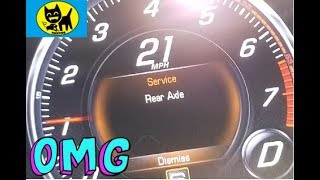
- "Service Rear Axle" Message — The Driver Information Center (DIC) displays 'Service Rear Axle' or 'Rear Axle System Off'. 🎬 Watch this owner's experience with the Service Rear Axle nightmare. The Check Engine Light also illuminates.
- Unstable handling during cornering — The car shimmies or loses traction unexpectedly in turns because the system stops managing rear wheel slip.
- StabiliTrak/Traction Control light flashes — The main traction control system intervenes aggressively during cornering to compensate for the disabled eLSD.
- Delayed Code Trigger — The code triggers 5-10 minutes into a drive when the RDCM performs its self-tests, not immediately at startup.
- Disabled eLSD function (also visible on scanner) — The eLSD deactivates, reducing traction during launches or cornering. The dash eLSD gauge shows dashes instead of a percentage.
Diagnostic Flowchart
Tap your situation to follow the diagnostic path that matches what you're seeing on this code.
Common Fixes & Costs
- Replace Vehicle Battery — Parts: $150-$300, Labor: $50-$100, ~0.5 hr book time (DIY)
- Replace Alternator — Parts: $300-$700, Labor: $200-$400, ~1.5 hr book time (Intermediate)
- Rear Differential Fluid Service — Parts: $50-$120, Labor: $150-$300, ~1 hr book time (DIY)
- Replace eLSD Hydraulic Drain Plug Seal — Parts: $20-$50, Labor: $100-$200, ~0.8 hr book time (DIY)
- Replace Rear Differential Control Module (RDCM) — Parts: $200-$800, Labor: $250-$500, ~2 hr book time (Professional)
- Replace Entire Rear Differential Assembly — Parts: $2500-$5500, Labor: $600-$1200, ~5 hr book time (Professional)
DIY vs Professional
- Rear Differential Fluid Service — Beginner: Yes, if comfortable working under a vehicle.
Tools: Jack and jack stands, socket set, fluid pump, drain pan, torque wrench. - Replace Vehicle Battery — Beginner: Yes.
Tools: Socket set or wrenches. - Replace Alternator — Beginner: No, this is for intermediate DIYers.
Tools: Socket set, wrenches, serpentine belt tool, torque wrench. - Replace Rear Differential Control Module (RDCM) — Beginner: No.
Tools: Socket set, trim removal tools, bi-directional scan tool with GM programming capabilities. - Replace eLSD Hydraulic Drain Plug Seal — Beginner: Yes, if comfortable with the fluid service procedure.
Tools: Jack and jack stands, socket set, fluid pump, drain pan, torque wrench, new plug/seal.
Used vs. New Parts: Buying Guide
When a used part is worth it: For expensive electronic modules like the RDCM or an alternator, a used part from a low-mileage, accident-damaged vehicle offers significant savings.
Donor-vehicle mileage cap: roughly under 60000 miles for the part to have meaningful remaining life.
Donor quality checklist:
- Verify donor vehicle mileage is under 60,000 miles.
- Visually inspect alternators for corrosion or bent pulleys.
- Ensure RDCM part numbers match exactly, as they are VIN-specific.
- Purchase from a seller offering a 30-90 day warranty.
Decision logic:
- If The part is an alternator and the vehicle is high-value. → Buy a new or professionally remanufactured part. The warranty outweighs the savings.
- If The part is an RDCM and a new OEM unit is over $600. → A used module from a low-mileage donor is reasonable, provided you have GM programming tools.
- If The vehicle is older (>10 years) and budget is the primary concern. → A used part is acceptable, acknowledging the higher risk of premature failure.
Warranty tradeoff: Used parts carry a 30-90 day warranty covering the part only. New OEM parts carry a 1-2 year warranty.
Worst-case if a used part fails: $400-800 if a used part fails after installation, accounting for repeat labor and reprogramming.
What Happens If You Wait — Timeline
- 0-1 month: The 'Service Rear Axle' light appears 5-10 minutes into a drive. The eLSD is disabled. The code clears but returns consistently. (MPG impact: 0%% · Added cost: $0)
- 1-6 months (Hydraulic Leak Path): The hydraulic pump ingests air. Whining or gurgling noises emit from the rear as the pump cavitates. C0414 appears alongside C0413. (MPG impact: 0%% · Added cost: $50 (Cost of lost fluid))
- 1-6 months (Electrical Fault Path): Voltage spikes actively damage the RDCM. Headlights burn out prematurely, the battery swells, and other warning lights flicker. (MPG impact: 5%% · Added cost: $800 - $2000 (Cost to replace fried RDCM and battery))
- 6+ months (Hydraulic Leak Path): The hydraulic pump fails completely from running dry, or internal clutch packs are damaged from lack of lubrication. (MPG impact: 0%% · Added cost: $2500 - $7000 (Cost of new pump or full differential assembly))
- 6+ months (Electrical Fault Path): Catastrophic electronic failure. Voltage spikes damage the Engine Control Module (ECU) and Body Control Module (BCM). The car fails to start. (MPG impact: 20%% · Added cost: $3000 - $7000 (Cost of alternator, RDCM, and other damaged modules))
Cost of Not Fixing It
- Short-Term (0-3 months): The eLSD is disabled, leading to reduced performance and unstable handling in aggressive driving. (Added cost: Negligible)
- Medium-Term (3-12 months): An overcharging alternator damages other sensitive electronic modules. A fluid leak damages the differential from fluid starvation. (Added cost: $500 - $2500+)
- Long-Term (1+ year): Ignoring an alternator leads to catastrophic failure of multiple electronic systems. Ignoring a fluid leak destroys the differential assembly. (Added cost: $2500 - $7000+)
Diagnosis Steps
- Test Battery and Alternator Voltage
Test resting battery voltage (12.6V) and running alternator voltage (13.2V-14.8V). Spikes above 15.0V indicate a bad alternator destroying the RDCM. Do not skip this step.
Tools: Digital Multimeter (Beginner) - Inspect Fluid and Hydraulic Plug
Check differential fluid level and inspect the eLSD hydraulic unit for leaks, specifically at the factory Teflon-taped drain plug.
Tools: Wrenches, Flashlight (Intermediate) - Scan for Subtype Codes
Read Chassis (C) codes. Look for C0413 and subtypes like '54' (overheating) or '58' (low pump current), plus C0414 or U-codes.
Tools: Advanced Bi-Directional Scanner (Intermediate) - Perform Hydraulic System Bleed
Command the RDCM hydraulic bleed routine. This must complete successfully after any fluid service. If it fails, the scanner provides the failure reason.
Tools: Professional Bi-Directional Scan Tool (Advanced) - Test eLSD Pump Motor Current
If C0413-58 is present, measure resistance between the pump motor pins or use an ammeter during the bleed procedure. Draw below 5 amps confirms pump failure.
Tools: Digital Multimeter, Ammeter Clamp, Wiring Diagram (Advanced) - Test the RDCM Power and Ground
Verify battery voltage (~12.6V key-on) at power pins and less than 0.1V at ground pins on the RDCM connector.
Tools: Digital Multimeter, Wiring Diagram (Advanced) - Inspect Wiring Harness
Visually inspect the RDCM wiring harness for chafing, road debris damage, or corroded connector pins.
Tools: Flashlight, Trim Removal Tools (Intermediate)
When This Code Triggers (Freeze-Frame Conditions)
- Engine Coolant Temp: 180-210°F (82-99°C) (The code sets after the vehicle reaches full operating temperature.)
- RPM: Idle to 2500 RPM (The eLSD self-test runs at low, steady speeds or shortly after startup.)
- Vehicle Speed: 5-40 mph (8-64 km/h) (The fault is detected during low-speed, in-town driving as the system performs initial self-checks.)
- Battery Voltage: 13.2-14.8V (The system monitors voltage closely; logging the fault when voltage is stable helps rule out momentary battery dips.)
Related Codes
- C0414 — Indicates a 'Rear Differential Hydraulic System' performance issue. If a bleed procedure clears C0413 but C0414 returns, it confirms a hardware problem like a weak pump or internal leak.
- U042B — 'Invalid Data Received From Chassis Control Module'. A secondary code caused by the RDCM sending corrupt data on the CAN bus. Fixing C0413 resolves it.
- C0407 — Indicates a fault in the 'Differential Clutch Control Solenoid Valve Circuit'. If the solenoid is faulty, the bleed cannot complete, setting C0413.
- C056E — 'Service Programming System (SPS) VIN Not Programmed'. Appears after replacing the RDCM if it has not been programmed with the vehicle's VIN.
Climate & Environmental Factors
- Extreme Cold: Differential fluid viscosity increases, causing groaning noises on tight turns. This indicates fluid health issues that eventually lead to a fault.
- High-Performance Driving / Track Use: Sustained aggressive driving overheats the eLSD clutch packs, triggering a C0413 with a '54' subtype. Heat accelerates the degradation of the hydraulic plug's Teflon tape seal.
- High Humidity / Road Salt: Promotes corrosion on exposed under-vehicle wiring harnesses, leading to poor connections and intermittent communication faults.
How to Talk to a Mechanic About This Code
Say this: "I have a 'Service Rear Axle' light and a C0413 code. I'd like a diagnostic that starts by testing the battery and checking the alternator for voltage spikes. If those are good, please check the eLSD fluid level and for any leaks at the hydraulic plug before attempting the scan tool bleed procedure."
This directs the mechanic to follow a logical, cost-effective diagnostic path instead of immediately quoting an expensive RDCM replacement.
Avoid saying:
- 'My Service Rear Axle light is on, can you fix it?'
- 'The internet says I need a new differential module.'
- 'Just do whatever it takes to fix the code.'
Questions to ask before authorizing the repair:
- What was the resting voltage of the battery and did you see any voltage spikes from the alternator when running?
- If you are recommending an RDCM replacement, can you confirm it has good power and ground and is communicating on the CAN bus?
- Did the scan tool's hydraulic bleed procedure fail, and if so, what reason did it give?
- Can you show me the old part you are replacing?
- What is the warranty on this specific repair, including parts and labor?
Where to Take It: Dealer vs Independent vs Chain
- Dealer:
Recommended if the vehicle is under warranty or if an independent shop fails to fix it. They have guaranteed access to required scan tools.
Best for: Vehicles still under warranty., Complex cases requiring a software re-flash or GM's latest TSBs., When you want a guaranteed fix with OEM parts.
Downsides: Highest labor rates., Defaults to replacing expensive modules rather than diagnosing cheaper root causes. (Typical cost: +50% vs. baseline) - Independent Shop:
Best fit for out-of-warranty cases, BUT you must call ahead and confirm they have a bi-directional scanner to perform the automated bleed.
Best for: Out-of-warranty vehicles where cost is a factor., Diagnosing common causes like battery/alternator issues or fluid leaks.
Downsides: Must verify the shop has a bi-directional scan tool capable of performing the GM-specific eLSD hydraulic bleed procedure., Technician experience with GM eLSD systems varies. (Typical cost: +0% vs. baseline) - Chain Shop:
AVOID for diagnosing C0413. They lack specialized tools and misdiagnose the problem.
Best for: Simple battery replacement or selling you a new alternator.
Downsides: Lacks the specific bi-directional scan tool required for the mandatory hydraulic bleed procedure., High pressure to upsell unnecessary parts. (Typical cost: -10% vs. baseline)
When to Walk Away From the Repair
If the total estimated repair cost exceeds 40-50% of your car's current private-party market value, consider selling or trading it in.
- Car worth $35000, fix is $3500: Fix it. This is a 10% repair cost, well below the threshold for a high-value performance car.
- Car worth $25000, fix is $7000: Borderline. A $7,000 repair is significant. Get a second opinion to confirm there isn't a cheaper fix before proceeding.
- Car worth $15000, fix is $8000: Walk away. The repair cost is over 50% of the car's value. It is not economically sensible to proceed.
What Scan Tool You Need for This Code
Minimum: A bi-directional scan tool capable of reading GM-specific Chassis (C) codes and performing the 'Automated Bleed' or 'Hydraulic System Bleed' procedure for the RDCM.
A basic $50 code reader cannot see Chassis codes and lacks bi-directional capability. It cannot command the mandatory hydraulic bleed procedure.
Budget: BlueDriver Pro Scan Tool (~$120) — Reads enhanced GM chassis codes and provides live data for monitoring battery voltage. It lacks the bi-directional control to perform the eLSD bleed procedure.
Mid-range: Foxwell NT510 Elite / NT710 (with GM Software) (~$180) — Offers OE-level diagnostics for GM, including the critical bi-directional control to command the eLSD automated bleed procedure.
Professional: Autel MaxiCOM MK808 / MaxiPRO MP900BT (~$500-900) — Professional-grade tools that definitively diagnose and fix the issue. They support the eLSD bleed and module programming.
Rent vs buy: You cannot rent the necessary bi-directional scan tool from auto parts stores. Buy a mid-range scanner only if you plan to perform other advanced DIY repairs.
How to Clear the Code After You Fix It
- Reconnect battery if disconnected.
- Use a compatible OBD-II scan tool to clear Chassis (C) codes.
- Perform the RDCM hydraulic bleed procedure using the scan tool.
- Perform the GM-specific drive cycle to allow all system monitors to run.
Drive cycle (~20 minutes): Start from cold. Idle for 2-3 minutes with A/C on. Accelerate to 55 mph and hold for 3-5 minutes. Coast down to 20 mph without braking. Accelerate to 55-60 mph and hold for 5 minutes. Coast down again. The eLSD self-test runs during low-speed portions.
Readiness monitors affected: Clearing all DTCs resets emissions monitors.
Before emissions retest: drive at least 50 miles to fully set monitors.
Watch out for:
- Clearing the code with a basic scanner fails; the code returns on the next drive cycle if the hydraulic bleed procedure is not completed.
- Disconnecting the battery clears the code but resets emissions monitors, causing an emissions test failure.
Will This Fail Emissions / State Inspection?
No — by itself this code doesn't fail OBD inspection (but it can keep readiness monitors from setting, which causes a separate fail).
- California: C0413 does not cause a smog check failure directly. However, if it triggers the Check Engine Light, the vehicle fails.
- New York: NYS inspection checks for any malfunction indicator light. If C0413 triggers the CEL or 'Service Rear Axle' light, it leads to a safety inspection failure.
- Pennsylvania: An illuminated warning light related to the differential system is grounds for failure at the inspector's discretion during the safety inspection.
Most Commonly Affected Vehicles
- Chevrolet Corvette (C7) (2014-2019) — Extremely common on Z51, Grand Sport, and Z06 models. Early 2014 models required 'triple flushes' of the differential fluid.
- Chevrolet Camaro (SS, SS 1LE, ZL1) (2016-2024) — High-performance models with the eLSD are prone to this code. GM released updated eLSD calibrations for 2017+ models.
- Cadillac ATS-V (2016-2019) — Susceptible to the leaking hydraulic port plug sealed with Teflon tape.
- Cadillac CTS-V (2016-2019) — Shares the eLSD technology and control systems with other high-performance GM vehicles.
- Cadillac Escalade / Escalade ESV (2015-2020) — 4WD models equipped with the optional electronic limited-slip differential display this code.
- GMC / Chevrolet Yukon, Tahoe, Silverado, Sierra (2014-2024) — Higher-trim trucks and SUVs equipped with the G80 automatic locking differential with eLSD experience this code.
- Saab 9-3, 9-5, 9-4X (XWD) (2008-2012) — Models with the Haldex Gen IV/V XWD system exhibit this code for hydraulic pump or controller faults.
Manufacturer-Specific Notes
- General Motors (Corvette): Early C7 models suffered fluid contamination from the factory, requiring a 'triple flush' of the differential fluid to resolve eLSD faults.
- General Motors (Performance Cars): The eLSD hydraulic port plug is sealed with Teflon tape from the factory. Pressure and heat shred the tape, causing leaks. Aftermarket O-ring seals fix this permanently.
- General Motors (Corvette/Camaro): A failing alternator overcharges the electrical system, destroying the RDCM. Replacing only the RDCM leads to repeat failure until the alternator is fixed.
- General Motors (Trucks/SUVs): Code B0413 exists on GM trucks. It is a Body code for the HVAC system, completely unrelated to the C0413 Chassis code.
Real Owner Stories
2016 Corvette Z06 at 30K miles - The Alternator Trap
Got 'Service Rear Axle' message intermittently. Dealer diagnosed a bad RDCM and replaced it. The code returned within a day.
What they tried:
- Dealer replaced RDCM ($1200) - code returned.
- Owner used a multimeter and saw voltage spiking to 15.5V on startup.
Outcome: The root cause was a failing alternator with a faulty voltage regulator. Replacing the alternator permanently fixed the issue. The original RDCM was destroyed by the voltage spikes.
Lesson: Always test the charging system for voltage stability (13.2-14.8V) before replacing the expensive control module.
2017 Camaro SS 1LE - The Misdiagnosis After Service
'Service Rear Axle' light appeared immediately after having the differential fluid changed at an independent shop.
What they tried:
- Shop cleared the code, but it returned immediately.
- Dealer diagnosed that the independent shop used the wrong type of gear oil.
Outcome: The dealer performed a 'triple flush' to remove the incorrect fluid, refilled with GM DEXRON LS 75W-90, and ran the scan tool bleed procedure. The code was resolved.
Lesson: The eLSD system requires exact OEM-specified fluid (ACDelco 10-4034). Non-specified fluid causes the self-test to fail.
2014 Corvette Z51 at 46K miles - The Persistent Leak
Owner experienced recurring C0413 and C0414 codes despite multiple dealer visits and a previous RDCM replacement.
What they tried:
- Dealer changed fluid - no fix.
- Owner inspected the differential and found fluid weeping from the eLSD hydraulic port plug.
Outcome: The owner replaced the factory Teflon-taped plug with an aftermarket plug featuring a Viton O-ring seal. This stopped the slow hydraulic leak, preventing air from entering the system.
Lesson: The factory Teflon tape on the eLSD hydraulic plug is a known failure point. Upgrade to an O-ring style plug for a permanent fix.
How to Prevent This Code From Triggering
- Perform regular battery health checks. (Every 6 months or during oil change.) — A weak battery is a leading cause of spurious electronic codes. Load testing identifies problems before they trigger random module faults.
- Monitor alternator voltage periodically. (Monthly.) — Catching an overcharging alternator (spikes >15V) early prevents the destruction of the expensive RDCM and other electronics.
- Use only GM-specified eLSD differential fluid. (At every fluid change.) — Using incorrect fluid causes the self-test failure that triggers C0413. The system requires GM DEXRON LS Gear Oil (P/N 88862624).
- Change differential fluid at appropriate intervals. (Every 45,000 miles for street driving, or after every 24 hours of track time.) — Clean fluid prevents premature wear on clutch packs and hydraulic components.
- Proactively replace the eLSD hydraulic plug. (During the next differential fluid service.) — Upgrading the factory Teflon-taped plug to an aftermarket Viton O-ring seal prevents fluid loss and air ingress.
Frequently Asked Questions
Is the eLSD hydraulic fluid the same as the differential gear oil?
No. The main differential uses gear oil, while the eLSD unit has a separate, sealed hydraulic system requiring specific hydraulic fluid. Opening the hydraulic system requires a scan tool bleed procedure.
Why did the code appear after I had my differential fluid changed?
This happens if the shop used the wrong gear oil viscosity or accidentally opened a hydraulic line. Introducing air into the eLSD system without performing a scan tool bleed triggers the code.
My mechanic replaced the RDCM but the code came back. What now?
Verify the alternator is providing stable voltage between 13.2V and 14.8V, as voltage spikes instantly destroy new modules. Also, confirm the mechanic successfully completed the mandatory scan tool hydraulic bleed procedure.
The dealer wants to replace the whole differential. Is that necessary?
Differential replacement is an absolute last resort for C0413. This code points to a fault in the hydraulic control system, fluid, or electronics, not the mechanical gears. Always diagnose the battery, alternator, and fluid leaks first.
Can I just clear the C0413 code and keep driving?
Clearing the code only turns off the light temporarily. It returns within 5 to 10 minutes of driving when the RDCM runs its mandatory self-test and detects the unbled hydraulic system.
Why did the code appear after a track day?
Extreme track driving overheats the differential clutches, triggering a C0413 with a '54' subtype code. Let the system cool completely, check the fluid condition, and perform a bleed procedure if the code persists.
Is C0413 the same as P0413?
No. C0413 is a GM-specific Chassis code for the eLSD system, while P0413 is a generic Powertrain code for the emissions system. Their diagnosis and repairs are completely unrelated.
Key Takeaways
- Code C0413 specifically targets General Motors vehicles equipped with an electronic limited-slip differential (eLSD), requiring a bi-directional scan tool to perform a mandatory hydraulic bleed procedure.
- Always test the alternator for voltage spikes above 15.0V before replacing the $800 Rear Differential Control Module (RDCM), as an overcharging alternator is the primary killer of this module.
- Inspect the eLSD hydraulic port plug for leaks; replacing the factory Teflon-taped plug with a $30 aftermarket Viton O-ring plug permanently resolves air intrusion issues.
- Never use standard gear oil in the eLSD hydraulic system; using anything other than the exact GM DEXRON LS 75W-90 specification guarantees a self-test failure and triggers this code.
Helpful Videos

Shop the Parts Behind C0413
Below are the parts most often responsible for code C0413, ranked by how frequently each one is the actual culprit (per the diagnosis above). Tap any to see what we have for your vehicle.



The information in this article is provided for general reference and educational purposes only. Vehicle specifications, procedures, and part compatibility can vary by production date, trim level, and region. Always consult your vehicle's factory service manual and verify part numbers before purchasing or performing repairs. Safety-critical components such as airbags, seat belts, and braking systems should be installed by a qualified professional.
- 🧭 Diagnostic Flowchart
- 🎬 Helpful Videos
- 🛍️ Shop This Part
- What Does C0413 Mean?
- Can I Drive With C0413?
- Common Causes
- Symptoms
- Common Fixes & Costs
- DIY vs Professional
- Used vs. New Parts: Buying Guide
- What Happens If You Wait — Timeline
- Cost of Not Fixing It
- Diagnosis Steps
- When This Code Triggers (Freeze-Frame Conditions)
- Related Codes
- Climate & Environmental Factors
- How to Talk to a Mechanic About This Code
- Where to Take It: Dealer vs Independent vs Chain
- When to Walk Away From the Repair
- What Scan Tool You Need for This Code
- How to Clear the Code After You Fix It
- Will This Fail Emissions / State Inspection?
- Most Commonly Affected Vehicles
- Manufacturer-Specific Notes
- Real Owner Stories
- 2016 Corvette Z06 at 30K miles - The Alternator Trap
- 2017 Camaro SS 1LE - The Misdiagnosis After Service
- 2014 Corvette Z51 at 46K miles - The Persistent Leak
- How to Prevent This Code From Triggering
- Frequently Asked Questions
- Is the eLSD hydraulic fluid the same as the differential gear oil?
- Why did the code appear after I had my differential fluid changed?
- My mechanic replaced the RDCM but the code came back. What now?
- The dealer wants to replace the whole differential. Is that necessary?
- Can I just clear the C0413 code and keep driving?
- Why did the code appear after a track day?
- Is C0413 the same as P0413?
- Key Takeaways
- 🎟️ Get 5% Off