

OBD-II Code C0454: Steering Angle Sensor Plausibility Failure
What C0454 means, why it triggers, and how to fix it
- Code C0454 disables critical safety systems like ABS and Electronic Stability Control because the steering angle data contradicts the vehicle's actual movement.
- Over 50% of C0454 codes stem from a bad wheel alignment or a forgotten sensor recalibration after a battery replacement, not a broken part.
- Driving with this code increases crash risk in emergency maneuvers, so limit driving to short trips under 40 mph until repaired.
- Save $200 to $900 in unnecessary parts by visually verifying your steering wheel is perfectly centered and performing a $100 scan tool recalibration before replacing the sensor.
What Does C0454 Mean?
Code C0454 means your car's main computer sees a disagreement between your steering wheel's position and how the car is actually moving. The Steering Angle Sensor (SAS) reports the wheel is turned, but other sensors (like yaw rate and lateral acceleration) report the vehicle is going straight, or vice-versa. This conflict forces the car to disable safety systems like stability control.
Technical definition: Code C0454 indicates a Steering Angle Sensor Plausibility Failure. The control module detects that the SAS signal contradicts data from other dynamic sensors (yaw rate, wheel speed, lateral acceleration). Unable to verify the driver's intended direction, the Electronic Brake Control Module (EBCM) disables related safety systems and illuminates warning lights.
Can I Drive With C0454?
Yes, But With Caution. Yes, but with caution. Your vehicle's electronic stability control (ESC/VSA) and ABS are disabled. This dramatically increases the risk of losing control in an emergency maneuver or on slippery roads. The car is mechanically driveable for short distances to a repair shop, but prolonged driving is unsafe.
Common Causes
- Steering Angle Sensor Not Calibrated (Very Common) — After a wheel alignment, battery replacement, or suspension work, the SAS requires recalibration to relearn the 'straight-ahead' position. Skipped calibrations are a primary cause of this code.
- Poor Wheel Alignment (Very Common) — If wheels are misaligned, the steering wheel isn't centered when driving straight. The SAS reports a turn, conflicting with other sensors and triggering the code.
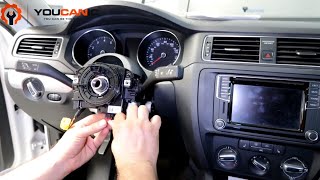
- Clock Spring Failure (Common) — The SAS often mounts directly to the clock spring. 🎬 See this walkthrough on replacing a clock spring and sensor. Broken internal ribbon cables disrupt the SAS signal, causing a C0454 code even if the sensor works perfectly. This is frequently misdiagnosed as a bad sensor.
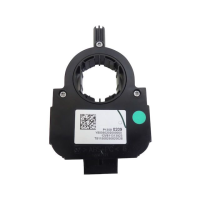
- Failing Steering Angle Sensor (SAS) (Common) — The sensor fails internally due to age, wear, or moisture. It sends erratic, frozen, or zero-value signals, forcing a fault.
- Fretting Corrosion on Connectors (Common) — GM vehicles frequently suffer from fretting corrosion (microscopic wear) on SAS connector terminals. This increases electrical resistance and weakens the signal.
- Damaged Wiring or Connectors (Less Common) — Wires in the steering column chafe or break due to constant movement, causing intermittent signal loss.
- Incorrect Steering Component Installation (Less Common) — If the steering wheel or column is removed and reinstalled off by a single spline, the SAS center point shifts, causing an immediate plausibility failure.
- Low Battery Voltage or Bad Ground (Less Common) — Modern stability control systems are highly sensitive to voltage drops. A weak battery or corroded ground strap causes the SAS module to malfunction.
- Faulty Yaw Rate or Lateral Acceleration Sensor (Rare) — A broken ABS wheel speed or yaw sensor reports incorrect vehicle movement, tricking the computer into flagging the perfectly functional SAS as the problem.
Symptoms
- Traction Control / Stability Control Light On — The system disables itself and illuminates the dashboard warning light (often a car with squiggly lines) because it cannot trust the steering data.
- ABS Light On — The Anti-lock Braking System relies on the SAS during cornering. A fault triggers the ABS warning light and disables the system.
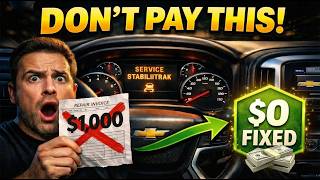
- Service StabiliTrak / AdvanceTrac / VSA Warning — GM, Ford, and Honda vehicles display specific text messages indicating a stability control system failure.
- Loss of Power Steering or Heavy Steering — Vehicles with electric power steering (EPS) reduce or shut off steering assist as a fail-safe, making the wheel very hard to turn.
- Advanced Safety Features Disabled — Lane-keeping assist, adaptive cruise control, and collision avoidance systems shut down because they require accurate steering data.
- Steering Wheel Doesn't Return to Center — The steering wheel fails to smoothly return to the straight-ahead position after a turn, indicating a mechanical alignment issue.
Diagnostic Flowchart
Tap your situation to follow the diagnostic path that matches what you're seeing on this code.
Common Fixes & Costs
- Steering Angle Sensor (SAS) Calibration Only — Parts: $0, Labor: $80-$150, ~0.7 hr book time (Professional)
- Wheel Alignment and SAS Calibration — Parts: $0, Labor: $180-$350, ~2.5 hr book time (Professional)
- Steering Angle Sensor (SAS) Replacement
— Parts: $100-$400, Labor: $100-$500, ~2.0 hr book time
(Professional)
Chevrolet/GMC Silverado/Sierra (2010-2013): OEM 19418403 (Alt: Dorman 601-175)
Ford Explorer (2011-2016): OEM BB5Z-3F818-A (Alt: Standard Motor Products SWS93) - Clock Spring Replacement
— Parts: $50-$300, Labor: $150-$400, ~2.2 hr book time
(Professional)
Hyundai Elantra/Sonata (2011-2015): OEM 93490-3S110 (Alt: Dorman 525-202) - Wiring Repair — Parts: $5-$20, Labor: $100-$250, ~1.5 hr book time (Intermediate)
DIY vs Professional
- Wheel Alignment 🟢 Beginner
Tools: Laser alignment rack, vehicle specification database. - SAS Calibration 🟢 Beginner
Tools: Bi-directional OBD-II scan tool. - SAS / Clock Spring Replacement 🟢 Beginner
Tools: Steering wheel puller, torque wrench, trim tools, bi-directional scan tool. - Wiring Repair 🟢 Beginner
Tools: Multimeter, wire strippers, soldering iron, heat shrink tubing.
Used vs. New Parts: Buying Guide
When a used part is worth it: Buying a used Steering Angle Sensor or Clock Spring is a high-risk strategy. It only makes sense for older vehicles on a tight budget where you accept the risk of premature failure.
Donor-vehicle mileage cap: roughly under 60000 miles for the part to have meaningful remaining life.
Donor quality checklist:
- Verify the donor vehicle's mileage and ensure the steering column was unaffected by any accident.
- Match the part number exactly.
- Avoid parts from flood-damaged vehicles.
Decision logic:
- If Part is a clock spring → Buy new OEM or high-quality aftermarket. A used clock spring has an unknown lifespan in its flexible ribbon cable.
- If Labor for replacement is over 2 hours → Buy new. Paying labor twice if the used part fails outweighs initial savings.
- If Vehicle is a luxury model with complex electronics → Buy new OEM to ensure perfect compatibility.
Warranty tradeoff: Salvage yard parts carry a 30-90 day warranty on the part only. New aftermarket parts offer 1-year to lifetime warranties. New OEM parts have a 1-2 year warranty.
Worst-case if a used part fails: $300-$700 to repeat labor and buy another replacement part.
What Happens If You Wait — Timeline
- Immediate: Code sets. ABS and Stability/Traction Control warning lights illuminate. All related safety systems are disabled. (MPG impact: 0%% · Added cost: $0. The primary cost is a significantly increased risk of an accident in an emergency maneuver.)
- 1-3 months: If the cause is a bad alignment, uneven tire wear begins. The car pulls slightly to one side. (MPG impact: 1-3%% · Added cost: $50-$150 in wasted fuel and early tire wear.)
- 3-9 months: Uneven tire wear becomes severe, ruining tires. Increased stress is placed on suspension components like ball joints and tie rods. (MPG impact: 3-5%% · Added cost: $400-$1,000 for a new set of prematurely worn tires.)
- 9+ months: Dashboard warning lights mask new problems. Risk of a major accident remains high. Secondary suspension component wear increases. (MPG impact: 3-5%% · Added cost: Over $1,000 for new tires and potential suspension repairs.)
Cost of Not Fixing It
- Immediate: Electronic Stability Control (ESC) and ABS are disabled, significantly increasing the risk of losing control in an emergency maneuver. (Added cost: Increased risk of an accident.)
- 0-6 months: If the root cause is a poor wheel alignment, continued driving causes accelerated and uneven tire wear. (Added cost: $300-$1200 for premature tire replacement.)
- 6+ months: Dashboard warning lights mask new, potentially serious safety issues. Suspension components suffer increased stress from misalignment. (Added cost: $500-$2000 in secondary suspension repairs.)
Diagnosis Steps
- Verify Wheel Alignment and Steering Wheel Position
Park on a level surface with the wheels pointing straight ahead. If the steering wheel is crooked by more than 5 degrees, a wheel alignment is your most likely fix.
Tools: Your eyes (Beginner) - Read Live Data with a Bi-Directional Scanner
Connect a scanner to the ABS module. Watch the 'Steering Angle' PID. With the wheel physically centered, it should read 0.0° ± 5.0°. Turn the wheel lock-to-lock; numbers must change smoothly without jumping or freezing.
Tools: Advanced OBD-II Scanner (Intermediate) - Attempt a Steering Angle Sensor Recalibration
Find the 'SAS Calibration' function in the scanner's ABS menu. Follow the prompts to center the wheel and reset the zero point. If calibration fails or the code returns immediately, proceed to electrical testing.
Tools: Advanced OBD-II Scanner (Intermediate) - Check Related Sensor Data
Compare the SAS reading to 'Yaw Rate' and 'Wheel Speed' sensors in live data. If the car is stationary but the yaw rate shows movement, that sensor is the actual cause of the plausibility error.
Tools: Advanced OBD-II Scanner (Advanced) - Inspect the SAS and Clock Spring Wiring
Visually inspect the wires and connectors at the steering column for damage or corrosion. Unplug and replug the connector. On GM vehicles, check terminals closely for dark smudges (fretting corrosion).
Tools: Flashlight, Trim removal tools (Intermediate) - Check for Technical Service Bulletins (TSBs)
Search online for TSBs related to C0454 or StabiliTrak issues for your specific VIN. Manufacturers frequently release updated parts or software to fix known SAS problems.
Tools: Online TSB Database (Intermediate) - [PRO TIP] Test Sensor Voltage Output
Back-probe the SAS connector. Verify 12V power and a clean ground (<0.1V). The signal wire voltage should sweep smoothly between 0.5V and 4.5V as the wheel turns. Erratic jumps indicate a faulty sensor.
Tools: Multimeter, Wiring diagram, Back-probe kit (Advanced) - [PRO TIP] Analyze SAS Signal with an Oscilloscope
Connect a scope to both SAS signal wires. Turning the wheel should produce two clean, opposing sawtooth or sine wave patterns. Glitches or flat lines instantly confirm a failed sensor.
Tools: Oscilloscope, Wiring diagram (Professional)
When This Code Triggers (Freeze-Frame Conditions)
- Vehicle Speed: 15-60 mph (Driving, not stationary. The code sets when the ECU compares steering angle to vehicle movement (yaw, wheel speed).)
- Steering Angle: Varies (e.g., 0° or >15°) (Triggers when the reported angle is illogical. For example, reading 20° while yaw sensors indicate straight travel.)
- Yaw Rate / Lateral G: Near 0 (A common trigger scenario is driving straight (zero yaw) while the SAS reports a significant steering angle.)
Related Codes
- C0710 — A generic code for a Steering Position Sensor fault. C0454 specifies a 'plausibility' failure (data contradicts other sensors), while C0710 indicates a direct circuit or internal sensor fault.
- C0545 — Indicates 'Steering Wheel Torque Sensor Calibration Not Learned'. C0454 tracks steering angle, while C0545 tracks steering effort. Often appears after steering rack replacement.
- U0126 — Indicates 'Lost Communication With Steering Angle Sensor Module'. Seeing this alongside C0454 points to a severe electrical issue (blown fuse, broken wire) rather than a calibration error.
- U0428 — Indicates 'Invalid Data Received From Steering Angle Sensor Module'. Set concurrently by other modules, confirming the network recognizes the SAS data as corrupt.
Climate & Environmental Factors
- High Humidity / Moisture: Moisture drives fretting corrosion on electrical connectors, a primary cause of C0454 on GM vehicles. It also penetrates poorly sealed sensor housings.
- Extreme Cold: Cold thickens the grease inside the steering angle sensor or clock spring, impeding movement. It also makes plastic components and wire insulation brittle.
- Road Salt: Salt spray accelerates corrosion on wiring, connectors, and ground points, causing erratic electrical behavior.
How to Talk to a Mechanic About This Code
Say this: "I have a C0454 code and my stability control light is on. I'd like to schedule a diagnostic. Please start by checking the live data from the steering angle sensor and attempting a recalibration before recommending any part replacements."
This signals you are informed about non-part-related causes of C0454. It directs them to perform the cheapest diagnostic steps first, preventing an immediate quote for an expensive sensor replacement.
Avoid saying:
- 'My traction control light is on, can you fix it?' (Too vague; invites the most expensive fix.)
- 'I think I need a new steering sensor.' (Don't diagnose it for them; you steer them away from a cheaper solution.)
- 'Just do whatever it takes to fix it.' (Gives a blank check for unnecessary repairs.)
Questions to ask before authorizing the repair:
- What did the live data from the steering angle sensor show? Was the angle reading zero when the wheel was straight?
- Did you successfully perform a steering angle sensor calibration, or did the procedure fail?
- If recommending a part replacement, how did you rule out a bad wheel alignment, a wiring problem, or a clock spring failure?
- Is this repair covered by any warranty or technical service bulletins (TSBs) for my vehicle?
- Can you provide a written estimate breaking down parts and labor?
Where to Take It: Dealer vs Independent vs Chain
- Dealer:
Go here FIRST only if your vehicle model has a known warranty extension. Otherwise, use as a last resort due to high cost.
Best for: Vehicles under warranty or with known warranty extensions (e.g., Ford Explorer steering rack, Hyundai clock spring)., Complex electronic issues on luxury vehicles (BMW, Audi, Mercedes)., When independent shops fail to diagnose the problem correctly.
Downsides: Highest labor rates, typically 1.5-2x more than independent shops., Defaults to replacing entire assemblies (like a steering rack) when a smaller component suffices. (Typical cost: +50% vs. baseline) - Independent Shop:
Best overall fit. Find a well-reviewed shop with ASE-certified technicians and specifically ask if they have a bi-directional scan tool to perform a Steering Angle Sensor calibration.
Best for: Most out-of-warranty vehicles., Performing alignments and SAS calibrations., Diagnosing common electronic faults on domestic and popular import brands.
Downsides: Quality depends heavily on the specific shop's diagnostic equipment., May lack access to the latest manufacturer-specific software or TSBs. (Typical cost: +0% vs. baseline) - Chain Shop:
Acceptable for a wheel alignment, but AVOID for diagnosing the C0454 code itself. If the light appears after their alignment, insist they perform the SAS calibration they missed.
Best for: Wheel alignments., Simple, non-diagnostic work like tire or battery replacement.
Downsides: Technician skill for complex electronic diagnostics is inconsistent., Often lack the advanced bi-directional scan tools required for SAS calibration., High pressure to upsell services. (Typical cost: -10% vs. baseline)
When to Walk Away From the Repair
If the estimated repair cost exceeds 50% of the car's private-party value, seriously consider selling or trading it in.
- Car worth $5000, fix is $700: Fix it. The repair cost is well below the 50% threshold and much cheaper than a new car payment.
- Car worth $3500, fix is $2200: Walk away. The repair cost is over 60% of the car's value. It's not a financially sound investment.
- Car worth $15000, fix is $1800: Fix it. This is a reasonable cost to maintain the safety and function of a higher-value vehicle.
What Scan Tool You Need for This Code
Minimum: A bi-directional scan tool capable of performing a 'Steering Angle Sensor (SAS) Calibration/Reset' and reading live data from the ABS/Chassis control module.
A basic $20-$80 code reader only shows the C0454 code. It CANNOT view live steering angle data or perform the mandatory SAS calibration required to complete the repair. Auto parts store 'loaner' tools are basic readers and will not work.
Rent vs buy: Buy, but only if you are a serious DIYer. Bi-directional scanners are generally not available through free loaner programs. For a one-time fix, paying a shop $80-$150 for calibration is cheaper than buying a capable scanner.
How to Clear the Code After You Fix It
- Perform required SAS calibration using a bi-directional scan tool.
- Use the scan tool to clear the C0454 code from the ABS/ESC module.
- Perform a test drive including straight-line driving and several full turns to confirm the fix.
Drive cycle (~15 minutes): Start the vehicle. Drive straight on a level surface above 15 mph for a short distance. Perform several slow, full turns to the left and right in a safe area. Drive for 5-10 minutes at mixed speeds. The warning light should remain off.
Readiness monitors affected: This is a Chassis code and does not affect emissions readiness monitors.
Watch out for:
- Clearing the code without performing the SAS calibration causes the code to return instantly.
- Manual reset procedures (disconnecting battery, turning wheel lock-to-lock) fail on most modern vehicles; a professional scan tool is required.
- Forgetting to clear the code from the ABS/ESC module after repair.
Will This Fail Emissions / State Inspection?
No — by itself this code doesn't fail OBD inspection (but it can keep readiness monitors from setting, which causes a separate fail).
- California: C0454 does not fail the OBD-II emissions Smog Check. However, an illuminated ABS/Stability light causes failure in a separate safety inspection.
- New York: An illuminated ABS warning light is grounds for immediate failure of the NYS safety inspection.
- Texas: An illuminated ABS warning light is NOT a cause for rejection in the state's safety inspection, though the primary red 'Brake' light is.
Most Commonly Affected Vehicles
- Chevrolet / GMC Silverado / Sierra (2007-2018) — Triggers a 'Service StabiliTrak' message. TSB PI0639C addresses fretting corrosion on sensor connectors as a common, cheap fix before replacing the $400 sensor.
- Ford Explorer (2011-2019) — The SAS is integrated into the electronic power steering rack. Failure triggers 'Service Power Steering' and requires a full rack replacement ($1500-$2500). Check Ford extended warranty 15N01.
- Hyundai / Kia Elantra, Optima, Sonata (2011-2015) — Often caused by a failed clock spring assembly. Hyundai issued extended warranties (e.g., TSB 17-BE-004-1) covering the clock spring for 15 years/unlimited miles.
- BMW 3-Series (E90, E92) (2006-2013) — The SAS is part of the switch unit (SZL). Dirt on the internal optical disc causes failure. Dealership replacement exceeds $1000.
- Honda Civic, CR-V, Odyssey (2011-2019) — SAS issues frequently appear after a battery disconnect. A simple scan tool calibration usually resolves the VSA warning lights without parts replacement.
Manufacturer-Specific Notes
- General Motors (GM): A 'Service StabiliTrak' message is the first sign of a SAS problem. TSB PI0639C addresses fretting corrosion on connectors, a fix that requires cleaning and dielectric grease rather than a new sensor.
- Ford: On EPAS-equipped models, the SAS is integrated into the steering rack. Failure requires replacing the entire expensive rack. Check Customer Satisfaction Program 15N01 for warranty extensions.
- Hyundai: Hyundai issued multiple warranty extensions (e.g., TSB 17-BE-004-1) for faulty clock springs housing the SAS, covering repairs for 15 years/unlimited miles.
- Subaru: A C0454 code disables the entire EyeSight suite, including adaptive cruise control and lane keeping. Calibration is highly sensitive and requires a perfectly level surface.
Real Owner Stories
2012 Chevy Silverado, 115K miles - The "Easy Fix"
Owner reported intermittent 'Service StabiliTrak' lights, especially during U-turns. Code C0454 was present.
Outcome: The owner cleaned the terminals with contact cleaner and applied dielectric grease (GM P/N 12377900). The code cleared and did not return. This fix, detailed in GM TSB PI0639C, cost under $20.
Lesson: On GM trucks, always inspect the SAS connector for fretting corrosion before replacing the sensor. It is a well-documented issue with a cheap fix.
2013 Hyundai Elantra, 80K miles - A Misdiagnosis Story
Airbag and ESC lights illuminated simultaneously with code C0454. The horn and steering wheel radio controls also failed.
Outcome: The owner found Hyundai TSB 17-BE-004-1 extending the clock spring warranty to 15 years/unlimited miles. A dealer confirmed the clock spring (which houses the SAS) was faulty and replaced it for free.
Lesson: If C0454 is accompanied by failing horn or steering wheel buttons, the clock spring is the culprit. Always check for warranty extensions.
2011 Ford Explorer, 120K miles - The Expensive Fix
'Service Power Steering' warnings appeared, steering became heavy, and code C0454 was stored.
Outcome: The mechanic determined the entire electronic power steering rack assembly was faulty, as the SAS is integrated. The repair cost over $2,000. The owner missed Ford's 10-year/150,000-mile extended warranty program (15N01) by a few months.
Lesson: For certain Ford models, C0454 indicates a failure of the entire steering rack. Check eligibility under warranty program 15N01 before the limit expires.
How to Prevent This Code From Triggering
- Perform a wheel alignment check periodically (Every 1-2 years or 12,000-15,000 miles) — Keeps the steering wheel centered, preventing the most common cause of a C0454 plausibility error and saving money on tires.
- Request SAS calibration after any alignment or suspension work (Every time alignment/suspension work is done) — Ensures the sensor's 'zero point' matches the new physical alignment of the wheels.
- Apply dielectric grease to critical connectors (When servicing components in harsh environments) — Creates a moisture-proof barrier preventing fretting corrosion on connector pins, a known issue on GM vehicles.
- Avoid hitting curbs and deep potholes (Daily driving habit) — Sudden impacts knock wheel alignment out of specification, directly leading to the C0454 code.
Frequently Asked Questions
Can a bad alignment really cause this expensive electronic code?
Yes, absolutely. If your steering wheel is not physically centered when you're driving straight, the Steering Angle Sensor constantly sends a signal that you're turning. This conflicts with wheel speed and yaw rate sensors, triggering the C0454 plausibility code.
I just got a wheel alignment and now my traction control light is on with code C0454. What happened?
The technician likely skipped the required Steering Angle Sensor (SAS) recalibration. The sensor's 'center' position is now incorrect because the physical alignment changed. Return to the shop and have them calibrate the sensor with a scan tool.
My mechanic wants to replace the Steering Angle Sensor, but I've read it might be the clock spring. How can I tell?
In many cars, the SAS and clock spring are one integrated unit. If your steering wheel controls (radio, cruise control) or horn also failed, the clock spring is the culprit. If only the stability/ABS lights are on, the SAS itself is more suspect.
Why did this code appear right after I replaced my battery?
The Steering Angle Sensor requires constant power to retain its memory and calibration. Disconnecting the battery causes the SAS to lose its 'zero point'. A simple recalibration procedure with a scan tool fixes this.
Can I replace the Steering Angle Sensor myself?
This is an advanced DIY job that involves removing the airbag, which carries significant safety risks. After replacement, the new sensor absolutely must be calibrated with a professional-grade, bi-directional scan tool. Failure to calibrate guarantees the code returns immediately.
Why did my power steering stop working with this code?
Your car's electronic power steering (EPS) uses the SAS to determine how much steering assistance to provide. When the computer receives an unreliable signal, it disables the assist as a fail-safe. This prevents erratic steering behavior but makes the wheel very heavy.
Is C0454 the same as P0454?
No, they are completely different. C0454 is a 'C' (Chassis) code related to the Steering Angle Sensor. P0454 is a 'P' (Powertrain) code related to the evaporative emissions (EVAP) system, often caused by a faulty fuel tank pressure sensor.
What does 'plausibility failure' mean?
Plausibility failure means a sensor's data contradicts other related sensors. For C0454, the steering angle sensor reports the wheel is turned 20 degrees, but wheel speed sensors show the car moving straight. The computer sees this conflict and flags the steering data as illogical.
Key Takeaways
- Code C0454 disables critical safety systems like ABS and Electronic Stability Control because the steering angle data contradicts the vehicle's actual movement.
- Over 50% of C0454 codes stem from a bad wheel alignment or a forgotten sensor recalibration after a battery replacement, not a broken part.
- Driving with this code increases crash risk in emergency maneuvers, so limit driving to short trips under 40 mph until repaired.
- Save $200 to $900 in unnecessary parts by visually verifying your steering wheel is perfectly centered and performing a $100 scan tool recalibration before replacing the sensor.
Helpful Videos
Shop the Parts Behind C0454
Below are the parts most often responsible for code C0454, ranked by how frequently each one is the actual culprit (per the diagnosis above). Tap any to see what we have for your vehicle.


The information in this article is provided for general reference and educational purposes only. Vehicle specifications, procedures, and part compatibility can vary by production date, trim level, and region. Always consult your vehicle's factory service manual and verify part numbers before purchasing or performing repairs. Safety-critical components such as airbags, seat belts, and braking systems should be installed by a qualified professional.
- 🧭 Diagnostic Flowchart
- 🎬 Helpful Videos
- 🛍️ Shop This Part
- What Does C0454 Mean?
- Can I Drive With C0454?
- Common Causes
- Symptoms
- Common Fixes & Costs
- DIY vs Professional
- Used vs. New Parts: Buying Guide
- What Happens If You Wait — Timeline
- Cost of Not Fixing It
- Diagnosis Steps
- When This Code Triggers (Freeze-Frame Conditions)
- Related Codes
- Climate & Environmental Factors
- How to Talk to a Mechanic About This Code
- Where to Take It: Dealer vs Independent vs Chain
- When to Walk Away From the Repair
- What Scan Tool You Need for This Code
- How to Clear the Code After You Fix It
- Will This Fail Emissions / State Inspection?
- Most Commonly Affected Vehicles
- Manufacturer-Specific Notes
- Real Owner Stories
- 2012 Chevy Silverado, 115K miles - The "Easy Fix"
- 2013 Hyundai Elantra, 80K miles - A Misdiagnosis Story
- 2011 Ford Explorer, 120K miles - The Expensive Fix
- How to Prevent This Code From Triggering
- Frequently Asked Questions
- Can a bad alignment really cause this expensive electronic code?
- I just got a wheel alignment and now my traction control light is on with code C0454. What happened?
- My mechanic wants to replace the Steering Angle Sensor, but I've read it might be the clock spring. How can I tell?
- Why did this code appear right after I replaced my battery?
- Can I replace the Steering Angle Sensor myself?
- Why did my power steering stop working with this code?
- Is C0454 the same as P0454?
- What does 'plausibility failure' mean?
- Key Takeaways
- 🎟️ Get 5% Off