

C0455 on 2012-2013 GMC Sierra: Steering Angle Sensor Circuit Causes and Fixes
On a 2012-2013 GMC Sierra, code C0455 almost always indicates a problem with the steering angle sensor circuit, triggering a 'Service StabiliTrak' message. The most common cause is a poor connection at the sensor, which can often be fixed for under $20 by shimming the connector and applying dielectric grease, as outlined in GM Technical Service Bulletin PI0639D. Replacing the sensor itself is often unnecessary.
- Code C0455 on a 2012-2013 Sierra will disable your StabiliTrak system and illuminate a warning on the dash.
- Before buying any parts, ALWAYS inspect the steering angle sensor's electrical connector for looseness. This is the most common cause.
- The official GM fix for a loose connector (TSB #PI0639C) is to add a shim and dielectric grease, which is a very low-cost repair.
- Only replace the steering angle sensor if the connector fix fails and live data from the sensor is confirmed to be faulty.
- This repair involves safety systems (airbag, stability control) and may require calibration, so professional service is recommended if you are not experienced.
What's Unique About the 2012-2013 Gmc SIERRA
The GMT900 platform, which includes the 2012-2013 Sierra, is well-known for this specific issue. The problem is so common that General Motors issued Technical Service Bulletin PI0639D, superseding earlier versions. This TSB acknowledges that the plastic connector for the steering angle sensor can have excessive clearance, leading to micro-vibrations and fretting corrosion on the electrical terminals. Fretting corrosion appears as small, dark smudges on the terminals where contact is made. This looseness causes a poor signal without the sensor itself actually failing. The official fix doesn't even involve replacing the sensor, but rather shimming the connector with adhesive stock and applying dielectric lubricant to the terminals.
Diagnostic Flowchart
Tap your situation to follow the diagnostic path that matches what you're seeing on this vehicle.
Symptoms You May Notice
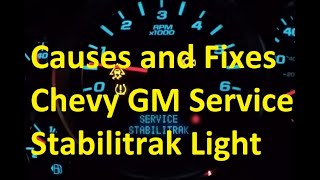
- "Service StabiliTrak" message displayed in the Driver Information Center (DIC). 🎬 Watch: What the Service StabiliTrak message means for your truck.
- StabiliTrak/Traction Control indicator light is on.
- ABS light may be illuminated.
- In rare cases, unexpected ABS activation at low speeds has been reported by owners.
- Replacing the steering angle sensor without first attempting the TSB fix for the connector. The TSB explicitly warns *not* to replace the sensor for the common fretting corrosion issue, as the problem will persist.
Most Likely Causes
- Poor Connection at Steering Angle Sensor Connector 🔴 High Probability → Shop Steering Angle Sensor A known design flaw documented in GM TSB PI0639D. The connector housing has excessive clearance, allowing movement that causes fretting corrosion on the terminals, leading to increased resistance and signal loss.
How to confirm: With the key on, gently wiggle the sensor's electrical connector at the base of the steering column. If it has noticeable vertical play, or if wiggling it causes the 'Service StabiliTrak' message to appear or disappear, this is the likely cause. Visually inspect the connector terminals for dark, smudgy deposits ('fretting corrosion'). A user on PerformanceTrucks.net reported their issue was resolved just by unplugging and replugging the sensor.
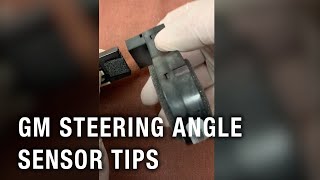
Typical fix: Per TSB #PI0639D, apply dielectric lubricant (GM P/N 12377900) to the connector terminals and add a piece of adhesive shim stock (Kent Automotive P/N P40100) to the flat surface of the male connector body to eliminate movement. Many owners report success using a small zip tie to secure the connector tightly as an alternative to the shim. 🎬 See this quick tip for fixing the sensor connector.
Est. part cost: $5-$25 - Faulty Steering Angle Sensor 🟡 Medium Probability → Shop Steering Angle Sensor While less common than the connector issue, the sensor itself can fail internally. However, TSB PI0639D explicitly warns not to replace the sensor for the connector fretting condition. This is often misdiagnosed, leading to repeat repairs.
How to confirm: If the connector fix does not resolve the code, the sensor is the next likely culprit. A professional scan tool can monitor the sensor's live data; if the angle readings are erratic, jumpy, stuck, or do not change smoothly as the wheel is turned, the sensor has likely failed.
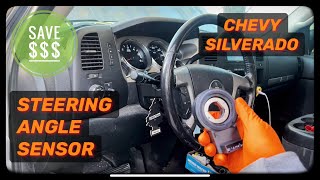
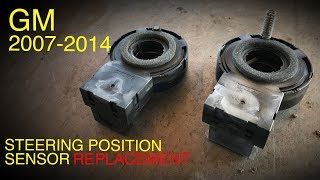
Typical fix: Replace the steering angle sensor. This requires disconnecting the battery, removing the airbag and steering wheel, and then replacing the sensor on the column. 🎬 Watch: Step-by-step guide to replacing the steering wheel sensor. The new sensor must be calibrated afterward.
Est. part cost: $60-$180 - Improperly Installed/Centered Steering Wheel ⚪ Low Probability This typically occurs after a separate repair, like steering shaft replacement, clock spring replacement, or a wheel alignment where the steering wheel was not properly centered before adjusting toe.
How to confirm: If the code appeared immediately after steering column work or an alignment, this is a strong possibility. A scan tool will show the steering angle is not near 0 degrees when driving straight. The code can set if the angle is off by more than 30 degrees. TSB #PIT4225F notes this as a possible cause if the wheel is not installed correctly on the shaft.
Typical fix: The steering wheel must be removed and reinstalled correctly, aligning the marks on the wheel and the steering shaft. A steering angle sensor recalibration is required afterward. An alignment shop can also perform the electronic calibration.
Est. part cost: $0-$100
Rare But Worth Checking
- Damaged Wiring Harness: Although uncommon, wiring between the sensor and the EBCM can become chafed or broken, causing an open or short in the circuit. If the TSB fix fails and a new sensor doesn't solve it, a continuity check of the harness is the next step.
- Faulty Electronic Brake Control Module (EBCM): This is very rare. The EBCM is the computer that receives the sensor's signal. It should only be considered after all other possibilities, including the sensor, connector, and wiring, have been definitively ruled out.
Diagnosis Steps
- Read the trouble codes from the Electronic Brake Control Module (EBCM) with a capable OBD-II scanner. Note if C0710 is also present.
- Safety First: Disconnect the negative battery terminal and wait 15 minutes before working near the steering column to deactivate the airbag system.
- Access the steering angle sensor's electrical connector, located at the base of the steering column under the dash.
- Inspect the connector for looseness or vertical play. This is the most common point of failure.
- If the connector is loose, perform the fix outlined in TSB #PI0639D: apply dielectric grease (GM P/N 12377900) and add adhesive shim stock (or a zip tie) to tighten the connection.
- Reconnect the battery, clear the codes, and test drive the vehicle. If the code does not return, the repair is complete.
- If the code returns, use a scan tool to monitor the live data from the steering angle sensor. Turn the steering wheel lock-to-lock and observe if the angle readings are smooth and accurate. Jumps, freezes, or dropouts indicate a faulty sensor.
- If the code appeared after recent steering or alignment work, verify the steering wheel is properly centered. A scan tool will show an angle other than zero when driving straight.
- If the connector is secure and the sensor's live data is faulty, replace the steering angle sensor (e.g., ACDelco P/N 20910871).
- After replacement, perform a steering angle sensor calibration using a compatible scan tool. This procedure tells the EBCM the new sensor's zero-point when the wheels are straight.
Parts You'll Likely Need
- Steering Angle Sensor
(OEM #20910871)— If the connector fix doesn't work, the sensor itself is the component that has failed internally. There were multiple part numbers used, so verifying by VIN is critical.
Trusted brands: ACDelco, GM Genuine
OEM price range: $120-$180
Aftermarket price range: $60-$100 - Dielectric Grease and Shim Stock
(OEM #12377900 (Dielectric Lubricant), Kent Automotive P40100 (Shim))— This is required for the most common fix, which addresses the poor connection at the sensor as per TSB #PI0639D.
Trusted brands: ACDelco, Permatex
OEM price range: $15-$25
Aftermarket price range: $5-$15
Related Codes That Often Appear With This One
- C0710 — This code is also related to the steering angle sensor and is frequently set alongside C0455 for the same root causes, as noted in TSBs PI0639C and its successor, PI0639D.
Technical Service Bulletins (TSBs) & Recalls
- PI0639D: Supersedes PI0639C. Details the primary cause of C0455/C0710 as a poor connector fit and outlines the repair using shim stock (Kent Automotive P40100) and dielectric grease (GM P/N 12377900). It explicitly warns *not* to replace the sensor for this condition and applies to a wide range of 2007-2017 GM trucks and SUVs.
- PIT4225F: Notes that C0455 can be set if the steering wheel is not properly installed on the steering shaft, requiring proper alignment and calibration.
Platform-Specific Known Issues
- A widely documented issue covered by GM TSB #PI0639D involves fretting corrosion and excessive clearance at the steering angle sensor connector, causing intermittent signal loss. The official repair is to add a shim and dielectric grease, not to replace the sensor itself.
- Owner experiences on forums like PerformanceTrucks.net confirm that simply unplugging, cleaning, and re-seating the connector can sometimes be enough to restore a solid connection and clear the code.
Mechanic-Grade Diagnostic Values
- Steering Angle Sensor Analog Signal Voltage — expected: Approximately 2.5V with the steering wheel centered, sweeping from ~0.25V (full left) to ~4.75V (full right).. Failure: Voltage is stuck, erratic, does not change with wheel rotation, or remains at 0.25V/4.75V.
- 12-Volt Reference at Sensor Connector — expected: 11.8V to 12.2V between the 12V reference circuit pin and a known good ground.. Failure: Voltage is significantly lower than battery voltage or is absent, indicating a power supply issue to the sensor.
- Low Reference Circuit Resistance — expected: Less than 20 ohms between the low reference circuit pin at the connector and a known good chassis ground.. Failure: High resistance (OL) indicates a poor ground connection for the sensor, which can cause erratic readings.
- Digital Marker Pulse Signal (Scan Tool Live Data) — expected: Displays as 'HIGH' when the steering wheel is within +/- 10 degrees of the center position.. Failure: Displays as 'LOW' when the wheel is centered, or is stuck in one state regardless of wheel position.
Hidden / Shadow Codes Worth Checking
- C0455 5A: The '5A' is a GM-specific symptom byte. TSB #PIT5207 links this specific code and symptom byte to issues that can arise after other vehicle modules have been programmed, suggesting a potential software or calibration conflict between modules. (see via A professional GM scan tool like a Tech2 or GDS2 is required to view these symptom bytes.)
Scan Tool Commands That Help
- Tech2 / GDS2 (or equivalent professional scanner): Steering Wheel Angle Sensor Calibration / Reset — This function is required after replacing the steering angle sensor, performing a wheel alignment, or any repair where the steering wheel's centered position may have been altered. It electronically 'zeros' the sensor's position relative to the straight-ahead direction of the wheels.
- Tech2 / GDS2 (or equivalent professional scanner): Live Data - Steering Wheel Position — Used during initial diagnosis to monitor the sensor's output in real-time (in degrees or volts). Observing the data stream while turning the wheel lock-to-lock is the primary method to determine if the sensor is functioning smoothly or has dead spots, jumps, or freezes.
Wiring & Ground Locations
- G201 — In the upper left corner of the instrument panel, near the A-pillar, behind the dash trim.. A poor dash-area ground can cause intermittent issues with various instrument panel modules and sensors that share the ground path, potentially affecting the BCM which processes the sensor signal.
- G300 — Underneath the vehicle, below the driver's door, on a body mount.. This is a major body ground. Corrosion here can lead to a host of difficult-to-diagnose electrical problems throughout the cab and chassis systems.
- Engine Block to Firewall/Chassis Ground Strap — Typically runs from the rear of the driver's side cylinder head/engine block to a stud on the firewall.. This is one of the most critical grounds on the vehicle. If it becomes corroded or broken, control modules can seek ground through other, smaller circuits, causing voltage fluctuations and erratic sensor behavior, including for the steering angle sensor.
Real Owner Repair Stories
- Tahoe Yukon Forum user (2007-2014 GM SUV (platform mate)) — C0455 code appeared after replacing the intermediate steering shaft.
❌ Tried (didn't work) Replacing the steering angle sensor did not fix the code.
✅ What actually fixed it Taking the vehicle to an alignment shop with computerized Hunter equipment. The technician found the steering wheel was off by a large margin (potentially 360 degrees) and performed a steering angle sensor reset/calibration for about $49, which resolved the code. - Chevrolet Forum user (2007 Suburban (platform mate)) — C0455 code, 'Stabilitrak off' message, and severe ABS activation that locked the brakes and made the vehicle undriveable.
❌ Tried (didn't work) Replacing the steering wheel position sensor. The C0455 code was cleared but the 'Stabilitrak off' light remained and a new, undefined code (B0110) appeared.
✅ What actually fixed it The owner gave up on DIY repair due to the complexity and had the vehicle towed to a dealer for diagnosis. This story highlights a rare but severe symptom and the difficulty that can arise even after replacing the suspected part.
OEM Part Supersession History
15886733, 25833069→19418403, then 20910871— Part has been updated and revised by the manufacturer over time.
Heads up: Using an older or incorrect part number may lead to persistent issues. It is critical to verify the correct, most current part number by VIN for the specific vehicle.
Helpful Videos

We Have This Part in Stock


The information in this article is provided for general reference and educational purposes only. Vehicle specifications, procedures, and part compatibility can vary by production date, trim level, and region. Always consult your vehicle's factory service manual and verify part numbers before purchasing or performing repairs. Safety-critical components such as airbags, seat belts, and braking systems should be installed by a qualified professional.
- Gmc SIERRA:
- 🧭 Diagnostic Flowchart
- 🎬 Helpful Videos
- 🛍️ Shop This Part
- What's Unique About the 2012-2013 Gmc SIERRA
- Symptoms You May Notice
- Most Likely Causes
- Rare But Worth Checking
- Diagnosis Steps
- Parts You'll Likely Need
- Related Codes That Often Appear With This One
- Technical Service Bulletins (TSBs) & Recalls
- Platform-Specific Known Issues
- Mechanic-Grade Diagnostic Values
- Hidden / Shadow Codes Worth Checking
- Scan Tool Commands That Help
- Wiring & Ground Locations
- Real Owner Repair Stories
- OEM Part Supersession History
- 🎟️ Get 5% Off