

OBD-II Code C0504: Left Front Wheel Speed Sensor Signal Problem
The Ultimate 2026 Guide to What C0504 Means, Why It Triggers, and Exactly How to Fix It
- Code C0504 disables your ABS and traction control, increasing emergency braking distances by up to 30%.
- Clean the magnetic encoder ring on the wheel hub before buying parts; removing metallic debris fixes this code in over 50% of GM vehicles.
- Graph the live sensor data using an OBD-II scanner; a signal that drops cleanly to 0 MPH indicates a broken wire, while a fuzzy signal points to a dirty tone ring.
- Do not confuse Chassis code C0504 with Powertrain code P0504; P0504 is a $20 brake switch failure common on Hyundai and Kia models.
- Expect to pay between $150 and $400 for an independent shop to replace a faulty left front wheel speed sensor, including parts and 1 hour of labor.
What Does C0504 Mean?
Code C0504 means your car's main computer (specifically the ABS or Electronic Brake Control Module) detects an intermittent, erratic, or unreliable signal from the front left wheel speed sensor. This sensor tells the computer precisely how fast that wheel is spinning. When the signal becomes jumpy or drops out, the computer disables safety systems like ABS and traction control as a precaution. Hitting a pothole or driving through deep water often triggers this temporary signal loss.
Technical definition: The official SAE/OBD-II definition is "Left Front Wheel Speed Sensor A Intermittent/Erratic Signal". This indicates the sensor signal is dropping out, inconsistent, or illogical compared to the other three wheels. The 'intermittent' nature points to a loose connection, debris, or a failing component rather than a complete circuit failure.
Can I Drive With C0504?
Yes, But With Caution. Yes, but with extreme caution. Your Anti-lock Brakes (ABS) and traction/stability control systems are disabled. This increases emergency braking distance by up to 30% on wet or gravel surfaces, as your wheels lock up and cause uncontrollable skids. Service the vehicle immediately to restore these critical safety features.
Common Causes
- Debris on Wheel Hub Magnetic Ring (Tone Ring) (Very Common) — The sensor reads a magnetic encoder ring on the wheel hub. Metallic debris, brake dust, and rust accumulate on this ring, creating a 'fuzzy' layer that distorts the magnetic signal. This is the #1 cause on GM vehicles.
- Damaged or Corroded Wiring/Connector (Very Common) — The wiring harness is exposed to harsh wheel-well conditions. Wires chafe, pinch, or break internally from suspension movement. Connectors fill with water and corrode, causing intermittent signal dropouts.
- Failed Wheel Speed Sensor (Common) — The sensor fails from internal electronic breakdown due to age, heat cycles, or moisture intrusion, sending a weak or jumpy signal to the computer.
- Worn or Loose Wheel Hub/Bearing Assembly (Less Common) — The magnetic tone ring is integrated into the wheel hub. If the wheel bearing develops excessive play, the distance (air gap) between the sensor and the ring constantly changes, destabilizing the signal.
- Damaged or Cracked Tone Ring (Less Common) — The tone ring cracks due to rust buildup underneath it (common on BMWs) or road debris damage. A cracked ring provides an inconsistent tooth count as the wheel rotates.
- Excessive Air Gap or Mounting Issues (Rare) — Rust and corrosion build up on the sensor's mounting surface, pushing the sensor away from the tone ring. This enlarges the air gap and weakens the signal.
- Faulty ABS Control Module or Ground (Rare) — The ABS module fails internally or suffers from a corroded chassis ground connection. This introduces electrical noise that corrupts incoming data from a perfectly good sensor.
Symptoms
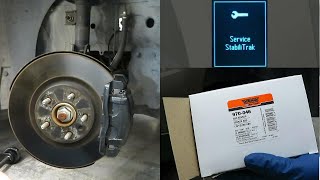
- ABS, Traction Control, and Brake Warning Lights Illuminated — The primary symptom is the simultaneous illumination of the ABS, Traction Control (TCS/Stabilitrak), and sometimes a flashing red BRAKE light on the dashboard.
- Uncommanded ABS/Traction Control Activation — The ABS pump activates or the brake pedal pulsates at low speeds (e.g., pulling into a parking spot) as the system incorrectly assumes a wheel is slipping.
- Erratic or Inoperative Speedometer — On vehicles that use wheel speed sensor data for the speedometer, the needle jumps, lags, or drops to zero intermittently.
- AWD System Disabled — On all-wheel-drive vehicles, a wheel speed sensor fault disables the AWD system and illuminates a warning light, as the system requires accurate speed data from all four wheels.
Diagnostic Flowchart
Tap your situation to follow the diagnostic path that matches what you're seeing on this code.
Common Fixes & Costs
- Clean Debris from Wheel Hub Magnetic Ring — Parts: $0, Labor: $150-$200, ~1.0 hr book time (DIY)
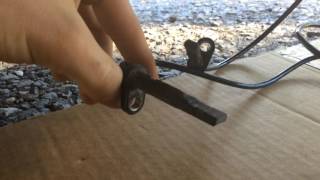
- Replace Left Front Wheel Speed Sensor — Parts: $30-$220, Labor: $150-$400, ~1.0 hr book time (DIY)
- Repair or Replace Wiring Harness/Connector — Parts: $20-$80, Labor: $150-$300, ~1.5 hr book time (Intermediate)
- Replace Left Front Wheel Hub/Bearing Assembly — Parts: $100-$400, Labor: $250-$650, ~2.2 hr book time (Intermediate)
- Replace ABS Control Module — Parts: $650-$1200, Labor: $800-$1500, ~2.0 hr book time (Professional)
DIY vs Professional
- Clean Debris from Wheel Hub Magnetic Ring 🟢 Beginner
Tools: Jack, Jack Stands, Lug Wrench, Socket Set, Flashlight, Brake Cleaner, Small Brush. - Replace Left Front Wheel Speed Sensor 🟢 Beginner
Tools: Jack, Jack Stands, Lug Wrench, Socket Set, Torque Wrench, Pliers. - Repair or Replace Wiring Harness/Connector 🟢 Beginner
Tools: Soldering Iron, Heat Shrink Tubing, Wire Strippers, Multimeter. - Replace Left Front Wheel Hub/Bearing Assembly 🟢 Beginner
Tools: Jack, Jack Stands, Breaker Bar, Axle Nut Socket, Torque Wrench, Hub Puller/Slide Hammer.
Used vs. New Parts: Buying Guide
When a used part is worth it: Never buy used wheel speed sensors or hub assemblies. These are critical safety wear-and-tear parts. A used part has an unknown lifespan and offers minimal savings compared to the risk of repeat labor costs.
Donor quality checklist:
- Match the part number exactly; sensor designs change year-to-year.
- Buy high-quality aftermarket (Bosch, NTK, Denso) or OEM parts. Cheap, unbranded sensors have high out-of-the-box failure rates.
Decision logic:
- If The part is a wheel hub/bearing assembly. → Always buy new. The risk of premature failure from a used bearing is too high.
- If The part is a wheel speed sensor. → Buy a new OEM or top-tier aftermarket sensor. The labor to replace a failed cheap sensor negates any initial savings.
Warranty tradeoff: Used parts carry a 30-day warranty. Aftermarket new parts offer 1-year to lifetime warranties. OEM parts installed by a dealer carry a 1-2 year warranty.
Worst-case if a used part fails: $200-$500 if a cheap part fails shortly after installation, requiring repeat labor.
What Happens If You Wait — Timeline
- 0-4 weeks: Code appears intermittently after hitting bumps or in wet weather. ABS/TCS lights turn off after restarting the car. No driving symptoms. (MPG impact: 0%% · Added cost: $0)
- 1-3 months: The fault becomes permanent; ABS and traction control lights stay on constantly. Safety systems are fully disabled. (MPG impact: 0-2%% · Added cost: $0-$25 in wasted fuel.)
- 3-9 months (If caused by wheel bearing): A failing wheel bearing progresses from a hum to a grinding noise with noticeable wheel wobble, causing uneven tire wear. (MPG impact: 2-5%% · Added cost: $200-$400 in premature tire wear.)
- 9+ months (If caused by wheel bearing): Catastrophic wheel bearing failure. Severe wobble damages the hub, steering knuckle, and CV axle, requiring a major suspension rebuild. (MPG impact: 5-10%% · Added cost: $1000-$2500 in suspension repairs.)
Cost of Not Fixing It
- Immediate: Disabled ABS and stability control systems pose a severe safety risk. Emergency stopping distances increase, and the risk of an uncontrollable skid skyrockets in poor weather. (Added cost: Potential cost of an accident.)
- 1-6 months: If a bad wheel bearing causes the fault, continued driving causes uneven tire wear due to wheel wobble. The vehicle pulls to one side when braking. (Added cost: $100-$250 in premature tire wear.)
- 6+ months: A completely failed wheel bearing damages the hub, steering knuckle, and CV axle, turning a standard repair into a major suspension rebuild. (Added cost: $800-$1500 in additional suspension repairs.)
Diagnosis Steps
- Read Codes and Graph Live Data
Use an ABS-capable OBD-II scanner to confirm C0504. Access the live data stream for all four wheel speed sensors. Graph the outputs and drive slowly. A good sensor shows a smooth line mirroring the other wheels. A faulty circuit shows sharp spikes, dropouts to 0 MPH, or a 'lazy' response.
Tools: OBD-II Scanner (ABS capable with Live Data) (Beginner) - Inspect and Clean Magnetic Encoder Ring
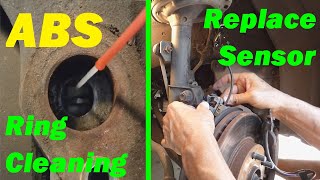
Remove the wheel and the single bolt holding the wheel speed sensor. Pull the sensor out, shine a light into the hole, and slowly rotate the hub. Look for metallic 'fuzz' or cracks on the magnetic ring. Use a small brush and brake cleaner to remove debris. Clean rust from the sensor's mounting surface to ensure the correct air gap.
Tools: Jack, Jack Stands, Socket Set, Flashlight, Small Brush, Brake Cleaner (Intermediate) - Visually Inspect Wiring and Connector
Trace the wire from the wheel hub up into the fender liner. Look for chafing, melting, or pinching. Unplug the connector and inspect pins for green corrosion. Wiggle the harness while a helper monitors the live data graph; if the signal drops out, you have found an internal wire break.
Tools: Flashlight (Beginner) - Check for a Bad Wheel Bearing
With the wheel on and the vehicle raised, grasp the tire at 12 and 6 o'clock and forcefully wiggle it. Repeat at 9 and 3 o'clock. Any perceptible play or grinding noise indicates a worn wheel bearing, which causes the erratic sensor signal.
Tools: Jack, Jack Stands (Beginner) - Test Sensor Electrical Properties
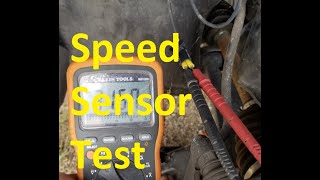
For a 2-wire passive sensor, use a multimeter to measure resistance (typically 800-2000 Ohms). An 'OL' reading means an open circuit. For an active sensor, turn the ignition on and verify 5V reference power and ground at the connector. Backprobe the signal wire; voltage should switch rapidly as the wheel spins.
Tools: Multimeter, Backprobe Pins (Advanced) - Analyze Sensor Signal with an Oscilloscope
Connect an oscilloscope to the sensor's signal and ground wires. Spin the wheel. A good passive sensor produces a clean AC sine wave; an active sensor produces a clean square wave. Dropouts or 'hash' confirm a fault in the sensor, tone ring, or wiring.
Tools: Oscilloscope, Backprobe Pins (Advanced) - Inspect ABS Module Ground and Connector
Locate the ABS control module. Unplug the main connector and check for backed-out pins or corrosion. Ensure the main ground wire bolted to the chassis is clean and tight. A poor ground causes erratic module behavior.
Tools: Basic Hand Tools, Wire Brush (Intermediate)
When This Code Triggers (Freeze-Frame Conditions)
- Vehicle Speed: 35-55 mph (Sets during steady-state highway driving when the faulty sensor's reading deviates erratically from the other three wheels.)
- Brake Pedal Status: Not Applied (Logs during normal cruising without any brake input.)
- Engine RPM: 1500-2500 RPM (Corresponds to steady cruising speeds where signal stability is expected.)
- ABS/TCS System Status: Enabled (Occurs while the system is active, immediately disabling the system and illuminating warning lights.)
Related Codes
- C0035 — The generic code for a Left Front Wheel Speed Sensor Circuit fault. C0504 specifically points to an intermittent signal (debris, loose bearing), while C0035 indicates a 'hard' fault like a completely dead sensor or severed wire.
- C0040, C0045, C0050 — Codes for the other three wheel speed sensors. If multiple codes appear simultaneously, investigate a systemic issue like a faulty ABS module or bad ground, not individual sensors.
- U0121 — 'Lost Communication With ABS Control Module'. Set by other computers when they cannot talk to the ABS module. Often a symptom of a failing ABS module causing the C0504 code.
- U0415 — 'Invalid Data Received From EBCM'. Set by other modules (like AWD) when they stop receiving reliable speed data. This is a symptom of C0504; fix C0504 first.
Climate & Environmental Factors
- Cold Climates / Road Salt: Saltwater accelerates corrosion of wiring harnesses and connector pins, causing intermittent open circuits. It also promotes rust buildup on the hub and tone ring.
- High Humidity / Heavy Rain: Compromised weather seals allow moisture into the sensor connector. Driving through deep water forces moisture into failing connectors, triggering the code.
How to Talk to a Mechanic About This Code
Say this: "I have an ABS light on and my scanner shows a C0504 code for the left front wheel speed sensor. I'd like to book a diagnostic appointment. Please graph the live data from all four wheel sensors, inspect the wiring, and check the magnetic tone ring for debris before recommending a part replacement."
This signals that you understand the common causes of a C0504 code. It directs the technician to perform a proper diagnosis instead of immediately replacing the sensor, saving you money.
Avoid saying:
- 'My ABS light is on, can you fix it?'
- 'Just replace the front left speed sensor.'
- 'Do whatever you think is best.'
Questions to ask before authorizing the repair:
- What did the live data graph for the left front sensor look like compared to the others?
- Did you find any debris on the magnetic tone ring or corrosion on the connector?
- If recommending a wheel bearing replacement, did you confirm excessive play or noise?
- What is the warranty on the recommended parts and labor?
Where to Take It: Dealer vs Independent vs Chain
- Dealer:
Recommended only if the vehicle is under warranty or requires dealer-specific calibration tools.
Best for: Vehicles still under warranty., Complex manufacturer-specific issues (e.g., BMW reluctor rings, GM TSBs)., Repairs requiring software updates or steering angle sensor calibration.
Downsides: Highest labor rates, often 1.5-2x more than independent shops., Defaults to replacing entire assemblies when cleaning would suffice. (Typical cost: +50% vs. baseline) - Independent Shop:
Best fit for most situations. A reputable independent shop effectively diagnoses and repairs C0504 faults for a reasonable price.
Best for: Most out-of-warranty C0504 repairs., Diagnosing bad wiring, failed sensors, or bad wheel bearings., Cost-conscious customers seeking good value.
Downsides: Diagnostic skill varies; choose a shop with ASE-certified technicians., Lacks specialized tools for calibrating certain European models. (Typical cost: +0% vs. baseline) - Chain Shop:
Avoid for initial diagnosis of an intermittent C0504 code, which requires nuanced troubleshooting.
Best for: Simple, straightforward part replacements like brake pads or tires.
Downsides: Technicians lack advanced diagnostic skills for intermittent electrical faults., High pressure to meet sales targets leads to upselling unnecessary parts. (Typical cost: -10% vs. baseline)
When to Walk Away From the Repair
If the estimated repair cost exceeds 40-50% of the car's private-party value, consider selling or trading it in.
- Car worth $4000, fix is $850: Fix it. This repair is well below the 50% threshold and restores a critical safety system.
- Car worth $3000, fix is $1600: Walk away. The repair cost is over 50% of the car's value. The fault likely requires extensive suspension work.
- Car worth $15000, fix is $900: Fix it. The cost is a small fraction of the vehicle's value.
What Scan Tool You Need for This Code
Minimum: A scanner that reads and clears Chassis (ABS) trouble codes and displays live sensor data for all four wheels.
A basic $20 engine code reader cannot access the ABS module. Without seeing the 'C' codes and live wheel speed data, you are completely blind and will waste money guessing which part to replace.
Budget: BlueDriver Pro or Autel AutoLink AL619 (~$70) — Reads/clears ABS codes and displays live data streams. This is the minimum required to see the faulty sensor's signal drop out during a test drive.
Mid-range: Foxwell NT630 Plus or Innova 5610 (~$150) — Offers robust ABS diagnostics, live data graphing, and special functions like Steering Angle Sensor (SAS) calibration, potentially saving a trip to the dealer.
Professional: Autel MaxiCOM MK808S / MK808Z (~$370) — Provides full dealer-level diagnostics, advanced live data graphing, bidirectional controls, and a comprehensive suite of service functions like SAS calibration and ABS bleeding.
Rent vs buy: Auto parts store loaner scanners typically only read engine codes, not ABS codes. Given that a budget ABS-capable scanner costs under $100, buying one is a better investment than paying a shop $150 for a diagnosis.
How to Clear the Code After You Fix It
- Use an ABS-capable OBD-II scan tool to erase the C-prefix trouble codes.
- Perform a short test drive, including several turns and stops, to confirm the ABS light stays off.
- Perform a steering angle sensor calibration if warning lights remain (required on BMW, Subaru, and some GM models).
Drive cycle (~15 minutes): The ABS system self-tests upon startup and during the first few moments of driving. A 15-minute drive cycle including speeds above 20 mph and two complete stops confirms the repair.
Readiness monitors affected: None
Watch out for:
- Using a basic $20 code reader fails to clear C0504 because it cannot access Chassis ('C') codes.
- Disconnecting the battery resets engine readiness monitors and radio presets without guaranteeing the ABS code clears.
- The code returns immediately if the root cause (e.g., metallic debris, chafed wiring) is ignored.
Will This Fail Emissions / State Inspection?
No — by itself this code doesn't fail OBD inspection (but it can keep readiness monitors from setting, which causes a separate fail).
- California: An illuminated ABS light passes a biennial SMOG check but fails a 'Brake and Lamp' inspection required for revived salvage vehicles.
- New York: An illuminated ABS warning light is a direct failure of the annual safety inspection. The vehicle cannot be legally registered or driven until repaired.
- Texas: For commercial vehicles requiring safety inspections, an ABS light passes, but a red 'BRAKE' warning light fails.
Most Commonly Affected Vehicles
- Chevrolet Equinox (2010-2017) — Extremely common. Usually caused by debris on the magnetic encoder ring or corrosion in the wheel well harness connector.
- GMC Terrain (2010-2017) — Mechanically identical to the Equinox; suffers from the exact same debris and wiring issues.
- BMW 3-Series (E90) (2006-2011) — Frequently caused by the metal reluctor ring on the rear driveshaft corroding, expanding, and cracking. Requires steering angle sensor calibration after repair.
- Cadillac SRX (2010-2016) — Prone to metallic debris accumulating on the magnetic encoder ring. Cleaning the ring is the most effective fix.
- Subaru Forester (2014-2018) — Often caused by a failed sensor or a bad wheel bearing. Requires steering angle sensor calibration after repair.
- Chevrolet Cruze (2011-2015) — Susceptible to wiring harness issues where the sensor wire chafes against the fender liner, causing an intermittent short.
- Honda HR-V (2016-2022) — Experiences premature wheel speed sensor failures requiring straightforward sensor replacement.
- Chevrolet Volt (2016-2019) — A fracturing 'anti-click' washer on the front axle nut creates debris that damages the sensor or contaminates the magnetic ring.
Manufacturer-Specific Notes
- General Motors (GM): For 2010+ models (Equinox, Terrain, SRX), the overwhelming cause is metallic debris stuck to the magnetic encoder ring. GM issued TSB #14-05-23-001 to address this. Always clean this ring before replacing parts.
- General Motors (GM): On 1999-2002 GM trucks (Suburban/Tahoe), C0504 means "Steering Assist Control Solenoid Return Circuit High" relating to the power steering system, not a wheel speed sensor. Verify the code definition for your specific year.
- Hyundai / Kia: These brands commonly use code P0504 for "Brake Switch A/B Correlation"—a failure of the brake light switch. Confirm if your scanner shows a 'C' (Chassis) or 'P' (Powertrain) code to avoid misdiagnosis.
- BMW: The Dynamic Stability Control (DSC) system is highly integrated. After replacing a wheel speed sensor, the system requires a steering angle sensor calibration to extinguish warning lights and restore function.
Real Owner Stories
2015 Chevy Equinox at 110K miles - The 'Easy Fix'
ABS and Stabilitrak lights came on intermittently during low-speed turns.
What they tried:
- A local shop quoted $350 to replace the left front wheel speed sensor.
- Owner researched online and found GM TSB #14-05-23-001 regarding hub debris.
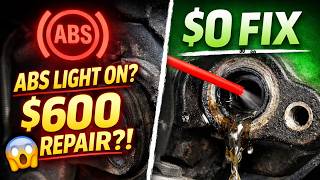
Outcome: The owner removed the sensor and cleaned metallic 'fuzz' from the magnetic encoder ring using a brush and brake cleaner. The lights have not returned in over a year. Total cost: $0.
Lesson: On GM vehicles, always clean the magnetic hub ring before replacing parts. It is the most common cause and a free fix.
2008 BMW E90 328i at 130K miles - A Misdiagnosis Story
ABS, DTC, and red BRAKE light illuminated. Cruise control inoperative.
What they tried:
- Replaced the left front wheel speed sensor with an aftermarket part. Lights remained.
- Replaced it again with a $200 genuine BMW sensor. Lights remained.
- Took the car to a BMW specialist.
Outcome: The actual fault was a cracked reluctor ring on the rear axle shaft. The crack provided an inconsistent signal that the DSC module misinterpreted as a front wheel fault. The shop replaced the rear axle shaft for $600.
Lesson: An intermittent signal from one wheel is sometimes misinterpreted by the ABS module. On BMWs, a rear reluctor ring failure falsely triggers a front wheel code.
2016 Subaru Forester at 85K miles - The Unusual Root Cause
ABS and Hill Assist lights came on suddenly.
What they tried:
- Replaced the left front wheel speed sensor; code returned immediately.
- Checked the wheel bearing for play; found none.
- A helper watched live scanner data while the owner wiggled the wiring harness in the wheel well. The signal dropped out when flexing a specific clip.
Outcome: An internal wire broke inside the insulation due to years of suspension movement. The owner soldered in a new $50 wiring pigtail (Subaru part #81822AG03A) and secured it with zip ties.
Lesson: Wiggling the harness while watching live data is a highly effective way to pinpoint an internal wire break.
How to Prevent This Code From Triggering
- Apply Dielectric Grease to Connectors (Whenever connectors are disconnected.) — Dielectric grease seals electrical connectors from moisture and oxygen, preventing water intrusion and corrosion in salt-belt regions.
- Clean Hub Area During Brake Service (Every brake pad/rotor replacement.) — Spray the exposed hub area with brake cleaner and brush away accumulated brake dust before it migrates to the magnetic encoder ring.
- Inspect Wiring Harness Routing (During every oil change or tire rotation.) — Ensure the sensor wire is secured in its clips and not rubbing against the tire or suspension. A mis-routed harness eventually chafes and fails.
- Address Minor Wheel Bearing Noise Early (As soon as humming/growling noise is detected.) — A noisy wheel bearing develops excessive play, changing the air gap between the sensor and tone ring. Replacing it early prevents the C0504 code and hub damage.
Frequently Asked Questions
Can I just replace the C0504 sensor to fix the problem?
You can, but it is often a waste of money. The most common causes are external, such as debris on the hub's magnetic ring or a broken wire. Always perform a thorough visual inspection and cleaning before buying a new sensor.
Why did my mechanic quote $600 to replace one sensor?
Dealerships charge premium labor rates and use OEM parts, which easily pushes a 1-hour sensor replacement past $500. An independent shop using quality aftermarket parts performs the exact same repair for $150 to $300. Always ask for a breakdown of parts versus labor.
My Hyundai has a P0504 code. Is this the same thing?
No, P0504 is a completely different powertrain issue. On Hyundai and Kia vehicles, P0504 indicates a failed brake light switch on the pedal arm, which is a cheap and easy fix. Always verify if your scanner is reading a 'C' (Chassis) or 'P' (Powertrain) code.
Is it safe to drive with code C0504?
You can drive, but your key safety systems are offline. In an emergency stop, your wheels lock up, increasing stopping distance by up to 30%. Fix it promptly before driving in rain or snow.
What is a tone ring or magnetic encoder ring?
It is a ring with precisely spaced teeth or magnets integrated into the wheel hub or axle. As the wheel spins, the sensor counts these teeth to measure speed. If the ring gets dirty or cracked, the sensor's count becomes inaccurate and triggers the code.
My mechanic wants to replace the whole wheel bearing. Is that necessary?
Yes, if the magnetic tone ring is damaged or the bearing is worn. On modern cars, the tone ring is permanently integrated into the wheel bearing assembly. You cannot replace just the ring; the entire hub must be swapped.
Can a bad battery cause a C0504 code?
Yes. Modern vehicles are highly sensitive to voltage drops. A weak battery causes low voltage during startup, triggering random communication and sensor codes from the ABS controller.
How do you test a wheel speed sensor?
First, use a multimeter to check a passive sensor's internal resistance (usually 800-2000 ohms) or verify 5V reference power on an active sensor. For a definitive test, connect an oscilloscope to watch the signal waveform as the wheel spins. A clean wave means the sensor works; a noisy wave indicates a fault.
Key Takeaways
- Code C0504 disables your ABS and traction control, increasing emergency braking distances by up to 30%.
- Clean the magnetic encoder ring on the wheel hub before buying parts; removing metallic debris fixes this code in over 50% of GM vehicles.
- Graph the live sensor data using an OBD-II scanner; a signal that drops cleanly to 0 MPH indicates a broken wire, while a fuzzy signal points to a dirty tone ring.
- Do not confuse Chassis code C0504 with Powertrain code P0504; P0504 is a $20 brake switch failure common on Hyundai and Kia models.
- Expect to pay between $150 and $400 for an independent shop to replace a faulty left front wheel speed sensor, including parts and 1 hour of labor.
Helpful Videos


Shop the Parts Behind C0504
Below are the parts most often responsible for code C0504, ranked by how frequently each one is the actual culprit (per the diagnosis above). Tap any to see what we have for your vehicle.



The information in this article is provided for general reference and educational purposes only. Vehicle specifications, procedures, and part compatibility can vary by production date, trim level, and region. Always consult your vehicle's factory service manual and verify part numbers before purchasing or performing repairs. Safety-critical components such as airbags, seat belts, and braking systems should be installed by a qualified professional.
- 🧭 Diagnostic Flowchart
- 🎬 Helpful Videos
- 🛍️ Shop This Part
- What Does C0504 Mean?
- Can I Drive With C0504?
- Common Causes
- Symptoms
- Common Fixes & Costs
- DIY vs Professional
- Used vs. New Parts: Buying Guide
- What Happens If You Wait — Timeline
- Cost of Not Fixing It
- Diagnosis Steps
- When This Code Triggers (Freeze-Frame Conditions)
- Related Codes
- Climate & Environmental Factors
- How to Talk to a Mechanic About This Code
- Where to Take It: Dealer vs Independent vs Chain
- When to Walk Away From the Repair
- What Scan Tool You Need for This Code
- How to Clear the Code After You Fix It
- Will This Fail Emissions / State Inspection?
- Most Commonly Affected Vehicles
- Manufacturer-Specific Notes
- Real Owner Stories
- 2015 Chevy Equinox at 110K miles - The 'Easy Fix'
- 2008 BMW E90 328i at 130K miles - A Misdiagnosis Story
- 2016 Subaru Forester at 85K miles - The Unusual Root Cause
- How to Prevent This Code From Triggering
- Frequently Asked Questions
- Can I just replace the C0504 sensor to fix the problem?
- Why did my mechanic quote $600 to replace one sensor?
- My Hyundai has a P0504 code. Is this the same thing?
- Is it safe to drive with code C0504?
- What is a tone ring or magnetic encoder ring?
- My mechanic wants to replace the whole wheel bearing. Is that necessary?
- Can a bad battery cause a C0504 code?
- How do you test a wheel speed sensor?
- Key Takeaways
- 🎟️ Get 5% Off