

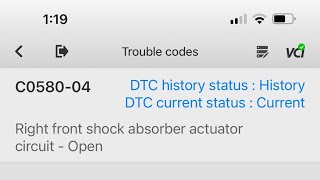
OBD-II Code C0580: Right Front Suspension Actuator Circuit Malfunction
What C0580 means, why it triggers, and how to fix it
- Code C0580 isolates the fault specifically to the right front electronic shock absorber or its wiring circuit.
- Expect a harsh ride, a 'Service Suspension System' dashboard warning, and a hard speed limit of 80 mph on many GM trucks.
- Inspect and reseat the 90-degree electrical connector on top of the right front shock before buying parts, as this $30 pigtail is the most frequent failure point.
- General Motors SUVs from 2001-2020 equipped with MagneRide or Autoride suspension account for the vast majority of C0580 codes.
What Does C0580 Mean?

Code C0580 means the Electronic Suspension Control Module (ESCM) detects a problem with the electrical circuit for the adjustable shock absorber (actuator) at the right front wheel. This forces the computer to disable the automatic damping system, resulting in a 'Service Suspension System' message on your dash.
Technical definition: The SAE/ISO definition for C0580 is 'Right Front Actuator Circuit'. It pairs with a two-digit suffix indicating the specific fault type: '01' (Short to Voltage), '02' (Short to Ground), or '04' (Open Circuit). The code sets when the ESCM detects that feedback from the actuator's circuit does not match the pulse-width modulated (PWM) command sent, or if the circuit is open or shorted. The ESCM continuously monitors this while the ignition is on. The code requires the fault to be present for 3 consecutive ignition cycles and the vehicle to exceed 3 mph (4.8 km/h) to latch and illuminate the warning.
Can I Drive With C0580?
Yes, But With Caution. Yes, you can drive, but your vehicle's automatic ride control is disabled. The ride feels stiff or bouncy, and handling is compromised, increasing stopping distances in emergencies. On many GM models, this code also triggers a 'SPEED LIMITED TO 80 MPH' message. Do not ignore this warning long-term.
Common Causes

- Damaged, Loose, or Corroded Wiring Connector (Very Common) — The 90-degree connector at the top of the right front shock is highly susceptible to vibration, heat, and moisture. A loose, corroded, or improperly seated connector is the most frequent cause of an open or shorted circuit.
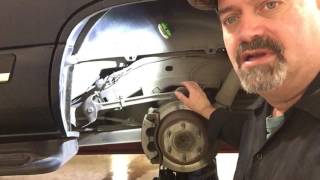
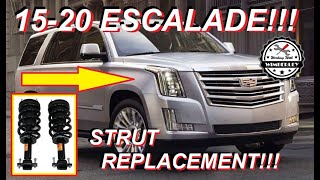
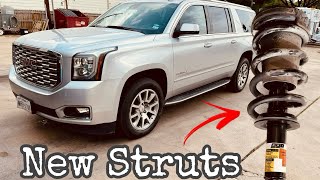
- Failed Right Front Shock Absorber (Actuator) (Common) — The electronic actuator built into the top of the shock absorber fails internally over time, creating an open or short. Internal wiring also breaks if the strut shaft is spun during installation of a new unit. 🎬 Watch: Step-by-step front MagneRide strut replacement for GM SUVs
- Chafed Main Chassis Harness (GM SUVs) (Less Common) — On 2015-2017 GM SUVs, a known issue (TSB PIT5556A) involves the main chassis wiring harness rubbing against a frame cross-member above the spare tire. This causes multiple intermittent electrical issues and codes, including C0580.
- Failed Electronic Suspension Control Module (ESCM) (Less Common) — The control module is a rare failure point. An internal fault in the ESCM prevents it from correctly reading or sending signals to the right front actuator. Always test the wiring and shock before condemning the module.
- Physical Interference from A/C Hoses (Uncommon) — On 2001-2003 GM SUVs, the auxiliary A/C evaporator hose routes too close to the right front shock connector. This rubbing damages the connector or wiring, leading to an intermittent fault.
- Unstable or Low System Voltage (Rare) — The suspension control module requires a stable 9-16V to operate correctly. A failing battery or alternator causes low system voltage, forcing the module to fail its self-test and trigger a fault code even if suspension components are good.
Symptoms

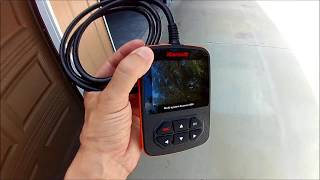
- Service Suspension System Message — A direct warning message appears on the driver information center (DIC). 🎬 Watch: Diagnosing the Service Suspension System message on GM vehicles
- Stiff, Harsh, or Bouncy Ride — When the system is disabled, the shocks default to a fixed, firm setting. This makes the ride feel unusually harsh over bumps or bouncy and unsettled.
- Vehicle Speed Limited to 80 MPH — On many GM trucks and SUVs, a fault in the electronic suspension system triggers a safety mode that limits vehicle speed to exactly 80 mph.
- Poor Handling and Reduced Stability — The vehicle feels less stable during turns, braking, or on uneven surfaces because the active suspension is not adjusting to driving conditions.
- ABS or Traction Control Lights — A fault in the suspension system triggers warning lights for the anti-lock brake or traction control systems, as these systems share data.
Diagnostic Flowchart
Tap your situation to follow the diagnostic path that matches what you're seeing on this code.
Common Fixes & Costs
- Repair or Replace Wiring Connector Pigtail — Parts: $15-$50, Labor: $100-$250, ~1.5 hr book time (Intermediate)
- Replace Right Front Shock Absorber Assembly — Parts: $400-$850, Labor: $150-$350, ~2 hr book time (Professional)
- Install Suspension Bypass/Delete Kit — Parts: $50-$150, Labor: $100-$200, ~1 hr book time (Intermediate)
- Repair Main Chassis Harness — Parts: $20-$60, Labor: $250-$500, ~3 hr book time (Professional)
- Replace Electronic Suspension Control Module (ESCM) — Parts: $150-$400 (rebuilt) or $600-$900 (new), Labor: $150-$300, ~1.5 hr book time (Professional)
Used vs. New Parts: Buying Guide
When a used part is worth it: A used electronic shock is rarely a good value. It only makes sense for a very old, high-mileage vehicle on a strict budget where the owner accepts the high risk of premature failure and repeat labor costs.
Donor-vehicle mileage cap: roughly under 60000 miles for the part to have meaningful remaining life.
Donor quality checklist:
- Verify the donor vehicle was not in a major accident.
- Check for any signs of fluid leakage ('weeping') on the shock body.
- Match the part number exactly, as different vehicle options use different shocks.
Decision logic:
- If The part is a known wear item with high labor cost for replacement. → Strongly favor buying new for the warranty and longer service life.
- If Vehicle is a daily driver and reliability is critical. → Buy new from an OEM or reputable aftermarket supplier like Arnott.
- If Vehicle is being repaired for immediate sale. → A low-cost used part might be considered, but is generally not recommended.
Warranty tradeoff: Used parts typically have a 30-90 day warranty covering the part only. New aftermarket parts often have a 1-year to lifetime warranty. New OEM parts usually carry a 24-month warranty.
Worst-case if a used part fails: $550-1200 if a used shock fails after installation, requiring a second replacement.
What Happens If You Wait — Timeline
- 0-1 month: Code C0580 is set, 'Service Suspension System' light is on. Ride becomes noticeably stiff or bouncy as the system defaults to a fixed firm setting. Handling is compromised. (MPG impact: 0%% · Added cost: $0)
- 1-6 months: Uncontrolled bouncing of the right front wheel causes uneven tire wear ('cupping' or 'scalloping'). This creates road noise and vibrations. (MPG impact: 0-1%% · Added cost: $250-$400 (for one prematurely worn tire))
- 6-12 months: Increased stress from constant vibration accelerates wear on the wheel bearing, ball joints, and control arm bushings. The cupped tire is ruined. (MPG impact: 1-2%% · Added cost: $600-$1200 (cost of a new tire plus wheel bearing or ball joint))
- 12+ months: Severe wear on multiple suspension components. Vehicle stability is significantly degraded, posing a safety risk. Repair requires replacing the original fault plus several worn-out parts. (MPG impact: 2-4%% · Added cost: $1500+)
Cost of Not Fixing It
- 0-6 months: Accelerated and uneven tire wear ('cupping') due to poor damping, leading to premature tire replacement. (Added cost: $800-$1500)
- 6-18 months: Increased stress on other suspension components like ball joints, control arm bushings, and tie rod ends, causing them to wear out faster. (Added cost: $500-$1200)
- 18+ months: Potential failure of critical components like wheel bearings. Compromised vehicle safety due to increased stopping distances and reduced stability. (Added cost: $1200+)
Diagnosis Steps

- Read the Code and Note Suffix
Use a professional OBD-II scanner capable of reading Chassis (C) codes to confirm C0580 is active. Note any two-digit suffix: '01' is Short to Voltage, '02' is Short to Ground, and '04' is Open Circuit.
Tools: Professional OBD-II Scanner (Beginner) - Inspect and Reseat the Shock Connector
Locate the right front shock tower in the engine bay. Disconnect the 90-degree electrical connector on top of the shock. Inspect for chafing, melting, breaks, or corrosion. Reconnect it firmly until it 'clicks' into place. A partially seated connector is the primary cause of an 'Open Circuit' (C0580-04) code.
Tools: Flashlight (Beginner) - Test the Shock Actuator Resistance
Disconnect the harness at the shock. Use a multimeter set to Ohms to measure the resistance between the two pins on the shock absorber itself. The reading must be between 2.7 and 3.3 ohms. An infinite reading (OL) indicates an open circuit, while a near-zero reading indicates a short. In either case, the shock has failed and requires replacement.
Tools: Multimeter (Intermediate) - [Pro Tip] Perform a Connector Swap Test
To definitively rule out the wiring harness pigtail, swap the left and right front shock connectors. Clear the codes and drive the vehicle. If the code changes from C0580 to C0575 (Left Front), the pigtail connector itself is faulty. If C0580 returns, the problem is in the shock or the main harness.
Tools: None (Advanced) - Test the Harness for Voltage and Ground
With the key on, use a multimeter to check the wiring harness connector (not the shock). Check for voltage on the control circuit and continuity to ground (less than 1.0 ohm) on the low reference circuit. An absence of either points to a problem further up the harness or with the ESCM.
Tools: Multimeter (Intermediate) - Command the Actuator with a Scan Tool
Connect a test lamp between the control circuit (Pin A) and low reference circuit (Pin B) on the harness connector. With the ignition ON, use a bi-directional scan tool to command the damper ON and OFF. The test lamp must illuminate and turn off as commanded. If it fails, test the control circuit for shorts or opens. If circuits test normal, the ESCM is faulty.
Tools: Bi-Directional Scan Tool, Test Lamp (Advanced) - Inspect Main Harness (GM SUVs)
On 2015-2017 GM SUVs, lower the spare tire and inspect the large wiring harness running over the frame cross-member for signs of rubbing or damage. This known issue (TSB PIT5556A) causes this code.
Tools: Basic hand tools (Advanced)
When This Code Triggers (Freeze-Frame Conditions)
- Battery Voltage: 9-16V (Stable voltage during operation.)
- Ignition Status: ON (Fault must be detected for 3 consecutive ignition cycles.)
- Vehicle Speed: > 3 mph (> 4.8 km/h) (Vehicle must be in motion for the code to latch.)
- System State: Active Monitoring (The ESCM continuously checks actuator circuits when the ignition is on.)
Related Codes
- C0575 — Identical fault for the Left Front Actuator Circuit. If C0575 and C0580 appear together, focus on components shared by both front wheels, such as the harness connection at the ESCM or the module itself.
- C0585 / C0590 — Codes for the Left Rear and Right Rear actuator circuits. Multiple actuator codes from different axles significantly increase the likelihood of a failed ESCM or a widespread wiring issue (TSB PIT5556A).
- C0561 — Means 'System Disabled'. This is an effect, not a cause. The ESCM sets C0580, disables the active suspension, and logs C0561 to report its disabled status. Resolve C0580 first.
- C0870 — Relates to the Suspension Position Sensor circuit. Diagnose and repair C0870 first, as a fault in the position sensor causes the ESCM to log other suspension codes.
Climate & Environmental Factors
- Road Salt / Humidity: In regions with heavy road salt or high humidity, salt and moisture penetrate the weather seals on the shock connector. This causes pin corrosion, high resistance, and intermittent open/short circuits that trigger C0580.
- Extreme Cold: Very cold temperatures make wiring insulation brittle and susceptible to cracking from engine vibration and suspension movement. This increases open-circuit faults (C0580-04) during winter months.
How to Talk to a Mechanic About This Code
Say this: "I have a 'Service Suspension System' light and my scanner shows code C0580 for the right front actuator circuit. I'd like to book a diagnostic appointment. Can you please start by checking the connector and wiring at the shock, and test the shock's internal resistance, before quoting a full shock or module replacement?"
This signals you understand the most common failure points. It directs the technician to perform the cheapest diagnostic steps first, preventing them from immediately quoting an expensive shock absorber or control module replacement.
Avoid saying:
- 'My service suspension light is on, can you fix it?'
- 'The car rides rough, just replace whatever is broken.'
- 'My friend said I need a new shock absorber.'
Questions to ask before authorizing the repair:
- What was the ohm reading across the two pins on the shock absorber? Was it between 2.7 and 3.3 ohms?
- Did you test the wiring harness for proper voltage and a good ground connection?
- Have you ruled out a simple broken wire at the connector pigtail?
- If the shock needs to be replaced, does your estimate include the mandatory wheel alignment?
- What is the warranty on the parts and labor for this repair?
Where to Take It: Dealer vs Independent vs Chain
- Dealer:
Recommended only if the issue is confirmed to be the control module or if other shops are unable to diagnose it. Otherwise, an independent shop is more cost-effective.
Best for: Vehicles under warranty, Complex cases with multiple TSBs (like the 2015-2017 harness chafing issue), Confirmed ESCM (Electronic Suspension Control Module) failures requiring manufacturer-specific programming
Downsides: Highest labor rates, Defaults to replacing an entire expensive shock assembly when a cheaper wiring repair is sufficient (Typical cost: +75% vs. baseline) - Independent Shop:
Best fit for most C0580 repairs. Ask if they are comfortable diagnosing chassis codes and have a scanner with bidirectional capabilities to test actuators.
Best for: Out-of-warranty vehicles where cost is a major factor, Diagnosing and repairing the most common causes: the wiring pigtail or the shock absorber itself
Downsides: Quality varies greatly; ensure the shop has experience with electronic suspensions (e.g., MagneRide), Lacks specific tools (like GM's GDS2) to program a new control module if needed (Typical cost: +0% vs. baseline) - Chain Shop:
AVOID for diagnosis and repair. The complexity of this system is beyond the scope of most chain shops, leading to wasted time and money.
Best for: Not recommended for this repair.
Downsides: Technicians lack specialized knowledge of electronic suspension systems, High risk of misdiagnosis (e.g., replacing the wrong part like a ride height sensor) or unnecessary upselling, Diagnostic tools cannot read chassis codes or perform required tests (Typical cost: -10% vs. baseline)
When to Walk Away From the Repair
If the estimated repair cost exceeds 40-50% of the vehicle's current private-party market value, seriously consider selling the vehicle as-is or trading it in.
- Car worth $15000, fix is $1200: Fix it. This is a significant but manageable repair cost relative to the vehicle's value.
- Car worth $8000, fix is $2500: Borderline. This requires replacing both front electronic shocks. Consider getting a second opinion or exploring a suspension conversion/delete kit as a cheaper alternative.
- Car worth $4500, fix is $2000: Walk away. The repair cost is nearly half the car's value. It's not economically sensible unless the vehicle is in otherwise perfect condition.
What Scan Tool You Need for This Code
Minimum: A scanner that reads and clears Chassis (C) codes. Basic engine-only code readers will not see this fault.
A standard $20 OBD-II reader does not detect Chassis codes like C0580. Proper diagnosis requires a tool that reads the 'C' code and performs bidirectional tests to command the actuator, confirming if the shock or wiring is at fault.
Budget: Autel MaxiAP AP200 or KINGBOLEN Ediag Elite (GM Specific) (~$70) — These Bluetooth dongles pair with your smartphone. They offer manufacturer-specific diagnostics, including reading Chassis codes and performing the bidirectional actuator tests needed for C0580.
Mid-range: Foxwell NT510 Elite or Autel MX808/MK808 (~$350) — These powerful handheld tools provide full system diagnostics, live data graphing, and robust bidirectional controls for testing suspension actuators. Ideal for the serious DIYer.
Professional: Autel MaxiCOM MK906BT or Launch X431 Series (~$900-1500) — Provides full, dealership-level functionality, including advanced coding and programming options necessary if the Electronic Suspension Control Module (ESCM) needs replacement.
Rent vs buy: Rent-a-tool scanners from auto parts stores are typically basic models that CANNOT read Chassis codes and are useless for C0580. Buying an affordable tool like the AP200 is a better investment.
How to Clear the Code After You Fix It
- Use a professional OBD-II scan tool to clear the DTCs.
- Perform a key cycle (turn ignition off for 60 seconds, then on).
- Drive the vehicle over 3 mph to allow the system to re-verify the repair.
Drive cycle (~15 minutes): After clearing the code, a short drive including speeds above 3 mph is sufficient for the ESCM to verify the fix. A current code clears after one malfunction-free ignition cycle.
Readiness monitors affected: Not directly applicable to this Chassis code, but clearing codes with a scanner often resets all emissions monitors.
Before emissions retest: drive at least 100 miles to fully set monitors.
Watch out for:
- Disconnecting the battery does not clear the code from the ESCM memory.
- The code returns immediately on the next drive if the underlying electrical fault is not repaired.
Will This Fail Emissions / State Inspection?
Yes — this code typically fails an OBD-II emissions inspection.
- California: An illuminated 'Service Suspension System' light causes a failure of the state safety inspection. Clearing the code resets emissions monitors, which must all be 'Ready' to pass the smog check.
- New York: The NYS safety inspection fails a vehicle for any illuminated malfunction indicator lights on the dashboard, including the suspension warning message.
- Texas: In the 17 counties requiring emissions testing, an illuminated warning light causes the vehicle to fail the overall safety inspection. A leaking shock absorber is also grounds for failure.
Most Commonly Affected Vehicles
- Cadillac Escalade / ESV (2002-2020) — Extremely common on models with Magnetic Ride Control (Z95) or Autoride (Z55). Early models (2002-2003) are subject to TSB 03-03-11-001. Later models (2015-2017) are noted in TSB PIT5556A.
- Chevrolet Tahoe (2001-2020) — Very common on LTZ, Premier, and Z71 trims with electronic suspension. Subject to the same A/C hose (2001-2003) and chassis harness (2015-2017) issues as the Escalade.
- GMC Yukon / Yukon XL Denali (2001-2020) — The Denali trim's standard Autoride/Magnetic suspension is highly susceptible. Subject to the same A/C hose (2001-2003) and chassis harness (2015-2017) TSBs.
- Chevrolet Suburban (2001-2020) — Higher trims with Z55 or Z95 suspension often log this code. Subject to the same A/C hose (2001-2003) and chassis harness (2015-2017) TSBs.
- Cadillac XTS (2013-2019) — Models equipped with Magnetic Ride Control experience this code, often due to a broken wire right at the connector on top of the strut.
- SAAB 9-4X (2011-2011) — Shares a platform and the electronic suspension system with the Cadillac SRX, and logs this exact code for actuator circuit faults.
- Chevrolet Corvette (2003-2013) — C5 and C6 models equipped with Magnetic Selective Ride Control (F55) set this code, often due to connector or wiring issues at the shock tower.
- Acura MDX (with Sport Package) (2007-2013) — These models use an Active Damper System (ADS). While the code number differs, the failure mode (leaking strut, faulty wiring) and symptom ('Check ADS' light) are identical to C0580 issues.
Manufacturer-Specific Notes
- General Motors (Cadillac, Chevy, GMC): This code is extremely common on GM trucks and SUVs with Magnetic Ride Control or Autoride. The issue is almost always the wiring connector on top of the shock or the shock itself, not the control module.
- General Motors (2015-2017 SUVs): TSB PIT5556A points to the chassis harness getting damaged above the spare tire, causing C0580 and many other seemingly unrelated electrical codes intermittently.
- General Motors (2001-2003 SUVs): TSB 03-03-11-001 involves the auxiliary A/C hose rubbing through the wiring for the right front shock connector. The fix involves replacing the connector and installing newly routed A/C hoses.
- General Motors (Cadillac CTS): On Cadillac CTS models built after Feb 22, 2011, the shock connector was updated to include a Connector Position Assurance (CPA) tab to prevent the connector from becoming partially unseated.
Real Owner Stories
2008 Chevy Tahoe LTZ with new shocks
Owner replaced both front struts. Immediately after the repair, a 'Service Suspension System' message with code C0580-04 (Open Circuit) appeared intermittently.
What they tried:
- Checked the connector on top of the new strut.
- Replaced the ride height sensor (did not fix the problem).
- Swapped the left and right front shock connectors (C0580 returned).
Outcome: The new shock was damaged during installation. Spinning the shaft breaks internal wiring. The owner returned to the shop to claim warranty labor.
Lesson: If code C0580 appears immediately after a shock replacement, the new part or the installation is the culprit. Do not replace unrelated parts like the ride height sensor.
2016 Suburban with 120K miles and intermittent code
An intermittent 'Service Suspension' message appeared. A shop found codes C0575 (Left Front) and C0580 (Right Front). The owner had replaced the struts 18 months prior.
What they tried:
- Replaced the Electronic Suspension Control Module (ESCM).
Outcome: Shortly after replacing the module, new codes for the rear appeared. The aftermarket shocks were the root cause due to lower quality, causing intermittent faults across the system.
Lesson: When multiple actuator codes appear, it points to a failing ESCM or a systemic quality issue with non-OEM replacement parts. Replacing the ESCM is an expensive guess if the shocks are faulty.
2015-2017 GM SUV with multiple intermittent electrical issues
Owner experienced a 'Service Suspension System' message (C0580) along with random warnings like 'Service Stabilitrak', 'Service Trailer Brake', and engine stalls.
What they tried:
- Initial diagnostics for individual codes failed to find a consistent fault.
Outcome: The root cause was the main chassis wiring harness rubbing against a frame cross-member above the spare tire (TSB PIT5556A). The fix involved repairing the chafed wires and rerouting the harness.
Lesson: If C0580 is present with unrelated electrical codes on a 2015-2017 GM SUV, inspect the chassis harness above the spare tire for chafing before replacing components.
How to Prevent This Code From Triggering
- Periodically inspect shock tower connectors (Every oil change) — Connectors at the top of the shocks are easily knocked loose. A quick visual check and push ensures they are seated, preventing intermittent 'Open Circuit' faults.
- Apply dielectric grease to shock connectors (When replacing shocks or servicing connectors) — Dielectric grease blocks moisture and road salt from entering the connector seal, preventing pin corrosion that leads to high resistance and circuit faults.
- Inspect and clean ride height sensors and linkages (Annually or if driving in heavy mud/snow) — Stuck or malfunctioning ride height sensors cause the system to behave erratically. Keeping linkages clean ensures the ESCM receives accurate data.
- Wash the vehicle's underbody (Monthly in salt-belt states) — Washing away road salt reduces corrosion on all underbody components, including suspension wiring, connectors, and the chassis harness.
Frequently Asked Questions
Can I just ignore the 'Service Suspension System' message?
You can, but do not ignore it long-term. Your vehicle's active handling is disabled, increasing stopping distances and reducing stability. Many GM models also enforce a hard 80 mph speed limit until repaired.
The code appeared right after I had new shocks installed. What happened?
The electrical connector likely wasn't plugged in securely, or the new shock was damaged during installation. Spinning the main shaft when tightening the top nut breaks the internal wiring of electronic shocks. Return to the installing shop to claim warranty labor.
Is it expensive to fix code C0580?
Costs range widely based on the root cause. A simple wiring pigtail repair costs under $250. Replacing a single OEM electronic shock absorber ranges from $600 to over $1,200 for parts, labor, and a required wheel alignment.
Can I replace the electronic shock with a cheaper, standard shock?
Yes, aftermarket conversion kits replace electronic shocks with passive ones, permanently disabling the active suspension. You must install 3-ohm resistors or an electronic bypass module across the harness connector to prevent the dashboard warning message.
My mechanic wants to replace the ESC module. What should I do?
Ask if they definitively tested the shock actuator resistance and performed a connector swap test first. The control module is a rare failure point compared to the shock or wiring. Replacing the module is an expensive guess if basic wiring hasn't been ruled out.
I replaced the ride height sensor but the C0580 code is still there. Why?
The ride height sensor and the shock actuator are entirely different components. Code C0580 specifically points to the actuator circuit inside the shock, not the external position sensor. Replacing the ride height sensor is a common misdiagnosis for this code.
My Cadillac or GMC is now limited to 80 mph. Is that because of code C0580?
Yes. Many GM vehicles with electronic suspension enter a limited performance mode when detecting a critical suspension fault like C0580. Restoring full speed requires fixing the root cause and clearing the code.
Key Takeaways
- Code C0580 isolates the fault specifically to the right front electronic shock absorber or its wiring circuit.
- Expect a harsh ride, a 'Service Suspension System' dashboard warning, and a hard speed limit of 80 mph on many GM trucks.
- Inspect and reseat the 90-degree electrical connector on top of the right front shock before buying parts, as this $30 pigtail is the most frequent failure point.
- General Motors SUVs from 2001-2020 equipped with MagneRide or Autoride suspension account for the vast majority of C0580 codes.
Helpful Videos
Shop the Parts Behind C0580
Below are the parts most often responsible for code C0580, ranked by how frequently each one is the actual culprit (per the diagnosis above). Tap any to see what we have for your vehicle.



The information in this article is provided for general reference and educational purposes only. Vehicle specifications, procedures, and part compatibility can vary by production date, trim level, and region. Always consult your vehicle's factory service manual and verify part numbers before purchasing or performing repairs. Safety-critical components such as airbags, seat belts, and braking systems should be installed by a qualified professional.
- 🧭 Diagnostic Flowchart
- 🎬 Helpful Videos
- 🛍️ Shop This Part
- What Does C0580 Mean?
- Can I Drive With C0580?
- Common Causes
- Symptoms
- Common Fixes & Costs
- Used vs. New Parts: Buying Guide
- What Happens If You Wait — Timeline
- Cost of Not Fixing It
- Diagnosis Steps
- When This Code Triggers (Freeze-Frame Conditions)
- Related Codes
- Climate & Environmental Factors
- How to Talk to a Mechanic About This Code
- Where to Take It: Dealer vs Independent vs Chain
- When to Walk Away From the Repair
- What Scan Tool You Need for This Code
- How to Clear the Code After You Fix It
- Will This Fail Emissions / State Inspection?
- Most Commonly Affected Vehicles
- Manufacturer-Specific Notes
- Real Owner Stories
- 2008 Chevy Tahoe LTZ with new shocks
- 2016 Suburban with 120K miles and intermittent code
- 2015-2017 GM SUV with multiple intermittent electrical issues
- How to Prevent This Code From Triggering
- Frequently Asked Questions
- Can I just ignore the 'Service Suspension System' message?
- The code appeared right after I had new shocks installed. What happened?
- Is it expensive to fix code C0580?
- Can I replace the electronic shock with a cheaper, standard shock?
- My mechanic wants to replace the ESC module. What should I do?
- I replaced the ride height sensor but the C0580 code is still there. Why?
- My Cadillac or GMC is now limited to 80 mph. Is that because of code C0580?
- Key Takeaways
- 🎟️ Get 5% Off