

C0710 on 2007-2014 GMC Yukon: Steering Position Signal Fault Causes and Fixes
On a 2007-2014 GMC Yukon, code C0710 indicates a problem with the Steering Angle Sensor signal, which is critical for the StabiliTrak system. The most common fix is replacing the sensor itself, but wiring issues and vehicle modifications should be checked first. A key culprit is fretting corrosion on the sensor connector, addressed by GM TSB PI0639B. Expect to pay a professional for this repair due to the need for special tools and calibration.
- Code C0710 on a 2007-2014 GMC Yukon means the stability control system has a problem with the steering angle sensor's signal.
- Before replacing parts, check for vehicle modifications (lifts, tires) and inspect the sensor's electrical connector for corrosion, as these are known issues per GM TSBs.
- The most likely failed part is the Steering Angle Sensor itself, but it must be confirmed by testing.
- This is not a simple DIY job. Replacing the sensor requires removing the steering wheel/airbag and calibrating the new part with a professional scan tool.
- Driving with this code is possible, but your stability and traction control systems will not work, reducing safety in emergency maneuvers.
What's Unique About the 2007-2014 Gmc YUKON
The GMT900 platform, which includes the 2007-2014 Yukon, is well-documented for issues with the StabiliTrak system related to this code. GM has issued multiple Technical Service Bulletins (TSBs) that point not just to sensor failure, but also to issues like connector corrosion from the telescoping steering column function and problems arising from vehicle modifications like suspension lifts. TSB PI0639B specifically details a fix for fretting corrosion on the sensor connector, which can cause high resistance and signal loss, and explicitly states not to replace the sensor for this condition. This makes it crucial to check for TSB-related issues before assuming the sensor itself has failed.
Diagnostic Flowchart
Tap your situation to follow the diagnostic path that matches what you're seeing on this vehicle.
Symptoms You May Notice
- "Service StabiliTrak" message on the Driver Information Center (DIC)
- "Service Traction Control" message on the DIC
- StabiliTrak/Traction Control warning light illuminated
- ABS light may be illuminated
- Unwanted or unexpected braking from the stability control system, sometimes described as a 'tick' in the steering wheel during turns.
- Traction control and stability control are disabled
- The code may appear intermittently, sometimes only during long highway trips.
- Replacing the Electronic Brake Control Module (EBCM) without proper diagnosis. The EBCM reports the code, but it is rarely the cause. A user on 2carpros.com reported replacing the EBCM only to have the code return immediately. Another user replaced the EBCM and the sensor before finding a wiring issue.
Most Likely Causes
- Wiring or Connector Issues 🔴 High Probability GM TSB PI0639B points to fretting corrosion on connector terminals, especially on vehicles with telescoping steering columns, due to the slight movement causing high resistance. The movement of the column causes the female terminals in the connector to rub against the male pins on the sensor, creating dark smudges (corrosion) and a poor connection.
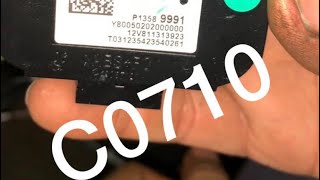
How to confirm: Visually inspect the sensor's electrical connector (located on the steering column) for dark smudges, corrosion, or loose pins. A magnifying glass may be needed. Wiggle the connector while monitoring live data to see if the signal cuts out. 🎬 See how to diagnose the C0710 code using live scan data.
Typical fix: Per TSB PI0639B, disconnect the connector, add a piece of adhesive-backed shim stock to the male connector to prevent movement, clean the terminals with a nylon brush, and apply a small amount of dielectric lubricant (GM Part #12377900) before reconnecting. If the code returns, the harness-side pigtail may need replacement.
Est. part cost: $5-$40 - Faulty Steering Angle Sensor (SAS) 🔴 High Probability → Shop Steering Angle Sensor The sensor is an electronic component with a finite lifespan, located in a high-movement area (steering column), making it susceptible to wear and tear. If the TSB connector fix does not resolve the issue, sensor failure is the next logical cause.
How to confirm: Use a scan tool to monitor the live data from the Steering Angle Sensor. The angle should read 0° when the steering is straight and change smoothly and consistently through its full range (approx. -550 to +550 degrees) as the wheel is turned. Erratic jumps, no signal, or a signal that is stuck indicates a bad sensor.
Typical fix: Replace the steering angle sensor and perform the calibration/relearn procedure with a compatible scan tool.
Est. part cost: $60-$150 - Vehicle Modifications 🟡 Medium Probability As per TSB #PIT4322P, modifications like suspension lifts, oversized tires, or aftermarket steering components can alter the vehicle's geometry and confuse the stability control system, triggering a C0710.
How to confirm: Inspect the vehicle for any non-factory suspension parts, wheels, tires, or steering components. The presence of these modifications is a strong indicator.
Typical fix: The fix may require adjusting the modifications, performing a precise four-wheel alignment, and then recalibrating the steering angle sensor. In some cases, the vehicle may need to be returned to stock specifications.
Est. part cost: $0-$200 - Improper Wheel Alignment ⚪ Low Probability If the steering wheel is not centered when the vehicle is driving straight, the SAS will report a turning angle that conflicts with the wheel speed sensors, which report no turn. The EBCM sees this conflict and sets the code. This can happen after suspension work if the steering wheel position isn't reset correctly.
How to confirm: Observe if the steering wheel is off-center while driving on a straight, flat road. A professional alignment check can confirm. A user on Tahoe Yukon Forum noted their wheel was off by a full turn after a rack and pinion replacement, causing the code.
Typical fix: Perform a four-wheel alignment, ensuring the steering wheel is perfectly centered. After the alignment, the SAS must be recalibrated using a scan tool.
Est. part cost: $100-$200
Rare But Worth Checking
- Loose Steering Angle Sensor Housing: → Shop Steering Angle Sensor
Diagnosis Steps
- Read all codes from the EBCM using a scan tool capable of reading Chassis (C) codes.
- Inspect the vehicle for any modifications (suspension lift, large tires, etc.) as noted in TSB #PIT4322P.
- Using the scan tool, access the live data for the Steering Angle Sensor. Verify the angle is at or near 0° when the wheels are straight.
- Turn the steering wheel lock-to-lock. The angle reading should be smooth and consistent, without any dropouts or erratic jumps, across a range of approximately -550 to +550 degrees.
- If the signal is erratic or absent, gain access to the steering angle sensor on the steering column.
- Inspect the sensor's electrical connector for corrosion, damage, or loose pins. TSB PI0639B specifically mentions fretting corrosion, which looks like dark smudges.
- If corrosion is found, perform the TSB procedure: add a shim, clean the terminals, and apply dielectric grease before re-testing.
- Check if the sensor housing itself is physically loose or has slid down the column shaft.
- If the connector and housing are good, test the sensor's power, ground, and signal circuits according to the service manual.
- If the wiring and connector are confirmed good but the signal is faulty, the Steering Angle Sensor is defective and needs replacement.
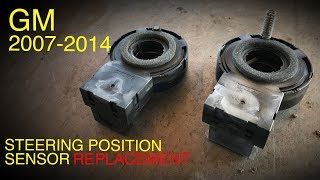
- After replacement, perform the Steering Angle Sensor calibration/relearn procedure using a compatible scan tool. 🎬 Watch: How to perform the steering angle sensor calibration procedure.
Parts You'll Likely Need
- Steering Angle Sensor
(OEM #19418403 (replaces 20910871))— This sensor is the most common point of failure for this code when a component is at fault, after the connector issue is ruled out.
Trusted brands: ACDelco (Professional or GM Genuine), Dorman
OEM price range: $100-$150
Aftermarket price range: $50-$90 - Dielectric Lubricant
(OEM #12377900)— Required for the TSB PI0639B procedure to prevent future fretting corrosion on the connector terminals.
Trusted brands: ACDelco, Permatex
OEM price range: $15-$25
Aftermarket price range: $5-$10 - Steering Angle Sensor Connector Pigtail — If fretting corrosion has damaged the connector beyond cleaning, replacing the pigtail ensures a solid connection. The TSB advises this as a next step if lubricating the connector does not resolve the issue.
Trusted brands: ACDelco, Dorman, Carquest
OEM price range: $30-$50
Aftermarket price range: $15-$30
Related Codes That Often Appear With This One
- C0455 — This code is for 'Steering Position Sensor Circuit Malfunction' and is often set alongside C0710 as they both relate to the same sensor and circuit. TSBs PI0639A/B list them together as being caused by the same connector fretting issue.
- U2143 — This is a 'Lost Communication With Steering Angle Sensor Module' code. It indicates a more severe communication breakdown between the sensor and the EBCM, often pointing to a wiring or connector failure rather than just an implausible signal.
Technical Service Bulletins (TSBs) & Recalls
- PIT4322P: Service Stability message with DTC C0710, advises to inspect for vehicle modifications.
- PI0639B: Service StabiliTrak message with DTC C0455 and/or C0710, points to fretting corrosion on connector terminals. Provides a specific repair procedure involving a shim and dielectric grease.
Platform-Specific Known Issues
- TSB #PIT4322P: Warns that vehicle modifications can cause unwanted stability activation and code C0710, and that these should be inspected before diagnostics.
- TSB #PI0639B (supercedes PI0639A): Points to fretting corrosion in the steering position sensor connector as a cause for C0710 and C0455. It explicitly recommends NOT replacing the sensor for this condition, but instead cleaning the connector, applying dielectric grease, and adding a shim to prevent movement.
Mechanic-Grade Diagnostic Values
- 5V Reference Circuit Voltage — expected: 4.8-5.2 V (between the 5V reference circuit terminal and ground). Failure: A reading outside this range indicates a fault in the EBCM or a short/open in the wiring.
- Low Reference Circuit Resistance — expected: Less than 2 Ω (end to end) or less than 20 Ω (between the circuit terminal and ground). Failure: Resistance higher than the specified value indicates an open or high resistance in the ground circuit.
- Signal Circuit Voltage (Steering Centered) — expected: 6.8-11.7 V (between the signal circuit terminal and ground). Failure: Voltage outside this range can indicate a short to voltage, short to ground, or a faulty EBCM.
Hidden / Shadow Codes Worth Checking
- C0710-5A: Steering Position Signal Not Plausible. This indicates the signal received is out of the expected range or doesn't logically match other vehicle sensor data. (see via Professional scan tools (like Autel, Launch) that can read manufacturer-specific symptom or sub-codes from the EBCM.)
- C0710-42: Steering Wheel Angle Signal Calibration Not Programmed. This indicates the sensor has not been calibrated or has lost its calibration. (see via Professional scan tools that can read manufacturer-specific symptom or sub-codes from the EBCM.)
Scan Tool Commands That Help
- GDS2 / Tech2 / Professional Scan Tool: Steering Wheel Angle Sensor Learn (or Calibration) — This function must be used after replacing the steering angle sensor, performing a wheel alignment, or replacing the EBCM. It resets the sensor's zero-point with the wheels straight ahead. The command is typically found in the EBCM 'Special Functions' menu.
Wiring & Ground Locations
- B99 — Component name for the Steering Wheel Angle Sensor, located on the steering column behind the clock spring.. This is the official GM identifier for the sensor itself, used when referencing service manual schematics for circuit testing.
- K17 — Component name for the Electronic Brake Control Module (EBCM), typically located on the driver's side frame rail in the engine bay.. This is the module that receives the signal from the B99 sensor and sets code C0710. All wiring tests for the sensor circuit originate or terminate at this module's connector.
Real Owner Repair Stories
- Tahoe Yukon Forum user 'itsbo1313' (GMC Yukon (year not specified, but within 2007-2014 range)) — Service Stabilitrak and traction control lights with code C0710, vehicle pulling to the left.
❌ Tried (didn't work) Multiple visits to the dealership could not identify the cause.
✅ What actually fixed it The owner had a nail in one tire and replaced it with a mismatched used tire, causing a constant pull. Replacing the mismatched tires with a new, matching set of four and clearing the code permanently resolved the issue. - Tahoe Yukon Forum user (GMC Yukon (year not specified)) — C0710 code after rack and pinion replacement.
❌ Tried (didn't work) An alignment was performed, but the code persisted.
✅ What actually fixed it The steering wheel was found to be off-center by one full turn. The fix was to disconnect the steering shaft under the hood, manually center the steering, and reconnect it. - Tahoe Yukon Forum user 'tahoe15' (2015+ model, but relevant process for GMT900) — C0710 and C0544 codes with Stabilitrak and steering error messages.
❌ Tried (didn't work) Simply connecting the new sensor without full installation did not clear the warning messages, although it changed the DTCs from 'current' to 'history'.
✅ What actually fixed it The full procedure of removing the steering column, physically replacing the old sensor with the new one, reinstalling the column, and then performing a 'SAS Relearn' with an Xtool D8S scan tool successfully cleared all codes and warnings.
When the Usual Fixes Don't Work
- While the TSB for connector fretting and sensor failure are the most common fixes, they are not guaranteed solutions. In one documented case on a similar GM platform, a technician replaced both the steering angle sensor and the EBCM, performed all calibrations, yet the C0710 and U2143 codes returned immediately. Live data showed the sensor was working, but the EBCM was not receiving the signal. The root cause was suspected to be a fault in the CAN bus wiring between the Power Steering Control Module (PSCM) and the EBCM, a diagnosis made more difficult by incorrect wiring diagrams in popular service manuals. This demonstrates that in rare cases, the fault can lie in the vehicle's data communication wiring, requiring advanced electrical diagnosis beyond simple part replacement.
OEM Part Supersession History
20910871→19418403— Updated part from manufacturer.
Heads up: This part is specific to the later half of the generation.15112675, 25833069→15886733— Updated part from manufacturer.
Heads up: This part is for the early years of the generation and is not interchangeable with the 2010+ part.
Model Year Variations Within This Range
- 2007-2009: These models use a different steering angle sensor, with the latest part number being 15886733.
- 2010-2014: These models use an updated steering angle sensor, with the latest part number being 19418403.
Helpful Videos


The information in this article is provided for general reference and educational purposes only. Vehicle specifications, procedures, and part compatibility can vary by production date, trim level, and region. Always consult your vehicle's factory service manual and verify part numbers before purchasing or performing repairs. Safety-critical components such as airbags, seat belts, and braking systems should be installed by a qualified professional.
- Gmc YUKON:
- 🧭 Diagnostic Flowchart
- 🎬 Helpful Videos
- What's Unique About the 2007-2014 Gmc YUKON
- Symptoms You May Notice
- Most Likely Causes
- Rare But Worth Checking
- Diagnosis Steps
- Parts You'll Likely Need
- Related Codes That Often Appear With This One
- Technical Service Bulletins (TSBs) & Recalls
- Platform-Specific Known Issues
- Mechanic-Grade Diagnostic Values
- Hidden / Shadow Codes Worth Checking
- Scan Tool Commands That Help
- Wiring & Ground Locations
- Real Owner Repair Stories
- When the Usual Fixes Don't Work
- OEM Part Supersession History
- Model Year Variations Within This Range
- 🎟️ Get 5% Off