

C0755 on 2007-2014 Chevrolet Malibu: TPMS Faults, Causes, and Fixes
Code C0755 on a 2007-2014 Chevy Malibu means there's a problem with the right front tire pressure sensor. The most common fix is replacing the sensor due to a dead battery. However, if you also have key fob or starting issues, the Remote Control Door Lock Receiver (RCDLR) is the likely culprit, a well-documented GM issue confirmed by multiple service bulletins.
- C0755 specifically points to the right front TPMS sensor.
- The most likely cause is a dead battery inside the sensor, which has a 7-10 year lifespan.
- If you also have issues with your key fob or starting the car, the problem is very likely the Remote Control Door Lock Receiver (RCDLR), not the sensor.
- Replacing the RCDLR or new TPMS sensors requires programming/relearning with special tools.
- It is often cost-effective to replace all four TPMS sensors if they are the original ones.
What's Unique About the 2007-2014 Chevrolet MALIBU
On this generation of Chevrolet Malibu and many other GM vehicles on the Epsilon/Epsilon II platform, the Tire Pressure Monitoring System (TPMS) is not independent. The signals from the tire sensors are received and processed by the Remote Control Door Lock Receiver (RCDLR), the same module that receives signals from your key fob. Because of this shared hardware, a failing RCDLR can cause both TPMS codes like C0755 and seemingly unrelated problems like the key fob not working, a 'No Remote Detected' message, or even a no-start condition. This is a well-documented issue, and multiple Technical Service Bulletins (TSBs) have been issued that point to a faulty RCDLR as the root cause when these combined symptoms occur.
Diagnostic Flowchart
Tap your situation to follow the diagnostic path that matches what you're seeing on this vehicle.
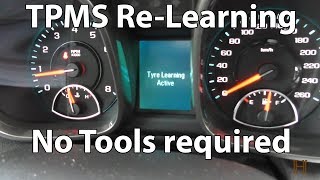
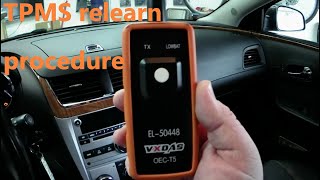
Generation note: This range covers the 7th generation (2008-2012) 🎬 Watch: How to perform the TPMS relearn procedure on 2012 models and the beginning of the 8th generation (2013-2014) 🎬 See how to program 2013-2014 sensors without using a tool Malibu. While the C0755 code has the same meaning for both, the specific part numbers for TPMS sensors and the RCDLR module may differ. TSB 08-03-16-001B specifically notes that 2008 models can lose RCDLR programming after a battery change or low voltage event. Always verify part numbers with your vehicle's VIN.
Symptoms You May Notice
- TPMS warning light flashing for approximately one minute, then staying on solid.
- Driver Information Center (DIC) shows dashes ('--') for the right front tire pressure.
- DIC displays 'Service Tire Monitor System' message.
- Intermittent or complete failure of key fob functions (lock/unlock, remote start).
- Significantly reduced range for the key fob.
- 'No Remote Detected' message on the DIC.
- Engine will not crank or start (no-start condition), often requiring the fob to be placed in the transmitter pocket to start. [4, ⭐ MANUFACTURER TSB — highest authority] Bulletin #PIC5650M
- Replacing only the TPMS sensor when the root cause is the RCDLR. If key fob or starting issues are also present, the RCDLR is the more likely culprit.
- Replacing the BCM when the fault lies with the RCDLR or the sensor itself.
- Replacing the RCDLR when the actual problem is a simple loose antenna connection or RF interference from a phone charger.
Most Likely Causes
- Dead or Failing TPMS Sensor Battery 🔴 High Probability → Shop Tire Pressure Monitoring System (TPMS) Sensor TPMS sensor batteries are non-rechargeable and have a finite lifespan, typically 7-10 years. Vehicles in this year range are at or beyond the expected life of the original sensors.
How to confirm: Use a TPMS diagnostic tool (like the J-46079 or equivalent) to attempt to 'wake up' or read the sensor. If the tool cannot get a reading, or if it shows a low battery status, the sensor has failed. This is the most likely cause if no other symptoms (like key fob issues) are present.
Typical fix: Replace the right front TPMS sensor. It is often recommended to replace all four sensors at the same time if they are original, as the others are likely to fail soon.
Est. part cost: $25-$60 per sensor - Faulty Remote Control Door Lock Receiver (RCDLR) 🟡 Medium Probability → Shop Keyless Entry Receiver This module is a known failure point on many GM platforms from this era. TSB #16-NA-396 was issued specifically to address internal RCDLR failures causing simultaneous TPMS and keyless entry problems.
How to confirm: This is the prime suspect if you experience TPMS codes along with key fob issues, reduced remote range, or no-start problems. A GM-specific scan tool can check for communication errors with the RCDLR. The presence of codes from both the C07xx and B3xxx series strongly points to the RCDLR or related interference. [⭐ MANUFACTURER TSB — highest authority] Bulletin #PIC5650M
Typical fix: Replace the RCDLR module. The new module must be programmed to the vehicle using a dealer-level scan tool or equivalent.
Est. part cost: $50-$150 - Poor RCDLR Antenna Connection ⚪ Low Probability Wiring connections can become loose or corroded over time. TSB #16-NA-061 details this specific issue, identifying three common disconnection points: the RCDLR module itself, the antenna amplifier module, and the antenna connection at the rear glass.
How to confirm: This should be investigated if symptoms are intermittent or affect sensors farthest from the receiver first (like the front tires). Inspect the coax cable connection at the RCDLR itself, at the antenna amplifier module, and where the amplifier connects to the antenna in the rear glass. A loose connection can cause weak signal reception, mimicking a failed sensor or RCDLR.
Typical fix: Securely reconnect the loose coax cable or antenna connector. Clean any corrosion found. This requires accessing trim panels, typically in the rear of the vehicle near the C-pillar.
Est. part cost: $0 if no parts are broken - Damaged TPMS Sensor ⚪ Low Probability → Shop Tire Pressure Monitoring System (TPMS) Sensor Sensors are vulnerable to physical damage during tire changes, by hitting a pothole, or from road salt corrosion.
How to confirm: Visual inspection after dismounting the tire. If a TPMS tool cannot read a sensor that is not old enough to have a dead battery, suspect physical damage.
Typical fix: Replace the damaged sensor and perform the TPMS relearn procedure.
Est. part cost: $25-$60
Rare But Worth Checking
- Radio Frequency (RF) Interference: TSB PIC5650K strongly advises checking for RFI before replacing parts. The RCDLR operates on sensitive radio frequencies (315 MHz or 433 MHz) that can be 'jammed' by other electronic devices, causing TPMS, key fob, and starting issues. Unplug ALL aftermarket devices (phone chargers, dash cams, USB power banks, aftermarket LED lights) and remove all other fobs or access cards from the key ring before diagnosis. The interference can be intermittent, only occurring when the offending device is powered on.
- Body Control Module (BCM) Fault: → Shop Body Control Module While rare, the BCM is the central computer that processes the information from the RCDLR. A fault within the BCM can mimic sensor or RCDLR issues. This should only be considered after all other possibilities have been exhausted and other BCM-related DTCs are present.
- RCDLR Memory Loss After Low Voltage (2008 Models): TSB 08-03-16-001B notes that on 2008 models specifically, a low voltage event (like changing the car battery) can cause the RCDLR to lose its programming for both key fobs and TPMS sensors. The fix is not replacement, but reprogramming the RCDLR with updated software via a Tech 2 or similar tool.
Diagnosis Steps
- Verify the code with an OBD-II scanner capable of reading Chassis (C) and Body (B) codes.
- Check for any other related DTCs, especially security (B-codes like B3055) or other TPMS codes (C0750, C0760, C0765). Note if key fob or starting issues are present.
- Crucial First Step: Remove all aftermarket electronics from the vehicle (phone chargers, dash cams, LED lights, etc.) and remove all other fobs/cards from the key ring to eliminate RF interference, per TSB PIC5650. Retest.
- Use a TPMS activation tool to try and read the right front sensor. Note its pressure, temperature, and battery status.
- If the tool cannot get a response from the sensor, and the sensor is old, the sensor itself has likely failed (usually a dead battery). This is the likely cause if no other symptoms exist.
- If the sensor reads fine on the tool but the car still sets C0755, OR if you are also experiencing key fob/starting issues, the problem is likely with the RCDLR's ability to receive the signal.
- Before replacing the RCDLR, inspect its antenna connections per TSB 16-NA-061. Check the coax connection at the RCDLR module, the antenna amplifier, and the rear glass antenna for looseness or corrosion.
- If RCDLR failure is still suspected, replacement and programming is the next step. This requires a GM-specific scan tool.
- After any repair (sensor or RCDLR replacement), perform the vehicle's TPMS relearn procedure as specified in the service manual.
Parts You'll Likely Need
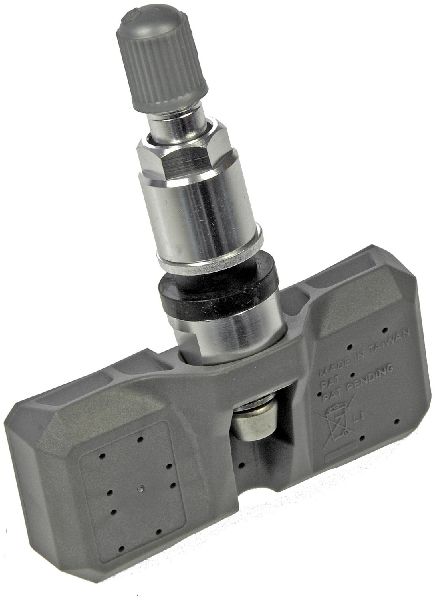
- Tire Pressure Monitoring System (TPMS) Sensor
(OEM #13598771 (ACDelco GM Original Equipment - verify for your specific year))— This is the most common failure point due to an expired internal battery, especially when no other symptoms are present.
Related Codes That Often Appear With This One
- C0750 — Fault in the Left Front TPMS sensor. Often set alongside other TPMS codes when the RCDLR is failing.
- C0760 — Fault in the Left Rear TPMS sensor.
- C0765 — Fault in the Right Rear TPMS sensor.
- B3055 — Related to the key transponder system, often appears with RCDLR failure or RF interference. [2, ⭐ MANUFACTURER TSB — highest authority] Bulletin #PIC5650M
- B3060 — Related to the security system and communication with the key, often appears with RCDLR failure. [⭐ MANUFACTURER TSB — highest authority] Bulletin #PIC5650M
Technical Service Bulletins (TSBs) & Recalls
- PIC5650M: Mentions a potential no crank, no start, or start stall concern with the security light on, accompanied by codes including C0755. Points to RF interference as a likely cause. [33, ⭐ MANUFACTURER TSB — highest authority] Bulletin #PIC5650M
- 16-NA-396: Directly addresses intermittent operation of key fobs and 'No Remote Detected' messages, along with TPMS codes (C0750, C0755, C0760, C0765), and identifies the cause as an internal failure of the RCDLR, recommending replacement.
- 16-NA-061: Details how a poor or disconnected RCDLR antenna connection can cause TPMS and keyless entry faults, providing a critical diagnostic step before component replacement.
- 08-03-16-001B: Specific to 2008 models (including Malibu), warns that a low-voltage event can erase RCDLR memory for fobs and TPMS, requiring reprogramming.
Platform-Specific Known Issues
- A known issue, documented in TSB #16-NA-396, links TPMS codes with key fob and no-start conditions due to a faulty Remote Control Door Lock Receiver (RCDLR).
- TSB #PIC5650M points to Radio Frequency Interference from aftermarket electronics as a common cause for these combined symptoms that can be misdiagnosed as a failed part. [33, ⭐ MANUFACTURER TSB — highest authority] Bulletin #PIC5650M
- TSB #16-NA-061 identifies a loose RCDLR antenna connection as another potential root cause for these exact symptoms.
- For 2008 models specifically, TSB #08-03-16-001B warns that the RCDLR can lose its programming after a battery change, requiring a software reflash, not a part replacement.
Hidden / Shadow Codes Worth Checking
- C0755 08: Signal Invalid. This indicates the RCDLR is receiving a signal, but the data is corrupt or not understandable. (see via GM GDS2 or other professional scan tool capable of reading symptom bytes.)
- C0755 29: Too Few Pulses. This symptom byte is specifically mentioned in TSB 16-NA-396 and strongly points to an internal failure of the RCDLR module when seen with other TPMS codes. (see via GM GDS2 or other professional scan tool capable of reading symptom bytes.)
- C0755 03: Low Voltage. This can indicate a failing battery within the TPMS sensor itself. (see via GM GDS2 or other professional scan tool capable of reading symptom bytes.)
Scan Tool Commands That Help
- GDS2 (Global Diagnostic System 2): Module Diagnostics > Remote Control Door Lock Receiver > Data Display — To view live data from the RCDLR, including the last known signal strength and battery status of each TPMS sensor. This helps differentiate a dead sensor from a reception issue.
- GDS2 (Global Diagnostic System 2): Tire Pressure Monitor (TPM) Learn — This is a required procedure after replacing any TPMS sensor or the RCDLR module to make the vehicle learn the new sensor IDs and their positions on the car.
- GDS2 (Global Diagnostic System 2): Module Diagnostics > Remote Control Door Lock Receiver > Configuration/Reset Functions > Add/Replace Key Fobs — This function is mandatory after replacing the RCDLR module. The new module must be programmed to recognize the vehicle's existing key fobs.
- J-46079 (or equivalent TPMS Tool): Simulate Mode — To test the RCDLR's reception. The tool can send a perfect, simulated sensor signal to the RCDLR. If the scan tool shows the RCDLR received the simulated signal but not the actual sensor's signal, it confirms the sensor is bad. If the RCDLR fails to receive the simulated signal, the RCDLR or its wiring is at fault.
Wiring & Ground Locations
- RCDLR Module — For the 2008-2012 (7th Gen) Malibu, the RCDLR is attached to the rear window shelf, under the trim panel in the center. For the 2013-2014 (8th Gen) Malibu, the module is located behind the left side of the dash.. This is the central receiving unit for all TPMS and key fob signals. Physical access is required to check its coaxial antenna connection (a common failure point per TSB 16-NA-061) and its main electrical connector for power and ground before replacement.
- G203 — For the 2008-2012 models, this ground is located under the center console. For 2013-2014 models, it is in the left kick panel area.. This is a major interior ground point. While not the dedicated ground for the RCDLR in all years, a poor connection here can cause a wide range of difficult-to-diagnose electrical issues in the BCM and other interior modules that communicate with the RCDLR.
- RCDLR Antenna — The antenna is a coaxial cable system consisting of the cable itself, an antenna amplifier module, and the antenna grid which is typically integrated into the right rear glass.. A disconnection at any of the three main points—at the RCDLR, at the amplifier, or at the glass—will cause a loss of signal and trigger TPMS codes. TSB 16-NA-061 notes that a disconnect farther from the RCDLR may only cause codes for the front tires, which are farthest away.
Real Owner Repair Stories
- Chevy Equinox Forum user (2007 Chevrolet Equinox (shares similar GM electronics)) — TPMS light was on, but the vehicle would not enter the TPMS relearn mode when prompted by the DIC.
❌ Tried (didn't work) Attempting the standard TPMS relearn procedure via the Driver Information Center (DIC).
✅ What actually fixed it The owner was advised that the Remote Control Door Lock Receiver (RCDLR) was the likely cause of the failure, as it controls both TPMS functions and the relearn procedure initiation. The problem was identified as a bad RCDLR module.
OEM Part Supersession History
22733524 (Key Fob)→This part number is for the 5-button key fob (FCC ID: KOBGT04A) commonly used on the 2007-2012 Malibu. It has not been directly superseded but is sold under various equivalent numbers.— N/A
Heads up: This fob is NOT compatible with 2013+ models which use a different FCC ID (OHT01060512) and key style.13504200 (Key Fob)→23335583— Part number consolidation and updates.
Heads up: This is the flip-key style fob for 2013-2016 Malibus with a standard key ignition (FCC ID: OHT01060512). It is not backward compatible with 2007-2012 models.13509517, 13510984 (RCDLR)→13595510, 13597910 respectively— Internal design revision to address the failure mode described in TSB 16-NA-396.
Heads up: These part numbers are listed in a TSB for newer vehicles but illustrate the common practice of GM superseding faulty RCDLRs. It is critical to use the VIN to get the correct, most current RCDLR part number for the specific Malibu being repaired, as different frequencies and features exist.
Model Year Variations Within This Range
- 2007-2012 (7th Gen): The RCDLR module is located under the rear package shelf/tray. The key fob is a separate unit from the key (FCC ID: KOBGT04A).
- 2013-2014 (8th Gen): The RCDLR module was moved to behind the left side of the dashboard. The vehicle uses a flip-style key with an integrated remote (FCC ID: OHT01060512).
- 2008 Only: A specific TSB (08-03-16-001B) notes that the RCDLR on 2008 models is susceptible to losing its key fob and TPMS programming after a low-voltage event, such as a battery replacement. The fix is reprogramming, not necessarily replacement.
Helpful Videos
We Have This Part in Stock

The information in this article is provided for general reference and educational purposes only. Vehicle specifications, procedures, and part compatibility can vary by production date, trim level, and region. Always consult your vehicle's factory service manual and verify part numbers before purchasing or performing repairs. Safety-critical components such as airbags, seat belts, and braking systems should be installed by a qualified professional.
- Chevrolet MALIBU:
- 🧭 Diagnostic Flowchart
- 🎬 Helpful Videos
- 🛍️ Shop This Part
- What's Unique About the 2007-2014 Chevrolet MALIBU
- Symptoms You May Notice
- Most Likely Causes
- Rare But Worth Checking
- Diagnosis Steps
- Parts You'll Likely Need
- Related Codes That Often Appear With This One
- Technical Service Bulletins (TSBs) & Recalls
- Platform-Specific Known Issues
- Hidden / Shadow Codes Worth Checking
- Scan Tool Commands That Help
- Wiring & Ground Locations
- Real Owner Repair Stories
- OEM Part Supersession History
- Model Year Variations Within This Range
- 🎟️ Get 5% Off