

C0755 on 2010-2017 GMC Terrain: Right Front TPMS Fault Causes and Fixes
This code indicates a fault with the right front tire pressure sensor. The most common cause is a dead battery within the sensor, which is not replaceable. The fix is to replace the entire sensor and perform a TPMS relearn procedure. It is wise to consider replacing all four sensors at once, as they tend to fail around the same time. If key fob issues are also present, the problem is likely the Remote Control Door Lock Receiver (RCDLR) module or its antenna wiring, not the sensor.
- C0755 points specifically to a problem with the right front TPMS sensor.
- The most likely cause on a 2010-2017 model is the original sensor's battery has died.
- The fix involves replacing the sensor (which requires dismounting the tire) and performing a simple relearn procedure.
- Consider replacing all four sensors at once, as the others are likely near the end of their service life.
- If other strange electrical issues (especially key fob or starting problems) are present, investigate for Radio Frequency Interference before replacing parts.
What's Unique About the 2010-2017 Gmc TERRAIN
On this generation of GMC Terrain and its platform mates, the TPMS sensors communicate with the Body Control Module (BCM) via the Remote Control Door Lock Receiver (RCDLR), which also manages vehicle security and key fob functions. A GM Technical Service Bulletin (TSB PIC5650M and its revisions) has noted that TPMS codes like C0755 can appear alongside security-related codes (like B3055) during a no-start or stalling event. This does not mean the TPMS sensor fault causes the engine issue; rather, it suggests a deeper electrical problem, often Radio Frequency Interference (RFI) from aftermarket devices like phone chargers or LED lights, that can 'jam' the signals for both the key fob and the TPMS sensors, triggering multiple, seemingly unrelated trouble codes.
Diagnostic Flowchart
Tap your situation to follow the diagnostic path that matches what you're seeing on this vehicle.
Symptoms You May Notice
- TPMS warning light flashing for about a minute and then staying on solid
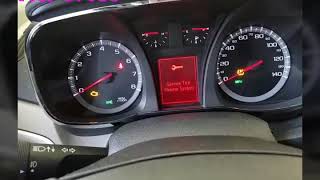
- "Service Tire Monitor System" message on the Driver Information Center (DIC)
- The pressure reading for the right front tire may show as dashes (--) on the DIC
- Inaccurate pressure reading for the right front tire that doesn't change correctly with inflation/deflation.
- Key fob may have poor range or be inoperative at the same time.
- Replacing the wrong sensor. Always confirm the location with a proper relearn procedure, as tire rotations can misplace sensor positions in the vehicle's memory if a relearn wasn't performed.
- Assuming a single sensor failure when multiple sensors are near the end of their battery life. Replacing one sensor may soon be followed by another failure.
Most Likely Causes
- Dead TPMS Sensor Battery 🔴 High Probability → Shop Tire Pressure Monitoring System (TPMS) Sensor TPMS sensor batteries are non-rechargeable and have a finite lifespan, typically 5-10 years. Vehicles in this year range are reaching the end of the original sensors' expected life. It is very common for the other sensors to fail within months of the first one.
How to confirm: Use a TPMS diagnostic tool to try and activate the sensor. If the tool cannot get a reading, or explicitly shows a 'LOW' or 'REPLACE' battery status, the sensor is dead. A scan tool can also sometimes read a 'low battery' status from the sensor before it fails completely.
Typical fix: Replace the right front TPMS sensor. The battery is integrated and cannot be replaced separately. Many owners and shops recommend replacing all four sensors at the same time to avoid repeat service visits.
Est. part cost: $30-$80 - Failed TPMS Sensor 🟡 Medium Probability → Shop Tire Pressure Monitoring System (TPMS) Sensor Internal electronics of the sensor can fail from age, vibration, or moisture intrusion.
How to confirm: Even if a TPMS tool shows the battery has some life, the sensor may not transmit data correctly. If the relearn procedure fails repeatedly for the right front wheel, the sensor is likely faulty.
Typical fix: Replace the right front TPMS sensor and perform the relearn procedure.
Est. part cost: $30-$80 - Damage During Tire Service ⚪ Low Probability
How to confirm: The issue appears immediately after new tires are installed or a flat is repaired. Visual inspection of the sensor (if the tire is dismounted) may show physical damage.
Typical fix: Replace the damaged TPMS sensor.
Est. part cost: $30-$80
Rare But Worth Checking
- Body Control Module (BCM) Fault: → Shop Body Control Module This is rare, but worth considering if C0755 is present with other unrelated electrical codes, especially security or communication codes mentioned in TSB PIC5650M.
- Radio Frequency (RF) Interference: Aftermarket electronic devices like phone chargers, dash cams, LED lighting, or CB radios can sometimes interfere with the low-power signal from the TPMS sensor. TSB PIC5650 specifically calls this out as a cause for intermittent TPMS and key fob issues.
- Failed Remote Control Door Lock Receiver (RCDLR): → Shop Keyless Entry Receiver The RCDLR is the receiver for both the key fobs and the TPMS sensors. A separate TSB (16-NA-396) notes that an internal failure in this module can cause a loss of communication with TPMS sensors, setting codes like C0755 with a ':29 - Too Few Pulses' subtype.
Diagnosis Steps
- Verify the TPMS warning light is on and code C0755 is present using an OBD-II scanner.
- Manually check the air pressure in all four tires to rule out an actual low-pressure situation.
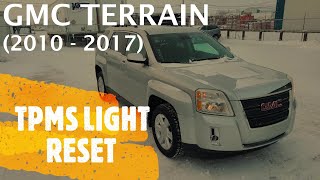
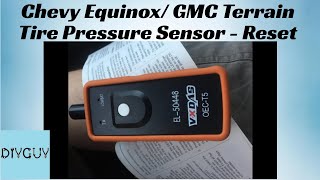
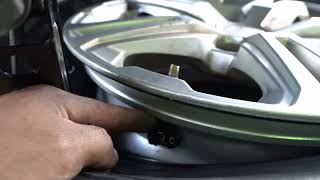
- Attempt the vehicle's TPMS relearn procedure. For this GMC Terrain, this typically involves using the driver information center controls to enter 'Tire Learn' mode and then using a simple TPMS activation tool at each wheel in sequence (LF, RF, RR, LR). 🎬 Watch: How to perform the TPMS relearn procedure. Alternatively, letting air out of each tire in sequence may work.
- If the horn does not chirp when you get to the right front tire, but does for the others, this strongly indicates a bad sensor in that wheel.
- Use a dedicated TPMS tool to attempt to read the sensor's data (ID, pressure, temperature, battery status). If the tool cannot get a signal or shows a low battery, the sensor has failed.
- If the sensor appears to be working but the code persists, inspect for potential sources of RF interference (unplug all aftermarket chargers/devices) or check for other BCM-related trouble codes that could indicate a larger issue.
- If key fob issues are also present, investigate the Remote Control Door Lock Receiver (RCDLR) and its antenna system as a primary suspect before replacing more sensors.
Parts You'll Likely Need
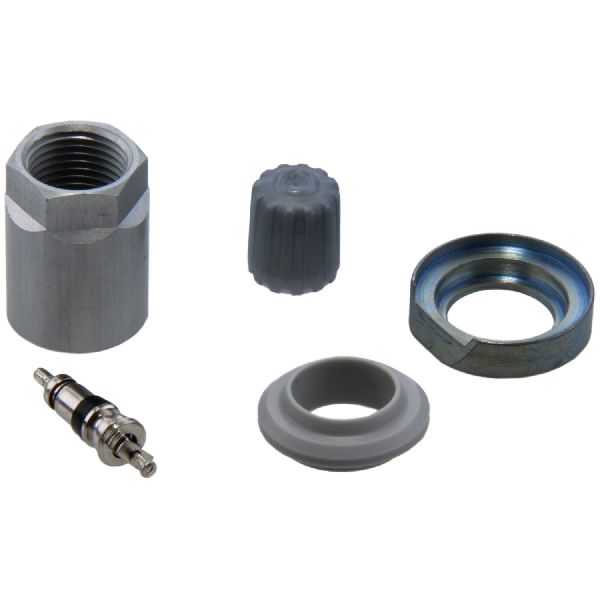
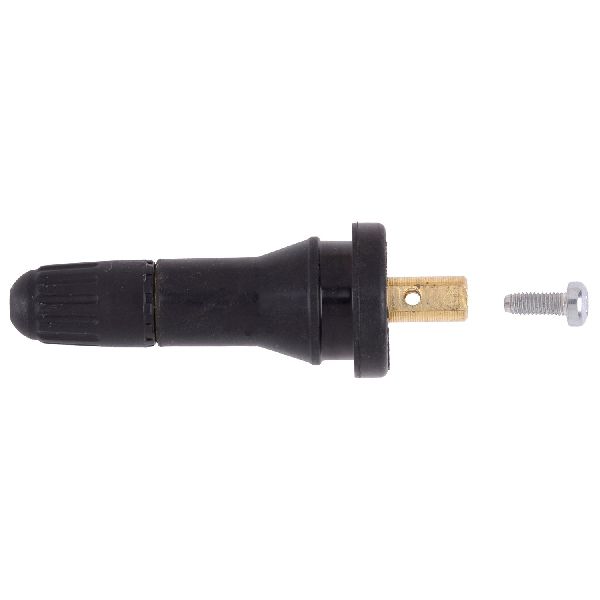
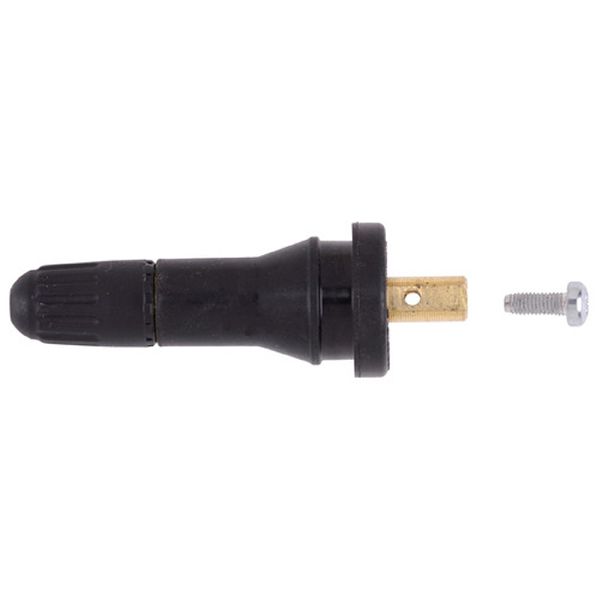
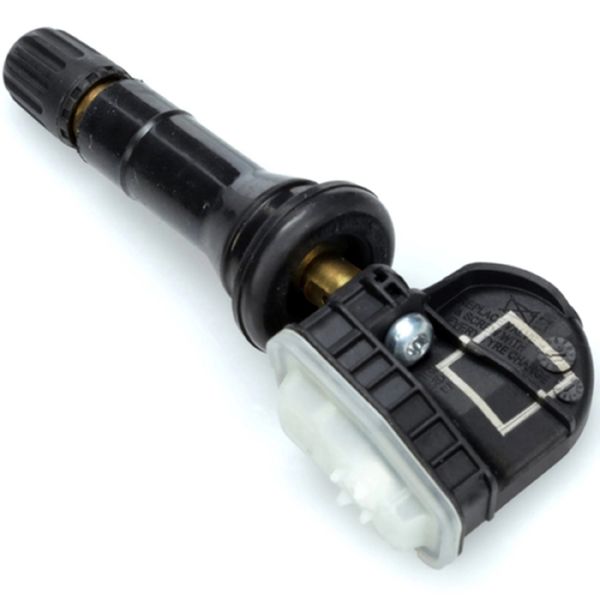
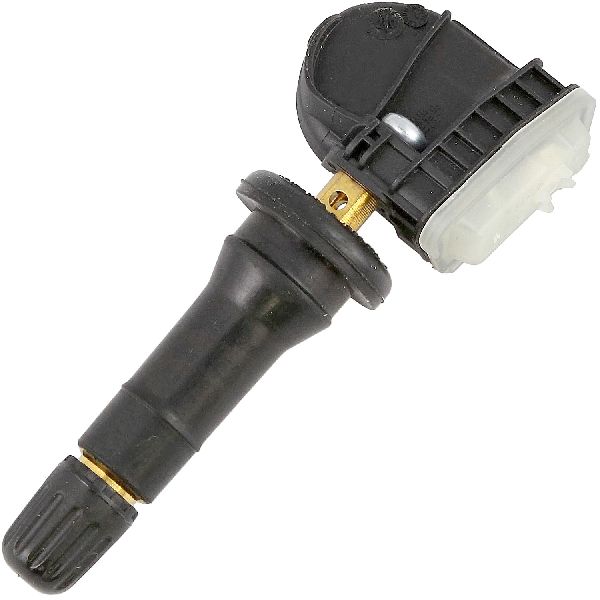
- Tire Pressure Monitoring System (TPMS) Sensor
(OEM #13586335 (superseded by 13598775, 13516165))— This is the component that fails, usually due to its internal battery dying after 5-10 years of service. It's a self-contained unit that operates at 315 MHz in North America.
Trusted brands: ACDelco (OEM), Schrader (OEM Supplier), Autel, Standard Motor Products
OEM price range: $50-$90
Aftermarket price range: $30-$60 - TPMS Relearn Tool
(OEM #EL-50448)— While not always strictly necessary (some GM models allow relearn by deflating the tire), a simple activation tool 🎬 See how to relearn TPMS manually without using a tool. like the EL-50448 makes the process faster, easier, and is very affordable. It is the most commonly recommended tool by owners for this platform.
Trusted brands: VETOMILE, JDIAG, ATEQ
OEM price range: $15-$30
Aftermarket price range: $10-$25
Related Codes That Often Appear With This One
- C0750 — Fault code for the Left Front TPMS sensor. Seeing multiple TPMS codes can indicate a systemic issue or that multiple sensors are failing around the same time due to age.
- C0760 — Fault code for the Left Rear TPMS sensor.
- C0765 — Fault code for the Right Rear TPMS sensor.
- B3055 — A key-related security code. As per TSB PIC5650M, if C0755 appears with this code and a no-start condition, it points towards a larger electrical or RFI issue, not a simple TPMS fault.
Technical Service Bulletins (TSBs) & Recalls
- PIC5650M (and revisions): Addresses a potential no-start or stall condition where various codes, including TPMS codes like C0755, may be present due to an underlying electrical or Radio Frequency Interference issue.
- 16-NA-396: Addresses intermittent loss of key fob and TPMS functions, which can set C0755, caused by an internal failure of the Remote Control Door Lock Receiver (RCDLR) module.
- 16-NA-061: Details diagnosis of a poor or disconnected RCDLR antenna system (coax cable, amplifier, glass antenna) as a cause for TPMS codes and poor key fob range.
Platform-Specific Known Issues
- TSB PIC5650M: Notes that in cases of a no-crank, no-start, or stall with the security light on, various DTCs may be found, including C0755. This points to a potential underlying electrical or module (BCM) fault, often RFI, rather than the TPMS sensor causing the drivability issue.
- Cascading Sensor Failure: Due to the consistent battery lifespan, it is extremely common for the remaining original TPMS sensors to fail shortly after the first one is replaced. Owners often recommend replacing all four sensors at once to save on future labor costs and hassle.
Mechanic-Grade Diagnostic Values
- RCDLR Power Supply Voltage — expected: 12.0V - 12.6V with key on, engine off.. Failure: 0V indicates a broken wire or blown fuse. The power wire is typically Red/White at the RCDLR connector.
- RCDLR Ground Circuit Resistance — expected: Less than 5.0 ohms, ideally less than 0.5 ohms.. Failure: High resistance or an Open Loop (O.L.) reading on a multimeter indicates a poor or broken ground connection. The ground wire is typically Black or Black/White. The test should be performed between the ground pin at the connector and a known-good chassis ground.
Hidden / Shadow Codes Worth Checking
- C0755 03: Right Front Tire Pressure Sensor Low Voltage. This symptom byte points directly to a weak signal from the sensor, most often due to a dying internal battery. (see via A professional scan tool (like GM GDS2/Tech2) capable of reading BCM symptom codes.)
- C0755 29: Right Front Tire Pressure Sensor Too Few Pulses. TSB 16-NA-396 specifically calls out this symptom byte. When seen with other TPMS codes, it strongly indicates an internal fault with the Remote Control Door Lock Receiver (RCDLR) module, not the individual tire sensors. (see via A professional scan tool (like GM GDS2/Tech2) capable of reading BCM symptom codes.)
- C0755 39: Right Front Tire Pressure Sensor Internal Malfunction. This indicates the sensor has failed internally, separate from a low battery condition. (see via A professional scan tool (like GM GDS2/Tech2) capable of reading BCM symptom codes.)
Scan Tool Commands That Help
- GM GDS2 / High-End Bidirectional Scanner: BCM Data List > TPMS Parameters — To observe live data parameters like 'Tire Pressure Sensor Rolling Count' and 'Hit Rate'. A low hit rate or a rolling count that doesn't increase can indicate RF interference or a weak signal that isn't being consistently received by the RCDLR, even if the sensor itself is good.
- GM GDS2 / High-End Bidirectional Scanner: Module Communication Test — To actively 'ping' the Remote Control Door Lock Receiver (RCDLR). If the scan tool cannot communicate with the RCDLR, it points to a wiring issue (power/ground) or a failed module, rather than a sensor problem.
Wiring & Ground Locations
- Remote Control Door Lock Receiver (RCDLR) — Typically located behind an interior trim panel in the rear of the vehicle. On the platform-mate 1st Gen Equinox, it is on the passenger side C-pillar, between the small rear quarter window and the rear passenger door. On similar GM SUVs (Yukon), it is in the driver's side rear D-pillar.. This module receives signals from both the TPMS sensors and key fobs. A failure in the module, its wiring, or its antenna will cause both systems to stop working, often leading to a misdiagnosis of a bad TPMS sensor.
- RCDLR Antenna System — This system consists of the RCDLR module, a coaxial cable running from it, an antenna amplifier module, and the antenna itself, which is often integrated into the right rear quarter glass.. TSB 16-NA-061 highlights that a poor connection at the module, the amplifier, or the glass antenna can cause intermittent or total loss of TPMS signals. Checking these three connection points for looseness or corrosion is a critical diagnostic step before replacing the RCDLR module.
- Grounds G301, G401, G403 — G301 is located under the driver's seat. G401 is in the left side of the luggage compartment, and G403 is in the right side of the luggage compartment.. These are the primary chassis ground points in the rear of the vehicle where the RCDLR is located. A corroded or loose connection at one of these grounds can cause a lack of power to the RCDLR, mimicking a failed module.
Real Owner Repair Stories
- Go-Parts article citing TSB 16-NA-396 (2017 GMC Yukon) — Code C0755, intermittent "No Remote Detected" messages, and key fob issues.
❌ Tried (didn't work) Replacing the TPMS sensor, Replacing the key fob battery
✅ What actually fixed it The dealer diagnosed an internal failure of the Remote Control Door Lock Receiver (RCDLR) module. Replacing and reprogramming the RCDLR module solved both the TPMS code and the key fob problems. - Reddit user on r/Chevrolet (2008 Chevrolet Equinox (1st Gen platform mate)) — All TPMS sensors not reporting, "Service Tire Pressure Monitoring System" message, and very poor key fob range (had to be right next to the car).
❌ Tried (didn't work) Searching for the RCDLR module in the incorrect location (left side panels)
✅ What actually fixed it After getting the correct location, the user found the RCDLR module behind the passenger side C-pillar trim and discovered its antenna was simply unplugged. Plugging the antenna back in restored full key fob range and allowed the TPMS sensors to be relearned successfully. - HR Repair on YouTube (2011 Chevy Silverado) — No communication with RCDLR on scan tool, key fobs not working.
❌ Tried (didn't work) Initially ordering a replacement RCDLR module before testing.
✅ What actually fixed it A wiring problem. Using a multimeter, the technician found 12V at the fuse but 0V at the RCDLR power wire (Red/White). Probing the wire at various points revealed a break in the power wire somewhere in the harness between the B-pillar and the module's location in the rear. Repairing the broken wire restored power and communication to the module.
OEM Part Supersession History
13586335→13598775— Standard part number update/revision.
Heads up: This is the correct supersession for the 315 MHz sensor used in North American market GMC Terrains. Be aware that part number 13516165 is also listed in some catalogs but is often a 433MHz sensor for other markets and is not compatible. Always verify the frequency before purchase.
Model Year Variations Within This Range
- 2010-2017: No significant variations have been identified for the TPMS system within this model year range for the North American market. The system consistently uses 315 MHz sensors and a similar relearn procedure across these years.
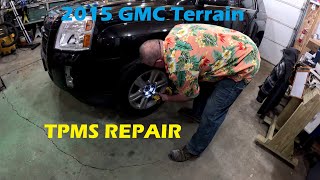
Helpful Videos
We Have This Part in Stock


The information in this article is provided for general reference and educational purposes only. Vehicle specifications, procedures, and part compatibility can vary by production date, trim level, and region. Always consult your vehicle's factory service manual and verify part numbers before purchasing or performing repairs. Safety-critical components such as airbags, seat belts, and braking systems should be installed by a qualified professional.
- Gmc TERRAIN:
- 🧭 Diagnostic Flowchart
- 🎬 Helpful Videos
- 🛍️ Shop This Part
- What's Unique About the 2010-2017 Gmc TERRAIN
- Symptoms You May Notice
- Most Likely Causes
- Rare But Worth Checking
- Diagnosis Steps
- Parts You'll Likely Need
- Related Codes That Often Appear With This One
- Technical Service Bulletins (TSBs) & Recalls
- Platform-Specific Known Issues
- Mechanic-Grade Diagnostic Values
- Hidden / Shadow Codes Worth Checking
- Scan Tool Commands That Help
- Wiring & Ground Locations
- Real Owner Repair Stories
- OEM Part Supersession History
- Model Year Variations Within This Range
- 🎟️ Get 5% Off