

C0775 on 2007-2014 Chevrolet Tahoe: TPMS Relearn Failure Explained
Code C0775 on a 2007-2014 Tahoe means the Tire Pressure Monitoring System (TPMS) sensor relearn procedure has failed or was not completed. This typically happens after a tire rotation or sensor replacement. The fix is to correctly perform the TPMS relearn procedure, which may require a special TPMS tool or can be done by letting air out of each tire in sequence.
- C0775 means the TPMS relearn procedure failed, it does not point to a specific broken part.
- The most common reason for this code is a tire rotation or sensor replacement without performing the relearn procedure.
- A dead battery in one of the TPMS sensors can prevent the relearn from completing, causing this code.
- You will likely need a simple, inexpensive GM-specific TPMS relearn tool (like an EL-50448) to fix this yourself.
- Always check your tire pressures manually with a gauge until the TPMS warning light is resolved.
What's Unique About the 2007-2014 Chevrolet TAHOE
The GMT900 platform, which includes the 2007-2014 Tahoe, uses a straightforward TPMS system where the Remote Control Door Lock Receiver (RCDLR) also functions as the TPMS receiver. Code C0775 is specifically a 'process' code, not a 'part' code. Unlike codes C0750, C0755, C0760, and C0765 which point to a specific faulty sensor, C0775 indicates a failure in the procedure to teach the vehicle which sensor is in which wheel location. This is a common issue after tire rotations or sensor replacements if the relearn procedure isn't performed correctly or if a sensor fails to transmit during the process.
Diagnostic Flowchart
Tap your situation to follow the diagnostic path that matches what you're seeing on this vehicle.
Symptoms You May Notice
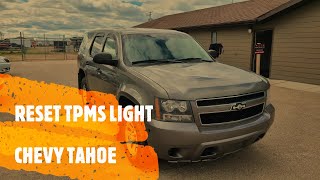
- TPMS warning light is on or flashing 🎬 Watch: How to reset and clear your TPMS light
- "Service Tire Monitor System" message on the Driver Information Center (DIC)
- Tire pressure readings on the DIC show dashes (--) instead of pressure values
- Key fob (remote lock/unlock) range may be noticeably reduced if the RCDLR module is the cause.
- Replacing the Body Control Module (BCM) when the issue is with the relearn procedure, a dead sensor, or the RCDLR.
Most Likely Causes
- TPMS Relearn Procedure Not Performed or Failed 🔴 High Probability This is the direct trigger for the code. It's required after tire rotations or sensor replacements to match the sensor IDs to their new positions. The process will time out and fail if not completed within the allotted time (approx. 5 minutes total).
How to confirm: If the code appeared immediately after a tire rotation, new tires, or sensor replacement, this is the most likely cause. Attempting the relearn procedure is the confirmation. If the relearn process is started, but not completed, all sensor IDs are erased and will display as dashes.
Typical fix: Perform the TPMS sensor relearn procedure. 🎬 See this walkthrough on programming your sensor positions This can be done using a TPMS activation tool (like the EL-50448) or by the 'tool-less' method of letting air out of the tires in sequence until the horn chirps for each one.
Est. part cost: $0-$30 for a basic relearn tool - One or More Faulty TPMS Sensors 🟡 Medium Probability → Shop Tire Pressure Monitoring System (TPMS) Sensor The batteries inside TPMS sensors have a finite lifespan, typically 7-10 years. A dead or failing sensor cannot transmit its ID, causing the relearn procedure to fail when the vehicle gets to that wheel.
How to confirm: Use a TPMS diagnostic tool to attempt to read the ID, battery status, and pressure from each sensor. If a sensor does not respond, it is faulty. Often, if one sensor battery has died, the others are near the end of their life, and it is common practice to replace all four.
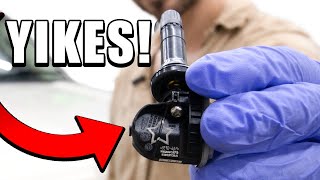
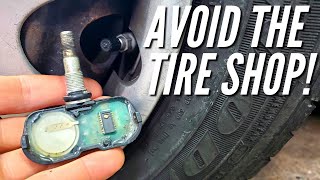
Typical fix: Replace the faulty TPMS sensor(s). The tire must be dismounted to do this. 🎬 Watch: How to replace sensors without a tire machine Afterwards, the relearn procedure must be performed.
Est. part cost: $30-$70 per sensor - Faulty Remote Control Door Lock Receiver (RCDLR) ⚪ Low Probability → Shop Keyless Entry Receiver The RCDLR acts as the antenna/receiver for both the TPMS sensors and the key fobs. If it fails, it cannot receive signals from any of the sensors, making the relearn process impossible. Water intrusion into the rear D-pillar is a known cause of RCDLR failure.
How to confirm: This is usually diagnosed when all sensors are confirmed to be working but the relearn procedure still fails. It is almost always accompanied by issues with the key fobs (remote lock/unlock/start) having very poor range. A scan tool may show communication DTCs with the RCDLR. The issue could also be a disconnected antenna coax cable leading to the module.
Typical fix: Inspect the RCDLR antenna connection. If intact, replace the Remote Control Door Lock Receiver module (located in the rear driver's side D-pillar) and program the new one using a Tech 2 or equivalent scan tool.
Est. part cost: $50-$150
Rare But Worth Checking
- Radio Frequency Interference (RFI):
- RCDLR/BCM Memory Loss:
Diagnosis Steps
- Verify that code C0775 is present using an OBD-II scanner capable of reading Chassis codes.
- Check for any other TPMS codes (C0750, C0755, C0760, C0765) that would indicate a specific faulty sensor.
- If you have a TPMS tool, attempt to scan each of the four sensors to confirm they are transmitting and have adequate battery life. If a sensor doesn't respond, it has likely failed and is the cause of the C0775 code.
- If all sensors appear to be working, attempt the TPMS relearn procedure.
- Initiate Relearn Mode: Turn the ignition to 'ON' (engine off). Either use the DIC buttons to scroll to the tire pressure screen and select the relearn option, OR press and hold the lock and unlock buttons on the key fob until the horn chirps twice and the DIC displays 'Tire Learning Active'. Warning: The key fob method will lock the doors; roll down a window to avoid locking yourself out.
- The left front turn signal will illuminate, indicating the first tire to learn.
- Activate the Sensor: Starting with the left front tire, use a TPMS activation tool (like an EL-50448) aimed at the tire sidewall near the valve stem to trigger the sensor. The horn will chirp once.
- Tool-less Alternative: If you do not have a tool, let air out of the tire for 8-15 seconds until the horn chirps. You will need to re-inflate your tires afterwards.
- Proceed to the right-front, right-rear, and finally left-rear tire, activating each sensor in turn. The vehicle will light up the corresponding turn signal for the correct tire. Wait for the single horn chirp at each one before moving to the next.
- After the final (left-rear) sensor is learned, the horn will chirp twice to signal the process is complete.
- If the procedure fails, and you have confirmed the sensors are good, suspect Radio Frequency Interference (RFI). Unplug all aftermarket accessories (phone chargers, LED lights, dash cams) and attempt the relearn again.
- If the relearn still fails, or if key fob range is also poor, investigate the RCDLR module and its antenna connection for faults. The module is located behind the driver's side D-pillar trim.
- If the relearn works but is forgotten on the next ignition cycle, use a bi-directional scan tool to check and rewrite the TPMS configuration in the BCM/RCDLR.
Parts You'll Likely Need
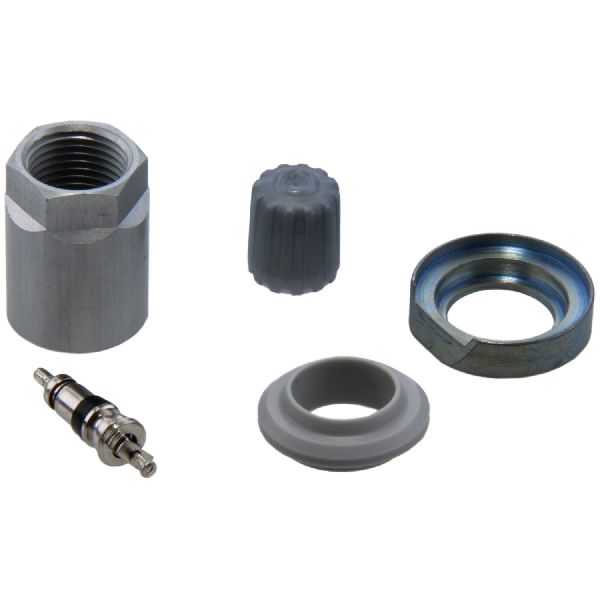
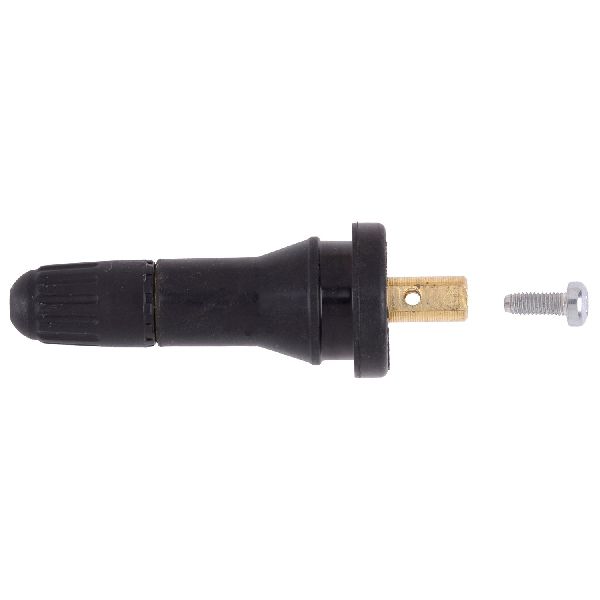
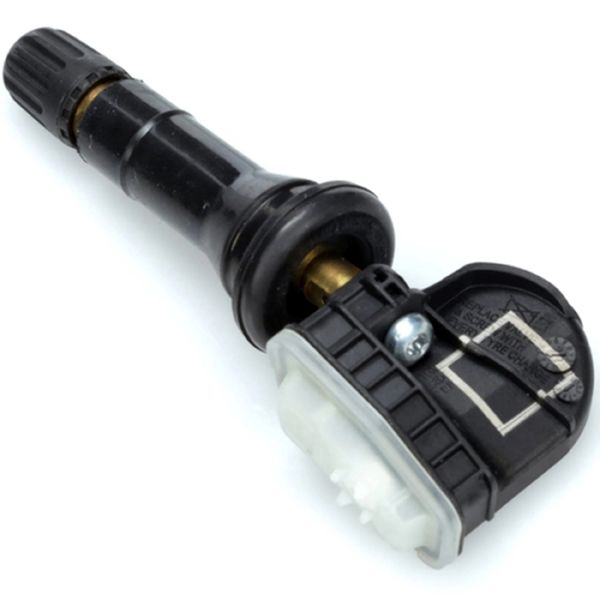
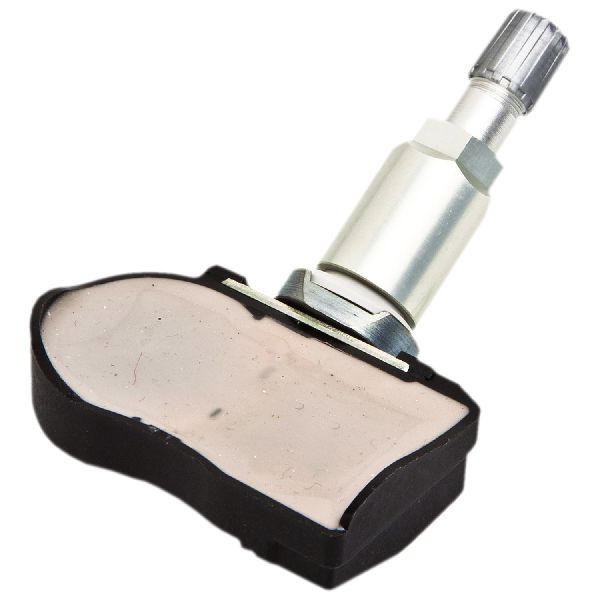
- Tire Pressure Monitoring System (TPMS) Sensor
(OEM #13598771 (supersedes 13586335))— A dead battery or internal fault in a sensor is a common reason the relearn procedure fails. The batteries are not serviceable and the entire 315 MHz sensor must be replaced.
Trusted brands: ACDelco, Schrader, Standard Motor Products, Continental
OEM price range: $40-$70
Aftermarket price range: $25-$50 - TPMS Relearn Tool
(OEM #EL-50448)— This tool is often required to activate the sensors in the correct order to complete the relearn procedure. It is a low-cost tool specific to GM vehicles and is faster and more reliable than the tire deflation method.
Trusted brands: VXDAS, JDIAG
OEM price range: $15-$30
Aftermarket price range: $10-$25
Related Codes That Often Appear With This One
- C0750 — Indicates a fault with the Left Front TPMS sensor. A faulty sensor can cause the C0775 relearn procedure to fail.
- C0755 — Indicates a fault with the Right Front TPMS sensor. A faulty sensor can cause the C0775 relearn procedure to fail.
- C0760 — Indicates a fault with the Left Rear TPMS sensor. A faulty sensor can cause the C0775 relearn procedure to fail.
- C0765 — Indicates a fault with the Right Rear TPMS sensor. A faulty sensor can cause the C0775 relearn procedure to fail.
Technical Service Bulletins (TSBs) & Recalls
- PIC5650M: Addresses intermittent issues like 'Service Tire Pressure Monitor' message (with codes C0750-C0775), poor key fob range, and no-start/stall conditions. It advises technicians to check for sources of Radio Frequency Interference (RFI) from aftermarket accessories before replacing any modules.
- 16-NA-061: While for 2015+ models, this TSB provides excellent context for the RCDLR system, explaining how a disconnected coax antenna cable can cause TPMS and key fob issues identical to those seen on GMT900 trucks.
Platform-Specific Known Issues
- The TSB #PIC5650M (and its subsequent revisions) groups C0775 with security and no-start codes. This is because all these systems (TPMS, Keyless Entry, Immobilizer) rely on low-power radio frequency signals. Aftermarket electronics like LED lights or USB chargers can create Radio Frequency Interference (RFI) that 'jams' the receiver (RCDLR), causing any or all of these systems to malfunction intermittently.
Mechanic-Grade Diagnostic Values
- TPMS Sensor Operating Frequency — expected: 315 MHz. Failure: A sensor transmitting on the wrong frequency will not be learned by the RCDLR.
- RCDLR Ground Circuit Resistance — expected: Less than 0.5 Ohms. Failure: High resistance between the ground wire at the RCDLR connector and the chassis indicates a poor ground at G402, causing intermittent or total module failure.
- RCDLR Power Supply Voltage — expected: 12V (Battery Voltage). Failure: No voltage at the power wire (typically Red/White) indicates a broken wire or blown fuse, preventing the module from operating.
Scan Tool Commands That Help
- Tech 2 / GDS2 / High-End Bi-Directional Scanner: BCM/RCDLR Reconfiguration or Setup — Use this when the TPMS relearn procedure completes successfully but the sensor data is lost after cycling the ignition. This function allows a technician to rewrite the vehicle's tire options (like placard pressure and tire type) into the module's memory, which can become corrupted.
- Tech 2 / GDS2: View RCDLR Data — To diagnose a suspected faulty RCDLR, a technician can view live data to see if the module is receiving any signals from the TPMS sensors and key fobs. This can help differentiate between a bad sensor, RFI, and a deaf receiver module.
Wiring & Ground Locations
- RCDLR (Remote Control Door Lock Receiver) — Behind the driver's side (left) D-pillar interior trim panel, often above the rear speaker.. This module is the single receiver for all TPMS sensor signals. If it fails, has a bad connection, or a disconnected antenna, no sensors can be learned, directly causing a C0775 after a failed relearn attempt.
- RCDLR Antenna Coax Cable — Runs from the RCDLR module to an antenna amplifier, which then connects to the antenna grid in the right rear quarter glass.. A disconnected coaxial cable at the RCDLR or at the antenna amplifier will prevent the module from receiving sensor signals, making a relearn impossible. This can be mistaken for a failed RCDLR module.
- G402 — On the left rear corner of the frame.. This is a primary ground point for rear-body components, including the RCDLR. A loose or corroded ground here can cause intermittent or complete failure of the RCDLR, leading to TPMS and key fob issues.
- RCDLR Connector — The electrical plug at the RCDLR module itself.. This is the point to test for power (often a Red/White wire) and ground (often a Black/White wire) to confirm the module is receiving power before condemning it.
Real Owner Repair Stories
- Tahoe Yukon Forum user 'KidWgn' (2012 Tahoe LTZ) — TPMS relearn was successful and pressures displayed correctly on the DIC. However, after turning the truck off and on again, the DIC would show dashes (--) for all tires and the warning light would return.
❌ Tried (didn't work) Repeating the relearn procedure multiple times.
✅ What actually fixed it The RCDLR module had lost its memory configuration. Using a bi-directional Launch scanner, the owner rewrote the tire type and placard pressure settings into the module. This restored the module's ability to permanently store the learned sensor IDs. - Tahoe Yukon Forum user (2008 Yukon Denali, 176k miles) — One sensor was known bad (weak battery). An attempt to perform the relearn procedure caused all four tire pressure readings to show dashes (--), whereas three were working before the attempt.
❌ Tried (didn't work) Attempting the relearn procedure with one known-bad sensor in the system.
✅ What actually fixed it Replacing the single bad TPMS sensor allowed the entire relearn sequence to complete successfully. The system requires all four sensors to respond in sequence to finalize the process; if it fails on any one sensor, it invalidates all previously stored IDs. - Chevrolet Forum user (2012 Tahoe Z71) — After water infiltrated the rear D-pillar, both the key fobs and TPMS system stopped working.
❌ Tried (didn't work) Programming new key fobs, which would appear to program but still not function.
✅ What actually fixed it The water damage required replacement of the RCDLR module. After replacement, the TPMS service message disappeared, indicating the new module was communicating, though a relearn was still required for the sensors and fobs.
OEM Part Supersession History
13586335→13598771— Standard part evolution and potential design improvements.
Heads up: While 13598771 is the common replacement, it has also been superseded by numbers like 13516164. It is critical to use a sensor that is compatible with the specific model year, as using an incorrect (even if physically identical) sensor can cause the relearn to fail.
Model Year Variations Within This Range
- 2007: On some 2007 models, the relearn mode is initiated through the Driver Information Center (DIC) buttons by finding the 'LEARN TIRE POSITIONS' message and pressing the set/reset button.
- 2008-2014: On later models, particularly base trims without DIC buttons, the primary method to enter relearn mode is by pressing and holding the lock and unlock buttons on the key fob. Higher trims may still use the DIC menu.
Helpful Videos
We Have This Part in Stock


The information in this article is provided for general reference and educational purposes only. Vehicle specifications, procedures, and part compatibility can vary by production date, trim level, and region. Always consult your vehicle's factory service manual and verify part numbers before purchasing or performing repairs. Safety-critical components such as airbags, seat belts, and braking systems should be installed by a qualified professional.
- Chevrolet TAHOE:
- 🧭 Diagnostic Flowchart
- 🎬 Helpful Videos
- 🛍️ Shop This Part
- What's Unique About the 2007-2014 Chevrolet TAHOE
- Symptoms You May Notice
- Most Likely Causes
- Rare But Worth Checking
- Diagnosis Steps
- Parts You'll Likely Need
- Related Codes That Often Appear With This One
- Technical Service Bulletins (TSBs) & Recalls
- Platform-Specific Known Issues
- Mechanic-Grade Diagnostic Values
- Scan Tool Commands That Help
- Wiring & Ground Locations
- Real Owner Repair Stories
- OEM Part Supersession History
- Model Year Variations Within This Range
- 🎟️ Get 5% Off