

OBD-II Code C1055: Front Axle Pressure Regulating Valve Fault
What C1055 means, why it triggers, and how to fix it
- Code C1055 indicates a failure in the front axle valve block or its control circuit, causing the front suspension to sag or lock in place.
- Always perform a soapy water leak test on the front air springs and valve block before replacing parts, as a $50 leaking air line mimics a $600 valve block failure.
- Driving with an active C1055 code and a sagging suspension forces the air compressor to run continuously, guaranteeing a burnout that adds $800 to $2,000 to your repair bill.
- On European vehicles like BMW and Land Rover, test the battery first; voltage drops below 12V frequently trigger false C1055 suspension faults or lock the module in 'transport mode'.
What Does C1055 Mean?
Code C1055 indicates a problem with the front axle pressure regulating valve. This valve acts as an electronic gatekeeper, controlling compressed air flow to the front air springs to keep the car level. The computer triggers this code when the valve, its circuit, or the managed pressure falls out of specification.
Technical definition: The SAE/ISO definition for C1055 is "Front axle – Pressure regulating valve". This indicates the suspension control module detects a circuit fault (open, short, or high resistance), a mechanical failure (stuck valve), or an implausible pressure reading related to the front axle's valve block.
Can I Drive With C1055?
Yes, But With Caution. Yes, but handling, braking, and comfort severely degrade. The system defaults to the bump stops, creating a harsh ride that damages suspension components. Driving with a leak causes the air compressor to run constantly and burn out, adding $800-$2,000+ for a new compressor. Limit driving to short, low-speed trips to a repair shop.
Common Causes
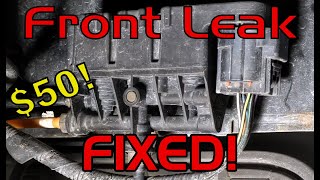
- Faulty air suspension valve block (Very Common) — The valve block contains multiple solenoids and is the most frequent failure point. 🎬 Watch: Step-by-step guide to replacing the front valve block. Internal seals degrade, causing leaks, or the electronic solenoids stick, corrode, or burn out.
- Leaking air lines or fittings (Common) — Plastic air lines become brittle and crack with age. Brass fittings at the valve block or air struts loosen, or their O-rings fail. This causes leaks, overworks the compressor, and triggers pressure faults.
- Damaged or corroded wiring/connectors (Common) — Located underneath the vehicle, the wiring harness and connectors are exposed to moisture and salt. Corrosion creates high resistance, while physical damage causes an open or short circuit.
- Faulty Front Ride Height Sensor (Common) — A faulty sensor sends incorrect voltage signals to the suspension module. The module interprets this bad data as a valve failure, logging C1055 even if the valve functions perfectly.
- Failing air suspension compressor (Less Common) — A weak compressor cannot supply adequate pressure, triggering faults. Usually, a leak elsewhere in the system causes the compressor to fail from being overworked.
- Blown fuse or faulty relay (Common) — High-amperage fuses and relays protect the system. A blown compressor fuse or a faulty relay disables the system and triggers this code.
- Moisture contamination (Saturated Dryer) (Less Common) — The compressor dryer removes moisture from the air. If saturated, moisture travels through the lines, freezing inside the valve block in cold weather and causing solenoids to stick.
- Air Suspension Control Module Failure (Rare) — Software glitches, internal corrosion, or hardware failure cause the module to incorrectly report a C1055 fault or fail to command the valve block.
Symptoms
- Suspension warning light on dashboard — An amber or red light illuminates, often accompanied by messages like "Suspension Fault," "Normal Height Only," or "Service Ride Control."
- Vehicle is not level when parked — One or both front corners sag or sit lower than the rear. This indicates an air leak or a valve stuck closed.
- Vehicle is stuck in high or low position — The front of the vehicle is stuck raised (valve stuck open) or completely lowered (cannot raise).
- Harsh or bouncy ride — The vehicle rides on its bump stops, making the ride quality extremely stiff as it no longer absorbs road imperfections.
- Air compressor runs constantly or not at all — The compressor hums continuously to compensate for a leak. If burned out or facing an electrical fault, it does not run at all.
- Battery drain overnight — A slow leak causes the control module to repeatedly wake up and run the compressor with the vehicle off, killing the battery.
Diagnostic Flowchart
Tap your situation to follow the diagnostic path that matches what you're seeing on this code.
Common Fixes & Costs
- Replace Leaking Air Line(s) or Fittings
— Parts: $50-$150, Labor: $100-$250, ~1 hr book time
(DIY)
: OEM Varies - Replace the Air Suspension Valve Block
— Parts: $150-$600, Labor: $200-$450, ~1.5 hr book time
(Intermediate)
: OEM RVH000095
: OEM 4F0616013
: OEM A2123200358 - Replace the Air Suspension Compressor
— Parts: $300-$1,200+, Labor: $250-$450, ~2 hr book time
(Intermediate)
: OEM LR072537 / LR078650 (AMK)
: OEM 4L0698007C / 7L8616006E
: OEM A1663200104 - Replace Front Ride Height Sensor
— Parts: $70-$300, Labor: $100-$250, ~0.8 hr book time
(DIY)
: OEM LR020157 (Right Front), LR020155 (Left Front)
: OEM 4E0941285G (Left Front)
: OEM A0105427717 - Repair or Replace Damaged Wiring/Connector
— Parts: $20-$150, Labor: $200-$500, ~2.5 hr book time
(Professional)
: OEM YMQ503220
: OEM N/A
: OEM N/A
Used vs. New Parts: Buying Guide
When a used part is worth it: A used OEM valve block from a low-mileage, accident-damaged vehicle is a cost-effective option for older vehicles where a new OEM part is prohibitively expensive. It is preferable to a cheap aftermarket part.
Donor-vehicle mileage cap: roughly under 60000 miles for the part to have meaningful remaining life.
Donor quality checklist:
- Verify the donor vehicle's mileage and ensure it was not scrapped due to suspension failure.
- Inspect the used part for corrosion around the electrical connector and brass air fittings.
- Match the part number exactly. Valve blocks are specific to model ranges.
- Avoid parts from regions with heavy road salt usage.
Decision logic:
- If The vehicle is less than 8 years old and a daily driver → Buy a new OEM or high-quality aftermarket (e.g., Arnott, RAPA) part. The reliability is worth the cost.
- If The budget is extremely tight and it's an older vehicle (>10 years) → A used OEM part is a viable risk. A rebuild kit for the existing OEM block is a cheaper, labor-intensive alternative.
- If The failure is a known wear item like internal O-rings → Favor new or remanufactured parts. Cheap aftermarket units fail prematurely.
Warranty tradeoff: Used parts offer a 30-90 day warranty. New high-quality aftermarket parts offer a limited lifetime warranty. New OEM parts carry a 1-2 year warranty.
Worst-case if a used part fails: $300-600. If a used valve block fails, the cost includes repeat labor plus another replacement part.
What Happens If You Wait — Timeline
- 0-1 Month: A slow leak begins. The 'Suspension Fault' light appears intermittently. The vehicle may be slightly uneven after parking overnight but levels out after starting. The compressor runs slightly longer. (Added cost: $0)
- 1-3 Months: The leak worsens. The vehicle noticeably sags every morning. The compressor runs for a minute or more at startup and cycles on during drives. Ride quality is occasionally harsh. (Added cost: $50 in accelerated compressor wear.)
- 3-6 Months: The compressor burns out from excessive operation. The warning light is permanent, and the compressor is silent. The vehicle drops to the bump stops, resulting in a harsh ride. (Added cost: $800 - $2,000 (Cost of a new compressor and relay, plus the original leak repair).)
- 6+ Months: Continued driving on bump stops causes secondary damage. The constant jarring destroys struts, damages bushings, and causes abnormal tire wear. (Added cost: $1,300 - $5,000+ (Cost of compressor, original leak repair, AND new air struts, bushings, or tires).)
Cost of Not Fixing It
- Immediate to 1 Month: A harsh ride and compromised handling. The vehicle visibly sags. The air compressor runs excessively to compensate for leaks, causing noise and battery drain. (Added cost: Negligible, but sets the stage for major failure.)
- 1-3 Months: The air suspension compressor burns out from constant operation. This is the most common and costly consequence of ignoring the initial fault. (Added cost: $800 - $2,000+)
- 3+ Months: Secondary suspension damage. Driving on the bump stops destroys the air struts, shock absorbers, and suspension bushings. Wiring harnesses can be damaged by contact with moving parts. (Added cost: $500 - $3,000+)
Diagnosis Steps
- Read the Fault Codes
Use an OBD-II scanner capable of reading Chassis (C-codes) to confirm C1055. Note if the code is 'current' or 'stored' and look for related codes (e.g., C1A20, C1131) for critical clues.
Tools: Advanced OBD-II Scanner (Beginner) - Visually Inspect the Suspension
Park on a level surface. Check if any corner sags. Listen for an audible hissing sound near the front wheels or under the vehicle, indicating an obvious air leak.
Tools: Flashlight (Beginner) - Perform a Soapy Water Leak Test
With the system pressurized, spray a soap and water mixture on the air lines, valve block fittings, and air springs. Bubbles form at the site of any leak. This is the most reliable way to find slow leaks.
Tools: Spray bottle, soapy water (Intermediate) - Check Fuses and Relays
Locate the fuses and relays for 'Air Suspension' or 'Electronic Suspension Control'. Visually inspect fuses and swap the suspension relay with an identical one (like the horn) to test its function.
Tools: Fuse puller, Owner's manual (Beginner) - Inspect Wiring and Connectors
Locate the front axle valve block. Unplug its electrical connector and inspect for green/white corrosion, bent pins, or damaged wires. Trace the harness for chafing or melting.
Tools: Flashlight, safety glasses (Intermediate) - Test the Valve Block Solenoids (Active Test)
Using a bi-directional scanner, command individual solenoids in the valve block to open and close. Listen for a distinct 'click'. If a solenoid does not click, the valve block is faulty.
Tools: Advanced OBD-II Scanner (Advanced) - Pro Tip: Test Valve Block Solenoid Resistance
Disconnect the valve block connector. Measure resistance between the pins for the front axle solenoids with a multimeter. A healthy coil reads 7-22 Ohms. 'OL' (open) or near zero (short) means the block has failed.
Tools: Multimeter, Wiring diagram (for pinout) (Advanced) - Pro Tip: Test Ride Height Sensor Signal Voltage
With ignition on, back-probe the sensor signal wire. Slowly jack the suspension arm up and down. Voltage must change smoothly (e.g., 0.5V to 4.5V). If voltage jumps or drops out, the sensor is bad.
Tools: Multimeter, Jack, Jack stands, Back-probe pins (Professional) - Advanced: Monitor Live Data PIDs
Monitor 'Reservoir Pressure' and 'Front Height Sensor Voltages' on a scan tool. Normal reservoir pressure is ~15-16 bar (217-232 PSI). Erratic sensor values or failure to build pressure isolates the failure point.
Tools: Advanced OBD-II Scanner (Advanced)
When This Code Triggers (Freeze-Frame Conditions)
- Vehicle Speed: 0 mph (The fault is often detected when the vehicle is first started, as the system performs a self-check and attempts to level the vehicle.)
- System Voltage: 11.5-12.5V (A fault logs during startup when battery voltage is lowest, or during operation if voltage is unstable.)
- Compressor Status: On / Commanded On (The code sets when the module commands the valve to open and fill the springs but does not see the expected change in height or pressure.)
- Ride Height Sensor Voltage (Front): Varies (e.g., 1.5V) (Captures the sensor voltage at the moment the fault logged, indicating if the vehicle was sagging or if the sensor reading was implausible.)
Related Codes
- C1A20 — "Pressure increases too slow when filling reservoir" commonly appears with C1055. It points to a significant air leak or a weak compressor. If present, a leak is your primary suspect.
- C1131 — "Unable to pressurize gallery" indicates a catastrophic air leak or a completely failed compressor. C1131 points to a total lack of pressure, whereas C1055 is a control fault.
- C1A13 — "Pressure does not decrease when venting gallery" points to a stuck exhaust valve. If the front of the vehicle is stuck 'up', it points directly to a stuck valve governed by the C1055 valve block.
- C1725 / C1726 — Common on Ford/Lincoln models, these codes for "Air Suspension Pneumatic Failure" accompany C1055 and frequently point to a dislodged height sensor linkage arm.
Climate & Environmental Factors
- Cold Weather: Low temperatures freeze moisture inside the valve block or air lines, causing blockages. Rubber air springs become stiffer and more brittle, increasing the risk of cracking and leaks.
- Road Salt & Humidity: Salt spray attacks the undercarriage, causing severe corrosion on electrical connectors, wiring harnesses, sensor brackets, and the valve block. This leads to high resistance and seized components.
- High Altitude: Less dense air forces the compressor to work harder and run longer to achieve target pressure, accelerating wear, especially if a small leak exists.
How to Talk to a Mechanic About This Code
Say this: "I have a C1055 suspension fault code and the front of my car is sagging. Please start with a comprehensive soapy water leak test on the front air springs, lines, and valve block, and check the live data from the front ride height sensors before recommending part replacements."
This directs the technician to perform crucial diagnostic steps (leak test, sensor check) before replacing an expensive compressor or valve block. It prevents the common misdiagnosis of simply replacing the part named in the code.
Avoid saying:
- 'My suspension is broken, fix it.'
- 'The car is bouncy, I think I need new shocks.'
- 'My suspension light is on, just do whatever it takes.'
Questions to ask before authorizing the repair:
- Did you find the leak? Can you show me the bubbles from the soapy water test?
- If there is no leak, what was the voltage reading from the ride height sensor when you moved the suspension?
- If you recommend a compressor replacement, did you find and fix the leak that caused it to burn out?
- What is the warranty on the parts and labor for this specific repair?
Where to Take It: Dealer vs Independent vs Chain
- Dealer:
A safe but expensive choice. Best for in-warranty or complex software-related scenarios. For out-of-warranty vehicles, an independent specialist offers better value.
Best for: Vehicles under warranty, Complex electronic issues on German brands (e.g., BMW 'transport mode'), Recalls or Technical Service Bulletin (TSB) related work
Downsides: Highest labor rates, often 1.5-2x independent shops., More likely to replace entire assemblies rather than smaller components. (Typical cost: +50% vs. baseline) - Independent Shop:
Best fit for most owners of out-of-warranty vehicles. An independent European car specialist correctly diagnoses C1055 faults routinely and performs the repair more cost-effectively than a dealer.
Best for: Out-of-warranty vehicles, especially European brands like Mercedes, BMW, Audi, and Land Rover., Shops specializing in a specific make with extensive air suspension experience., Getting a second opinion on a high dealership quote.
Downsides: Quality varies greatly; you must find a true specialist, not a general repair shop., May lack the latest software for brand-new models. (Typical cost: +0% vs. baseline) - Chain Shop:
AVOID. Air suspension diagnosis is a specialized skill. A chain shop is not the appropriate venue for this repair and guarantees frustration and wasted money.
Best for: Simple, unrelated maintenance like oil changes, tires, and batteries.
Downsides: Technicians lack specialized training and diagnostic equipment for complex air suspension systems., High pressure to upsell encourages unnecessary part replacement., Highly likely to misdiagnose the issue or refuse the job entirely. (Typical cost: -10% vs. baseline)
When to Walk Away From the Repair
If the total estimated repair cost for the air suspension system exceeds 50% of the car's Kelley Blue Book (KBB) private-party value, seriously consider selling the vehicle or installing a coil spring conversion kit.
- Car worth $15000, fix is $2500: Fix it. This is a typical cost for a significant air suspension repair (e.g., compressor and one strut) and falls well below the threshold.
- Car worth $8000, fix is $4500: Walk away. The repair cost exceeds 50% of the vehicle's value. A cascade failure (leaks, compressor, valve block, and struts) easily reaches this cost. It is not economically rational to proceed.
- Car worth $4000, fix is $1800: Borderline. If the rest of the car is in excellent condition, it might be worth it. Get a second opinion and price a coil conversion kit before committing.
What Scan Tool You Need for This Code
Minimum: A scanner that reads and clears Chassis (C) codes. A basic engine-only (P-code) reader is useless for C1055 and shows 'No Codes Found'.
C1055 is a Chassis code. Proper diagnosis requires live data from height and pressure sensors, plus bi-directional control to command valves and the compressor. Without this, you are guessing.
Budget: BlueDriver Pro (~$90) — Reads and clears Chassis codes (like C1055) on supported vehicles. It displays live data but lacks the bi-directional control needed for active tests. Good for confirming the code before visiting a shop.
Mid-range: Autel MK808S / Kingbolen K7 (~$350-400) — The sweet spot for serious DIYers. Offers full system diagnostics, reads C-codes, graphs live data (critical for height sensor voltage), and provides bi-directional control. You can command the compressor on/off and open/close individual valves to pinpoint failures. Includes suspension height calibration.
Professional: Autel MaxiCOM MK906BT / Launch X431 Series (~$1200+) — Provides all midrange functions with faster processing, broader vehicle coverage, ECU coding, and topology mapping. Essential for a professional shop but overkill for a DIYer focused on a single vehicle.
How to Clear the Code After You Fix It
- Use an advanced OBD-II scan tool to clear the Chassis (C) fault codes. A standard engine code reader will not work.
- Turn the ignition off and then on again.
- Start the vehicle and allow the air suspension compressor to run and pressurize the system.
- If a height sensor was replaced, perform a mandatory height calibration procedure using the scan tool.
Drive cycle (~15 minutes): Start the vehicle and let the system self-test. Operate the ride height controls to raise and lower the vehicle through its full range. Drive for 10-15 minutes, including turns and bumps, to ensure the system functions correctly and the fault does not return.
Readiness monitors affected: Not applicable. Chassis codes do not affect engine emissions readiness monitors.
Watch out for:
- Using a basic OBD-II scanner that cannot access or clear chassis codes.
- Failing to perform a height calibration after replacing a ride height sensor.
- Clearing the code without fixing the underlying leak. The fault returns as soon as the system attempts to operate.
Will This Fail Emissions / State Inspection?
No — by itself this code doesn't fail OBD inspection (but it can keep readiness monitors from setting, which causes a separate fail).
- California: A C1055 code will not cause a failure of the OBD-II emissions inspection, which focuses on powertrain (P-codes).
- New York: New York's annual safety inspection checks the suspension. A vehicle that is visibly sagging can be failed for safety reasons at the inspector's discretion.
- Texas: The Texas safety inspection requires a functional suspension. A C1055 fault leading to a collapsed suspension is grounds for a safety inspection failure.
Most Commonly Affected Vehicles
- Land Rover Range Rover Sport, LR3, LR4 (2005-2016) — Extremely common. Early LR3s used a failure-prone Hitachi compressor, updated to a robust AMK unit later. A failing compressor or valve block triggers a cascade of codes, including C1055.
- Audi A8 (D3), Q7 (4L), Allroad (2002-2017) — The valve block (Part No. 4F0616013) is a frequent failure point. Removing air lines from the original block often damages the seals, requiring a new block.
- Mercedes-Benz S-Class (W222), GL/GLS-Class (X164/X166), ML/GLE-Class (W164/W166) (2006-2020) — The AIRMATIC system is prone to valve block and compressor issues, often triggered by air spring leaks. On the W222 S-Class, a failed valve block causes both front corners to drop completely.
- BMW X5 (E70), 7-Series (F01/F02) (2007-2015) — The Electronic Height Control (EHC) module gets stuck in 'transport mode' after a battery replacement or deep discharge, disabling adjustments and mimicking a hardware fault.
- Porsche Cayenne (2003-2017) — Shares its platform and air suspension system with the Audi Q7 and VW Touareg. Susceptible to identical valve block, compressor, and air spring failures.
- Ford / Lincoln Expedition / Navigator (2003-2017) — Often logs codes C1725/C1726 alongside C1055. Per TSB 06-15-10, a common cause is the height sensor linkage arm detaching. The fix is replacing the arm with an updated part.
- GM (Cadillac / Chevrolet / GMC) Escalade / Tahoe / Yukon with Autoride (2001-2020) — Autoride (Z55) systems are prone to rear air bladder leaks. This burns out the compressor and logs C1055 when front axle control is compromised.
- Volkswagen Touareg (2004-2017) — As a platform-mate to the Porsche Cayenne and Audi Q7, the Touareg suffers from identical air suspension ailments, including frequent valve block failures.
Manufacturer-Specific Notes
- Suzuki: C1055 means "Manual (SOS) Switch Green Indicator Malfunction". This is a body electrical code pointing to a fault in the emergency call system's button light. It has no relation to the suspension.
- Land Rover / Jaguar: Intermittent air suspension faults are often caused by an aging battery providing insufficient voltage. Always test the battery before replacing suspension components. Upgrading from the Hitachi to the AMK compressor is a documented fix for widespread failures.
- BMW: The Electronic Height Control (EHC) module enters 'transport mode' after a battery dies. This locks the suspension high and disables adjustments, mimicking a bad valve block. Deactivate it using diagnostic software like INPA or DIS.
- GM (Autoride): The primary symptom is a 'Service Ride Control' message. The most common failure is cracked rubber air bladders on the rear shocks. Ignoring this quickly burns out the compressor.
- Ford / Lincoln: Technical Service Bulletin (TSB) 06-15-10 addresses related codes C1725/C1726 by identifying a common failure of the height sensor linkage arm detaching. The repair is replacing the arm with an updated part.
Real Owner Stories
2015 RAM 1500 at 140,000 miles - The Misdiagnosis
Owner experienced constant "Service Air Suspension" warnings. The truck was stuck low. Soapy water revealed two small leaks at the compressor fittings.
What they tried:
- Attempted to replace the VOSS fittings with universal brass fittings, failing to create a proper seal.
- The truck remained permanently stuck in the low position.
- A dealership quoted $2,100 to replace the entire air line assembly.
Outcome: The actual cause was a defective valve block. The initial leak diagnosis was correct, but the botched DIY fitting repair introduced a massive secondary leak, confusing the diagnostic process.
Lesson: Be cautious with air line fitting repairs. An improper seal creates a larger leak and complete system failure. Sometimes a leak at a fitting indicates a fault within the attached component.
2006 Ford Expedition - The Easy Fix
Vehicle leaned to one side with a "Service Air Suspension" message. Codes C1725 and C1726 were present alongside C1055.
What they tried:
- Initial thought was a major pneumatic failure like a bad air spring.
- Visual inspection revealed the height sensor linkage arm popped off its ball stud.
Outcome: Per Ford TSB 06-15-10, the fix was replacing the linkage arms with a revised part designed to prevent detachment. This low-cost repair resolved all symptoms.
Lesson: On Ford/Lincoln SUVs, visually inspect height sensor linkages before assuming complex pneumatic failures. A detached arm mimics a much more expensive problem.
2016 Mercedes-Benz SUV - The Cascade Failure
One corner sagged overnight. The issue progressed until the compressor ran constantly.
What they tried:
- The owner ignored the initial slow leak.
- A mechanic replaced the burned-out compressor, but symptoms returned.
- A second compressor was installed and failed shortly after.
Outcome: Proper diagnosis identified a slow leak in a rear air strut. The constant running to compensate burned out two new compressors. The final repair required replacing the leaking strut, the compressor, and the damaged compressor relay.
Lesson: The compressor is the victim, not the culprit. Always perform a thorough leak test and fix the source before replacing a burned-out compressor, or the new one will fail.
2007 BMW X5 (E70) - The Electrical Gremlin
After replacing a dead battery, the air suspension warning light illuminated, and the suspension locked in a high position.
What they tried:
- The owner suspected a failed valve block or compressor.
- Took the vehicle to an independent BMW specialist.
Outcome: The specialist diagnosed the Electronic Height Control (EHC) module entered 'transport mode' during the low voltage event, locking out adjustments. Using diagnostic software, they deactivated transport mode, restoring normal function without replacing parts.
Lesson: On European vehicles, a dead battery triggers 'transport mode' in various modules. If suspension faults appear immediately after a battery issue, check the transport mode status before authorizing hardware replacements.
How to Prevent This Code From Triggering
- Periodically service the air compressor dryer. (Every 2-3 years or 30,000 miles) — The dryer's desiccant absorbs moisture. Once saturated, it allows water into the system, which freezes in cold weather or corrodes the valve block.
- Wash the vehicle's undercarriage regularly, especially in winter. (Monthly in salt-belt regions) — Road salt accelerates corrosion on electrical connectors, sensor linkages, and the aluminum valve block, leading to electrical faults.
- Perform an annual visual inspection of air suspension components. (Once per year) — Check for chafing on air lines, cracking in rubber air springs, and ensure height sensor linkages are secure. Catching a rubbing line prevents future failure.
- Listen for changes in compressor run time. (Ongoing habit) — A compressor running more frequently is the earliest sign of a new air leak. Fixing a leak early prevents the compressor from burning out.
- Test and maintain battery health. (Annually, especially on European vehicles) — Low battery voltage causes electronic control modules to behave erratically, log false codes, or enter protective modes.
Frequently Asked Questions
What does the front axle pressure regulating valve actually do?
It acts as an electronically controlled gate that directs compressed air into your front air springs to raise the vehicle, holds the air to maintain height, or releases air to lower it. This process keeps the car level and provides a smooth ride.
Can I drive my car with a C1055 code and a suspension fault warning?
Driving a short distance to a repair shop at low speed is possible, but extended driving is highly discouraged. The ride becomes extremely harsh, and handling is severely compromised. A persistent air leak causes the compressor to run continuously until it burns out, adding $800-$2,000+ to your repair bill.
I replaced the valve block but C1055 returned. What are the common misdiagnosis pitfalls?
The top reasons for a returning code are an overlooked slow air leak, a faulty ride height sensor sending bad data, or hidden wiring corrosion. Always perform a thorough leak test and check sensor data before replacing expensive parts twice.
What is 'suspension height calibration' and is it required after a repair?
Suspension height calibration is a procedure done with an advanced scan tool that teaches the control module the correct height at each corner. It is absolutely necessary after replacing a ride height sensor or the suspension control module. It is recommended if the vehicle does not sit perfectly level after a valve block or compressor replacement.
Can a bad valve block destroy my new air compressor?
Yes. If the valve block has an internal or external leak, it constantly bleeds air from the system. The compressor runs non-stop to maintain pressure, causing it to overheat and burn out prematurely.
Is replacing an air suspension valve block a DIY job?
Yes, for an experienced DIYer. After safely supporting the vehicle and depressurizing the system, the job involves unplugging one electrical connector and unscrewing color-coded air lines. It is critical to avoid cross-threading the brass fittings into the new aluminum block.
My car has code C1055 but it's a Suzuki. What does that mean?
For most Suzuki models, C1055 is not a suspension code. It indicates a problem with the green indicator light for the emergency 'SOS' call button, usually located in the overhead console. The fault is typically the light assembly itself, the wiring, or the telematics control module.
Key Takeaways
- Code C1055 indicates a failure in the front axle valve block or its control circuit, causing the front suspension to sag or lock in place.
- Always perform a soapy water leak test on the front air springs and valve block before replacing parts, as a $50 leaking air line mimics a $600 valve block failure.
- Driving with an active C1055 code and a sagging suspension forces the air compressor to run continuously, guaranteeing a burnout that adds $800 to $2,000 to your repair bill.
- On European vehicles like BMW and Land Rover, test the battery first; voltage drops below 12V frequently trigger false C1055 suspension faults or lock the module in 'transport mode'.
Helpful Videos
Shop the Parts Behind C1055
Below are the parts most often responsible for code C1055, ranked by how frequently each one is the actual culprit (per the diagnosis above). Tap any to see what we have for your vehicle.


The information in this article is provided for general reference and educational purposes only. Vehicle specifications, procedures, and part compatibility can vary by production date, trim level, and region. Always consult your vehicle's factory service manual and verify part numbers before purchasing or performing repairs. Safety-critical components such as airbags, seat belts, and braking systems should be installed by a qualified professional.
- 🧭 Diagnostic Flowchart
- 🎬 Helpful Videos
- 🛍️ Shop This Part
- What Does C1055 Mean?
- Can I Drive With C1055?
- Common Causes
- Symptoms
- Common Fixes & Costs
- Used vs. New Parts: Buying Guide
- What Happens If You Wait — Timeline
- Cost of Not Fixing It
- Diagnosis Steps
- When This Code Triggers (Freeze-Frame Conditions)
- Related Codes
- Climate & Environmental Factors
- How to Talk to a Mechanic About This Code
- Where to Take It: Dealer vs Independent vs Chain
- When to Walk Away From the Repair
- What Scan Tool You Need for This Code
- How to Clear the Code After You Fix It
- Will This Fail Emissions / State Inspection?
- Most Commonly Affected Vehicles
- Manufacturer-Specific Notes
- Real Owner Stories
- 2015 RAM 1500 at 140,000 miles - The Misdiagnosis
- 2006 Ford Expedition - The Easy Fix
- 2016 Mercedes-Benz SUV - The Cascade Failure
- 2007 BMW X5 (E70) - The Electrical Gremlin
- How to Prevent This Code From Triggering
- Frequently Asked Questions
- What does the front axle pressure regulating valve actually do?
- Can I drive my car with a C1055 code and a suspension fault warning?
- I replaced the valve block but C1055 returned. What are the common misdiagnosis pitfalls?
- What is 'suspension height calibration' and is it required after a repair?
- Can a bad valve block destroy my new air compressor?
- Is replacing an air suspension valve block a DIY job?
- My car has code C1055 but it's a Suzuki. What does that mean?
- Key Takeaways
- 🎟️ Get 5% Off