

OBD-II Code C1105: Right Rear Wheel Speed Sensor Circuit Fault
What C1105 means, why it triggers, and how to fix it
- Code C1105 indicates a right rear wheel speed sensor circuit failure, immediately disabling your ABS, traction control, and AWD systems.
- Clean the sensor's mounting surface with a wire brush before buying parts; rust buildup increases the air gap and causes 30% of these false failures.
- Verify your manufacturer's specific definition for C1105, as it means 'Traction Control Lamp Short' on Fords but 'Right Rear Sensor' on Nissans.
- Test passive 2-wire sensors with a multimeter to confirm resistance between 800 and 1,700 Ohms before replacing the unit.
- Do not drive in wet or icy conditions with an active C1105 code, as the disabled ABS increases stopping distances by over 20% on loose surfaces.
What Does C1105 Mean?
Code C1105 means the vehicle's main computer (ECU) detects a signal failure from the right rear wheel speed sensor. This sensor reports wheel rotational speed. The computer disables safety systems like ABS and Traction Control and illuminates dashboard warning lights until the circuit is repaired.
Technical definition: The SAE/ISO definition for C1105 varies by manufacturer. Nissan and Infiniti define it as 'RR RH SENSOR-2' (right rear wheel speed sensor). Ford defines it as 'Traction Control Disable Lamp - Circuit Short to Battery'. Hyundai uses 'Ignition Voltage Low'. Always verify the manufacturer-specific definition, though a right rear sensor fault is the most common real-world cause.
Can I Drive With C1105?
Yes, But With Caution. Yes, you can drive, but your Anti-lock Braking System (ABS) and Traction Control are disabled. Your regular hydraulic brakes still function. However, without ABS, your wheels lock up during hard braking, increasing stopping distances by over 20% on loose surfaces and causing a complete loss of steering control during a skid. Repair this immediately to restore your vehicle's safety systems.
Common Causes
- Faulty Right Rear Wheel Speed Sensor (Very Common) — The sensor fails internally due to age, heat cycles, moisture intrusion, or manufacturing defects. This is the primary trigger for C1105.
- Incorrect Air Gap Due to Rust/Debris Buildup (Common) — Rust and scale build up on the hub underneath the sensor's mounting point. This physically pushes the sensor away from the tone ring, weakening the signal.
- Wiring Harness or Connector Damage (Common) — Wires leading from the sensor to the ABS module break, fray, or corrode due to road debris or element exposure. Connectors suffer from bent or corroded pins.
- Damaged or Contaminated ABS Tone Ring (Common) — The toothed or magnetic reluctor ring cracks, rusts, or accumulates metallic debris, preventing the sensor from reading a clean rotational signal.
- Failing Wheel Hub Bearing (Less Common) — Modern vehicles integrate the tone ring into the wheel hub bearing. A failing, wobbly bearing damages the tone ring or creates excessive movement, causing an erratic signal.
- Low or Unstable Battery Voltage (Less Common) — A weak 12V battery causes the voltage-sensitive ABS module to trigger false codes like C1105 during startup or heavy electrical load.
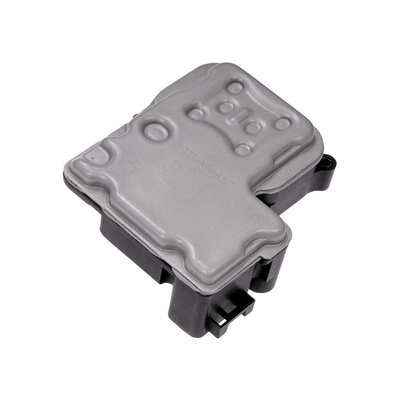
- Faulty ABS Control Module (Rare) — The ABS control module fails internally and cannot process the incoming sensor signal. This is the last component to suspect after verifying the sensor, ring, and wiring.
Symptoms
- ABS Warning Light On — The primary symptom. The ABS light remains permanently illuminated on the dashboard.
- Traction/Stability Control Light On — Traction and stability systems require wheel speed data. They disable automatically, illuminating the TCS, VDC, or ESC lights.
- AWD/4WD System Warning Light On — All-wheel-drive systems disable and trigger a warning light when wheel speed data is lost.
- ABS Fails to Engage — During a hard stop on wet or loose surfaces, the wheels lock up and skid instead of pulsating.
- Reduced Engine Power (Limp Mode) — Certain vehicles (e.g., Nissan) enter a reduced power limp mode as a safety precaution when critical ABS faults occur.
- Erratic Speedometer (also visible on scanner) — If the vehicle uses the rear wheel speed sensor for vehicle speed calculation, the speedometer needle jumps erratically or drops to zero.
Diagnostic Flowchart
Tap your situation to follow the diagnostic path that matches what you're seeing on this code.
Common Fixes & Costs
- Clean Sensor Mounting Surface and Tone Ring — Parts: $0-$15, Labor: $80-$150, ~0.8 hr book time (DIY)
- Replace Right Rear Wheel Speed Sensor — Parts: $20-$100, Labor: $100-$200, ~1.0 hr book time (DIY)
- Repair Wiring Harness or Connector — Parts: $10-$50, Labor: $150-$300, ~2.0 hr book time (Intermediate)
- Replace Wheel Hub Bearing Assembly — Parts: $100-$300, Labor: $150-$350, ~2.5 hr book time (Intermediate)
- Replace or Repair ABS Control Module — Parts: $200-$600, Labor: $150-$300, ~1.8 hr book time (Professional)
Used vs. New Parts: Buying Guide
When a used part is worth it: Never buy a used wheel speed sensor. It is an exposed electronic component prone to heat and moisture failure. The low cost of a new aftermarket part makes a used sensor a poor value.
Donor-vehicle mileage cap: roughly under 40000 miles for the part to have meaningful remaining life.
Donor quality checklist:
- Source from a low-mileage vehicle in a dry climate to avoid corrosion.
- Verify an exact part number match.
- Inspect wiring and connectors for brittleness or cracked insulation.
Decision logic:
- If Replacing a critical safety component like a wheel speed sensor → Buy a new OEM or premium aftermarket part (Bosch, NTK, Delphi) for guaranteed reliability.
- If Budget is the absolute primary concern on a high-mileage vehicle → Purchase a budget new aftermarket sensor with a warranty rather than a used salvage part.
Warranty tradeoff: Used parts offer 30-90 day warranties. Budget aftermarket sensors offer 1-year warranties. Premium aftermarket and OEM parts carry 1-year to limited lifetime warranties.
Worst-case if a used part fails: $150-$300 to repeat the labor and diagnostics if a cheap part fails prematurely.
What Happens If You Wait — Timeline
- Immediate: Code C1105 is stored. ABS, Traction Control, and Stability Control warning lights illuminate. Safety systems are disabled. (MPG impact: 0%% · Added cost: $0)
- 0-1 month: Driving continues with disabled safety systems, increasing accident risk in emergency braking. AWD systems disable on equipped vehicles. (MPG impact: 0%% · Added cost: $0 (Safety risk is the primary cost))
- 1-6 months: The vehicle automatically fails state safety inspections, preventing legal registration renewal. (MPG impact: 0%% · Added cost: $50-$200 (Cost of failed inspection and re-inspection))
- 6+ months: Intermittent connections due to corrosion become permanent open circuits. Resale value drops significantly due to dashboard warning lights. (MPG impact: 0%% · Added cost: $200+ (Diminished vehicle value))
Cost of Not Fixing It
- Immediate: Loss of ABS and Traction/Stability Control. Increased risk of skidding and loss of control during emergency braking or in slippery conditions. (Added cost: N/A (Safety Risk))
- Next State Inspection: Guaranteed failure of the safety inspection in states like New York and Texas, preventing legal vehicle registration. (Added cost: $0 (Requires repair to pass))
- Long-Term: Disables dependent systems like All-Wheel Drive (AWD) or adaptive cruise control. No direct progressive mechanical damage occurs. (Added cost: N/A)
Diagnosis Steps
- Read Codes & Check Live Data
Use an ABS-capable OBD-II scanner to confirm C1105. View live data for all four wheel speed sensors while driving slowly. The right rear sensor should match the others. A reading stuck at 0 mph, jumping erratically, or showing an impossible speed (e.g., 255 mph) confirms a circuit fault.
Tools: OBD-II Scanner with ABS Live Data (Beginner) - Visually Inspect Sensor, Wiring, and Connector
Raise the rear of the vehicle. Locate the right rear wheel speed sensor on the hub. Inspect the sensor body, connector, and wiring harness for frayed wires, melted insulation, or corroded pins. Trace the wire to the chassis looking for damage.
Tools: Jack, Jack Stands, Flashlight (Beginner) - Inspect Tone Ring and Clean Mounting Surface
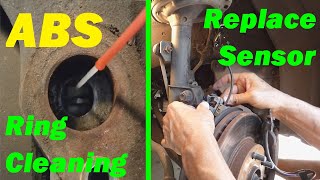
Remove the sensor (usually one 10mm bolt). Aggressively clean the rust off the hub mounting surface with a wire brush. Inspect the tone ring inside the hub for cracks, missing teeth, or metallic debris. Spin the hub to ensure the ring is not loose.
Tools: Socket Set, Wire Brush, Brake Cleaner (Intermediate) - Swap Sensors to Isolate Fault
If the left and right rear sensors are identical, swap them. Clear the codes and drive. If the code changes to C1106 (Left Rear), the sensor is definitively faulty. If C1105 returns, the problem is in the wiring harness or the hub/tone ring.
Tools: Socket Set (Intermediate) - Test Passive (2-Wire) Sensor with Multimeter
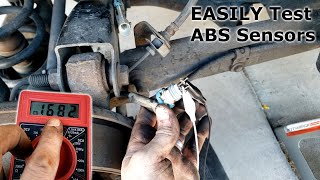
Disconnect the sensor. Measure resistance across the two pins. A good sensor reads 800-1,700 Ohms. An open circuit (OL) or 0 Ohms means it failed. Next, set the multimeter to AC Volts. Spin the wheel hub by hand; the sensor must generate at least 100mV AC.
Tools: Multimeter, Jack, Jack Stands (Advanced) - Test Active (3-Wire) Sensor with Oscilloscope
Active sensors require power. Verify 5V or 12V reference voltage and ground at the harness connector. Back-probe the signal wire with an oscilloscope while spinning the wheel. You must see a clean square wave pattern. A missing or noisy waveform indicates a bad sensor or tone ring.
Tools: Multimeter, Oscilloscope, Back-probe Kit (Advanced) - Test Harness for Continuity
Disconnect the harness from the sensor and the ABS module. Check for continuity on the power, ground, and signal wires end-to-end. Each wire must read less than 1 Ohm. Test resistance between each wire and ground to ensure there are no shorts (must read OL).
Tools: Multimeter, Vehicle Wiring Diagram (Advanced) - Check ABS Module Power and Grounds
If the sensor and wiring test good, check the main power and ground connections at the ABS module connector. Use a test light to load the circuits, ensuring they carry current. If power and grounds are solid, the ABS module requires replacement.
Tools: Multimeter, Test Light, Wiring Diagram (Professional)
When This Code Triggers (Freeze-Frame Conditions)
- Vehicle Speed: 15-55 mph (Sets when the ABS module sees three wheels reporting speed while the right rear wheel reports zero or an implausible speed.)
- Brake Pedal: Not Applied (Detected during steady-state driving, not exclusively during braking events.)
- System Voltage: 11.5-14.5V (The ABS module requires normal operating voltage to run diagnostics and flag the code.)
- Time After Ignition On: > 10 seconds (Logged after the initial system self-check completes and the vehicle is in motion.)
Related Codes
- C1101 — Appears with C1105 on Nissan vehicles. The sensor assembly contains two internal elements; C1101 is 'Sensor 1' and C1105 is 'Sensor 2'. Both codes together confirm a failed sensor assembly.
- C1106 / C1107 / C1108 — Equivalent codes for the other wheel speed sensors (Left Rear, Right Front, Left Front). Diagnosing them follows the exact same logic on the corresponding wheel.
- C1155 — A generic code for 'Wheel Speed Sensor Input Circuit Failure'. C1105 pinpoints the Right Rear wheel. If you only have C1155, use scanner live data to find the erratic wheel.
- C1145 — Refers to the 'Yaw Rate Sensor' for stability control. Because stability systems use both yaw rate and wheel speed data, a fault in one triggers codes in the other.
Climate & Environmental Factors
- Cold Weather and Snow/Ice: Snow and ice pack into the wheel wells, physically obstructing the sensor's view of the tone ring and causing a temporary signal loss.
- Moisture and Humidity (Freeze/Thaw Cycles): Water seeps into aging connectors. In cold climates, this moisture freezes, expands, and breaks the electrical connection, causing intermittent faults.
- Road Salt and Corrosion (Rust Belt): Salt accelerates rust buildup on the hub, pushing the sensor away from the tone ring and increasing the air gap until the signal fails.
How to Talk to a Mechanic About This Code
Say this: "I have an ABS light on and my scanner shows a C1105 code, pointing to the right rear wheel speed sensor circuit. Please check the sensor, the wiring, and the tone ring before recommending a part replacement."
This directs the mechanic to perform a thorough diagnosis of the entire circuit rather than just replacing the most obvious part, saving you money if the issue is a simple wiring problem or rust debris.
Avoid saying:
- 'My ABS light is on, can you just fix it?'
- 'I'm pretty sure it's the sensor, just swap it out.'
- 'Just do whatever you think is best.'
Questions to ask before authorizing the repair:
- What was the result of the diagnostic? Was the failure in the sensor, wiring, or tone ring?
- Did you check the live data from the wheel speed sensor? What did it show?
- If the sensor needs to be replaced, what is the warranty on the new part and the labor?
- Can you show me the damaged part after the repair is complete?
Where to Take It: Dealer vs Independent vs Chain
- Dealer:
Recommended only if the vehicle is under warranty or if initial diagnosis at an independent shop fails to resolve the issue.
Best for: Vehicles still under warranty., Complex, manufacturer-specific electronic issues or recalls., When the code has a non-standard meaning for your specific brand (e.g., Ford or Hyundai).
Downsides: Significantly higher labor rates and parts costs., Less willing to diagnose simple wiring faults, preferring to replace entire assemblies. (Typical cost: +50% vs. baseline) - Independent Shop:
Best fit. This is a straightforward repair that competent independent shops handle efficiently. Using quality aftermarket parts provides significant savings over a dealer.
Best for: Out-of-warranty vehicles where cost is a factor., Common faults like a bad wheel speed sensor or wiring damage., Building a long-term relationship with a trusted mechanic.
Downsides: Quality and expertise vary widely; check ASE certifications., May lack the latest diagnostic tools for very new vehicles. (Typical cost: +0% vs. baseline) - Chain Shop:
Acceptable, with caution. Best for a straightforward sensor swap, but be wary of authorizing more extensive diagnostics without a second opinion.
Best for: Simple, clear-cut sensor replacements where you have already diagnosed the issue., Tire and brake jobs.
Downsides: Technician skill varies dramatically., High pressure to upsell services; may push for a full hub replacement when only a sensor is needed. (Typical cost: -10% vs. baseline)
When to Walk Away From the Repair
If the total estimated repair cost for the C1105 code and any other known issues exceeds 40-50% of your car's current private-party value, consider selling or trading it in.
- Car worth $4000, fix is $2000: Walk away. A $2000 repair on a $4000 car is a poor investment. The money is better put toward a replacement vehicle.
- Car worth $12000, fix is $500: Fix it. This repair cost is well below the threshold and restores a critical safety feature, preserving the vehicle's value.
- Car worth $2500, fix is $750: Borderline. If the car is otherwise reliable, the repair is worthwhile. If it has other pending issues, it is time to walk away.
What Scan Tool You Need for This Code
Minimum: An OBD-II reader that reads and clears Anti-lock Braking System (ABS) codes. A basic engine-only code reader will not see C1105.
A standard $20 code reader only communicates with the Engine Control Unit (ECU). C1105 is stored in the ABS module. You need a scanner specifically advertised with ABS capabilities.
Budget: BlueDriver Pro (~$100) — Connects to your smartphone via Bluetooth. It reads and clears ABS codes and displays live data from all four wheel speed sensors, allowing you to see if the right rear sensor is reading incorrectly while driving.
Mid-range: Foxwell NT630 Plus (~$150) — A dedicated handheld scanner that reads/clears ABS codes and shows live data. Its bidirectional control performs an 'automated bleed' function, essential if you replace the ABS module or introduce air into the system.
Professional: Autel MaxiCOM MK808 / MK808BT (~$450-550) — A professional-grade tablet scanner with full bidirectional control. It actuates individual ABS solenoids for advanced testing and performs ABS bleeding and module programming. Overkill for a one-time fix but invaluable for a serious DIYer.
Rent vs buy: For a one-time diagnosis, auto parts stores like AutoZone offer free loaner tools capable of reading ABS codes. If you perform regular maintenance, buying a tool like the BlueDriver is a worthwhile investment.
How to Clear the Code After You Fix It
- Fix the underlying mechanical or electrical fault.
- Use an ABS-capable OBD-II scan tool to access the chassis/ABS module.
- Record and clear the C1105 fault code.
- Perform a 15-minute test drive to confirm the warning lights remain off.
Drive cycle (~15 minutes): ABS systems do not require complex emissions drive cycles. After clearing the code, drive for 15 minutes at speeds above 20 mph, executing several turns and smooth stops. If the repair is successful, the ABS light stays off.
Readiness monitors affected: None. ABS faults do not affect emissions readiness monitors.
Watch out for:
- Using a basic engine-only code reader that cannot access or clear ABS module memory.
- Disconnecting the battery, which fails to clear hard codes from the ABS module.
- Clearing the code without fixing the root cause, causing the light to return immediately.
Will This Fail Emissions / State Inspection?
No — by itself this code doesn't fail OBD inspection (but it can keep readiness monitors from setting, which causes a separate fail).
- California: An ABS light will not fail a California smog check, which focuses strictly on emissions readiness and engine codes.
- New York: An illuminated ABS warning light is an automatic failure for the annual safety inspection.
- Texas: An illuminated ABS light fails the state safety inspection, as the service brake system warning indicators are strictly evaluated.
Manufacturer-Specific Notes
- Nissan / Infiniti: C1105 almost always points to the right rear wheel speed sensor circuit. The presence of code C1101 alongside C1105 is a near-certain confirmation of a bad sensor assembly.
- Ford: On models like the Focus, C1105 means 'Traction Control Disable Lamp - Circuit Short to Battery', a wiring issue for an indicator light, not a sensor fault. Separately, a failed Ford sensor causes live data to stick at 255 mph.
- Hyundai / Kia: C1105 means 'Ignition Voltage Low'. For actual wheel speed issues, these brands suffer rear wheel bearing failures where water damages the integrated magnetic encoder.
- Honda: A common cause on Civics and Accords is rust building up on the steering knuckle under the sensor's mounting flange. Removing the sensor and cleaning this surface fixes the problem without new parts.
- Jeep: A recall (NHTSA 24V838000) exists for 2018-2019 Grand Cherokees for a faulty ABS module that disables ABS/ESC. Wrangler JKs also suffer high rates of ABS module failure.
Real Owner Stories
2013 Nissan Sentra SR at 168k miles with intermittent ABS light.
ABS, VDC, and Slip lights illuminated randomly, especially when wet. Scanner confirmed C1105, but live data showed the sensor reporting accurate speed.
What they tried:
- Unplugged the sensor, which generated C1101 and C1105, proving the wiring to the module was intact.
Outcome: The owner removed the right rear sensor, wire-brushed the rust off the hub mounting surface, and reinstalled it. The code cleared permanently. Rust buildup was interfering with the signal.
Lesson: Always remove, clean, and reseat the sensor before buying parts. Rust buildup on the mounting surface is a primary cause of intermittent signal issues in the rust belt.
2014 Infiniti Q50 with ABS/AWD lights and C1105 after a jump start.
Warning lights appeared immediately after jump-starting a dead battery. The C1105 code returned instantly after being cleared.
What they tried:
- Attempted to clear the code multiple times with a running engine.
Outcome: The voltage spike from the jump start pushed a marginal sensor over the edge into a hard fault. The immediate return of the code confirmed a hard sensor failure rather than a temporary low-voltage glitch.
Lesson: Always verify battery health when multiple electronic codes appear. If the code persists after installing a healthy battery, proceed with diagnosing the sensor circuit.
2009 Nissan Rogue hit a curb, triggering multiple ABS/AWD/VDC lights.
After striking a curb with the right rear wheel, codes C1105, C1203, and C1210 appeared simultaneously.
What they tried:
- Pulled codes with an ABS-capable scanner.
Outcome: The impact physically damaged the right rear sensor wiring, causing C1105. Codes C1203 and C1210 were secondary communication faults triggered because the AWD system lost the ABS data.
Lesson: If a code appears immediately after a physical impact, focus entirely on that wheel. Ignore secondary communication codes until the primary physical damage is repaired.
2013 Infiniti JX35 with C1105 months after a wheel bearing replacement.
C1105 appeared months after a shop replaced the right rear wheel hub. The owner replaced the speed sensor, but the code remained.
What they tried:
- Replaced the right rear wheel speed sensor.
- Visually inspected wiring and cleaned rust from the hub.
Outcome: The aftermarket wheel hub assembly had a defective integrated magnetic tone ring that failed prematurely. The problem was the tone ring, not the sensor.
Lesson: If a code appears on a corner where a hub bearing was recently replaced, the new hub's integrated tone ring is the primary suspect.
How to Prevent This Code From Triggering
- Apply Dielectric Grease to Connectors (Whenever a connector is unplugged for service.) — Applying dielectric grease to the rubber seal of electrical connectors creates a barrier against moisture and road salt, preventing pin corrosion.
- Regularly Wash Underbody and Wheel Wells (Seasonally, and frequently during winter in salt-belt states.) — Power washing the wheel wells removes road salt and brake dust, slowing the corrosion that seizes sensors and damages wiring.
- Inspect Wiring During Brake Jobs (Every brake service or tire rotation.) — Visually inspecting the wheel speed sensor wire for chafing or improper routing prevents future breaks caused by suspension movement.
- Avoid Splicing Wires When Possible (During any electrical repair.) — Every splice is an entry point for moisture. If repair is necessary, use adhesive-lined heat shrink connectors to create a weatherproof seal.
Frequently Asked Questions
Is it safe to drive with code C1105?
You can drive, but it is significantly less safe. Your normal brakes work, but the anti-lock (ABS) and traction control features are disabled. This increases the risk of skidding and losing steering control in an emergency stop.
What happens if you don't fix C1105?
Ignoring the code leads to a failed state safety inspection and disables dependent systems like AWD or cruise control. There is no risk of direct mechanical damage to the engine or transmission, but the safety risk is severe.
I replaced the sensor but the C1105 code came back. What now?
If the code returns after replacing the sensor, the fault lies elsewhere in the circuit. Inspect the ABS tone ring for damage, clean the hub mounting surface, and check the wiring harness for breaks. If the tone ring is integrated into the wheel bearing, you must replace the entire hub assembly.
I replaced the wheel hub assembly and now I have a C1105 code. What happened?
This usually means the new hub assembly has a defective integrated tone ring. Alternatively, the wheel speed sensor or its wiring harness was damaged during the hub installation process. Always verify the sensor's live data output after a hub replacement.
Why did my ABS, Traction Control, and AWD lights all come on at once?
These safety systems require the speed of each individual wheel to function. When the computer loses the signal from one wheel, it disables all dependent systems as a precaution.
Can I fix code C1105 myself?
Yes, replacing a bad wheel speed sensor or cleaning a rusty mounting surface is a straightforward DIY repair. However, replacing a press-in hub assembly or diagnosing the ABS module requires professional tools.
What are the most common misdiagnosis mistakes for C1105?
The biggest mistake is replacing the sensor without checking for rust buildup on the mounting surface or a corroded wiring connector. Another pitfall is failing to verify the code's meaning for your specific vehicle, as C1105 on a Ford is not a wheel sensor issue.
Key Takeaways
- Code C1105 indicates a right rear wheel speed sensor circuit failure, immediately disabling your ABS, traction control, and AWD systems.
- Clean the sensor's mounting surface with a wire brush before buying parts; rust buildup increases the air gap and causes 30% of these false failures.
- Verify your manufacturer's specific definition for C1105, as it means 'Traction Control Lamp Short' on Fords but 'Right Rear Sensor' on Nissans.
- Test passive 2-wire sensors with a multimeter to confirm resistance between 800 and 1,700 Ohms before replacing the unit.
- Do not drive in wet or icy conditions with an active C1105 code, as the disabled ABS increases stopping distances by over 20% on loose surfaces.
Helpful Videos
Shop the Parts Behind C1105
Below are the parts most often responsible for code C1105, ranked by how frequently each one is the actual culprit (per the diagnosis above). Tap any to see what we have for your vehicle.



The information in this article is provided for general reference and educational purposes only. Vehicle specifications, procedures, and part compatibility can vary by production date, trim level, and region. Always consult your vehicle's factory service manual and verify part numbers before purchasing or performing repairs. Safety-critical components such as airbags, seat belts, and braking systems should be installed by a qualified professional.
- 🧭 Diagnostic Flowchart
- 🎬 Helpful Videos
- 🛍️ Shop This Part
- What Does C1105 Mean?
- Can I Drive With C1105?
- Common Causes
- Symptoms
- Common Fixes & Costs
- Used vs. New Parts: Buying Guide
- What Happens If You Wait — Timeline
- Cost of Not Fixing It
- Diagnosis Steps
- When This Code Triggers (Freeze-Frame Conditions)
- Related Codes
- Climate & Environmental Factors
- How to Talk to a Mechanic About This Code
- Where to Take It: Dealer vs Independent vs Chain
- When to Walk Away From the Repair
- What Scan Tool You Need for This Code
- How to Clear the Code After You Fix It
- Will This Fail Emissions / State Inspection?
- Manufacturer-Specific Notes
- Real Owner Stories
- 2013 Nissan Sentra SR at 168k miles with intermittent ABS light.
- 2014 Infiniti Q50 with ABS/AWD lights and C1105 after a jump start.
- 2009 Nissan Rogue hit a curb, triggering multiple ABS/AWD/VDC lights.
- 2013 Infiniti JX35 with C1105 months after a wheel bearing replacement.
- How to Prevent This Code From Triggering
- Frequently Asked Questions
- Is it safe to drive with code C1105?
- What happens if you don't fix C1105?
- I replaced the sensor but the C1105 code came back. What now?
- I replaced the wheel hub assembly and now I have a C1105 code. What happened?
- Why did my ABS, Traction Control, and AWD lights all come on at once?
- Can I fix code C1105 myself?
- What are the most common misdiagnosis mistakes for C1105?
- Key Takeaways
- 🎟️ Get 5% Off