

C1114 on 2007-2014 GMC Sierra 1500: Service Trailer Brake System Fixes
On 2007-2014 GMC Sierra 1500s, code C1114 and a 'Service Trailer Brake System' message are most often caused by electrical issues like corrosion in the 7-pin trailer connector, a poor battery state of charge, or damaged wiring along the frame. Start by inspecting all trailer-related connectors, checking fuses in the under-hood fuse box, and testing battery health before replacing expensive modules.
- Do not immediately assume the trailer brake controller has failed. The problem is most likely a simple wiring, connector, or battery issue.
- Start your diagnosis with the easiest and most common fixes: inspect the 7-pin connector for corrosion and test the vehicle's battery.
- The main wire to inspect for damage is the dark blue wire (circuit 47) in the harness running to the rear bumper.
- This code disables your truck's ability to control trailer brakes, making it unsafe to tow until the issue is resolved.
- If you use a 5th-wheel or gooseneck harness, ensure it is routed correctly and not being pinched or intermittently disconnected, as this can also trigger the code.
What's Unique About the 2007-2014 Gmc SIERRA 1500
This issue is very common on this platform and its GMT900/K2XX siblings (Silverado, Tahoe, Yukon) and is well-documented by GM through numerous Technical Service Bulletins (TSBs). The trailer brake control system is highly sensitive to electrical fluctuations. The Trailer Brake Power Control Module continuously sends a test pulse through the wiring (circuit 47) to detect a connected trailer and monitor for faults. This constant monitoring makes the system susceptible to faults from even minor water intrusion, connector corrosion, or loose connections, often leading to a C1114 code without any actual module failure.
Diagnostic Flowchart
Tap your situation to follow the diagnostic path that matches what you're seeing on this vehicle.
Generation note: This range covers the end of the GMT900 platform (2007-2013) and the first year of the K2XX platform (2014). While the issue is common to both, connector locations, wiring diagrams, and specific module part numbers may differ slightly. The diagnostic approach, however, remains consistent. For example, the updated 7-pin connector (part 23404450) is specified for 2014-2018 models in TSBs. For GMT900 trucks, TSB #PIT4595J mentions an updated TBCM calibration to improve diagnostics for high-resistance shorts.
Symptoms You May Notice
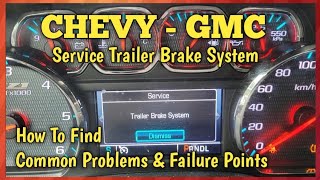
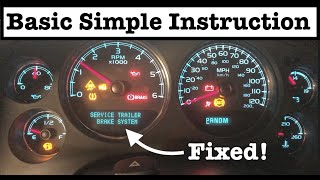
- "Service Trailer Brake System" message on the DIC
- "Check Trailer Wiring" message on the DIC
- Integrated trailer brake controller is disabled
- No power output to the trailer brakes
- Message may appear with or without a trailer connected
- Trailer gain adjustment on dash switch is unresponsive 🎬 Watch: Common failure points and how to fix the warning message.
- Replacing the Trailer Brake Control Module (TBCM) without first diagnosing wiring, connectors, and battery health.
- Replacing the dash-mounted trailer brake control switch when the fault is in the wiring or rear module.
Most Likely Causes
- Poor Connection at 7-Pin Trailer Connector 🔴 High Probability → Shop Trailer Wiring Harness The rear bumper connector is exposed to weather, road salt, and moisture, leading to corrosion on the pins and terminals. A loose-fitting trailer plug can also cause intermittent connections, which the system detects as a fault.
How to confirm: Visually inspect the truck's 7-pin connector and the trailer's plug for green or white corrosion, bent pins, or debris. Wiggle the connection while the truck is on to see if it triggers the message. Ensure the connector door holds the plug tightly.
Typical fix: Clean the terminals thoroughly with a wire brush and electrical contact cleaner. Apply dielectric grease to prevent future corrosion. If heavily damaged or loose, replace the 7-pin connector socket. 🎬 See how to clean and repair a corroded trailer connector. GM issued an updated part (23404450) with a stronger spring door to maintain a better connection, particularly for 2014+ models.
Est. part cost: $20-$60 - Weak or Failing Battery / Poor Battery Connections 🟡 Medium Probability → Shop Vehicle Battery The trailer brake control module requires a stable voltage between 9.5 and 17 volts to operate correctly. A weak battery, corroded terminals, or a failing alternator can cause voltage drops that trigger faults in the sensitive module. TSB #PIT5521A specifically advises addressing battery issues first.
How to confirm: Test the battery voltage with a multimeter (should be ~12.6V engine off, ~14.7V engine on). Load test the battery at an auto parts store. Clean any corrosion from the battery terminals and check ground connections, especially the main battery-to-frame and battery-to-engine block grounds.
Typical fix: Clean battery terminals and ground points. If the battery fails a load test, replace it. Consider replacing the negative battery cable if it shows signs of internal corrosion, as this is a known issue.
Est. part cost: $150-$250 - Damaged or Corroded Wiring 🟡 Medium Probability The trailer brake output wire (dark blue wire, circuit 47) runs the length of the truck frame and is susceptible to damage from road debris, improper jacking, or water intrusion into non-sealed splices. A common chafe point is where the harness runs over the frame near the spare tire.
How to confirm: Visually inspect the wiring harness running from the front of the vehicle to the rear 7-pin connector. Pay close attention to the dark blue wire. Look for chafing, breaks, or corroded splices, especially in the area above the spare tire. 🎬 Watch this walkthrough for inspecting and repairing damaged frame wiring. Perform a continuity test on the dark blue wire if visual inspection is inconclusive.
Typical fix: Repair the damaged section of wire using heat-shrink butt connectors or by replacing the damaged harness section.
Est. part cost: $10-$100 - Corrosion at Trailer Brake Power Module Connector ⚪ Low Probability → Shop Trailer Brake Control Module As mentioned in TSB #PIT5529A, the connector for the Trailer Brake Power Module can corrode. Its location, often above the spare tire, exposes it to moisture and road spray kicked up by the rear wheels.
How to confirm: Lower the spare tire for access. Locate the module mounted to the frame rail above where the spare tire sits. Disconnect its electrical connector and inspect for any signs of moisture, pin corrosion, or wire damage.
Typical fix: Clean the connector terminals with contact cleaner and a small brush. Apply dielectric grease before reconnecting. If corrosion is severe, the connector pigtail and/or the module may need to be replaced.
Est. part cost: $25-$200
Rare But Worth Checking
- Faulty Trailer Brake Control Module (TBCM) or Relay: → Shop Trailer Brake Control Module This is often suspected first but is less common than wiring or connection issues. GM notes in TSB #PIT4595J that many returned modules are fully functional. Rule out all other causes before replacing the module. The module itself is located above the spare tire.
- Faulty Trailer Wiring: The issue may not be with the truck at all. A short or open in the trailer's own wiring can cause the truck to set this code. Test with a known-good trailer or a dedicated trailer circuit tester (like the GM tool EL-52641) to confirm if the fault is with the truck or the trailer.
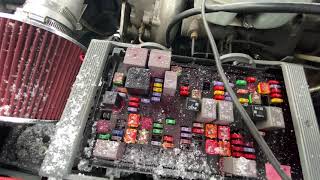
- Blown Trailer Brake Fuse: A blown fuse can cause the system to become disabled and trigger the warning message. Check the under-hood fuse box for fuses related to 'Trailer Brakes' or 'TBC'. On many K2XX trucks (2014+), this can be a 30A J-case fuse for the trailer power stud.
- Aftermarket Trailer Sway Control System: Some aftermarket trailer-mounted sway control devices can interfere with the operation of the factory ITBC. When the sway module activates, it can cause the truck to set a C1114 code and disable the trailer brakes.
Diagnosis Steps
- Read all stored DTCs from the Chassis Control Module.
- If a trailer is connected, disconnect it. The problem must be diagnosed on the truck first.
- Check the trailer brake related fuses in the under-hood fuse box. This is often a 30A J-case fuse labeled 'STUD 2' or 'Trailer Brakes'.
- Perform a battery and charging system test. Ensure battery voltage is stable and within spec (12.6V+ engine off, ~14V running). Clean battery terminals and check the main ground (G401 on GMT900) as per TSB #PIT4595J.
- Thoroughly inspect the 7-pin trailer connector at the rear bumper for corrosion, damage, or loose pins. Clean or replace as needed.
- Lower the spare tire. Inspect the full length of the trailer wiring harness along the truck's frame, paying close attention to the dark blue wire (circuit 47). Look for any signs of physical damage, chafing, or poor repairs, especially where the harness goes over the frame.
- Locate and inspect the Trailer Brake Power Module and its electrical connector (above the spare tire) for corrosion, as noted in TSB #PIT5529A and shown in owner videos.
- If a GM Tech 2 or equivalent scan tool is available, monitor the 'TBCM Relay Feedback Signal'. The voltage should be stable between 3.2-4.1V. Readings outside this range point to a wiring short.
- As a final step, test with a known-good trailer or a trailer circuit tester (like GM tool EL-52641) to confirm the fault lies within the truck itself.
- Only consider replacing the Trailer Brake Control Module or relay after all other possibilities have been exhausted.
Parts You'll Likely Need
- 7-Pin Trailer Connector Socket
(OEM #23404450)— This is the most common failure point due to exposure. The OEM part was updated with a stronger door spring to hold the trailer plug more securely. - Trailer Brake Power Module
(OEM #85073617)— This module, located above the spare tire, is susceptible to moisture and corrosion. It is often replaced to fix the issue after wiring and connectors have been checked. - 30A J-Case Fuse — The main fuse for the trailer brake power stud can blow due to shorts in the truck or trailer wiring, disabling the system.
- Negative Battery Cable
(OEM #22846471)— The factory negative battery cable on GMT900 trucks is known to corrode internally, causing a host of electrical issues, including trailer brake system faults.
Related Codes That Often Appear With This One
- C1112 — This code relates to the trailer brake control relay circuit and often appears with C1114 due to shared wiring, power sources, and being monitored by the same module.
- C1113 — This code indicates a short to battery in the relay control circuit, which can be caused by the same wiring harness issues that trigger C1114.
- U1556 — This is a communication code that can be set alongside C1114 when corrosion affects multiple circuits in the Trailer Brake Power Module connector.
Technical Service Bulletins (TSBs) & Recalls
- PIT5509L: Diagnostic tip for 'Service Trailer Brake System' message with DTC C1114.
- PIT4595J: Diagnostic tips for 'Service Trailer Brake' message with DTCs C1114 and C1112.
- PIT5509K: Diagnostic tip for 'Service Trailer Brake System' message when a trailer is connected.
- PIT5529A: Points to corroded terminals on the battery and Trailer Brake Power Module connector for codes C1112, C1113, C1114, etc.
- PIT5521A: Advises addressing battery issues first before diagnosing C1114.
Platform-Specific Known Issues
- GM has issued multiple Technical Service Bulletins (TSBs) for this exact issue, including PIT5509L, PIT4595J, and PIT5529A.
- TSB #PIT5521A specifically highlights the importance of checking the battery's state of health before beginning in-depth diagnostics.
- TSB #PIT5529A points to corrosion at the Trailer Brake Power Module connector as a potential cause for a group of codes including C1114.
- TSB #PIT4595J notes that water intrusion can affect both the trailer brake relay and the 7-pin connector, causing intermittent faults.
Mechanic-Grade Diagnostic Values
- TBCM Relay Feedback Signal Voltage (using Tech 2 Scan Tool) — expected: 3.2 - 4.1 Volts. Failure: A voltage reading lower or higher than the specified range indicates a short in the circuit 47 wiring. Higher voltage may be correctable with a TBCM software update on GMT900 models.
- Trailer Brake Control Relay Ground Circuit Resistance — expected: Less than 5 ohms. Failure: Resistance greater than 5 ohms between the ground circuit terminal (Terminal B) at the relay connector and a known good ground indicates an open or high resistance in the ground circuit.
- Trailer Brake Control Relay 10-volt Control Circuit Voltage — expected: 9 - 11 Volts. Failure: Voltage outside this range between the control circuit terminal (Terminal E) and ground points to a short or open in the circuit, or a faulty TBCM.
Scan Tool Commands That Help
- GDS2: Data Display -> Trailer Brake Control Output Circuit — Use this parameter to see how the Chassis Control Module is interpreting the status of Circuit 47. It will display 'Okay', 'Short to Ground', or 'Short to Power', directly telling you the type of fault it has detected.
- GDS2: Data Display -> Trailer Brake Type — Use this to verify if the module is correctly identifying the connected trailer's brake type ('Electro-magnetic' or 'Electro-over hydraulic'). If it shows 'Undefined' with a trailer connected, it points to a connection or recognition problem.
- Tech 2: Chassis -> Trailer Brake Control Module -> Data Display -> TBCM Relay Feedback Signal — This is a key diagnostic step for intermittent faults on GMT900 trucks. Monitoring this live data value can reveal shorts to voltage or ground that are not present at all times.
Wiring & Ground Locations
- G401 — On the GMT900 (2007-2013) platform, this ground is located on the driver's side frame rail, near the driver's side tire.. TSB #PIT4595J specifically calls out inspecting and cleaning ground G401. A poor ground here can cause a variety of trailer-related electrical faults, including C1114.
- Trailer Brake Power Module (TBCM) — Mounted to the frame rail, directly above the spare tire. The spare tire must be lowered to access the module and its connector.. This is the location of the control module itself. The module and its connector are highly susceptible to corrosion from road spray, which is a primary cause of C1114 after the 7-pin connector is ruled out.
- Junction Box (for aftermarket controllers) — For installing aftermarket controllers on the K2XX (2014+) platform, the factory plug-in point is in a junction box to the left of the brake pedal, under the driver's side dash.. While not directly related to the factory ITBC, knowing this location is critical if an aftermarket controller has been installed or removed, as wiring issues at this junction can cause faults.
- Circuit 47 — This is the dark blue wire that runs from the Trailer Brake Power Module above the spare tire, along the frame, to the 7-pin connector at the bumper.. This is the specific circuit monitored for faults that set code C1114. Any short or open along its length will trigger the code.
Real Owner Repair Stories
- YouTube user @youtubebikermike (2015 GMC Sierra) — "Service Trailer Brake System" message on the DIC.
❌ Tried (didn't work) Checked wiring harness, which appeared visually okay.
✅ What actually fixed it Replacing the Trailer Brake Power Control Module located above the spare tire. The owner noted that while many people replace the in-dash switch, his 'mechanical intuition' pointed to the more complex component under the truck, which resolved the issue. - YouTube user @59Motorsports (2014-2018 GM Truck (specific model not stated, likely Sierra/Silverado)) — "Service Trailer Brake System" message on the dash.
❌ Tried (didn't work) Replacing the in-dash trailer brake controller module/switch did not fix the problem.
✅ What actually fixed it The owner found a blown 30 amp J-case fuse in the under-hood fuse box. Specifically, it was fuse #2 for the 'trailer battery system'. Replacing this fuse cleared the code.
OEM Part Supersession History
23104453, 23114650, 23337305→85073617— Standard part evolution and integration of design updates for the Trailer Brake Power Module.
Model Year Variations Within This Range
- 2007-2013 (GMT900): TSB #PIT4595J mentions that updated TBCM calibrations were released in TIS2WEB to improve diagnostics for high-resistance shorts to voltage. This software update may resolve some C1114 issues on these earlier models, particularly if the TBCM Relay Feedback Signal is higher than 4.1V.
- 2014 (K2XX): The 2014 model year introduced a new electrical architecture. The module is referred to as the Chassis Control Module (CCM) or Brake System Control Module (BSCM). The updated 7-pin connector (23404450) is specifically called out for these models to ensure a tight connection.
Helpful Videos
We Have This Part in Stock



The information in this article is provided for general reference and educational purposes only. Vehicle specifications, procedures, and part compatibility can vary by production date, trim level, and region. Always consult your vehicle's factory service manual and verify part numbers before purchasing or performing repairs. Safety-critical components such as airbags, seat belts, and braking systems should be installed by a qualified professional.
- Gmc SIERRA 1500:
- 🧭 Diagnostic Flowchart
- 🎬 Helpful Videos
- 🛍️ Shop This Part
- What's Unique About the 2007-2014 Gmc SIERRA 1500
- Symptoms You May Notice
- Most Likely Causes
- Rare But Worth Checking
- Diagnosis Steps
- Parts You'll Likely Need
- Related Codes That Often Appear With This One
- Technical Service Bulletins (TSBs) & Recalls
- Platform-Specific Known Issues
- Mechanic-Grade Diagnostic Values
- Scan Tool Commands That Help
- Wiring & Ground Locations
- Real Owner Repair Stories
- OEM Part Supersession History
- Model Year Variations Within This Range
- 🎟️ Get 5% Off