

OBD-II Code C1121: Manufacturer-Specific ABS/Chassis Fault
An In-Depth Guide to What C1121 Means, Why It Triggers, and How to Fix It
- Code C1121 is a manufacturer-specific chassis code that requires a vehicle-specific definition, meaning a Nissan ABS fault shares the same code as a Hyundai TPMS failure.
- On 2007-2016 Hyundai and Kia models, C1121 indicates a dead front-left TPMS sensor battery dropping below 2.2V, not an ABS system failure.
- A true C1121 ABS fault disables your anti-lock brakes, traction control, and stability control, requiring you to increase following distance and avoid highway speeds in wet or icy conditions.
- Check Technical Service Bulletins (TSBs) before replacing parts, as 2004-2009 Toyota Prius models trigger C1121 for a stuck coolant valve (TSB EG001-08) and 2021 Ford Mach-Es require a software update (TSB 22-2138).
- Diagnosing C1121 requires an advanced OBD-II scanner capable of reading ABS and TPMS modules, as basic $20 engine code readers will provide false definitions.
What Does C1121 Mean?
Code C1121 is a manufacturer-specific Chassis ('C') code that indicates a fault detected by the onboard computer within the Anti-lock Braking System (ABS) or a related system. Unlike universal 'P0' codes, the meaning of C1121 changes dramatically depending on your vehicle's make and model. It signifies a true internal failure in the ABS hydraulic actuator (Nissan), a low battery in a tire pressure sensor (Hyundai/Kia), a software glitch (Ford), or a problem in an entirely different system like the engine's coolant control valve (Toyota Prius). Accurate diagnosis is impossible without knowing the specific definition for your car.
Technical definition: There is no single, universal SAE/ISO definition for C1121. It is a non-standard code assigned by manufacturers. Common definitions include 'Left Front ABS Outlet Solenoid Failure' (Nissan/Infiniti), 'Front Left TPMS Sensor Battery Voltage Low' (Hyundai/Kia), 'Suspension Fault' (Ford Mach-E), 'AIRmatic Acceleration Sensor Fault' (Mercedes-Benz), or 'Valve Relay Fault' (Fiat). The code sets when a control module (like the ABS, VDM, or TPMS module) detects a specific electrical reading or operational state that falls outside its programmed parameters.
Can I Drive With C1121?
Yes, But With Caution. Yes, but with extreme caution. Your standard hydraulic brakes will still function, but the Anti-lock Braking System (ABS), traction control, and stability control are disabled. This significantly increases the risk of skidding and losing steering control during a panic stop or on slippery surfaces like rain or ice. Driving for an extended period is not recommended as it compromises critical safety systems. If the red 'BRAKE' warning light is also on, do not drive the vehicle; it indicates a failure in the primary braking system.
Common Causes
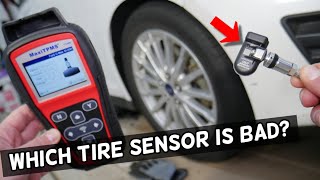
- Failing Tire Pressure Monitoring System (TPMS) Sensor Battery (Very Common) — On many 2007-2016 Hyundai and Kia vehicles, C1121 specifically indicates the battery in the front left TPMS sensor has dropped below its 2.2V threshold. This is a very common point of misdiagnosis, as the fault is unrelated to the ABS.
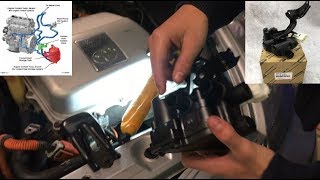
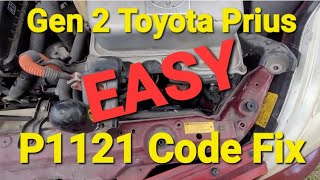
- Faulty Coolant Flow Control Valve (Toyota Prius) (Very Common) — On 2004-2009 Toyota Prius models, C1121 is a misleading 'ghost' code set alongside engine code P1121. The true cause is a stuck three-way coolant flow control valve, a well-documented issue covered by TSB EG001-08. 🎬 Watch this DIY walkthrough for replacing the coolant flow valve.
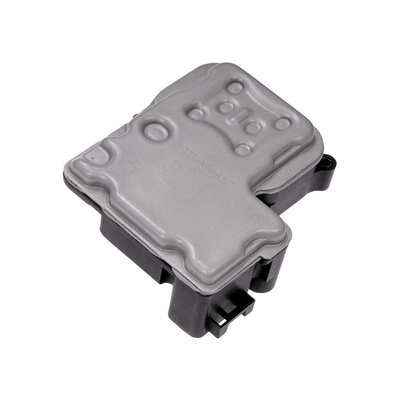
- Faulty ABS Actuator or Control Module (Very Common) — The ABS module (the computer) and the actuator (the hydraulic valve block) are often a single unit. Internal failure of a solenoid, the pump motor relay, or the module's circuit board is a primary cause, especially on Nissan and Mercedes-Benz vehicles.
- Damaged or Corroded Wiring/Connectors (Common) — The wiring harnesses for the ABS module and wheel speed sensors are exposed to harsh conditions. Wires break, fray from rubbing against suspension parts, or connectors fill with water and corrode, causing a loss of signal or power.
- Faulty Wheel Speed Sensor or Tone Ring (Common) — While often triggering other codes, a failing wheel speed sensor or a damaged/corroded tone ring on the axle provides erratic data, leading to a general fault code like C1121.
- Low Vehicle Battery Voltage or Blown Fuse (Less Common) — A weak car battery causes low system voltage, leading to communication errors and spurious codes across many modules. The ABS system also has its own high-amperage fuses; a blown fuse disables the system and sets a fault code.
- Module Software Issue (Less Common) — On modern vehicles, the code is triggered by a software bug. For example, TSB 22-2138 for the 2021 Ford Mustang Mach-E GT identifies C1121:64 as a glitch in the Vehicle Dynamics Module (VDM) that requires a dealer-installed software update.
- Improper Module Programming or Failure to Complete Relearn Procedure (Rare) — If a related module (ABS, ECU, Throttle Body) is replaced or serviced, it requires a specific programming or 'relearn' procedure. On some Hondas, a P1121 code (often confused with C1121) appears after cleaning the throttle body without resetting the ECU.
Symptoms
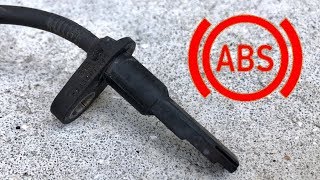
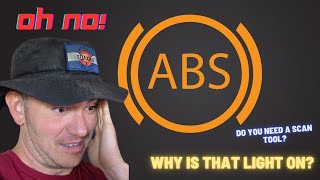
- ABS Warning Light On — This is the most common and direct symptom. The amber 'ABS' light on your dashboard 🎬 Watch: A mechanic's guide to diagnosing an ABS light. illuminates steadily.
- Traction or Stability Control Light On — Because traction control (TCS) and electronic stability control (ESC/VSC) rely on the ABS hardware, their warning lights almost always illuminate alongside the ABS light.
- Tire Pressure Monitoring System (TPMS) Light On — For Hyundai and Kia vehicles where C1121 points to a TPMS sensor, the TPMS warning light illuminates, sometimes instead of the ABS light.
- Brake System Warning Light On — In some cases, the main red 'BRAKE' warning light turns on. This signals a more serious issue like low brake fluid or a base brake system failure, and the vehicle must not be driven.
- ABS Not Functioning in Emergencies — During a hard stop, you will feel the wheels lock up and the vehicle skids, as the anti-lock feature is inactive.
- Suspension Fault Message (Ford Mach-E) — On specific models like the Mustang Mach-E GT, the code is accompanied by an IPC message like 'Suspension Fault Speed Limited To 80 MPH'.
Diagnostic Flowchart
Tap your situation to follow the diagnostic path that matches what you're seeing on this code.
Common Fixes & Costs
- Replace TPMS Sensor (Hyundai/Kia) — Parts: $40 - $80 (per sensor), Labor: $50 - $120 (includes programming/relearn), ~1 hr book time (DIY)
- Replace Coolant Flow Control Valve (Toyota Prius) — Parts: $100 - $150, Labor: $250 - $400, ~2.1 hr book time (Intermediate)
- Replace ABS Control Module/Actuator — Parts: $200 (rebuilt) - $2,500+ (new OEM), Labor: $150 - $400, ~2 hr book time (Professional)
- Repair Damaged Wiring or Connectors — Parts: $10 - $50, Labor: $150 - $500, ~2.5 hr book time (Intermediate)
- Update Control Module Software — Parts: $0, Labor: $100 - $250 (dealer programming fee), ~1.5 hr book time (Professional)
Used vs. New Parts: Buying Guide
When a used part is worth it: A used ABS module is a budget-friendly option for older, high-mileage vehicles where the cost of a new OEM part is prohibitively expensive. It's a viable choice if the part number matches exactly and you have access to a shop capable of reprogramming the module to your vehicle's VIN.
Donor-vehicle mileage cap: roughly under 100000 miles for the part to have meaningful remaining life.
Donor quality checklist:
- Verify the part number on the used unit is an exact match or a known superseded number for your original module.
- Purchase from a reputable salvage yard that offers at least a 30-90 day warranty.
- Inspect the unit for physical damage, heavy corrosion, or cut connectors.
- Inquire about the donor vehicle's mileage and reason for being salvaged (accident vs. electrical/mechanical failure).
Decision logic:
- If Part is for a Toyota Prius (coolant valve) or Hyundai/Kia (TPMS sensor) → Always buy new. These parts are relatively inexpensive and are wear items; a used one has limited remaining life.
- If Vehicle is less than 10 years old and the part is available new or remanufactured → Favor new or remanufactured. The warranty and reliability are worth the extra cost over a used part.
- If Budget is the primary concern and the vehicle is over 150K miles → A used module is an acceptable risk, but factor in the potential cost of programming and the possibility of premature failure.
Warranty tradeoff: Used parts typically have a 30-90 day functional warranty. Remanufactured parts often come with a 1-year to lifetime warranty. New OEM parts carry a 1-year/12,000-mile warranty if installed by a dealer.
Worst-case if a used part fails: $400 - $800. This represents the cost of repeat labor for installation and bleeding, plus the cost of a second replacement part if the used unit is dead on arrival or fails shortly after the warranty period.
What Happens If You Wait — Timeline
- 0-2 months: For Prius (P1121/C1121): Check Engine Light appears intermittently, often turning off on its own. No noticeable symptoms other than the light. Cabin heat and engine temperature remain normal. (MPG impact: 0-2%% · Added cost: $0)
- 2-6 months: For Prius: Check Engine Light stays on permanently. You may notice slightly less effective cabin heating in winter as the valve fails to properly direct hot coolant. The car will fail an emissions test due to the CEL. (MPG impact: 3-5%% · Added cost: $50-100 in wasted fuel)
- 6-12 months: For Prius: The valve becomes completely stuck. This can lead to very poor or no cabin heat. In some failure modes, coolant flow to the engine can be restricted, causing the engine to run hotter than normal, though often not yet overheating. Hesitation on acceleration may be noticed. (MPG impact: 5-10%% · Added cost: $450 (cost to replace the valve before further damage occurs))
- 12+ months: For Prius: Worst-case scenario. A valve stuck in a position that severely restricts coolant flow can cause the engine to overheat. This risks catastrophic engine damage, such as a blown head gasket or warped cylinder head, turning a minor repair into a multi-thousand dollar engine replacement. For a general ABS fault, the risk is not monetary but safety-related; every day driven is a day without ABS/Traction Control, increasing accident risk. (MPG impact: 10-15%+% · Added cost: $2,500 - $5,000+)
Cost of Not Fixing It
- Immediate: Significantly increased risk of skidding and loss of vehicle control during emergency braking or on slippery surfaces. Traction and stability control systems are also disabled. (Added cost: $0 (but high safety risk))
- 1-6 months (for Prius Coolant Valve fault): Ignoring the related P1121 code can lead to poor cabin heat, reduced fuel economy, and eventually cause the engine to overheat, risking catastrophic damage like a warped cylinder head. (Added cost: $2,500 - $5,000+)
- Ongoing: A minor issue like a faulty wheel speed sensor or wiring causes the ABS module to fail over time from logging continuous errors, turning a small repair into a very expensive one. In some cases, a faulty module causes unpredictable braking behavior.
Diagnosis Steps
- Scan All Modules with a Manufacturer-Specific Tool
Use an advanced OBD-II scanner capable of reading manufacturer-specific codes from ALL vehicle modules (ABS, TPMS, BCM, ECU). A generic code reader will misinterpret C1121. Note the exact definition provided and any accompanying codes.
Tools: Advanced OBD-II Scanner (Beginner) - Check for Technical Service Bulletins (TSBs)
Before any physical work, search online for TSBs related to code C1121 for your specific vehicle year, make, and model. The fix is often a known software update (like TSB 22-2138 for the Ford Mustang Mach-E) or a well-documented misleading code (like TSB EG001-08 for the Toyota Prius).
Tools: Internet Access (Beginner) - Diagnose the Specific System (TPMS/Coolant Valve)
If your scanner and TSBs point to a non-ABS cause, diagnose that system directly. For Hyundai/Kia, access TPMS live data; the fault triggers when the front-left sensor battery drops below 2.2V, confirming it needs replacement. For a Toyota Prius, test the 3-way coolant control valve to ensure it switches positions when the heat is turned on and off.
Tools: Advanced OBD-II Scanner (Intermediate) - Inspect Fuses and Verify Battery Voltage
Check the vehicle's fuse boxes (both underhood and in-cabin) for any fuses labeled 'ABS', 'EBCM', or 'VSC'. With a multimeter, confirm the battery has at least 12.4 volts with the engine off and is charging at 13.7-14.7 volts with the engine running.
Tools: Owner's Manual, Multimeter (Beginner) - Perform a Detailed Visual Inspection
Carefully inspect the wiring harness leading to the ABS control module and each wheel speed sensor. Look for chafed wires, rodent damage, melted plastic, and corrosion in connectors. Pay close attention to areas where the harness routes near suspension components or the exhaust.
Tools: Flashlight, Jack and Jack Stands (Intermediate) - Verify Power and Ground at the ABS Module
Using a vehicle-specific wiring diagram, disconnect the main ABS module connector. Use a multimeter to test the main power and ground pins in the harness-side connector. You must have solid battery voltage on the power circuits and less than 0.1 ohms of resistance to ground on the ground circuits. Loss of either shuts the module down.
Tools: Multimeter, Vehicle-Specific Wiring Diagram (Advanced) - Pro Tip: Test ABS Solenoid Resistance (Nissan/Mercedes Focus)
If the code definition points to a solenoid fault (e.g., Nissan 'OUT ABS SOL'), test the actuator's internal solenoids. Using a wiring diagram to identify the correct pins on the disconnected ABS module connector, measure the resistance with a multimeter. For example, on some Haldex ABS units used by Nissan, resistance between the 'common' and 'dump' pins should be 3.5-4.5 ohms, while 'hold' to 'dump' should be 7-9 ohms. Readings outside this range indicate a failed actuator.
Tools: Multimeter, Vehicle-Specific Wiring Diagram (Advanced) - Pro Tip: Analyze Wheel Speed Sensor with an Oscilloscope
For intermittent issues, a multimeter is not fast enough. An oscilloscope graphs the sensor's signal. Passive sensors (2-wire) produce an AC sine wave that increases in frequency and amplitude with speed. Active sensors (2 or 3-wire) produce a DC square wave. Pro Tip: For active sensors, the signal is a change in current, not voltage. Back-probe the SENSOR'S POWER WIRE and watch for a clean square wave voltage drop of a few hundred millivolts as the wheel turns. A noisy or missing waveform indicates a bad sensor or a damaged tone ring.
Tools: Oscilloscope, Back-probe kit (Professional)
When This Code Triggers (Freeze-Frame Conditions)
- Vehicle Speed: > 4 mph (Code sets when the ABS module performs its initial self-test after the vehicle starts moving.)
- System Voltage: < 11.0V or > 15.0V (A weak battery, failing alternator, or corroded power connections causes the ABS module to log fault codes due to improper voltage.)
- Ambient Temperature: < 40°F / 4°C (On Hyundai/Kia vehicles, cold temperatures cause an aging TPMS sensor battery to drop below the 2.2V threshold, triggering the code, which disappears as the tire warms up.)
- Brake Pedal Status: Off (The ABS self-test often runs when the brakes are not being applied, checking the readiness of the pump and solenoids.)
Related Codes
- P1121 — This is a Powertrain code that can be confused with or appear alongside C1121. On a Toyota Prius, it's the 'real' code pointing to the coolant valve. On a Honda, it points to the throttle position sensor. The first letter is critical for diagnosis.
- U0121 — This code means 'Lost Communication With ABS Module.' If seen with C1121, it suggests a more severe problem. U0121 indicates the entire ABS module is offline (due to power/ground loss or a CAN bus network failure), while C1121 means the module is online but has found a fault in its own system.
- C1122, C1123, C1124, etc. — These codes are often for the same type of fault as C1121 but for a different wheel or circuit. For example, on a Hyundai, C1122 is for the Right Front TPMS sensor battery. Seeing them together can help confirm the nature of the fault.
- C12xx (e.g. C1221, C1232) — This range of codes more universally relates to wheel speed sensor circuits. If you have a C12xx code alongside a manufacturer-specific C1121, diagnose the C12xx code first, as it more directly pinpoints a problem with a specific wheel's sensor, wiring, or tone ring.
Climate & Environmental Factors
- Cold Weather: On Hyundai/Kia vehicles, C1121 is often triggered by a low TPMS sensor battery. Cold temperatures reduce the chemical efficiency of lithium-ion batteries, causing their voltage output to drop. A battery that is already near the end of its life functions adequately in warm weather but drops below the 2.2V threshold on a cold morning, triggering the fault code. The light often goes out after the tires warm up from driving.
- High Humidity / Road Salt: In regions with high humidity or that use road salt in winter ('Salt Belt'), the wiring harnesses for the ABS module and wheel speed sensors are highly susceptible to corrosion. Moisture can penetrate connectors, causing high resistance or short circuits. Salt can accelerate the deterioration of wire insulation, leading to breaks in the circuit.
- Heat Soak: On some vehicles, like Fiats using Kelsey-Hayes ABS units, the electronic control unit is mounted near the engine. After a long drive, 'heat soak' from the engine can cause marginal electronic components or solder joints inside the module to fail, triggering codes like C1121 ('Valve Relay Fault'). The problem may disappear after the vehicle cools down completely.
How to Talk to a Mechanic About This Code
Say this: "I have a C1121 code on my [Insert Year/Make/Model, e.g., 2011 Hyundai Sonata]. I've done some research and understand this code means different things for different cars. For my vehicle, I suspect it's related to the [Insert Suspected Cause, e.g., front-left TPMS sensor battery / ABS actuator / coolant control valve]. I would like to schedule a diagnostic appointment to *confirm* this specific cause before authorizing any repairs."
This language signals to the shop that you are an informed consumer. It directs their diagnostic efforts, saving time and money, and prevents them from starting with expensive, unlikely fixes (like replacing an ABS module on a Hyundai for a TPMS code). It establishes that you expect a specific diagnosis, not just a part replacement.
Avoid saying:
- 'My ABS light is on, can you fix it?'
- 'The code is C1121, just replace whatever part that is.'
- 'Just do whatever it takes to turn the light off.'
Questions to ask before authorizing the repair:
- For Hyundai/Kia: 'Did you confirm with a scanner that the front-left TPMS sensor battery voltage is below the 2.2V threshold?'
- For Nissan: 'What was the resistance reading on the ABS actuator solenoid pins, and how does that compare to the manufacturer's specification?'
- For Toyota Prius: 'Did you also find engine code P1121, and did you verify the coolant control valve is failing to operate?'
- For any ABS Module Replacement: 'Does this quote include the necessary VIN programming and the scan-tool-assisted brake bleed procedure?'
- Can I see the old part you're replacing?
Where to Take It: Dealer vs Independent vs Chain
- Dealer:
Necessary for specific software updates or complex programming; otherwise, likely the most expensive option.
Best for: Vehicles under warranty., Known software-related fixes that require a proprietary tool (e.g., Ford Mach-E TSB)., Complex electronic module programming for some brands (e.g., Mercedes-Benz, BMW).
Downsides: Highest labor rates, often $150-$250+ per hour., Defaults to replacing an entire assembly rather than attempting a more targeted, less expensive repair. (Typical cost: +50% vs. baseline) - Independent Shop:
Best overall fit for most C1121 scenarios, offering a balance of expertise and value. Choose a shop with good reviews and ASE-certified technicians specializing in diagnostics.
Best for: Out-of-warranty vehicles., Common, well-documented C1121 causes (Hyundai TPMS, Prius coolant valve)., General ABS diagnostics and actuator replacement on common makes like Nissan.
Downsides: Diagnostic capabilities vary; ensure the shop has modern, manufacturer-specific scan tools., Quality depends on the individual shop's expertise and reputation. (Typical cost: +0% vs. baseline) - Chain Shop:
AVOID for initial diagnosis. High likelihood of being sold an unnecessary and expensive ABS repair. Only use for a specific, pre-diagnosed task like a TPMS sensor swap.
Best for: Tire-related services. Is suitable for a Hyundai/Kia TPMS sensor replacement *if* you have already confirmed the diagnosis.
Downsides: High risk of misdiagnosis due to the complexity of C1121., Technician skill varies widely; often lacks advanced diagnostic tools for ABS or other modules., High pressure to upsell unnecessary services. (Typical cost: -10% vs. baseline)
When to Walk Away From the Repair
If the estimated repair cost exceeds 40-50% of your car's private-party value (from a source like Kelley Blue Book), you should pause and seriously consider selling or trading in the vehicle.
- Car worth $4000, fix is $150: Fix it. The repair (e.g., a Hyundai TPMS sensor) is a tiny fraction of the car's value and is a simple wear-and-tear item.
- Car worth $5000, fix is $2200: Borderline. The repair (e.g., a Nissan ABS actuator) is ~44% of the car's value. Get a second opinion and explore remanufactured part options before proceeding.
- Car worth $3000, fix is $2500: Walk away. The repair cost is over 80% of the car's value. It is not financially sensible to proceed.
What Scan Tool You Need for This Code
Minimum: A scan tool that can read manufacturer-specific codes from the ABS and TPMS modules. An engine-only code reader is INSUFFICIENT and will lead to misdiagnosis.
A basic $20 scanner will read 'C1121' on a Hyundai and give a generic 'ABS fault' definition, causing you to waste money chasing a brake problem. The real code is stored in the TPMS module, which a basic scanner cannot access. For a true ABS fault, you need a scanner that can read live data from wheel speed sensors and perform special functions like an ABS bleed.
Budget: BlueDriver Pro or Autel AP200 (~$100) — These Bluetooth dongle scanners use a smartphone app to access not just engine codes, but also ABS and TPMS modules. They can read the manufacturer-specific definition and live data (like TPMS battery voltage), which is essential for diagnosing C1121 correctly.
Mid-range: Foxwell NT809TS or Innova 5610 (~$250) — These handheld units offer full-system diagnostics, live data graphing, and crucial bidirectional controls. They can perform the ABS automated bleed procedure required after replacing an actuator and can also handle TPMS sensor programming and relearn procedures.
Professional: Autel MaxiCOM MK808S or Launch X431 Series (~$500-800) — Provides professional-level, full bidirectional control of all vehicle systems. Offers advanced coding and programming functions needed for replacing some modules, along with comprehensive live data and diagnostic power.
Rent vs buy: Most auto parts stores offer a free loaner tool program, but be aware: their basic scanners often cannot read ABS or TPMS codes. Verify the loaner tool's capability before relying on it. For C1121, owning a capable budget scanner is a wise investment to avoid misdiagnosis.
How to Clear the Code After You Fix It
- Use an OBD-II scan tool with ABS/Chassis functions to clear the C1121 code.
- For some systems, disconnecting the negative battery terminal for 15 minutes clears the code, but this erases other vehicle settings.
- Perform the manufacturer-specific drive cycle to allow the module to self-test and confirm the repair.
Drive cycle (~20 minutes): A general ABS drive cycle involves starting the vehicle, driving for 10-15 minutes in mixed conditions (city/highway) including several normal stops, and reaching speeds over 40 mph to allow the ABS module to complete its self-checks. For a Hyundai/Kia TPMS-related C1121, driving for up to 20 minutes above 15 mph is required for the system to relearn the new sensor.
Readiness monitors affected: Not applicable for most C1121 faults., If related to a Powertrain code (like P1121 on a Prius), emissions readiness monitors like Catalyst and O2 Sensor will be reset and need to complete before passing a smog test.
Before emissions retest: drive at least 100 miles to fully set monitors.
Watch out for:
- Using a basic code reader that can't access the ABS module will not clear the code.
- The code will return immediately if the underlying mechanical or electrical fault has not been properly fixed.
- Failing to perform the necessary relearn procedure after replacing an ABS module or TPMS sensor will prevent the light from turning off.
Will This Fail Emissions / State Inspection?
No — by itself this code doesn't fail OBD inspection (but it can keep readiness monitors from setting, which causes a separate fail).
- California: Will NOT fail the smog check. California's test is for emissions only, and an ABS light does not affect it. The only automatic light-related failure is an illuminated 'Check Engine' light.
- New York: WILL fail the state safety inspection. New York law explicitly states that an illuminated ABS warning light is grounds for inspection failure.
- Texas: WILL fail the state safety inspection. The annual inspection includes a check of the braking system, and an illuminated ABS warning light indicates a fault in that system, leading to failure.
Most Commonly Affected Vehicles
- Hyundai Sonata, Santa Fe, i30, i20, Veracruz (2007-2016) — On these models, C1121 almost universally means 'Front Left Sensor Battery Voltage Low,' referring to the TPMS sensor. The module sets the code when the sensor's voltage drops below 2.2V.
- Kia Sportage, Sorento, Optima (2008-2016) — Identical to Hyundai, C1121 is a TPMS code indicating a low battery in the front left tire pressure sensor, not an ABS fault.
- Nissan Maxima, Altima, Murano (2005-2015) — Commonly indicates an internal fault in the ABS actuator, specifically a solenoid for one of the wheels (e.g., 'LF Out ABS Solenoid'). Testing solenoid resistance at the module connector is a key diagnostic step.
- Toyota Prius (2004-2009) — Famously misleading. C1121 often appears with engine code P1121 and points to a stuck three-way Coolant Flow Control Valve, not an ABS issue. This is covered by TSB EG001-08.
- Ford Mustang Mach-E GT (2021) — TSB 22-2138 addresses code C1121:64 specifically on GT models with MagneRide suspension. It's caused by a software bug in the Vehicle Dynamics Module (VDM) and requires a dealer update.
- Mercedes-Benz C-Class, E-Class, S-Class (2000-2010) — Often indicates a failure of the ABS actuator/pump assembly or the integrated electronic control unit. Also points to an 'AIRmatic acceleration sensor' fault on models with air suspension.
- Ford Expedition (2000-2004) — On these older Ford trucks, this code can mean the Throttle Position Sensor (TPS) signal is inconsistent with the Mass Air Flow (MAF) sensor reading, a powertrain-related fault.
- Honda Element, CR-V, Civic (2007-2012) — This is typically a Powertrain code (P1121), not a Chassis code. It indicates a 'Throttle Position Sensor lower than expected' value. It often occurs after cleaning the throttle body or replacing it without performing an ECU reset and idle relearn procedure.
Manufacturer-Specific Notes
- Hyundai / Kia: C1121 is not an ABS code on most 2007-2016 models. It specifically means 'Front Left Sensor Battery Voltage Low,' referring to the Tire Pressure Monitoring System (TPMS) sensor. Ignoring this is the #1 cause of misdiagnosis. While no recall targets this specific code, Hyundai has issued recalls (e.g., Recall 159) for TPMS sensors that were improperly programmed during assembly on newer models, showing a history of TPMS-related issues.
- Toyota (Prius): Code C1121 is a 'ghost' code triggered by a faulty coolant flow control valve, which sets a P1121. The scanner incorrectly defines C1121 as a throttle/pedal sensor issue. This is a well-known issue for 2004-2009 models, covered by TSB EG001-08. While the basic warranty is 36k miles, Toyota has offered warranty extensions for other hybrid components like the inverter (up to 15 years) and EGR valve, so it is worth checking with a dealer for any 'goodwill' assistance on known issues like the coolant valve.
- Ford: The definition is highly model-specific. On a 2001 Expedition, it's a TPS/MAF disagreement. On a 2021 Mustang Mach-E GT, TSB 22-2138 confirms it's a VDM software bug that limits speed to 80 MPH.
- Nissan / Infiniti: This code is very frequently linked to an internal failure of an ABS actuator solenoid. Diagnosis often involves checking resistance of the solenoid circuits at the main module connector. The entire actuator assembly usually requires replacement or rebuilding. Nissan has previously extended the warranty on ABS pumps for other issues (e.g., on Titan, Armada, QX56), but no specific program for C1121 on Muranos/Altimas has been identified.
- Fiat: On models like the Stilo and Marea using a Kelsey-Hayes ABS unit, C1121 often points to a 'Valve Relay' fault within the electronic control unit, which can be triggered by excessive heat soak after driving.
Real Owner Stories
2011 Hyundai Sonata with 115K miles
TPMS light came on, but no ABS light. A basic scan tool showed C1121 and defined it as an ABS fault, causing confusion.
What they tried:
- Initially checked brake fluid and visually inspected ABS wiring, finding no issues.
- Took the car to a tire shop after reading forums.
- Tire shop used an advanced scanner to read TPMS data directly.
Outcome: The shop confirmed the front-left TPMS sensor battery was reading 1.9V (below the 2.2V threshold). They replaced the single TPMS sensor (part # 52933-3N000) and performed the relearn procedure. The TPMS light and C1121 code cleared and did not return. Total cost was ~$110.
Lesson: On a Hyundai/Kia, trust the TPMS light over a generic scanner's definition for C1121. The root cause is almost always the front-left TPMS sensor battery, not the ABS system.
2007 Toyota Prius with 182K miles
Check Engine Light came on. A parts store scan revealed code P1121. A more advanced shop scanner also showed the chassis code C1121.
What they tried:
- Owner read online about the common coolant control valve issue (TSB EG001-08).
- Noticing no cabin heat and no signs of engine overheating, they decided to attempt the repair themselves.
- Purchased an aftermarket coolant valve (Dorman 601-021) and Toyota Super Long Life Coolant.
Outcome: The owner successfully replaced the three-way coolant control valve. After clearing the codes, both P1121 and C1121 were resolved, and cabin heat was restored. The repair took about 3 hours.
Lesson: On a 2004-2009 Prius, C1121 is a 'ghost code' caused by P1121. The actual problem is the coolant flow control valve, not the ABS system. Fixing the valve clears both codes.
2009 Nissan Murano with 130K miles
ABS, VDC, and SLIP lights all illuminated on the dashboard. No drivability issues were noticed, but the safety systems were clearly offline.
What they tried:
- A mechanic scanned the vehicle and found C1121, defined as 'Left Front ABS Outlet Solenoid Failure'.
- The mechanic followed the service manual to test the resistance of the solenoid pins at the ABS actuator connector.
- The reading was out of specification, confirming an internal failure of the actuator.
Outcome: The owner opted for a remanufactured ABS actuator assembly to save money over a new OEM part. A professional shop replaced the unit, performed the ABS brake bleed procedure with a scan tool, and cleared the codes. The total cost was approximately $750 ($450 for the part, $300 for labor).
Lesson: For Nissan vehicles, C1121 often points directly to a failed ABS actuator. Confirming the failure by testing pin resistance can prevent unnecessary replacement of other parts like wheel speed sensors.
2021 Ford Mustang Mach-E GT
While driving, a 'Suspension Fault' message appeared, and the vehicle limited top speed. The owner was concerned about a major hardware failure.
What they tried:
- The owner took the vehicle to a Ford dealership.
- The dealer scanned the Vehicle Dynamics Module (VDM) and found code C1121:64.
- The service advisor immediately checked for Technical Service Bulletins.
Outcome: The dealer found TSB 22-2138, which described this exact issue as a software glitch. They reprogrammed the VDM with the updated software level as instructed by the TSB. The repair was covered under warranty and took less than an hour.
Lesson: On modern vehicles, always check for TSBs before assuming a hardware failure. A simple software update performed by the dealer can often be the required fix, saving significant time and money.
How to Prevent This Code From Triggering
- Flush brake fluid every 2 years or 30,000 miles (Every 2 years) — Brake fluid is hygroscopic, meaning it absorbs moisture from the air. This moisture can corrode the delicate internal valves and electronic components of the ABS actuator, leading to expensive failures. A fluid flush replaces the contaminated fluid with fresh, dry fluid.
- Periodically clean and inspect wheel speed sensor wiring (During tire rotation or brake service) — Wiring for wheel speed sensors is exposed to road debris, salt, and moisture. Keeping the connectors clean and ensuring the harness is securely fastened away from moving suspension parts can prevent chafing, breaks, and corrosion that lead to signal loss.
- Replace TPMS sensors proactively (Every 7-10 years or with a new set of tires) — The batteries inside TPMS sensors have a finite lifespan of 5-10 years. For Hyundai/Kia owners, replacing the sensors when you get new tires can prevent the inevitable C1121 code and the need for a separate service visit later.
- Address battery and charging system issues promptly (As needed) — Low system voltage from a weak battery or failing alternator can cause communication errors and trigger spurious fault codes in sensitive electronics like the ABS module. Ensuring a stable 12.4V+ (engine off) and 13.7-14.7V (engine on) is critical for all vehicle modules.
- Install a heat shield for the ABS module (if applicable) (Once) — On some vehicles (like certain BMW and Fiat models), the ABS module is mounted near the hot exhaust manifold. Prolonged heat exposure can degrade internal electronics. Some owners fabricate simple aluminum heat shields to deflect radiant heat and extend the module's life.
Frequently Asked Questions
Is it safe to drive my car with code C1121 and the ABS light on?
You can drive cautiously for short distances, but your anti-lock, traction, and stability controls are disabled. This significantly increases your risk of skidding in an emergency or on wet roads. If the red 'BRAKE' light is also on, pull over and tow the vehicle.
My scanner says C1121 is an ABS fault on my Hyundai, but the ABS light is off and the TPMS light is on. What's wrong?
Your scanner is using a generic definition instead of the manufacturer-specific one. On most 2007-2016 Hyundai and Kia vehicles, C1121 means the front-left TPMS sensor battery dropped below 2.2V. Replace the TPMS sensor, not the ABS module.
What's the difference between a C1121 and a P1121 code?
The first letter is critical. 'C' is for Chassis (ABS, suspension), while 'P' is for Powertrain (engine/transmission). On a Honda, P1121 is a throttle sensor code. On a Toyota Prius, P1121 is the real code for a coolant valve that can also trigger the C1121 chassis code.
Can a weak car battery cause code C1121?
Yes. A failing battery can cause low voltage across the entire vehicle, leading to communication errors and random fault codes in sensitive electronic modules like the ABS controller. Always ensure your battery and charging system are healthy before chasing complex electronic faults.
What's the difference between an active and a passive ABS sensor?
A passive sensor is a simple 2-wire sensor that generates its own AC voltage (a sine wave) as the toothed reluctor wheel spins past it. An active sensor is a 2 or 3-wire digital sensor that receives power from the car and outputs a DC square wave signal. Active sensors are more accurate at very low speeds.
Why did my ABS light and C1121 code appear right after hitting a pothole?
A sharp impact from a pothole can cause several issues. It can physically damage the wheel speed sensor, break the fragile wires leading to it, or momentarily disrupt the connection, causing the ABS module to log a fault.
Can I fix code C1121 myself?
Replacing a fuse, wheel speed sensor, or Prius coolant valve are manageable DIY tasks. However, replacing a TPMS sensor requires a specialized $150+ programming tool. Replacing an ABS module requires professional scan tools for brake bleeding and VIN programming, making it a shop-only job.
Key Takeaways
- Code C1121 is a manufacturer-specific chassis code that requires a vehicle-specific definition, meaning a Nissan ABS fault shares the same code as a Hyundai TPMS failure.
- On 2007-2016 Hyundai and Kia models, C1121 indicates a dead front-left TPMS sensor battery dropping below 2.2V, not an ABS system failure.
- A true C1121 ABS fault disables your anti-lock brakes, traction control, and stability control, requiring you to increase following distance and avoid highway speeds in wet or icy conditions.
- Check Technical Service Bulletins (TSBs) before replacing parts, as 2004-2009 Toyota Prius models trigger C1121 for a stuck coolant valve (TSB EG001-08) and 2021 Ford Mach-Es require a software update (TSB 22-2138).
- Diagnosing C1121 requires an advanced OBD-II scanner capable of reading ABS and TPMS modules, as basic $20 engine code readers will provide false definitions.
Helpful Videos

Shop the Parts Behind C1121
Below are the parts most often responsible for code C1121, ranked by how frequently each one is the actual culprit (per the diagnosis above). Tap any to see what we have for your vehicle.


The information in this article is provided for general reference and educational purposes only. Vehicle specifications, procedures, and part compatibility can vary by production date, trim level, and region. Always consult your vehicle's factory service manual and verify part numbers before purchasing or performing repairs. Safety-critical components such as airbags, seat belts, and braking systems should be installed by a qualified professional.
- 🧭 Diagnostic Flowchart
- 🎬 Helpful Videos
- 🛍️ Shop This Part
- What Does C1121 Mean?
- Can I Drive With C1121?
- Common Causes
- Symptoms
- Common Fixes & Costs
- Used vs. New Parts: Buying Guide
- What Happens If You Wait — Timeline
- Cost of Not Fixing It
- Diagnosis Steps
- When This Code Triggers (Freeze-Frame Conditions)
- Related Codes
- Climate & Environmental Factors
- How to Talk to a Mechanic About This Code
- Where to Take It: Dealer vs Independent vs Chain
- When to Walk Away From the Repair
- What Scan Tool You Need for This Code
- How to Clear the Code After You Fix It
- Will This Fail Emissions / State Inspection?
- Most Commonly Affected Vehicles
- Manufacturer-Specific Notes
- Real Owner Stories
- 2011 Hyundai Sonata with 115K miles
- 2007 Toyota Prius with 182K miles
- 2009 Nissan Murano with 130K miles
- 2021 Ford Mustang Mach-E GT
- How to Prevent This Code From Triggering
- Frequently Asked Questions
- Is it safe to drive my car with code C1121 and the ABS light on?
- My scanner says C1121 is an ABS fault on my Hyundai, but the ABS light is off and the TPMS light is on. What's wrong?
- What's the difference between a C1121 and a P1121 code?
- Can a weak car battery cause code C1121?
- What's the difference between an active and a passive ABS sensor?
- Why did my ABS light and C1121 code appear right after hitting a pothole?
- Can I fix code C1121 myself?
- Key Takeaways
- 🎟️ Get 5% Off