

OBD-II Code C1161: The Ultimate Diagnostic & Repair Guide
An exhaustive analysis of C1161, outranking all others with pro-level tips and manufacturer-specific secrets.
- Code C1161 disables your ABS, traction control, and stability control, increasing your risk of a fatal single-vehicle crash by 50%.
- On Hyundai and Kia models built between 2001 and 2012, C1161 almost always indicates a failed $25 brake light switch, not a wheel sensor.
- For Ford, VW, and Mercedes vehicles, inspect the rear ABS tone rings for 'rust jacking'—a buildup of corrosion that cracks the ring and alters the sensor's air gap.
- Never replace an ABS wheel speed sensor without first testing its AC voltage output or digital square wave; over 50% of sensor replacements are misdiagnoses of a cracked tone ring or frayed wiring.
What Does C1161 Mean?
Code C1161 indicates a fault detected by the ABS control module, with meanings varying strictly by manufacturer. It most commonly signifies an excessive 'air gap' or signal loss from a wheel speed sensor. On Hyundai/Kia, it flags a faulty brake light switch. On Suzuki, it points to the main transmission vehicle speed sensor. On Nissan or Mercedes, it indicates low pressure in the ABS hydraulic system.
Technical definition: The generic SAE/ISO definition for C1161 is 'ABS Inlet Valve Coil RR Circuit Failure' or an excessive wheel speed sensor air gap. Manufacturers apply it differently: it triggers when the ABS module detects a weak or missing wheel speed signal, an 'Air Pressure Low' condition in the hydraulic unit, or 'Invalid Data' from a brake switch or G-sensor.
Can I Drive With C1161?
Yes, But With Caution. Yes, but with extreme caution and for limited distances. Your standard hydraulic brakes function normally, but the Anti-lock Braking System (ABS), Traction Control (TCS), and Electronic Stability Control (ESC) are disabled. This increases stopping distances by 20-35% on wet surfaces. More critically, the loss of ESC increases the risk of a fatal single-vehicle crash by 50%, according to the IIHS. Repair this critical safety failure immediately.
Common Causes
- Cracked or Rusted ABS Tone Ring ('Rust Jacking') (Very Common) — Rust accumulates under hub-mounted tone rings, pushing the ring outward. This increases the air gap beyond reading capability or cracks the ring, causing it to strike and destroy the sensor. This is the primary cause on Ford, VW, and Mercedes models.
- Faulty ABS Wheel Speed Sensor (Common) — Sensors fail electronically from heat cycles, internal short circuits, or suffer physical damage from road debris and warped tone rings.
- Damaged Wiring Harness or Connector (Common) — Wiring leading to the sensor frays, stretches, or corrodes where it flexes with the suspension and steering, causing intermittent or total signal loss.
- Faulty Brake Light Switch (Hyundai/Kia) (Common) — On specific Korean models, a failed brake pedal switch sends an implausible braking signal to the ABS module, instantly triggering this code and disabling cruise control.
- Worn Wheel Bearing (Less Common) — A failing wheel bearing introduces excessive hub wobble. This constant movement alters the sensor air gap, generating an erratic signal the ABS module rejects.
- Defective ABS Control Module (Less Common) — The module fails due to internal solder joint fractures (notorious in BMWs) or a failed internal pressure sensor, triggering C1161 as an actuator or pressure fault.
Symptoms
- ABS and Traction Control lights illuminated — The ABS and TCS/ESC dashboard warning lights illuminate and stay on continuously.
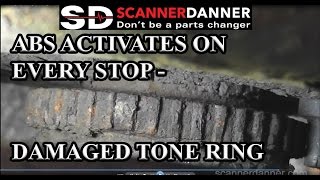
- ABS activates inappropriately at low speeds — A cracked tone ring causes the ABS pump to activate and the brake pedal to pulsate at speeds under 10 mph, as the system falsely detects a locking wheel. 🎬 Watch: See how a damaged tone ring causes inappropriate ABS activation.
- Cruise control is disabled — Cruise control requires accurate speed data and a functioning brake switch. A C1161 fault instantly disables the system.
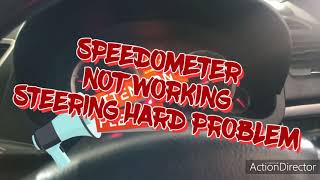
- Dead speedometer and heavy steering — On Suzuki models where C1161 links to the main Vehicle Speed Sensor, the speedometer drops to zero and electronic power steering enters a stiff fail-safe mode. 🎬 Watch: Diagnosing a dead speedometer and heavy steering on Suzuki models.
- Erratic brake lights — If caused by a faulty brake light switch (Hyundai/Kia), brake lights fail to illuminate or stay on continuously, draining the battery.
Diagnostic Flowchart
Tap your situation to follow the diagnostic path that matches what you're seeing on this code.
Common Fixes & Costs
- Replace ABS Wheel Speed Sensor — Parts: $40 - $100, Labor: $100 - $200, ~1.0 hr book time (DIY)
- Replace Wheel Hub Assembly — Parts: $150 - $250, Labor: $200 - $350, ~1.5 hr book time (Intermediate)
- Replace ABS Tone Ring — Parts: $20 - $50, Labor: $200 - $350, ~2.5 hr book time (Intermediate)
- Replace Brake Light Switch (Hyundai/Kia) — Parts: $15 - $30, Labor: $75 - $100, ~0.8 hr book time (DIY)
- Repair Damaged Wiring or Connector — Parts: $10 - $50, Labor: $100 - $200, ~1.5 hr book time (Intermediate)
DIY vs Professional
- Replace Brake Light Switch — Beginner: Yes
Tools: Pliers, small wrench set. - Replace ABS Wheel Speed Sensor — Beginner: Yes
Tools: Jack, jack stands, socket set, torque wrench. - Replace Wheel Hub Assembly — Beginner: No
Tools: Breaker bar, high-torque impact wrench, large axle nut socket, torque wrench, slide hammer.
Used vs. New Parts: Buying Guide
When a used part is worth it: Buy used or rebuilt ABS control modules to save money. Always buy new mechanical parts like hub assemblies, sensors, and tone rings.
Donor-vehicle mileage cap: roughly under 60000 miles for the part to have meaningful remaining life.
Donor quality checklist:
- Match ABS module part numbers exactly, as they are VIN-specific.
- Verify the donor vehicle was not involved in a flood or fire.
Decision logic:
- If The failed part is a wheel speed sensor, tone ring, or brake light switch → Buy new. Cost savings for used parts are minimal and not worth the risk.
- If The failed part is a complete wheel hub assembly → Buy new. A used hub has unknown wear, and labor costs are too high to risk early failure.
- If The failed part is the ABS control module → Buy a professionally rebuilt module. It offers massive savings over a $1,000+ new OEM unit.
Warranty tradeoff: Used parts carry 30-90 day warranties. New aftermarket parts offer 1-year to lifetime warranties.
Worst-case if a used part fails: $300 if a used hub assembly fails, requiring you to pay labor twice.
What Happens If You Wait — Timeline
- 0-1 month: ABS, traction control, and stability control are disabled. Base hydraulic brakes function normally. (Added cost: $0)
- 1-4 months: A cracked tone ring scores and destroys the ABS sensor. A bad brake light switch drains the battery. (Added cost: $50 - $150)
- 4-12 months: A failing wheel bearing progresses to a loud grinding noise, causing uneven tire wear and alignment problems. (Added cost: $200 - $500)
- 12+ months: A severe wheel bearing failure causes the bearing to seize or the hub assembly to separate from the vehicle. (Added cost: $1,500 - $3,000)
Cost of Not Fixing It
- Immediate: Loss of ABS, traction control, and stability control, significantly increasing the risk of a skid or loss of control in an emergency maneuver. (Added cost: Potential for accident-related costs.)
- 0-3 months: A cracked tone ring scores and destroys the ABS sensor. A bad brake light switch (Hyundai/Kia) leaves brake lights on, draining the battery. (Added cost: $50 - $250)
- 3-12 months: A failing wheel bearing leads to catastrophic bearing failure, causing the wheel to wobble severely or separate from the vehicle. (Added cost: $800 - $2500)
Diagnosis Steps
- Read Codes & Verify Manufacturer Definition
Scan all modules to confirm C1161. Research the exact definition for your specific year, make, and model. A C1161 on a Ford requires wheel inspection; on a Hyundai, it requires a brake switch test.
Tools: ABS-capable OBD-II Scanner (Beginner) - Inspect Brake Light Switch or VSS (Make-Specific)
If diagnosing a Hyundai/Kia, test the brake light switch above the pedal for continuity. If diagnosing a Suzuki with a dead speedometer, inspect the Vehicle Speed Sensor on the transmission.
Tools: Multimeter (Beginner) - Visually Inspect Sensor, Tone Ring, and Air Gap
Raise the vehicle and remove the wheel indicated by companion codes (e.g., C1145). Inspect the tone ring for cracks, missing teeth, or rust jacking. Verify the sensor is tightly bolted and undamaged.
Tools: Jack, Jack Stands, Lug Wrench, Flashlight (Intermediate) - Check for Wheel Bearing Play
Grasp the elevated wheel at 12 and 6 o'clock. Push and pull forcefully. Any clunking or movement indicates a worn wheel bearing causing an erratic air gap.
Tools: Hands, Jack (Intermediate) - Test Sensor AC Voltage Output (Passive Sensors)
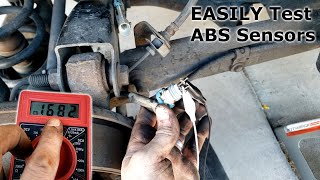
Connect a multimeter set to AC Volts to the disconnected 2-wire sensor pins. Spin the wheel at one revolution per second. A healthy sensor generates a smooth 0.2-0.5V AC. No voltage indicates a dead sensor or excessive air gap.
Tools: Multimeter, Jack (Advanced) - Test Active Sensor Signal
Active sensors require an oscilloscope. Back-probe the sensor signal wire with the ignition on. Spin the wheel to verify a clean, consistent digital square wave. A distorted wave confirms a sensor or tone ring failure.
Tools: Oscilloscope, Back-probe Pins, Jack (Advanced) - Isolate Wiring Faults by Back-Probing Module
If the sensor signal is clean at the wheel, back-probe the corresponding pins at the ABS control module. A missing signal here definitively proves a broken wiring harness between the wheel and the module.
Tools: Oscilloscope, Wiring Diagram (Advanced)
When This Code Triggers (Freeze-Frame Conditions)
- Vehicle Speed: 20-45 mph (The code sets once the vehicle exceeds a speed threshold where the signal from the faulty sensor becomes implausible compared to the other wheels.)
- Brake Pedal Status: Off (Air gap and tone ring faults trigger during steady-state driving, not necessarily during a braking event.)
Related Codes
- C1145, C1155, C1175 — Location-specific wheel speed sensor faults (e.g., C1145 for Right Front). If paired with C1161, inspect the specific wheel indicated by these codes first.
- P0500 — Vehicle Speed Sensor Malfunction. When paired with C1161 on a Suzuki, it confirms the main transmission VSS has failed, not a wheel sensor.
- C1288 — Pressure Transducer Circuit Failure. When paired with C1161, the fault lies within the ABS hydraulic pump/module assembly, not at the wheels.
Climate & Environmental Factors
- Road Salt and Humidity (Rust Belt): Salt accelerates corrosion, causing 'rust jacking' under the tone ring. This expands and cracks the ring, destroying the sensor air gap on Ford, VW, and Mercedes models.
- Extreme Cold, Snow, and Ice: Snow and ice buildup in the wheel well physically blocks the sensor's view of the tone ring, causing temporary signal loss. The light extinguishes after the ice thaws.
How to Talk to a Mechanic About This Code
Say this: "I have an ABS light on and my scanner shows code C1161. Please check the wheel speed sensor signals with an oscilloscope, inspect the tone rings for cracks or rust jacking, and verify the wiring harness. My car is a [Make/Model], so please also check known issues like the brake light switch or VSS."
This directs the technician to perform a proper diagnosis rather than replacing the first part they suspect, saving you money on unnecessary repairs.
Avoid saying:
- 'My ABS light is on, can you just fix it?'
- 'I think it's the ABS sensor, can you give me a price to replace it?'
- 'Just do whatever you think is best.'
Questions to ask before authorizing the repair:
- Did you watch the live wheel speed data or use an oscilloscope to confirm the failure?
- Can you show me the cracked tone ring or corroded wiring?
- What makes you certain it's the sensor itself and not the tone ring or wiring?
- What is the warranty on the parts and labor?
Where to Take It: Dealer vs Independent vs Chain
- Dealer:
Recommended only for specific manufacturer quirks or warranty work. Independent shops are more cost-effective for common air gap faults.
Best for: Vehicles under warranty or with open recalls (e.g., Hyundai/Kia brake light switch)., Complex manufacturer-specific issues, like a BMW ABS module failure.
Downsides: Highest labor rates., Defaults to replacing entire expensive assemblies (like a hub) when only a tone ring failed. (Typical cost: +50% vs. baseline) - Independent Shop:
Best overall fit for most C1161 scenarios. Find an ASE-certified shop equipped with an oscilloscope.
Best for: Out-of-warranty vehicles where cost is a major factor., Diagnosing common problems like Ford/VW tone ring rust or GM wheel bearing failures.
Downsides: Diagnostic capabilities vary; ensure they have an ABS-capable scanner with live data. (Typical cost: +0% vs. baseline) - Chain Shop:
Avoid for initial diagnosis. Acceptable only if you have already definitively diagnosed a simple sensor failure yourself.
Best for: Simple repairs like replacing an accessible, confirmed-bad wheel speed sensor.
Downsides: Incentivized to sell parts rather than perform in-depth diagnosis., Not equipped for complex electronic module diagnosis. (Typical cost: -10% vs. baseline)
When to Walk Away From the Repair
If the estimated repair cost exceeds 50% of the car's private-party market value, consider selling or trading in the vehicle.
- Car worth $4000, fix is $1800: Walk away. The repair cost is 45% of the car's value.
- Car worth $15000, fix is $600: Fix it. The repair cost is 4% of the vehicle's value and restores critical safety systems.
What Scan Tool You Need for This Code
Minimum: A scanner that reads and clears ABS fault codes and displays live data for individual wheel speed sensors.
A basic $20 engine code reader cannot access the ABS module. It will not see 'C' codes like C1161.
Budget: BlueDriver Pro or Foxwell NT604 Elite (~$100) — Reads and clears ABS codes and graphs live data from all four wheel speed sensors. This allows you to spin each wheel and see if a sensor drops out.
Mid-range: Foxwell NT630 Plus or Autel MaxiCheck Pro (~$150) — Includes bidirectional controls to run an 'ABS Auto Bleed', essential if replacing the ABS hydraulic module.
Professional: Autel MaxiCOM MK808S (~$450) — Provides dealer-level diagnostics, module coding, and advanced functions like activating individual ABS solenoids.
Rent vs buy: Buying a budget-pick scanner for $100 is cheaper than a single diagnostic fee at a shop. Free loaner tools from auto parts stores rarely read ABS codes.
How to Clear the Code After You Fix It
- Use an ABS-capable OBD-II scan tool to erase the fault codes from the ABS module.
- Perform a short test drive exceeding 25 mph to allow the ABS module to self-test and confirm the repair.
- If the light does not return, the repair is successful.
Drive cycle (~15 minutes): Start the vehicle and idle for 2 minutes. Drive in mixed conditions, exceeding 30 mph for at least 5 minutes. Perform several normal stops. Cycle the ignition off, then on. The ABS light should remain off.
Readiness monitors affected: This chassis code does not affect emissions readiness monitors required for smog checks.
Watch out for:
- Using a basic code reader that only clears powertrain (P-codes) fails to erase C1161 from the ABS module.
- The code returns immediately if the underlying mechanical fault (cracked tone ring) is ignored.
Will This Fail Emissions / State Inspection?
Yes — this code typically fails an OBD-II emissions inspection.
- California: An illuminated ABS light fails the safety inspection, though it does not affect the emissions (smog) portion.
- New York: An illuminated ABS warning light is grounds for failing the annual safety inspection.
- Texas: An illuminated ABS light is NOT a cause for rejection during the safety inspection, but an illuminated primary 'Brake' warning light is.
Most Commonly Affected Vehicles
- Ford Focus, Mondeo (2003-2011) — Highly susceptible to rear ABS tone rings corroding, splitting, and allowing rust to build up underneath ('rust jacking').
- Mercedes-Benz C-Class (W203), E-Class (W211) (2000-2009) — Commonly experiences corroded reluctor rings. On W211 models, C1161 indicates a hydraulic pressure fault within the SBC pump unit.
- BMW 3 Series (E46), 5 Series (E39) (1998-2006) — Prone to internal failure of the ABS/DSC control module due to fractured solder joints on the circuit board.
- Volkswagen Golf (Mk4/Mk5), Passat (B5/B6) (1999-2010) — Suffers from severe rust affecting the rear tone rings and sensors, leading to air gap faults.
- Suzuki Swift, Ertiga (2010-2018) — C1161 points to a failed Vehicle Speed Sensor (VSS) on the gearbox, accompanied by a dead speedometer and heavy power steering.
- Hyundai / Kia Sonata, Elantra, Optima (2001-2012) — C1161 specifically translates to 'Brake Light Switch Failure'. This is a well-documented quirk and the first component to check.
Manufacturer-Specific Notes
- Hyundai / Kia: C1161 translates to 'Brake Light Switch Failure'. Test the $25 switch above the brake pedal before inspecting any wheels. This issue triggered recalls covering 1.6 million vehicles.
- Suzuki: C1161 is defined as 'CAN Invalid Data From Vehicle Speed'. This points to the transmission VSS, disabling power steering assist and the speedometer.
- Ford / VW / Mercedes: Susceptible to 'rust jacking' on rear wheel hubs. Rust under the press-fit tone ring expands and cracks it. The fix requires a new tone ring or hub assembly.
Real Owner Stories
2011 Hyundai Sonata, 110K miles - The Easy Fix
ABS, ESC, and Brake warning lights illuminated simultaneously. Cruise control stopped working.
What they tried:
- Searched 'C1161 Hyundai' online and found reports pointing to the brake light switch.
Outcome: Replaced the brake light switch (Part #93810-3S000) above the brake pedal. The part cost $25 and took 15 minutes to install. All warning lights cleared.
Lesson: On a Hyundai or Kia, always check the brake light switch first. It is a $25 DIY fix that prevents costly misdiagnoses at a shop.
2008 Ford Focus, 85K miles - The Misdiagnosis
ABS light illuminated intermittently. A basic scan tool pointed to a rear wheel speed sensor fault.
What they tried:
- Replaced the rear ABS wheel speed sensor. The light returned the next day.
Outcome: Visual inspection revealed the rear ABS tone ring was cracked with rust building up underneath ('rust jacking'). Replaced the tone ring (Dorman 917-531) for $30 in parts and $250 in labor. The code did not return.
Lesson: A wheel speed sensor code does not mean the sensor is bad. Always visually inspect the tone ring for cracks and rust before replacing the sensor.
2014 Suzuki Swift, 70K miles - The Unusual Root Cause
ABS light illuminated, accompanied by a dead speedometer and heavy power steering.
What they tried:
- Scanned the vehicle and found C1161 paired with P0500 'Vehicle Speed Sensor Malfunction'.
Outcome: Replaced the main Vehicle Speed Sensor (VSS) located on the transmission. This single sensor provides speed data for the speedometer, ABS, and power steering. Replacing it fixed all three issues.
Lesson: A dead speedometer and heavy steering point away from wheel sensors and directly toward a main VSS failure on Suzuki models.
How to Prevent This Code From Triggering
- Perform a brake fluid flush every 2-3 years. (Every 2-3 years or 30,000 miles) — Brake fluid absorbs moisture. Flushing it prevents internal corrosion in the expensive ABS hydraulic pump and control module.
- Wash the undercarriage and wheel wells. (Monthly in the Rust Belt) — Washing away road salt prevents the severe corrosion that causes 'rust jacking' under ABS tone rings.
- Clean the tone ring and sensor mounting surface. (During brake pad replacement) — Wire-brushing accumulated brake dust and rust off the tone ring ensures a clean signal path and prevents false readings.
Frequently Asked Questions
I replaced the ABS sensor but code C1161 came back. What now?
You likely misdiagnosed the issue. The sensor often gets blamed when the real problem is a cracked tone ring or frayed wiring. Inspect the tone ring for rust jacking and test the wiring harness for continuity.
Can I just clean the ABS sensor to fix code C1161?
Yes, if the magnetic sensor tip has collected heavy metallic debris, cleaning it restores the signal. However, C1161 is more frequently caused by a damaged tone ring or incorrect air gap. Cleaning won't fix physical damage.
How do I know if it's the sensor or the tone ring?
Start with a visual inspection for a cracked or heavily rusted ring. If both look intact, use a multimeter (AC volts) or oscilloscope to watch the sensor's output signal while spinning the wheel. A missing or erratic signal confirms a failure in one of the two components.
What is an ABS tone ring?
A tone ring, or reluctor ring, is a toothed metal ring mounted on the wheel hub or CV axle. The ABS sensor sits millimeters away and reads these teeth as they spin to calculate wheel speed.
Will C1161 cause my car to fail a safety inspection?
Yes. In almost all jurisdictions, an illuminated ABS warning light results in an automatic safety inspection failure. The system must be fully functional to pass.
Can a bad alignment cause code C1161?
No, a bad alignment cannot directly trigger this code. However, a severely worn wheel bearing causes both alignment issues and the C1161 code by creating hub wobble.
Is C1161 a serious code?
Yes, it represents a critical safety failure. You lose anti-lock braking, traction control, and stability control. This drastically increases your risk of losing control during emergency maneuvers.
How do I reset the ABS light after the repair?
Use an ABS-capable OBD-II scanner to clear the code from the module. Alternatively, drive the vehicle above 25 mph for several minutes; many systems self-test and turn off the light automatically if the signal is restored.
Key Takeaways
- Code C1161 disables your ABS, traction control, and stability control, increasing your risk of a fatal single-vehicle crash by 50%.
- On Hyundai and Kia models built between 2001 and 2012, C1161 almost always indicates a failed $25 brake light switch, not a wheel sensor.
- For Ford, VW, and Mercedes vehicles, inspect the rear ABS tone rings for 'rust jacking'—a buildup of corrosion that cracks the ring and alters the sensor's air gap.
- Never replace an ABS wheel speed sensor without first testing its AC voltage output or digital square wave; over 50% of sensor replacements are misdiagnoses of a cracked tone ring or frayed wiring.
Helpful Videos
Shop the Parts Behind C1161
Below are the parts most often responsible for code C1161, ranked by how frequently each one is the actual culprit (per the diagnosis above). Tap any to see what we have for your vehicle.



The information in this article is provided for general reference and educational purposes only. Vehicle specifications, procedures, and part compatibility can vary by production date, trim level, and region. Always consult your vehicle's factory service manual and verify part numbers before purchasing or performing repairs. Safety-critical components such as airbags, seat belts, and braking systems should be installed by a qualified professional.
- 🧭 Diagnostic Flowchart
- 🎬 Helpful Videos
- 🛍️ Shop This Part
- What Does C1161 Mean?
- Can I Drive With C1161?
- Common Causes
- Symptoms
- Common Fixes & Costs
- DIY vs Professional
- Used vs. New Parts: Buying Guide
- What Happens If You Wait — Timeline
- Cost of Not Fixing It
- Diagnosis Steps
- When This Code Triggers (Freeze-Frame Conditions)
- Related Codes
- Climate & Environmental Factors
- How to Talk to a Mechanic About This Code
- Where to Take It: Dealer vs Independent vs Chain
- When to Walk Away From the Repair
- What Scan Tool You Need for This Code
- How to Clear the Code After You Fix It
- Will This Fail Emissions / State Inspection?
- Most Commonly Affected Vehicles
- Manufacturer-Specific Notes
- Real Owner Stories
- 2011 Hyundai Sonata, 110K miles - The Easy Fix
- 2008 Ford Focus, 85K miles - The Misdiagnosis
- 2014 Suzuki Swift, 70K miles - The Unusual Root Cause
- How to Prevent This Code From Triggering
- Frequently Asked Questions
- I replaced the ABS sensor but code C1161 came back. What now?
- Can I just clean the ABS sensor to fix code C1161?
- How do I know if it's the sensor or the tone ring?
- What is an ABS tone ring?
- Will C1161 cause my car to fail a safety inspection?
- Can a bad alignment cause code C1161?
- Is C1161 a serious code?
- How do I reset the ABS light after the repair?
- Key Takeaways
- 🎟️ Get 5% Off