

C1168 on 2016-2018 Lincoln MKX: Right Rear ABS Sensor Causes and Fixes
Code C1168 on a 2016-2018 Lincoln MKX means there's a fault with the right rear ABS wheel speed sensor. This is most often caused by a failed sensor itself or damaged wiring. The 'Service AdvanceTrac' warning light is a primary symptom. Expect to pay $30-$60 for an aftermarket sensor, with a DIY difficulty of 2/5.
- Code C1168 means the right rear ABS wheel speed sensor is not working correctly, which also disables the 'AdvanceTrac' system.
- The most common fix is to replace the right rear ABS sensor, which is an affordable and accessible DIY repair held by one bolt.
- Before replacing the sensor, inspect the wiring for damage and check the wheel for wobble, which indicates a bad wheel bearing/hub assembly.
- Do not continue to drive indefinitely with this light on; your ABS and traction control are disabled, compromising safety in emergency situations.
What's Unique About the 2016-2018 Lincoln MKX
The Lincoln MKX from this generation shares its CD4 platform with the Ford Edge. On these vehicles, while the sensor itself is a common failure point, it's also critical to inspect the ABS tone ring. On earlier models, these rings were separate parts pressed onto the axle shaft and were notorious for cracking due to rust buildup underneath them. For the 2016-2018 MKX, the tone ring is typically integrated into the rear wheel bearing and hub assembly. Excessive play from a failing wheel bearing can damage the magnetic encoder ring or the sensor itself, causing a C1168 code. A critical and often overlooked issue, identified in a Technical Service Bulletin, is the potential for damaged wiring or a poorly seated connector between the main harness and the sub-harness, specifically between connectors C1016 and C1168. [⭐ MANUFACTURER TSB — highest authority]
Diagnostic Flowchart
Tap your situation to follow the diagnostic path that matches what you're seeing on this vehicle.
Symptoms You May Notice
- ABS warning light is illuminated on the dashboard.
- Traction control or stability control (AdvanceTrac) warning light is on.
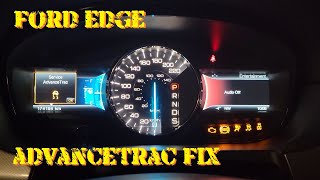
- A 'Service AdvanceTrac' message may appear in the instrument cluster. 🎬 See how to diagnose and fix common AdvanceTrac warning lights.
- In rare cases, the brake pedal may pulsate at very low speeds as the ABS incorrectly activates due to an erratic signal from a cracked tone ring.
- During a hard stop, the wheels may lock up and skid.
- Cruise control may be disabled.
- Replacing the ABS sensor when the actual problem is a failing wheel bearing with a damaged integrated magnetic ring.
- Replacing the wheel bearing/hub assembly when the problem is only a simple wiring break or corroded connector.
- Focusing only on the wheel-end components and missing a harness issue further up the line, such as the one described in TSB SSM 47791. [⭐ MANUFACTURER TSB — highest authority]
Most Likely Causes
- Failed Right Rear ABS Wheel Speed Sensor 🔴 High Probability → Shop ABS Wheel Speed Sensor The sensor is an exposed electronic component that operates in a harsh environment near the wheel, subject to water, road salt, and debris, which leads to internal failure over time.
How to confirm: Use a diagnostic scanner that can read ABS live data. Monitor all four wheel speed sensors while driving; the right rear sensor will read 0 mph or have an erratic, jumpy signal compared to the other three smooth signals. Alternatively, test the sensor's resistance with a multimeter; a reading outside the typical 800-2,000 ohm range or an open circuit indicates failure. Comparing the resistance to the sensor on the opposite side is a reliable method.
Typical fix: Replace the right rear ABS wheel speed sensor. The sensor is typically held into the wheel knuckle by a single 8mm bolt.
Est. part cost: $30-$80 - Damaged Wiring or Connector 🟡 Medium Probability The wiring harness runs down the suspension and is subject to constant movement, vibration, and exposure. Wires can break internally, chafe against components, or connector pins can corrode. A manufacturer TSB specifically notes potential damage or poor seating of wiring between connectors C1016 and C1168. [⭐ MANUFACTURER TSB — highest authority, 43]
How to confirm: Visually inspect the wiring harness from the wheel well to the sensor for any signs of breaks, chafing, or corrosion. Disconnect the sensor and check the electrical connector pins for damage or corrosion ('green crusties'). Perform a continuity test on the harness wires from the sensor connector back to the ABS module.
Typical fix: Repair the broken section of wire or replace the pigtail connector. Ford supports pigtail repairs for these harnesses. In some cases, the entire rear harness section may need replacement.
Est. part cost: $15-$40 for a pigtail, $100+ for a harness section. - Damaged/Failed Rear Wheel Bearing and Hub Assembly ⚪ Low Probability → Shop Hub Assembly The magnetic tone ring that the ABS sensor reads is integrated into the seal of the rear wheel bearing. If the bearing fails, it can develop excessive play (wobble), which can damage the magnetic encoder ring or cause an inconsistent gap with the sensor. Road salt and moisture can also degrade the bearing and its integrated ring.
How to confirm: With the vehicle raised, check for play by grabbing the wheel at the 12 and 6 o'clock positions and trying to rock it. Any noticeable movement or a humming/growling noise while driving that changes pitch when turning indicates a bad bearing.
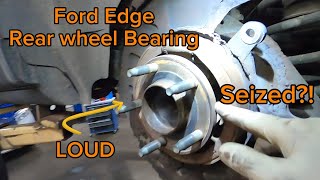
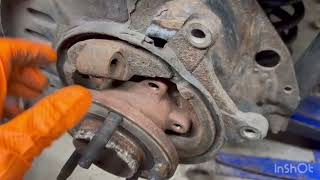
Typical fix: Replace the entire rear wheel bearing and hub assembly. This is a more involved repair that often requires removing the brake caliper, rotor, and axle nut. 🎬 Watch: How to replace the rear wheel bearing and hub.
Est. part cost: $150-$300
Rare But Worth Checking
- Faulty ABS Control Module: This is very rare and should only be considered after the sensor, wiring, and wheel bearing/hub assembly have all been confirmed to be in good condition. A professional diagnostic is required to condemn the module, often after checking for specific communication codes like U0121 or internal fault codes like U3000. The module is located on the ABS hydraulic unit and may require replacement of the entire assembly.
Diagnosis Steps
- Connect an OBD-II scanner capable of reading ABS/Chassis codes to confirm C1168 is the active fault.
- Use the scanner's live data function to monitor the speeds of all four wheels while driving. Confirm that the right rear wheel speed reads incorrectly (e.g., 0 mph) or drops out compared to the others.
- Raise and safely support the vehicle. Remove the right rear wheel.
- Visually inspect the ABS wheel speed sensor (bolted into the knuckle) for physical damage or an accumulation of metallic debris on its magnetic tip.
- Carefully inspect the wiring harness leading to the sensor for any cuts, chafing, heat damage, or sharp bends. Follow it into the wheel well.
- Disconnect the sensor and inspect the connector pins on both the sensor and the harness side for corrosion, moisture, or damage.
- Check the wheel for excessive play by attempting to rock it from top to bottom. Any significant wobble points to a bad wheel bearing, which contains the tone ring.
- If visual checks are inconclusive, test the sensor with a multimeter. Check for resistance between the two pins; it should typically be between 800-2000 Ohms. An open or shorted reading indicates a bad sensor. Compare with the sensor on the other side for a baseline.
- Perform an AC voltage test. With the multimeter set to AC Volts, spin the wheel at approximately one revolution per second. A good sensor should generate a small AC voltage (e.g., >100-200mV).
- If the sensor tests bad, replace it. If the sensor tests good, the issue is likely in the wiring or the wheel bearing's magnetic ring.
- If a new sensor does not fix the issue, perform a continuity and resistance test on the wiring harness from the sensor connector back to the ABS module to rule out an intermittent open or short circuit. Pay attention to the area between connectors C1016 and C1168 as noted in TSB SSM 47791. [⭐ MANUFACTURER TSB — highest authority]
- If all other components test good, the fault may lie within the ABS control module, which requires advanced diagnostics.
Parts You'll Likely Need
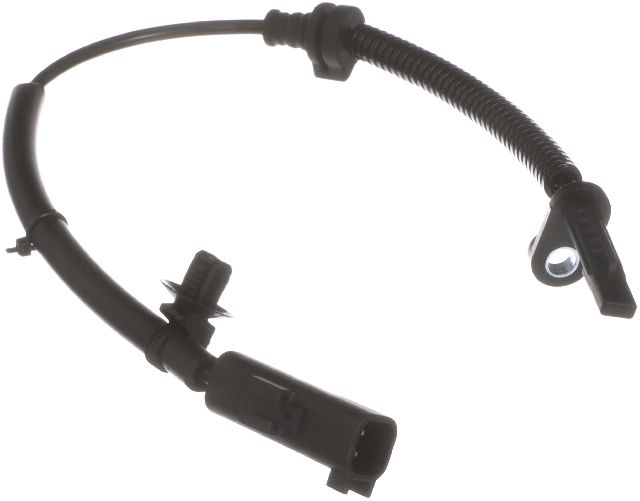
- Rear ABS Wheel Speed Sensor
(OEM #DG9Z-2C190-E)— This is the most common failure point for code C1168. The sensor is an electronic component that fails over time due to heat and environmental exposure.
Trusted brands: Motorcraft, Dorman, Bosch, NGK/NTK, Holstein
OEM price range: $50-$90
Aftermarket price range: $25-$60 - Rear Wheel Bearing and Hub Assembly
(OEM #512668 (Aftermarket reference))— If the wheel bearing fails, the integrated magnetic tone ring can be damaged, causing this code. A humming or roaring noise from the rear of the vehicle is a key symptom.
Trusted brands: Motorcraft, Timken, Moog, SKF
OEM price range: $200-$300
Aftermarket price range: $120-$200
Technical Service Bulletins (TSBs) & Recalls
- SSM 47791
Platform-Specific Known Issues
- There is a known recall (Ford recall 20S37) for the 2016-2018 MKX concerning wiring under the 16-way power seats that can be damaged, but this is unrelated to the ABS system.
- A recall for front brake jounce hoses (Ford recall 20S42) also exists for these models, which can cause a loss of brake fluid but does not directly cause code C1168.
Mechanic-Grade Diagnostic Values
- ABS Wheel Speed Sensor Resistance — expected: 800 - 2,000 Ohms (Varies by manufacturer). The most reliable test is comparing the reading to the known-good sensor on the opposite wheel; they should be very close.. Failure: An open circuit (infinite resistance) or a short circuit (zero resistance), or a value significantly different from the opposing sensor.
- ABS Wheel Speed Sensor AC Voltage Output — expected: Greater than 100-200 millivolts (0.1-0.2 VAC) when spinning the wheel by hand at about one revolution per second.. Failure: No AC voltage is generated, or the voltage is extremely low, indicating a dead sensor or a problem with the tone ring/gap.
Scan Tool Commands That Help
- Ford IDS (Integrated Diagnostic System): ABS Self Test / On-Demand Self Test — To command the ABS module to check itself and its connected components for faults beyond what is detected during normal operation.
- Ford IDS (Integrated Diagnostic System): Programmable Module Installation (PMI) — This is required after replacing the ABS control module to configure the new module to the vehicle's specific settings and VIN.
Wiring & Ground Locations
- Connectors C1016 and C1168 — These are inline connectors for the wiring harness between the main body harness and the wheel speed sensor sub-harness.. TSB SSM 47791 explicitly identifies that a poor connection or damaged wiring between these two specific connectors can cause ECT sensor codes and, by extension, similar wiring integrity faults for other systems like ABS on the MKX. This is a known failure point away from the sensor itself. [⭐ MANUFACTURER TSB — highest authority]
- Fuse F46 (Engine Fuse Box - Bottom) — In the bottom section of the engine compartment power distribution box.. This 40-amp J-case fuse supplies power to the 'Anti-lock brake system pump'. A loss of power here would disable the entire system and could set various codes.
- Fuse F57 (Engine Fuse Box) — In the main engine compartment power distribution box.. This fuse (typically 10 or 15 amp) powers the 'Anti-lock brake system valves'. It is essential for the control and operation of the ABS hydraulic unit.
- Ground G103 (Likely Location) — On the left side of the engine compartment.. Wiring diagrams for the previous generation MKX show the ABS module is grounded at G103. A poor ground connection here can cause intermittent and difficult-to-diagnose electronic faults, including false sensor codes.
Real Owner Repair Stories
- YouTube video by 'Taras Kul' (Lincoln MKX (similar generation to 2016-2018), platform-mate to Ford Edge) — ABS and traction control lights were on.
❌ Tried (didn't work) Replacing the ABS wheel speed sensor.
✅ What actually fixed it The problem was not the sensor, but a bad speed sensor ring (tone ring) on the CV Axle. Replacing the entire CV Axle resolved the issue. While the 2016-18 MKX has the ring on the bearing, this story highlights that the problem is not always the sensor itself.
OEM Part Supersession History
DG9Z-2C190-J→JG9Z-2C190-P— Part revision and improvement by the manufacturer.
Model Year Variations Within This Range
- 2016-2017 vs 2018: There are minor differences in the passenger and engine compartment fuse box layouts. For example, in the engine fuse box, fuse #10 is for 'Power point 1' in 2016-2017 models but becomes 'Power point 5' in 2018 models. While not directly affecting the primary ABS circuits, it's a known variation when diagnosing electrical issues.
Helpful Videos

We Have This Part in Stock



The information in this article is provided for general reference and educational purposes only. Vehicle specifications, procedures, and part compatibility can vary by production date, trim level, and region. Always consult your vehicle's factory service manual and verify part numbers before purchasing or performing repairs. Safety-critical components such as airbags, seat belts, and braking systems should be installed by a qualified professional.
- Lincoln MKX:
- 🧭 Diagnostic Flowchart
- 🎬 Helpful Videos
- 🛍️ Shop This Part
- What's Unique About the 2016-2018 Lincoln MKX
- Symptoms You May Notice
- Most Likely Causes
- Rare But Worth Checking
- Diagnosis Steps
- Parts You'll Likely Need
- Technical Service Bulletins (TSBs) & Recalls
- Platform-Specific Known Issues
- Mechanic-Grade Diagnostic Values
- Scan Tool Commands That Help
- Wiring & Ground Locations
- Real Owner Repair Stories
- OEM Part Supersession History
- Model Year Variations Within This Range
- 🎟️ Get 5% Off