

OBD-II Code C1232: Left Front Wheel Speed Sensor Circuit Malfunction
What C1232 means, why it triggers, and how to fix it
- Code C1232 disables your ABS and traction control, increasing emergency stopping distances by up to 30% on wet roads.
- On GM vehicles, a worn wheel hub bearing is the #1 cause of C1232, requiring a $300-$700 replacement rather than a simple sensor swap.
- Verify your manufacturer's specific code definition before buying parts; C1232 points to the rear axle on 1995-2001 Fords and indicates a Yaw Rate Sensor failure on Toyotas.
- If replacing the wheel hub or sensor doesn't clear the code instantly, test the wiring harness for internal breaks using a multimeter continuity check.
What Does C1232 Mean?
C1232 indicates your vehicle's computer detected an electrical circuit fault for the left front wheel speed sensor. This sensor's signal dictates how fast the wheel spins. Without this data, the Anti-lock Braking System (ABS) and Traction/Stability Control Systems (TCS/ESC) shut down as a safety precaution.
Technical definition: The official SAE definition for C1232 is "Left Front Wheel Speed Circuit Open or Shorted". The ABS module triggers this code when it detects complete signal loss, a short to power, or a short to ground. It typically sets when the module reads zero speed from the left front wheel while other wheels report speeds above 5 mph for several seconds. On GM systems, it sets if circuit voltage drops below 0.75V or exceeds 4.25V.
Can I Drive With C1232?
Yes, But With Caution. Yes, but your Anti-lock Braking System (ABS) and Traction Control are disabled. Drive with extreme caution, as your wheels lock up during hard braking. This increases stopping distances by 20-30% on wet surfaces and eliminates computer-assisted skid control, requiring you to manually pump the brakes to maintain steering in an emergency.
Common Causes
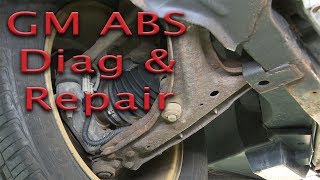
- Worn Wheel Hub / Bearing Assembly (Very Common) — As the wheel bearing wears, it develops excessive play. This wobble increases the air gap between the sensor's magnetic tip and the tone ring, causing the signal to drop out entirely at low speeds. This is the primary cause on GM front-wheel-drive vehicles. 🎬 Watch: Diagnosing and repairing a GM wheel bearing fault.
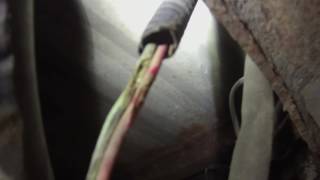
- Damaged or Broken Wiring Harness (Very Common) — The wiring harness flexes constantly from steering and suspension movement. This causes visible damage like frayed wires and corroded connector pins, or invisible internal breaks where the copper severs inside the intact insulation jacket.
- Faulty Wheel Speed Sensor (Common) — The sensor fails internally from age, heat cycles, and vibration. On most modern vehicles, the sensor integrates directly into the wheel hub assembly, requiring complete hub replacement.
- Cracked or Debris-Covered ABS Tone Ring (Less Common) — The toothed reluctor ring cracks when rust expands underneath it, creating an inconsistent gap the sensor misinterprets. Metallic debris from brake wear also contaminates the ring, disrupting the magnetic field.
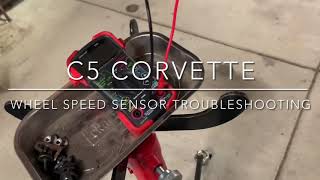
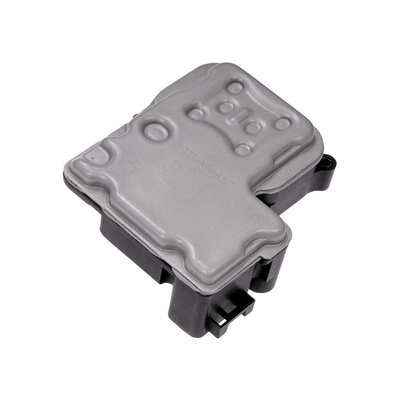
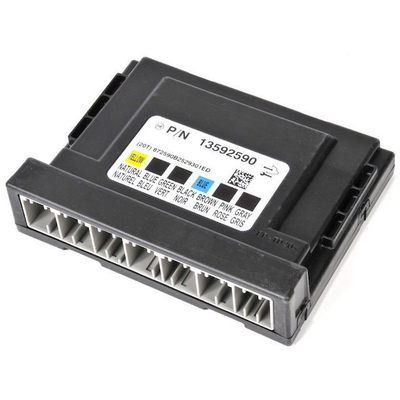
- Faulty ABS Control Module (EBCM) (Less Common) — The internal circuits processing the left front sensor signal fail, causing the module to reject a perfectly good signal. This is a documented failure point on specific vehicles like the C5 Corvette.
- Mismatched Tire Sizes (Rare) — Using a tire with a significantly different diameter forces that wheel to rotate at a different speed. While this usually triggers a 'variation' code, some systems interpret the persistent discrepancy as a hard circuit fault.
Symptoms
- ABS and Traction Control Lights Illuminated — The ABS, Traction Control (TCS), and Stability Control (ESC) warning lights illuminate and remain on, as these systems rely on the same disabled wheel speed sensor.
- ABS Activates Incorrectly at Low Speeds — The brake pedal pulses and the ABS pump runs at speeds under 10 mph on dry pavement. This false activation stems from a weak, erratic signal caused by a failing wheel bearing.
- Brakes Lock Up During Hard Braking — With ABS disabled, wheels skid during an emergency stop, significantly increasing stopping distance and eliminating your ability to steer around obstacles.
- Loss of Advanced Driver Assistance Systems (ADAS) — Dependent systems like all-wheel drive (AWD), adaptive cruise control, hill-start assist, and collision avoidance disable automatically.
Diagnostic Flowchart
Tap your situation to follow the diagnostic path that matches what you're seeing on this code.
Common Fixes & Costs
- Replace Wheel Hub Bearing Assembly (with integrated sensor)
— Parts: $120-$400, Labor: $150-$450, ~1.5 hr book time
(Intermediate)
Chevrolet Corvette C5 (1997-2004): OEM
GM FWD (e.g., Impala 2000-2005): OEM - Replace Wheel Speed Sensor Wiring Harness
— Parts: $25-$75, Labor: $100-$200, ~1.2 hr book time
(Intermediate)
GM FWD Cars: OEM - Replace Standalone Wheel Speed Sensor
— Parts: $50-$180, Labor: $90-$150, ~1 hr book time
(DIY)
Ford Ranger (1995-2001, Rear Axle): OEM - Clean or Replace ABS Tone Ring — Parts: $20-$150, Labor: $150-$300, ~2 hr book time (Professional)
- Repair or Replace ABS Control Module (EBCM)
— Parts: $250-$500 (Repair) or $600-$2200 (New), Labor: $110-$200, ~1.5 hr book time
(Professional)
Chevrolet Corvette C5 (2001-2004): OEM
Used vs. New Parts: Buying Guide
When a used part is worth it: Buying a used wheel hub/bearing assembly is never recommended, as bearings are wear items with finite lifespans. A used wiring harness pigtail or a remanufactured ABS module is acceptable.
Donor-vehicle mileage cap: roughly under 40000 miles for the part to have meaningful remaining life.
Donor quality checklist:
- Ensure wiring has no visible corrosion, cracking, or previous splice repairs.
- Avoid parts from Rust Belt vehicles due to severe corrosion risk.
- Match the ABS module part number exactly to avoid programming failures.
Decision logic:
- If The required part is a wheel hub/bearing assembly. → Buy a new, high-quality aftermarket (Timken, SKF) or OEM part. Used hubs risk immediate premature failure.
- If The required part is a discontinued ABS Control Module (e.g., early C5 Corvette). → Purchase a professionally remanufactured unit with a warranty.
- If The part is a wiring pigtail. → A used part is acceptable if spliced with weatherproof heat-shrink connectors.
Warranty tradeoff: Used parts carry 30-day warranties. New premium hubs include 1-3 year warranties, preventing you from paying labor twice.
Worst-case if a used part fails: $300-$600 to replace a used wheel hub that fails prematurely.
What Happens If You Wait — Timeline
- 0-4 weeks: Code C1232 sets, ABS and Traction Control lights turn on. Vehicle safety systems are disabled. (MPG impact: 0%% · Added cost: $0)
- 1-3 months: If caused by a bad bearing, a faint humming noise begins at speeds over 40 mph due to rotational drag. (MPG impact: 1-3%% · Added cost: $10-$40 in wasted fuel)
- 3-6 months: Bearing noise progresses to a distinct grinding that changes when turning. Significant play causes uneven tire wear. (MPG impact: 3-8%% · Added cost: $150-$350 for a new tire plus wasted fuel.)
- 6+ months / Immediate Risk: Loud grinding and wobbling sensation. Catastrophic bearing failure is imminent. The wheel separates from the vehicle, causing total loss of control. (MPG impact: 10%+% · Added cost: $1,000-$2,500+ for damage to the knuckle, spindle, axle, and brakes.)
Cost of Not Fixing It
- Immediate: Loss of ABS and stability control. Increased risk of skidding and longer stopping distances in emergencies. (Added cost: Thousands of dollars in potential accident damage.)
- 1-6 months: If caused by a bad wheel bearing, continued driving destroys the bearing, causing severe vibration and uneven tire wear. (Added cost: $150-$300 for a replacement tire.)
- 6+ months: Catastrophic failure of a severely worn wheel bearing causes the wheel to separate from the vehicle, resulting in total loss of control. (Added cost: $2000+ for suspension, axle, and body repairs.)
Diagnosis Steps
- Read Codes and Check Live Data
Connect an ABS-capable scanner. Confirm C1232 and note communication codes like U0121. View the live data stream for all four wheel speed sensors while a helper spins the left front wheel by hand. If the speed stays at zero while others respond, the signal is lost.
Tools: OBD-II Scanner (with ABS Live Data), Jack, Jack Stands (Beginner) - Inspect Wheel Bearing (Wiggle Test)
Securely raise the front left of the vehicle. Grasp the tire at 12 and 6 o'clock and push/pull aggressively. Any perceptible play or grinding noise confirms a worn wheel bearing, a leading cause of this code.
Tools: Jack, Jack Stands (Beginner) - Visual Inspection of Wiring
Remove the wheel. Inspect the wiring harness from the hub to the frame for cuts, chafing, or stretching. Disconnect the sensor and check the pins for green/white corrosion or moisture.
Tools: Lug Wrench, Flashlight (Beginner) - Test Sensor Resistance (Passive Sensors)
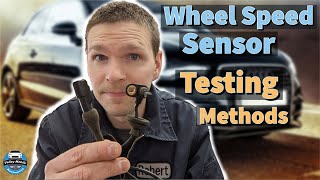
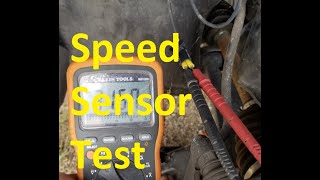
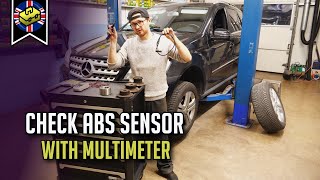
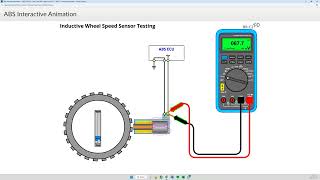
Unplug the sensor. Use a multimeter (Ohms) across the two sensor pins. A healthy passive sensor reads 800-2,000 Ohms (GM specifies 1,040-1,160 Ohms). 'OL' indicates an open circuit; near-zero indicates a short. Both require replacement.
Tools: Multimeter, Vehicle Service Manual (Intermediate) - Test Sensor Voltage Output (Passive Sensors)
Switch the multimeter to AC Volts. Connect leads to the sensor pins and spin the hub at one revolution per second. It must generate at least 100mV AC. Zero or low voltage indicates a dead sensor or excessive air gap from a bad bearing.
Tools: Multimeter (Intermediate) - Test for Bias Voltage (Active Sensors)
For 2-wire digital or 3-wire active sensors, resistance checks are invalid. With the key on and sensor unplugged, check the harness connector for a 1.5V to 5V DC reference voltage from the ABS module. Absence of voltage confirms a wiring or module fault.
Tools: Multimeter, Vehicle Wiring Diagram (Advanced) - Check Harness Continuity and for Shorts
Disconnect the harness from the sensor and the ABS module. Check for continuity (less than 1 Ohm) on both wires end-to-end. Check each wire for a short to ground and a short to each other. Wiggle the harness during testing to expose internal breaks.
Tools: Multimeter, Vehicle Wiring Diagram (Professional) - Perform Intermittent Fault (Water Intrusion) Test
If the code appears only in wet conditions, spray the sensor connector and harness with a 5% saltwater solution. Test drive above 25 mph. If C1232 returns, water is penetrating the circuit and causing a short.
Tools: Spray Bottle, Salt, Water (Professional) - Analyze Sensor Waveform with an Oscilloscope
Connect a lab scope to view the wheel speed signal. A passive sensor shows an AC sine wave; an active sensor shows a digital square wave. Gaps, noise, or a flat line definitively prove a fault in the sensor, tone ring, or bearing.
Tools: Automotive Oscilloscope (Lab Scope) (Professional)
When This Code Triggers (Freeze-Frame Conditions)
- Vehicle Speed: 10-25 mph (Sets when the ABS module sees three wheels reporting speed while the left front reports zero for several seconds.)
- Brake Pedal: Not Applied (Detected during normal driving acceleration, not necessarily during a braking event.)
- System Voltage: 12.6-14.8V (Normal operating voltage. Low system voltage triggers erroneous sensor codes.)
Related Codes
- C1233 — Identical fault for the Right Front Wheel Speed Sensor. Swap the sensor pigtails left-to-right; if the code changes to C1233, the pigtail is bad.
- C1225 — Left Front Excessive Wheel Speed Variation. C1232 means the signal is gone; C1225 means it is erratic. C1225 strongly points to a wobbly wheel bearing or cracked tone ring.
- U0121 — Lost Communication With ABS Control Module. If present alongside C1232, the entire ABS module is offline. Diagnose U0121 power/ground issues first.
Climate & Environmental Factors
- High Humidity / Road Salt: Salt and moisture accelerate corrosion inside wiring harness connectors, causing shorts. Rust buildup under the ABS tone ring cracks the ring, creating an erratic signal.
- Extreme Cold: Wiring insulation becomes brittle. Constant flexing from steering causes the hardened insulation to crack, exposing the copper wire to the elements and severing the circuit.
- Potholes / Rough Roads: Sharp impacts sever fatigued wires inside their insulation, break fragile sensor internals, or shift a worn wheel bearing enough to drop the magnetic signal.
How to Talk to a Mechanic About This Code
Say this: "I have an ABS light on and my scanner shows code C1232 for the left front wheel speed circuit. I'd like to book a diagnostic appointment. Can you please test the sensor, wiring harness, and check for wheel bearing play to pinpoint the failure, rather than immediately replacing the hub?"
This signals you understand the common failure points (wiring, bearing, sensor). It steers the mechanic towards proper diagnosis instead of defaulting to the most expensive part replacement.
Avoid saying:
- 'My ABS light is on, can you fix it?'
- 'Just replace the left front ABS sensor.'
- 'I hit a pothole and the light came on, do whatever you think is best.'
Questions to ask before authorizing the repair:
- How did you determine the [hub/wiring/sensor] was the point of failure?
- Did you test the sensor's voltage output or resistance?
- Did you check the wiring harness for continuity and shorts back to the ABS module?
- Is there any play in the wheel bearing?
- What is the warranty on the part and the labor for this repair?
Where to Take It: Dealer vs Independent vs Chain
- Dealer:
Recommended only for warranty work or if diagnosis points to a failed ABS control module requiring proprietary software.
Best for: Vehicles still under warranty, Complex issues like a failed EBCM requiring proprietary programming, Recalls or technical service bulletins related to the ABS system
Downsides: Significantly higher labor rates and parts costs, Defaults to replacing entire assemblies when a smaller component suffices (Typical cost: +50% vs. baseline) - Independent Shop:
Best fit for the vast majority of C1232 cases. An experienced independent technician efficiently diagnoses and repairs common causes at a fair price.
Best for: Most out-of-warranty C1232 repairs, Diagnosing common failures like bad wheel bearings or damaged wiring, Providing better value and direct communication with the technician
Downsides: Quality varies; check reviews and ASE certifications, Lacks expensive programming tools for complex module replacements (Typical cost: +0% vs. baseline) - Chain Shop:
Use with caution. Acceptable for a straightforward hub replacement, but avoid for initial diagnosis of an intermittent electrical fault.
Best for: If the diagnosis is already confirmed to be a simple hub or sensor replacement
Downsides: Technician skill is inconsistent, Lacks advanced diagnostic tools for tricky electrical faults, High pressure to upsell additional services (Typical cost: -10% vs. baseline)
When to Walk Away From the Repair
If the estimated repair cost for the C1232 fault exceeds 40-50% of your car's private-party value, consider selling or trading it in.
- Car worth $4000, fix is $750: Fix it. This repair cost is well within a reasonable range to maintain a functional and safe vehicle.
- Car worth $3000, fix is $1500: Walk away. The repair costs 50% of the car's value. This is especially true if the fix requires an expensive ABS module.
- Car worth $15000, fix is $900: Fix it. The repair cost is a small fraction of the vehicle's value and is essential for safety.
What Scan Tool You Need for This Code
Minimum: An OBD-II scanner that reads and clears Anti-lock Brake System (ABS) fault codes.
A standard $20 engine code reader cannot see the C1232 code. The ABS system is a separate computer module requiring a scanner specifically advertised with ABS capabilities.
Budget: Foxwell NT301 / Autel ML629 (~$70) — Reads and clears ABS codes, allowing you to identify C1232. Offers limited live data for the ABS system.
Mid-range: BlueDriver Pro / Foxwell NT630 Plus (~$120) — Provides live data streaming for all four wheel speed sensors. You can spin the wheel and watch the speed reading on your phone to see if the signal is present or absent.
Professional: Autel MaxiCOM MK808 / Launch CRP919E (~$500-800) — Offers full bidirectional control to command the ABS module. Provides OEM-level diagnostics, advanced live data graphing, and access to wiring diagrams.
How to Clear the Code After You Fix It
- Use an ABS-capable OBD-II scan tool to clear the fault code.
- Perform a test drive to confirm the ABS light remains off.
- The code clears automatically after a specific number of successful drive cycles (e.g., 100 on GM models) if the fault is resolved.
Drive cycle (~10 minutes): Start the vehicle and drive above 25 mph for at least 30 seconds. Perform several turns and stops to ensure the system functions correctly.
Readiness monitors affected: This is a chassis code and does not affect emissions readiness monitors.
Watch out for:
- Basic $20 engine scanners cannot access the ABS module to clear C1232.
- Disconnecting the battery does not clear active ABS fault codes stored in non-volatile memory.
- If the underlying wiring or bearing issue remains, the code returns immediately upon driving.
Will This Fail Emissions / State Inspection?
No — by itself this code doesn't fail OBD inspection (but it can keep readiness monitors from setting, which causes a separate fail).
- California: An ABS light passes the standard smog test, but fails a 'Brake and Lamp Inspection' required for salvage titles.
- New York: An illuminated ABS warning light is immediate grounds for failure of the annual safety inspection.
- Texas: An illuminated ABS light results in rejection during the state safety inspection.
Most Commonly Affected Vehicles
- Chevrolet Corvette (C5) (1997-2004) — Extremely common. Caused by spread female pins in the harness connector or a faulty EBCM. EBCMs on 1997-2000 models are notoriously difficult to repair.
- General Motors FWD Cars (Alero, Grand Am, Impala) (1998-2011) — The code is most frequently caused by premature front wheel bearing wear. The axle nut must be torqued to spec before lowering the car to prevent rapid failure.
- Ford Explorer, Ranger (1995-2001) — CRITICAL: C1232 does NOT refer to the left front wheel on these trucks. It indicates a fault with the single speed sensor on the rear differential housing.
- Jeep Wrangler (JK) (2007-2018) — The sensor wire stretches and breaks during suspension articulation, especially on vehicles with aftermarket lift kits.
- Hyundai / Kia Elantra, Tucson, Sportage (2000-2020) — The ABS tone ring cracks or delaminates due to rust buildup underneath it, causing an erratic signal.
- BMW 1-Series, 3-Series (E90, E82) (2004-2019) — Sensors seize in the wheel hub due to galvanic corrosion, making removal extremely difficult without breaking the sensor.
Manufacturer-Specific Notes
- Toyota / Lexus / Scion: CRITICAL: On Toyota vehicles, C1232 is NOT a wheel speed sensor code. It refers to a 'Yaw Rate Sensor Malfunction' within the Vehicle Stability Control system.
- General Motors: On FWD cars, the root cause is almost always the wheel hub bearing assembly developing play. TSB 16-NA-298 notes erratic signals cause ABS pump noises at low speeds.
- Ford: On 90s and 2000s trucks (Ranger, Explorer), C1232 specifically points to the single speed sensor on the rear differential. Start diagnostics at the rear axle.
- Chevrolet (Corvette C5): The most common failure is the small female pins inside the wiring harness connector spreading apart. A close second is a failed Electronic Brake Control Module (EBCM).
Real Owner Stories
2002 Chevrolet Corvette C5 at 85K miles
ABS and Traction Control lights appeared with code C1232. Owner replaced the left front wheel hub assembly ($250), but the code returned instantly.
What they tried:
- Replaced left front wheel hub/sensor assembly - no change.
- Swapped the left and right wiring harness pigtails - the code did NOT change to C1233, ruling out the pigtail.
- Visually inspected the female pins in the main harness connector on the frame, finding one spread open and corroded.
Outcome: Used a small pick to bend the female pin back into shape for a tighter connection and cleaned it. The lights stayed off. Total cost: $0 (after the unnecessary hub replacement).
Lesson: On a C5 Corvette, the most common cause of C1232 is a poor connection at the harness, not the hub itself. Inspect connector pins before replacing expensive parts.
2004 Oldsmobile Alero at 120K miles
Intermittent ABS lights during slow turns. Code C1232 stored. A shop quoted $500 to replace the wheel hub assembly.
What they tried:
- Jacked up the car and found significant play in the left front wheel, confirming a bad bearing.
- Noticed the wiring harness insulation was frayed where it flexed near the lower control arm.
- Tugging gently on the wire pulled it apart, revealing an internal break.
Outcome: Replaced the wiring harness pigtail ($45) and the wheel hub assembly ($160). The code cleared. Total DIY cost was $205.
Lesson: On GM FWD cars, a bad bearing and a bad wiring harness often occur together due to suspension flexing. Always inspect the wiring thoroughly, even if you find a bad bearing.
1999 Ford Ranger at 155K miles
ABS light on, code C1232 pulled at an auto parts store. No noticeable driving symptoms.
What they tried:
- Inspected the left front wheel, checked wiring, and tested the sensor, finding nothing wrong.
- Searched online forums for 'Ford Ranger C1232' and found the code's unique meaning for this truck.
Outcome: Learned that C1232 refers to the Vehicle Speed Sensor (VSS) on the rear differential. Found the rear sensor covered in metallic sludge. Cleaning the sensor and connector resolved the issue. Cost: $5.
Lesson: Code definitions are vehicle-specific. On 90s/2000s Ford trucks, C1232 points to the rear axle, not the front wheel.
How to Prevent This Code From Triggering
- Apply Dielectric Grease to Connectors (Anytime the connector is disconnected) — Seals out moisture and oxygen that cause pin corrosion, a primary cause of signal interruption.
- Inspect and Secure Wiring Harness (During every tire rotation) — Ensures the harness is secured in its clips and not rubbing against suspension components, preventing physical wire damage.
- Clean Hub and Sensor Mating Surfaces (When replacing sensor or hub) — Removing rust ensures the new sensor sits flat and maintains the correct air gap to the tone ring.
- Use Torque Wrench on Axle Nut (When replacing a front wheel hub assembly) — Correctly torquing the axle nut preloads the new wheel bearing. Improper torque guarantees premature bearing failure.
Frequently Asked Questions
I replaced the hub and sensor, but the C1232 code came back instantly. What now?
This indicates the fault is not the hub or sensor. The problem lies upstream in the wiring harness between the sensor and the ABS module, or within the module itself. Perform a continuity test on the harness wires to locate the break.
Can I just clean the ABS sensor to fix code C1232?
Cleaning a sensor covered in metallic brake dust restores the signal temporarily. However, C1232 indicates an open or short circuit, pointing to an electrical or mechanical failure. Cleaning cannot resolve a broken wire or a failing wheel bearing.
Can a low battery cause a C1232 code?
Yes. A weak battery causes low voltage conditions that trigger random electronic fault codes, including communication and sensor circuit errors. Always ensure your battery is fully charged before beginning complex ABS diagnostics.
Why did the ABS light come on right after hitting a pothole?
A sharp impact severs fatigued wires inside the insulation or breaks fragile internal sensor components. The jolt also causes a worn wheel bearing to shift, creating an air gap that drops the signal.
My scanner says the fault is on the left, but I suspect it's the right side. Is that possible?
Some aftermarket scanners contain software glitches that misreport the fault, swapping the left and right sides. If you exhaustively tested the indicated side with no success, perform a quick resistance check on the opposite side sensor.
What are the risks of driving with code C1232?
The primary risk is a significant reduction in braking performance during emergencies. Without ABS, your wheels lock up, causing skids and loss of steering control. Stopping distances on wet or icy roads increase dramatically.
Can a bad alignment cause a C1232 code?
A bad alignment does not directly cause a C1232 circuit code. Severe alignment problems accelerate wheel bearing wear, which eventually leads to a C1232, but you will notice uneven tire wear or poor handling first.
What is the 'saltwater test' for a C1232 code?
This professional diagnostic trick finds intermittent wiring faults that only occur in wet weather. A technician sprays the sensor connector and harness with a mild saltwater solution to simulate rain. If the code returns on a test drive, water is penetrating the circuit and causing a short.
Key Takeaways
- Code C1232 disables your ABS and traction control, increasing emergency stopping distances by up to 30% on wet roads.
- On GM vehicles, a worn wheel hub bearing is the #1 cause of C1232, requiring a $300-$700 replacement rather than a simple sensor swap.
- Verify your manufacturer's specific code definition before buying parts; C1232 points to the rear axle on 1995-2001 Fords and indicates a Yaw Rate Sensor failure on Toyotas.
- If replacing the wheel hub or sensor doesn't clear the code instantly, test the wiring harness for internal breaks using a multimeter continuity check.
Helpful Videos
Shop the Parts Behind C1232
Below are the parts most often responsible for code C1232, ranked by how frequently each one is the actual culprit (per the diagnosis above). Tap any to see what we have for your vehicle.



The information in this article is provided for general reference and educational purposes only. Vehicle specifications, procedures, and part compatibility can vary by production date, trim level, and region. Always consult your vehicle's factory service manual and verify part numbers before purchasing or performing repairs. Safety-critical components such as airbags, seat belts, and braking systems should be installed by a qualified professional.
- 🧭 Diagnostic Flowchart
- 🎬 Helpful Videos
- 🛍️ Shop This Part
- What Does C1232 Mean?
- Can I Drive With C1232?
- Common Causes
- Symptoms
- Common Fixes & Costs
- Used vs. New Parts: Buying Guide
- What Happens If You Wait — Timeline
- Cost of Not Fixing It
- Diagnosis Steps
- When This Code Triggers (Freeze-Frame Conditions)
- Related Codes
- Climate & Environmental Factors
- How to Talk to a Mechanic About This Code
- Where to Take It: Dealer vs Independent vs Chain
- When to Walk Away From the Repair
- What Scan Tool You Need for This Code
- How to Clear the Code After You Fix It
- Will This Fail Emissions / State Inspection?
- Most Commonly Affected Vehicles
- Manufacturer-Specific Notes
- Real Owner Stories
- 2002 Chevrolet Corvette C5 at 85K miles
- 2004 Oldsmobile Alero at 120K miles
- 1999 Ford Ranger at 155K miles
- How to Prevent This Code From Triggering
- Frequently Asked Questions
- I replaced the hub and sensor, but the C1232 code came back instantly. What now?
- Can I just clean the ABS sensor to fix code C1232?
- Can a low battery cause a C1232 code?
- Why did the ABS light come on right after hitting a pothole?
- My scanner says the fault is on the left, but I suspect it's the right side. Is that possible?
- What are the risks of driving with code C1232?
- Can a bad alignment cause a C1232 code?
- What is the 'saltwater test' for a C1232 code?
- Key Takeaways
- 🎟️ Get 5% Off